
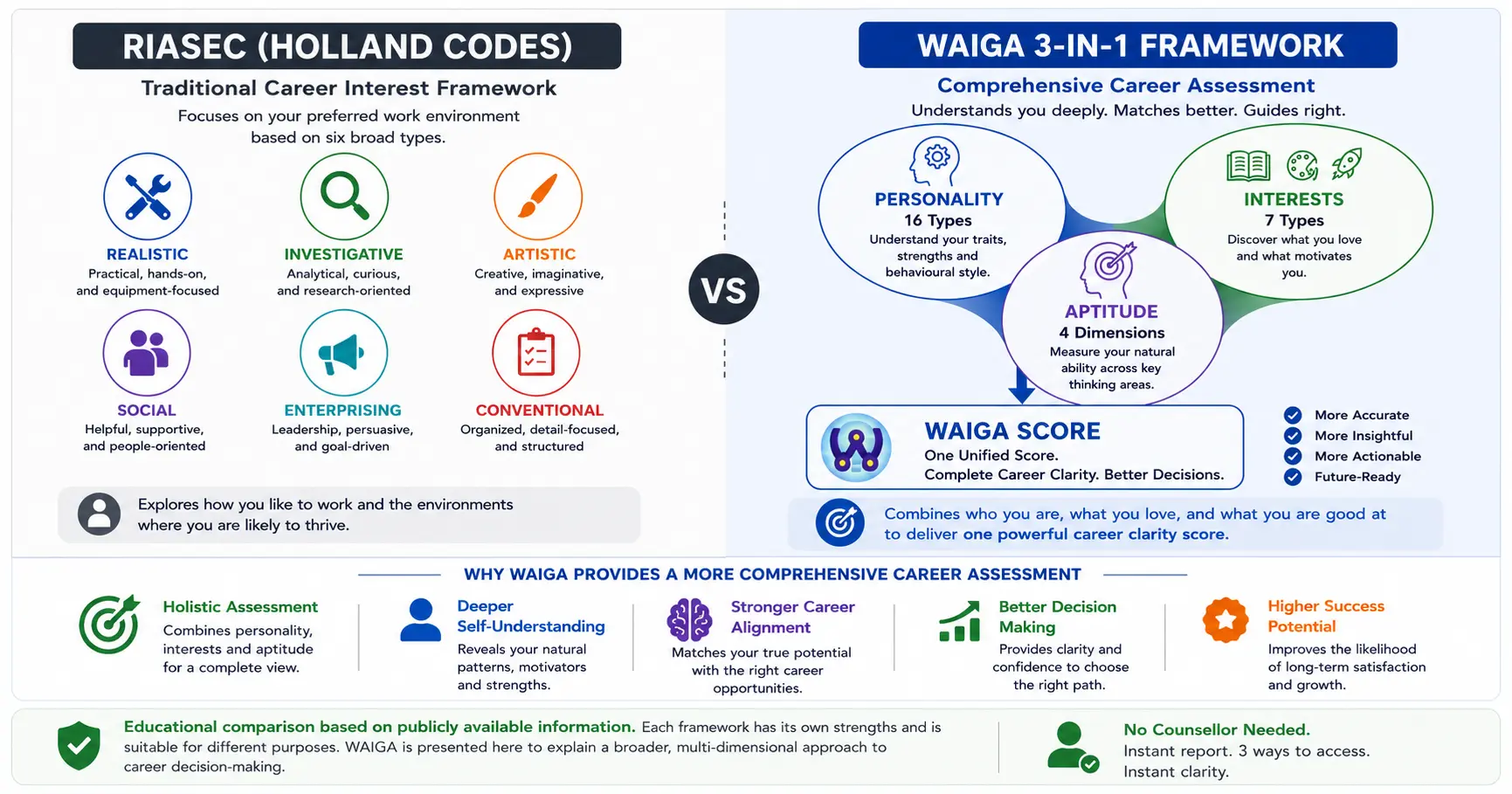
WAIGA vs Holland Codes
Two Frameworks. One Question: Which Careers Are Right for You?
For decades, the Holland Codes — also known as the RIASEC model — has been the dominant framework in career assessment. Developed by Dr. John Holland in the 1950s and refined through decades of vocational psychology research, it remains the foundation of many career guidance tools used in schools, universities and career centres worldwide.
The WAIGA framework — What Am I Good At? — takes a fundamentally different and more complete approach. Rather than categorising career fit through a single dimension, WAIGA measures interests across 7 distinct types, personality across 16 types, and aptitude across 4 independent dimensions — combining all of them into a single unified WAIGA score.
This article compares both frameworks honestly — what each measures, what each delivers, and where the key differences lie.
What the Holland Codes (RIASEC) Framework Measures
The Holland Codes model is built around six personality and interest types, represented by the acronym RIASEC:
- Realistic (R) — practical, hands-on, mechanical
- Investigative (I) — analytical, intellectual, scientific
- Artistic (A) — creative, expressive, unstructured
- Social (S) — helping, teaching, interpersonal
- Enterprising (E) — leading, persuading, competitive
- Conventional (C) — organised, detail-oriented, structured
A Holland Codes assessment identifies which two or three of these types most closely match the individual, and then matches those types to career environments that attract similar profiles.
The framework has genuine strengths. It is well-researched, widely validated and has been used successfully in vocational guidance for over sixty years. The core insight — that people tend to be more satisfied in career environments that match their personality and interest type — is sound and well-supported by evidence.
Where Holland Codes Falls Short
Despite its longevity and widespread use, the Holland Codes framework has four significant structural limitations.
Gap 1 — Aptitude is completely absent. A Holland Codes assessment can tell you that you have a strong Investigative profile — meaning you are drawn to analytical, intellectual work. But it cannot tell you whether you have the specific numerical, verbal or critical reasoning aptitude that different investigative careers demand.
Two people with identical Holland Codes profiles can have very different aptitude profiles — and very different outcomes in the same career. A person with a strong Investigative profile and high numerical aptitude may thrive as a data scientist or financial analyst. The same Investigative profile with stronger verbal aptitude may be far better suited to research writing, law or academic work. The Holland Code is identical. The right career is entirely different.
Gap 2 — Only 6 interest types — an incomplete picture. Holland’s six RIASEC categories cover broad territory but conflate meaningfully different interests within each type. For example, the Artistic category groups together verbal and creative interests that in practice lead to very different careers — writing and journalism versus visual arts and design. A more granular framework separates these into distinct types, producing more precise career matching.
Gap 3 — No worst-fit guidance. Holland Codes tells you which career environments fit your type. It does not tell you which careers to avoid — which environments are most likely to create dissatisfaction, underperformance or burnout based on your specific profile. Knowing what to walk away from is as valuable as knowing what to pursue. Holland Codes offers no answer here.
Gap 4 — Personality and interests are conflated. In the RIASEC model, personality type and vocational interest are effectively measured together as a single dimension. Someone’s preference for social interaction (personality) and their interest in helping others (vocational interest) are treated as part of the same construct. In reality, these are distinct dimensions that diverge in important ways — and when they do, a single-dimension assessment misses the nuance entirely.
What the WAIGA Framework Measures
The WAIGA framework was developed over five years — from 2006 to 2011 — by a multi-disciplinary team of psychologists and industry professionals, each with over 30 years of real-world expertise. The team brought together two complementary bodies of knowledge: the psychological rigour needed to measure Personality, Interests and Aptitude with scientific validity — and the practical industry depth needed to ensure the framework reflected how career fit actually plays out across real organisations and real careers.
WAIGA was launched online in 2011 and has since been used by students and professionals across countries.
The framework measures three independent dimensions — each with a level of depth that surpasses most established tools:
Dimension 1 — Interests: 7 Distinct Types
Where Holland Codes uses 6 combined interest-personality types, WAIGA measures interests across 7 independent types — a more granular categorisation that captures meaningful distinctions between interest profiles that other frameworks conflate.
This additional granularity matters significantly in practice. Holland’s framework, for example, groups together interest types that in reality lead to very different careers. A student who loves language and writing has a fundamentally different career profile from one who loves visual creativity and design — yet both might fall under the same broad category in a 6-type framework. WAIGA’s 7 types capture these distinctions precisely, producing more accurate career matching as a result.
The specific type names are not published — this is a deliberate decision to protect the integrity of the framework methodology. What matters for the purpose of this comparison is the depth and precision: 7 independently measured interest types produce significantly more accurate career-interest matching than 6 combined categories.
Dimension 2 — Personality: 16 Types
WAIGA measures personality across 16 distinct types — a depth of categorisation comparable to the most established personality frameworks in vocational psychology, including the widely recognised 16-type systems used in professional psychological assessment globally.
The 16 personality types are not named publicly — this is a deliberate decision to protect the integrity of the framework methodology. What matters for the purpose of this comparison is the depth: 16 personality types produce significantly more precise career-personality matching than 6 combined interest-personality categories.
Measured independently from interests, WAIGA’s personality dimension answers a different question from the interest dimension. Interests reveal what you are drawn to work on. Personality reveals how you naturally work — your communication style, your decision-making approach, your response to pressure, your working environment preferences. These are genuinely different questions. WAIGA treats them as such.
Dimension 3 — Aptitude: 4 Independent Dimensions
This is where WAIGA most significantly surpasses Holland Codes — and every other major career assessment framework currently in widespread use.
WAIGA measures aptitude across 4 independent dimensions:
1. Verbal Reasoning The ability to understand, analyse and communicate through language. Relevant to careers in law, journalism, management, education, counselling and any role where written or spoken communication is central to performance.
2. Numerical Reasoning The ability to work with numbers, data, patterns and mathematical relationships. Relevant to careers in finance, engineering, data science, accounting, actuarial work and any role where quantitative analysis drives decision-making.
3. Logical Reasoning The ability to identify patterns, evaluate arguments and work through structured relationships to reach valid conclusions. Relevant to careers in law, engineering, programming, strategy and any field requiring rigorous logical thinking.
4. Analytical Reasoning The ability to break down complex information into its component parts, evaluate relationships between elements and synthesise information from multiple sources into well-reasoned conclusions. Relevant to research, consulting, medicine, policy analysis and any role where analytical judgement under complexity drives outcomes.
The WAIGA Score
All three dimensions — 7 interest types, 16 personality types, 4 aptitude dimensions — are combined into a single unified WAIGA score. This score is used to rank every career in the WAIGA database from most to least compatible with the individual’s complete profile.
The result is not a personality type, not a general career environment category and not a list of fields that might suit you. It is a ranked, specific, actionable list — your Top 10 best-fit careers and your Bottom 10 careers to avoid — delivered instantly, without requiring a counsellor to interpret it.
In one formula: 7 interest types + 16 personality types + 4 aptitude dimensions = 1 WAIGA score.
A Direct Comparison — WAIGA vs Holland Codes
| Feature | Holland Codes | WAIGA |
| Interest types measured | 6 (combined with personality) | 7 (independent) |
| Personality types | Conflated with interests | 16 types (independent) |
| Aptitude dimensions | 0 | 4 independent |
| Total independent dimensions | 1 | 3 |
| Combined unified score | No | Yes — single WAIGA score |
| Top careers ranked | General environment match | Top 10 ranked by score |
| Worst-fit careers identified | No | Yes — Bottom 10 |
| Instant downloadable report | Varies by platform | Yes — always |
| Counsellor required | Often yes | No — self-readable |
| Developed with psychologists | Yes | Yes |
| Industry professionals in development | No | Yes — 30+ years each |
| Years of dedicated development | Decades of research | 5 years (2006-2011) |
Attribution and Academic Context
Holland Codes is an academic framework developed by Dr. John Holland, first published in his 1959 research and refined through subsequent decades of vocational psychology work. The RIASEC model is widely documented in public academic literature. All information about this framework referenced in this article is based on publicly available academic sources. WAIGA is an independent framework developed separately and is not affiliated with, endorsed by, or connected to Dr. Holland, his estate, or any other framework referenced in this article.
An Honest Acknowledgement of Existing Frameworks
It would be misleading to dismiss Holland Codes. It has contributed enormously to vocational psychology and remain genuinely valuable. Holland’s core insight — that person-environment fit matters for career satisfaction — is sound and well-supported by evidence.
The WAIGA framework does not reject these contributions — it builds on them.
WAIGA incorporates interest measurement that is more granular than Holland’s 6 types, personality measurement at the same depth as the most established 16-type systems, and adds four aptitude dimensions that neither framework measures at all. It then combines all three into a single unified score and uses it to rank careers — producing both a best-fit list and a worst-fit list that no other framework provides.
This is not a replacement of existing frameworks. It is a more complete synthesis — developed with psychological rigour and deep industry expertise — of what career assessment should deliver in practice.
Why the Development Background Matters
The Holland Codes was developed primarily in academic settings — by researchers whose expertise was psychological and theoretical.
WAIGA’s development team brought a different and complementary combination: psychologists who ensured the framework met the standards of validated psychological measurement — and industry professionals with over 30 years of real-world experience each, who had observed career mismatch and its consequences from inside organisations across multiple sectors and countries.
This means WAIGA’s career database, its scoring methodology and its understanding of what career fit actually looks like in practice were informed not just by psychological theory but by decades of watching how people perform, thrive and struggle in real organisations across real industries.
The career assessment that results is not just academically sound. It is operationally grounded in a way that purely academic frameworks are not.
Which Framework Should You Use?
If you have access only to a Holland Codes assessment, use it. The guidance it provides is better than none.
If you have taken a 16-type personality assessment and found it useful, continue to use it — understanding your personality type is genuinely valuable in isolation.
But if you want the most complete picture available — one that measures your interests more precisely across 7 types, your personality at equal depth across 16 types, and adds 4 aptitude dimensions that no other major framework measures — and combines all of it into a single score that ranks careers and identifies both the best fits and the ones to avoid — WAIGA gives you that complete picture.
The question is not which framework is most famous or most widely used. It is which one gives you the most complete and reliable answer to the question you are actually asking: which career is genuinely right for me — and which ones should I walk away from?
A Note on Framework Recognition
The Holland Codes and other established frameworks have the advantage of decades of academic research and widespread institutional adoption. WAIGA is a newer framework — operational since 2011 — and is building its body of published validation.
What WAIGA has that older frameworks do not is a clear structural rationale for why measuring all three dimensions independently — interests across 7 types, personality across 16 types, aptitude across 4 dimensions — produces more complete career guidance than measuring one or two dimensions alone. And a track record, since 2011, of helping students and professionals across countries make more confident career decisions — independently, without a counsellor.
The numbers tell the story clearly:
7 interest types + 16 personality types + 4 aptitude dimensions = 1 WAIGA score.
No other framework does all of this. No other framework comes close.
Ready to experience the WAIGA framework for yourself?
The WAIGA Test combines your Personality, Interests and Aptitude into a single score — instantly giving you your Top 10 best-fit careers and Bottom 10 careers to avoid.
- Download link appears on screen the moment you finish
- PDF report emailed to you automatically
- Re-download anytime from your My Account dashboard
- No counsellor needed — fully self-readable report
- Trusted since 2011
✔ Registration takes 2 minutes | ✔ Instant report — 3 ways to access | ✔ No counsellor needed
✔ Best on laptop or desktop | ✔ Set aside 30-40 minutes | ✔ Purchased test stays in dashboard — take it anytime