
Choosing a Career Is Hard. Choosing the Right Tool to Help Is Harder.
How to Choose the Right Career
Most people who want structured guidance about their career face a surprisingly confusing first step: which assessment should they actually use?
A quick search reveals dozens of options — personality tests, interest inventories, aptitude assessments, career quizzes. Each claims to offer clarity. Each approaches the question differently. And very few explain clearly what they actually measure, what they do not measure, and who they are best suited for.
This article explains seven of the most widely used career assessment frameworks — honestly, without bias, without ranking them against each other. The goal is simply to help you understand what each one does, so you can make an informed choice about which approach is right for your specific situation.
What Career Assessments Actually Measure
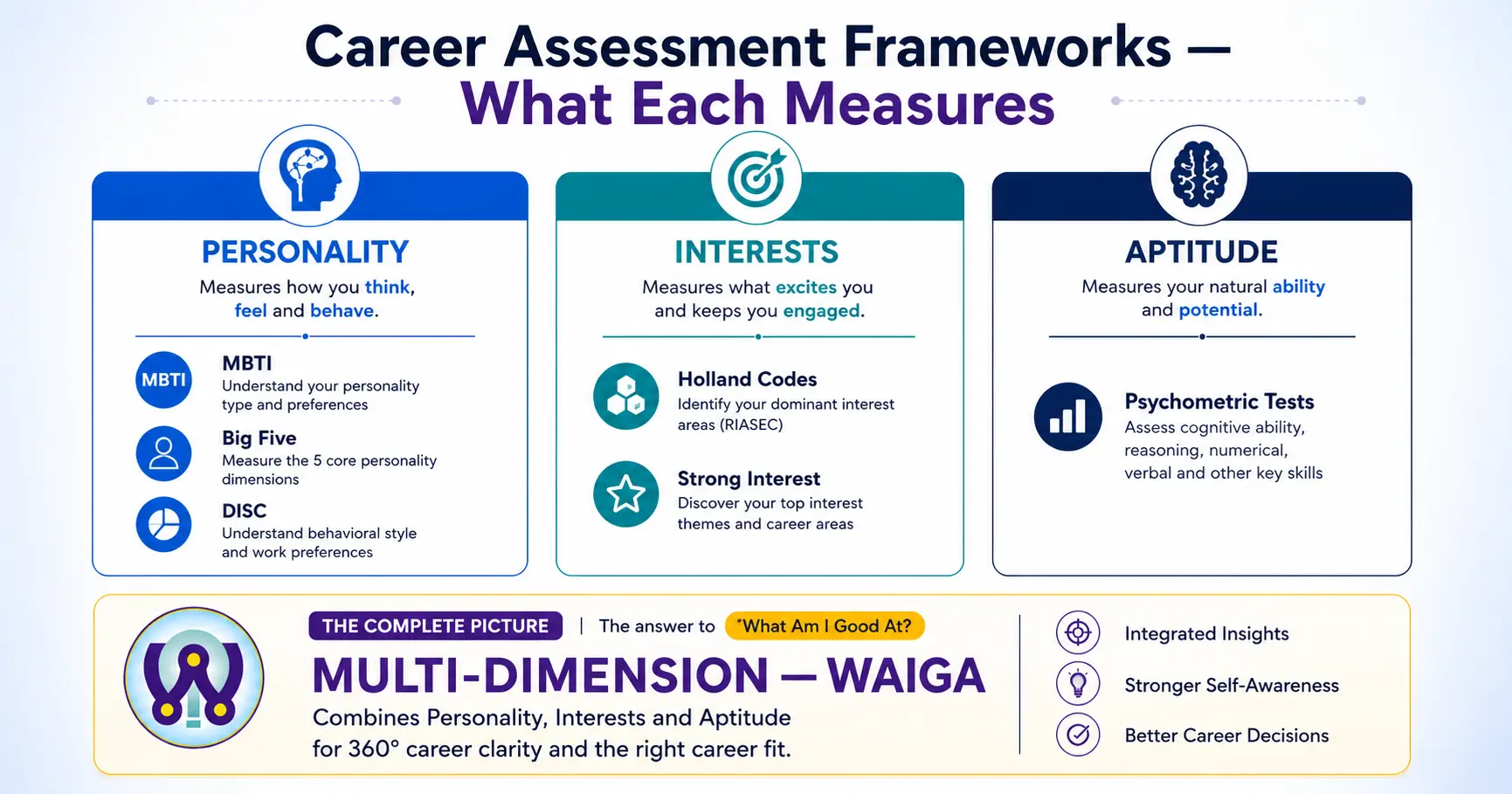
Before looking at specific frameworks, it helps to understand that career assessments generally measure one or more of three distinct dimensions:
Personality — how you naturally behave, communicate, make decisions and prefer to work. Personality-based assessments identify your working style and the kinds of environments that suit you.
Interests — what you are genuinely drawn to, what engages you, what kinds of work and subjects you find motivating. Interest-based assessments help identify which fields and activities align with your natural inclinations.
Aptitude — your natural cognitive ability in specific domains — how you reason with words, numbers, logical problems and complex information. Aptitude assessments identify what you are naturally capable of excelling at.
Different assessments measure different combinations of these three dimensions. Understanding which dimension an assessment focuses on helps you understand what kind of answer it can give you — and what kind of answer it cannot.
“To understand why all three must be measured together, read: Why Career Clarity Requires Multiple Dimensions“
Group 1 — Personality-Based Frameworks
1. Myers-Briggs Type Indicator (MBTI)
What it measures: Personality preferences across four dimensions — where you focus your attention (Introversion/Extraversion), how you take in information (Sensing/Intuition), how you make decisions (Thinking/Feeling) and how you approach the world (Judging/Perceiving).
What it produces: One of 16 personality types, described by a four-letter code (e.g. INTJ, ENFP). Each type is associated with general working style preferences and broad career environments that suit it.
Widely used for: Self-awareness, team dynamics, understanding communication styles and general career environment compatibility.
What it does not measure: Vocational interests and aptitude are not part of the MBTI framework. The assessment tells you how you work — not specifically what you should work on, or whether you have the natural ability to excel in a given field.
Best suited for: People who want to understand their working style and personality in depth. Widely used in corporate environments for team building and communication.
2. Big Five Personality Assessment (OCEAN)
What it measures: Five broad personality dimensions — Openness to experience, Conscientiousness, Extraversion, Agreeableness and Neuroticism (emotional stability).
What it produces: Scores on each of the five dimensions, showing where you fall on a spectrum from low to high for each trait.
Widely used for: Academic research, corporate hiring and psychological assessment. The Big Five is one of the most scientifically validated personality frameworks in psychology.
What it does not measure: Like MBTI, it measures personality only — not vocational interests or aptitude. It is primarily descriptive rather than prescriptive — it tells you who you are, not specifically which career to choose.
Best suited for: Those who want a research-validated personality profile. Often used alongside other assessments rather than as a standalone career guidance tool.
3. DISC Assessment
What it measures: Four behavioural tendencies — Dominance, Influence, Steadiness and Conscientiousness — focusing on how you respond to problems, people, pace and procedures.
What it produces: A profile showing your dominant and secondary DISC styles, with implications for how you work, communicate and lead.
Widely used for: Corporate environments — particularly sales, leadership development and team dynamics. DISC is widely used in HR and management training contexts.
What it does not measure: Career-specific guidance, vocational interests and aptitude are not part of the DISC framework. It is primarily a workplace behaviour tool rather than a career choice tool.
Best suited for: Professionals in corporate environments who want to understand their working and communication style. Less relevant for students making initial career or stream decisions.
Group 2 — Interest-Based Frameworks
4. Holland Codes (RIASEC)
What it measures: Vocational interests across six categories — Realistic, Investigative, Artistic, Social, Enterprising and Conventional. The model identifies which two or three of these interest types are most dominant for an individual.
What it produces: A three-letter Holland Code (e.g. ISA, ECS) that is matched to career environments that tend to attract similar interest profiles.
Widely used for: School and university career counselling worldwide. Holland Codes is one of the most thoroughly researched frameworks in vocational psychology, with decades of published validation studies.
What it does not measure: Aptitude is not part of the Holland framework. Two people with identical Holland Codes can have very different cognitive strengths — and therefore very different career outcomes in the same field. The framework also does not identify careers to avoid.
Best suited for: Students and graduates who want a structured way to identify which career environments match their interests. Widely available through school counsellors, universities and online platforms.
“For a detailed comparison of the Holland Codes framework with WAIGA, read: WAIGA vs Holland Codes — Which Career Framework Is More Complete?“
5. Strong Interest Inventory
What it measures: Vocational interests across a broad range of occupations, work activities, subjects and leisure activities. Based on Holland’s RIASEC framework but significantly expanded in scope.
What it produces: A detailed interest profile showing General Occupational Themes (based on Holland Codes), Basic Interest Scales and specific Occupational Scales matched to real job titles.
Widely used for: University career centres and professional career counselling. One of the most widely used career interest assessments in the United States.
What it does not measure: Like Holland Codes, it focuses on interests only. Aptitude and personality are not measured. Typically requires a qualified professional to administer and interpret.
Best suited for: Those with access to a qualified career counsellor who can administer and discuss the results. Less accessible as a self-directed tool.
Group 3 — Aptitude-Based Tools
6. Psychometric Aptitude Tests
What they measure: Cognitive ability across specific domains — commonly verbal reasoning (understanding and using language), numerical reasoning (working with numbers and data), logical reasoning (identifying patterns and drawing conclusions) and spatial reasoning (visualising objects and shapes).
What they produce: Scores on each aptitude dimension, showing where natural cognitive strengths lie.
Widely used for: Graduate and professional hiring assessments. Companies like SHL, Talent Q and Korn Ferry publish widely used aptitude test batteries used in recruitment.
What they do not measure: Vocational interests and personality are not part of standard aptitude testing. A high aptitude score tells you what you are capable of — not what you are drawn to or whether the working environment will suit you.
Best suited for: Those preparing for graduate recruitment processes, or those who want an objective measure of their cognitive strengths to inform career decisions.
Group 4 — Multi-Dimension Frameworks
7. WAIGA — What Am I Good At?
What it measures: All three dimensions of career fit — Interests, Personality and Aptitude — independently and simultaneously, in a single assessment.
WAIGA measures vocational interests across 7 distinct types, personality across 16 types, and aptitude across 4 independent dimensions: Verbal Reasoning, Numerical Reasoning, Logical Reasoning and Analytical Reasoning.
What it produces: A single unified WAIGA score combining all three dimensions — used to rank careers from most to least compatible with the individual’s complete profile. The report includes a Top 10 list of best-fit careers ranked by score, a Bottom 10 list of careers to avoid, graphical analysis of all three dimensions, and a full personality profile. The report is delivered instantly and is fully self-readable — no counsellor needed.
Developed: Over five years (2006-2011) by a multi-disciplinary team of psychologists and industry professionals, each with over 30 years of real-world expertise. “Launched online in 2011. Read more about how the WAIGA framework was developed“
What makes it different: Most career assessments measure one or two dimensions and present results separately, leaving the individual to interpret how they interact. WAIGA measures all three independently and combines them into one score — producing a more complete and directly actionable output than single-dimension frameworks.
Best suited for: Students choosing streams or degrees, graduates entering the job market, and professionals considering a career change — anyone who wants a complete picture of career fit across all three dimensions in a single, self-directed assessment.
How to Choose the Right Assessment for Your Situation
With seven frameworks described above, the question becomes: which one is right for you?
The answer depends on what question you are actually trying to answer.
“I want to understand how I work and communicate” A personality framework — MBTI, Big Five or DISC — answers this well. These are particularly useful if you are already in a career and want to improve your performance, relationships and working style.
“I want to understand what fields and activities engage me” An interest framework — Holland Codes or the Strong Interest Inventory — answers this. These are particularly useful for students who have not yet committed to a direction and want to explore which broad fields align with their natural inclinations.
“I want to know what I am cognitively good at” An aptitude assessment answers this. Particularly useful if you are preparing for graduate hiring processes or want an objective measure of your natural cognitive strengths.
“I want a complete picture — interests, personality and aptitude together — so I can identify which specific careers to pursue and which to avoid” A multi-dimension framework that combines all three answers this. This is the most complete approach and produces the most actionable output for career decision-making.
One Final Thought — What Most Assessments Cannot Tell You
Most career assessments are designed to tell you what might suit you. Very few are designed to tell you what to avoid.
This distinction matters more than it might initially seem. Knowing that five careers align well with your profile is useful. Knowing that three specific careers are likely to create sustained mismatch — and should be walked away from before you invest years of education and effort in them — is equally valuable.
When choosing a career assessment, it is worth asking not just “does this tell me where to go?” but also “does this tell me where not to go?”
Want to understand the WAIGA framework in more depth?
Or experience WAIGA yourself — at no cost:
Best on laptop or desktop |Takes 20-30 minutes | No counsellor needed