
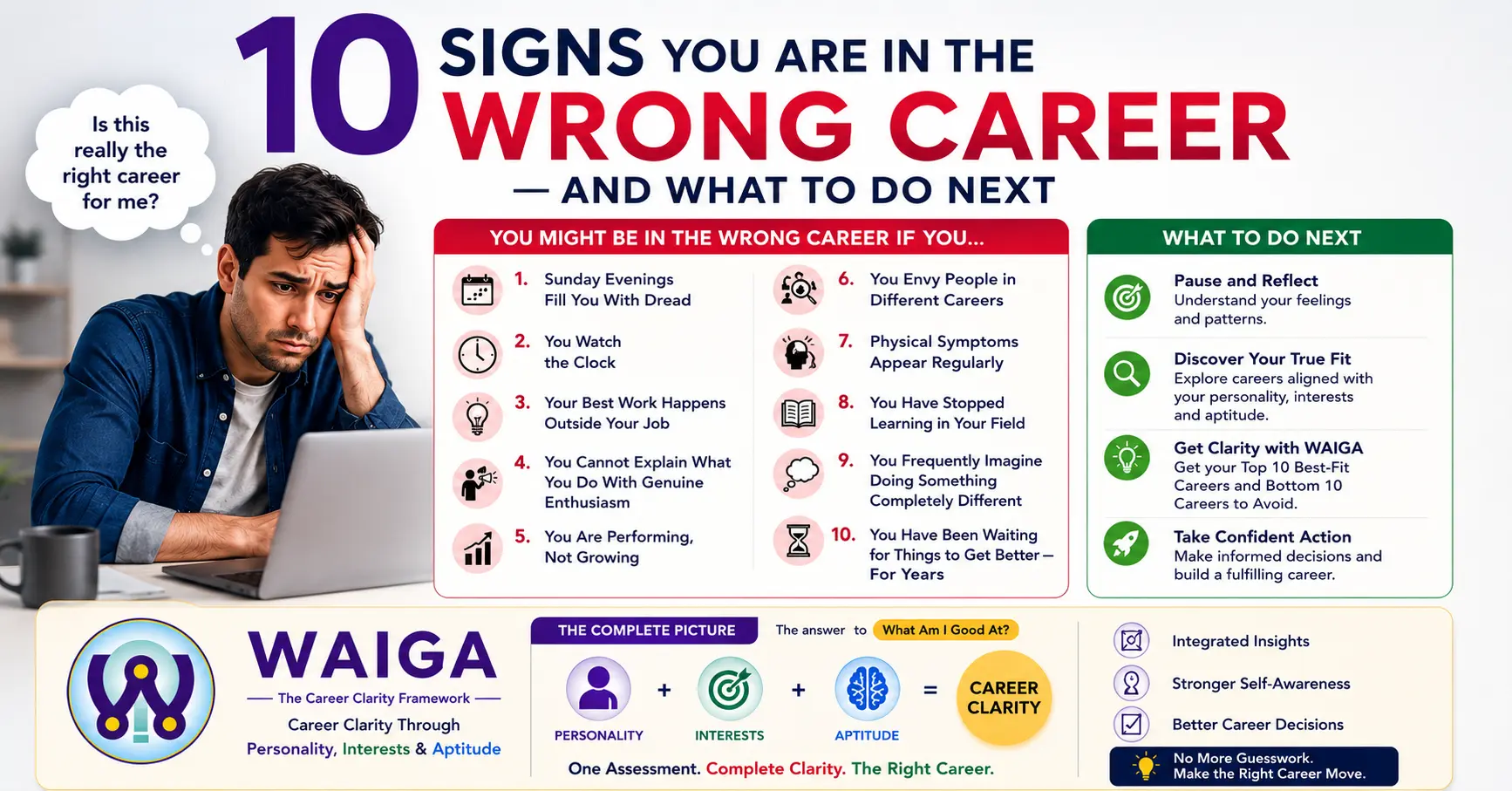
The Career That Looks Right But Feels Wrong – Signs You Are in the Wrong Career
There is a particular kind of professional dissatisfaction that is hard to name. You are not failing. You are not being mistreated. Your salary is acceptable. Your colleagues are fine. And yet something feels fundamentally off — a persistent sense that you are in the wrong place, doing the wrong work, heading in the wrong direction.
This feeling is more common than most people admit. And it is more important than most people act on.
The average person spends over 90,000 hours of their life at work. Spending those hours in a career that does not align with who you are — your natural strengths, your genuine interests, your personality — is not just uncomfortable. It is costly, in ways that compound over time.
Here are 10 signs that the career you are in may not be the right one — and what to do if several of them apply to you.
Sign 1 — Sunday Evenings Fill You With Dread
Not the mild reluctance that most people feel at the end of a weekend. A genuine, heavy dread. The kind that arrives on Sunday afternoon and sits with you through dinner, through the evening, through trying to sleep.
This is your nervous system signalling something important. A career that fits does not produce this response consistently. You may have difficult weeks, demanding projects and stressful periods — but the underlying orientation is one of engagement, not dread.
If Sunday evenings have felt this way for months or years — not because of a specific project or difficult phase, but as a baseline — that is a significant signal.
Sign 2 — You Watch the Clock
In work that genuinely engages you, time moves differently. You look up and two hours have passed. You get absorbed in a problem and forget to eat lunch.
In work that does not fit, time slows down. You find yourself checking the time repeatedly — not because you are lazy, but because the work is not engaging the parts of you that need to be engaged.
Clock-watching is not a character flaw. It is feedback about fit.
Sign 3 — Your Best Work Happens Outside Your Job
You are energetic and creative when working on side projects, volunteering, helping friends with problems in a different domain, or pursuing hobbies that involve skills your job does not use.
The same person who drags through the working day produces impressive, energetic output in a completely different context. This is not a motivation problem. It is a fit problem. The skills and interests that genuinely engage you are not being used where you spend most of your time.
Sign 4 — You Cannot Explain What You Do With Genuine Enthusiasm
Ask someone in the right career what they do and they light up. They explain it with energy, use specific language, bring examples without prompting.
Ask someone in the wrong career and something different happens. The explanation is accurate but flat. There is competence without passion, description without enthusiasm. They tell you what the job involves but not why it matters to them — because, honestly, it does not.
If describing your career to someone new feels like reading from a job description rather than talking about something you care about, that is worth noticing.
Sign 5 — You Are Performing, Not Growing
Early in most careers, there is a learning curve. Things are challenging, unfamiliar and stimulating. You are acquiring new skills, solving new problems, developing competence.
At some point in the wrong career, that curve flattens — and instead of growing, you are just performing. Executing familiar tasks. Maintaining existing skills. Going through motions that no longer challenge or develop you.
This is different from the natural steadying that comes with mastery. In the right career, mastery opens new levels of challenge. In the wrong career, it closes into repetition.
Sign 6 — You Envy People in Different Careers
Not envying their salary or their status — but genuinely envying what they spend their days doing.
You read about someone’s work in a completely different field and feel a pull. You meet someone at a social gathering who describes their job with obvious enthusiasm and find yourself wishing you felt that way about yours. You watch a documentary about a profession and think — that is what I should be doing.
This kind of envy is not destructive. It is directional. It is pointing you somewhere.
Sign 7 — Physical Symptoms Appear Regularly
Persistent fatigue that sleep does not fix. Frequent headaches on working days. A vague, low-grade anxiety that lifts noticeably on weekends or during holidays.
The body has a way of expressing what the mind rationalises away. When work is consistently misaligned with who you are, the sustained effort of showing up and performing in ways that do not come naturally creates a physical toll that shows up in predictable patterns.
This is not to say every physical symptom is career-related. But if symptoms follow a clear pattern — present during the working week, absent during breaks — the pattern is worth taking seriously.
Sign 8 — You Have Stopped Learning in Your Field
In the right career, you naturally seek out more knowledge. You read industry publications, follow developments, attend events, pursue qualifications — not because you have to, but because you are genuinely interested in the field.
In the wrong career, keeping up with the field feels like a chore. Professional development becomes something you do to maintain employability rather than something you seek because you care. You are not curious about where the field is going because you do not feel invested in being part of it.
Genuine curiosity about your field is a sign of fit. The absence of it is a sign worth examining.
Sign 9 — You Frequently Imagine Doing Something Completely Different
Not just vague daydreaming — but recurring, specific thoughts about a different kind of work. The same alternative keeps coming back. You find yourself researching it online, asking people in that field what they do, calculating whether a transition is possible.
This is your mind repeatedly returning to something it finds compelling. The frequency and specificity of these thoughts are proportional to how strong the underlying pull is.
Sign 10 — You Have Been Waiting for Things to Get Better — For Years
The most telling sign of all. You told yourself it would get better once you passed the next milestone — the promotion, the pay rise, the new project, the new team, the new role. Some of those milestones came. And the fundamental feeling did not change.
That is because the fundamental issue is not the role, the manager or the company. It is the fit between who you are and what the career demands. Changing the context without changing the career direction is rearranging the furniture in the wrong house.
What to Do if Several of These Apply to You
Recognition is the first step. The second is understanding why the mismatch exists — which requires a clear picture of your own Personality, Interests and Aptitude and how they align or misalign with your current career.
Without that structured understanding, most career change attempts follow a predictable and disappointing pattern: you move from the wrong career to a different wrong career, guided by what seems more interesting or better paid, without ever identifying what actually fits.
Three honest things to do next:
1. Separate the career from the context. Before concluding you are in the wrong career, ask whether you are in the wrong role, team or company within a career that could fit you. Sometimes the mismatch is contextual rather than fundamental. Sometimes it is not.
2. Get a structured assessment of all three dimensions. Not just an interest quiz. Not just a personality type. A structured assessment that independently measures your Aptitude, Interests and Personality — and combines them into a ranked picture of which careers align most strongly with all three. This gives you a reliable foundation for decisions rather than another round of guesswork.
3. Give yourself permission to take this seriously. Career dissatisfaction is not weakness or ingratitude. It is information. The longer you dismiss it, the more it costs — in years, energy, potential and wellbeing. Taking it seriously and acting on it is not self-indulgent. It is responsible.
A Note on Timing
There is rarely a perfect time to address a career mismatch. There is always a mortgage, a family commitment, a colleague who depends on you, a bonus coming up, a promotion within reach.
But there is also never a time when the cost of staying in the wrong career gets smaller. It compounds. Skills that are not being used atrophy. Years in the wrong direction make course correction more effortful. The energy required to perform inauthentically takes a cumulative toll.
The best time to address a career mismatch is always now — starting with understanding, not with a dramatic resignation, but with a clear and honest assessment of what is actually going on.
Recognise several of these signs in yourself?
The WAIGA Test combines your Personality, Interests and Aptitude into a single score — instantly giving you your Top 10 best-fit careers and Bottom 10 careers to avoid.
- Download link appears on screen the moment you finish
- PDF report emailed to you automatically
- Re-download anytime from your My Account dashboard
- No counsellor needed — fully self-readable report
- Trusted since 2011
✔ Best on laptop or desktop | ✔ Takes 20-30 minutes | ✔ Instant report — 3 ways to access | ✔ No counsellor needed — ever
✔ Registration takes 2 minutes |✔ Purchased test stays in dashboard — take it anytime