The Ultimate Career Guide
How to Choose the Right Career: The Complete Step-by-Step Guide
Introduction
Choosing the right career is one of the most important decisions you will ever make. It influences not only your income, but also your daily satisfaction, confidence, lifestyle, and long-term growth. Yet, despite its importance, many people make this decision with surprisingly little information.
Some choose a career because they scored well in a particular subject. Others follow family expectations, copy their friends, or pursue professions that appear prestigious or financially rewarding. While these reasons may seem sensible at first, they often overlook the most important question:
Is this career actually the right fit for me?
This is why many students lose interest in their chosen courses, professionals switch careers after a few years, and countless people feel unfulfilled despite achieving what they once considered success.
The good news is that career selection does not have to be based on guesswork. Like any important decision, it can be approached systematically.
The most successful career decisions are rarely based on a single factor such as passion, salary, or academic performance. Instead, they emerge from understanding multiple aspects of who you are and matching them with careers where those qualities can thrive.
In this guide, you’ll learn:
- Why choosing a career is more complicated than most people think.
- The four essential factors that should influence every career decision.
- Why many traditional career assessments provide only part of the picture.
- Common mistakes that lead to poor career choices.
- A structured approach that can help you make a confident and informed decision.
Whether you are a student planning your future, a graduate exploring career options, or a professional considering a career change, this guide will help you understand the principles behind choosing a career that fits you—not just today, but for years to come.
Table of Contents
Why Choosing a Career Is So Difficult
If choosing the right career were easy, very few people would regret their career decisions. Yet surveys across the world consistently show that a significant number of people are dissatisfied with their jobs or would choose a different career if given another opportunity.
The reason is simple: career choice is far more complex than it appears.
Unlike many life decisions, there is no single “correct” answer. The best career for one person may be completely unsuitable for someone else, even if they have similar academic qualifications or come from the same background.
Several factors make career selection particularly challenging.
Too Many Choices
Today’s students and professionals have access to thousands of career options. Traditional professions such as engineering, medicine, law, and teaching now exist alongside emerging careers in artificial intelligence, data science, digital marketing, cybersecurity, UX design, sustainability, content creation, and many more.
While having more choices is beneficial, it also creates decision paralysis. When every option appears attractive, choosing one becomes increasingly difficult.
Advice Comes from Everywhere
Parents, teachers, relatives, friends, social media influencers, career websites, and coaching institutes often offer career advice. Although most of it is well-intentioned, the recommendations are frequently based on personal experiences, opinions, or current trends rather than an individual’s unique strengths and preferences.
Following someone else’s successful path does not guarantee that it will be the right path for you.
The World of Work Is Changing Rapidly
Technology is transforming industries at an unprecedented pace. New occupations are emerging while others are evolving or becoming less relevant. Skills that were valuable a decade ago may no longer be sufficient, making career planning more dynamic than ever before.
This means that choosing a career requires looking beyond today’s job market and considering long-term adaptability and future opportunities.
Most People Don’t Fully Understand Themselves
Perhaps the biggest challenge is that many people make career decisions without first understanding themselves.
They may know which subjects they enjoy or which careers are popular, but they often have limited insight into their natural interests, personality, abilities, preferred work environment, or the kind of work that genuinely motivates them.
Without this self-awareness, career decisions are often based on assumptions rather than evidence.
There Is No Single Factor That Determines Career Success
Many people believe they should simply “follow their passion.” Others focus only on salary, job security, or academic performance.
While each of these factors is important, none of them alone is enough.
A career that matches your interests but not your abilities may become frustrating. A high-paying profession that conflicts with your personality may lead to stress and burnout. Likewise, being highly capable in a field does not necessarily mean you will enjoy working in it every day.
Successful career decisions are rarely based on one factor. They are made by considering multiple dimensions together.
The good news is that once you understand these dimensions, career selection becomes far more structured, logical, and confident.
The next section explains the four essential factors that every individual should evaluate before choosing a career.
“The biggest career mistake isn’t choosing the wrong profession—it’s choosing one without first understanding yourself”
The Four Essential Factors You Must Know Before Choosing Any Career
Every career decision should answer one simple question:
“Will this career allow me to perform well, enjoy my work, and grow over the long term?”
To answer that question objectively, you need to understand yourself from multiple perspectives.
Many people make the mistake of focusing on only one factor. They may choose a career because they enjoy a subject, because it pays well, or because someone recommended it. While these considerations are important, none of them alone is enough to make a confident career decision.
Career psychologists and researchers have long recognised that successful career choices are based on understanding several dimensions of an individual—not just one.
The four most important dimensions are:
1. Your Interests – What Naturally Attracts You?
Your interests represent the kinds of activities you naturally enjoy and are motivated to pursue. They influence what captures your attention, what keeps you engaged, and what type of work feels meaningful.
For example, some people enjoy solving technical problems, while others are drawn towards helping people, creating designs, conducting research, managing businesses, or working with data.
When your work aligns with your interests, you are more likely to stay motivated, continue learning, and find satisfaction in your career.
However, interest alone is not enough.
You may love aviation but lack the aptitude required to become a pilot. You may enjoy drawing but not necessarily want to build a full-time career as a designer.
Interests tell us what we enjoy, but they do not tell us whether we are naturally suited for that career.
2. Your Personality – How Do You Naturally Work?
Personality influences how you think, communicate, make decisions, solve problems, and interact with other people.
Some individuals thrive in highly structured environments, while others prefer flexibility and creativity. Some enjoy leading teams, while others perform best working independently. Some gain energy from meeting people every day, while others prefer analytical or behind-the-scenes work.
Choosing a career that matches your personality often leads to greater job satisfaction because your daily work aligns with your natural behavioural style rather than constantly working against it.
A mismatch between personality and career can result in unnecessary stress, lower confidence, and reduced long-term satisfaction—even if the individual is highly capable.
3. Your Aptitude – What Are You Naturally Good At?
Aptitude refers to your natural ability to learn and perform certain types of tasks.
Different careers demand different abilities. Some require strong numerical reasoning, others depend on verbal communication, logical thinking, spatial visualisation, attention to detail, creativity, or problem-solving.
While skills can certainly be developed through education and practice, people usually learn faster and perform better in areas where they possess natural aptitude.
For example, someone may be deeply interested in architecture but struggle with spatial reasoning. Another person may not initially consider engineering but possess exceptional analytical ability that enables them to excel in it.
Understanding your aptitude helps identify careers where you are more likely to perform successfully.
4. Career Opportunities – Where Can You Build a Sustainable Future?
Even when a career matches your interests, personality, and aptitude, it should also offer realistic opportunities for growth.
The employment landscape changes continuously. New industries emerge, technology transforms existing roles, and market demand evolves over time.
According to the World Economic Forum’s Future of Jobs Report, technological advancement and artificial intelligence are reshaping the skills employers seek, making lifelong learning and adaptability more important than ever.
Before committing to any profession, it is important to consider questions such as:
- Is there growing demand for this career?
- What skills will employers expect in the future?
- Does this career offer opportunities for advancement?
- Is it financially sustainable?
- Can it adapt to changes in technology and society?
Considering these practical factors ensures that your career choice is not only personally fulfilling but also professionally sustainable.
Why Looking at Only One Factor Can Be Misleading
Imagine choosing a career based only on your interests.
You might enjoy the work but struggle with the abilities it requires.
Now imagine choosing only on the basis of aptitude.
You may perform well but never truly enjoy what you do.
Choosing only because a profession offers a high salary may lead to financial success but personal dissatisfaction. Similarly, choosing only because your family recommends a profession may ignore your own strengths and aspirations.
Every individual is unique.
The most reliable career decisions are made by combining interests, personality, aptitude, and career opportunities rather than relying on any one factor in isolation.
This multi-dimensional approach provides a far more complete understanding of career fit and forms the foundation of modern career assessment methods.
In the next section, we’ll explore why many traditional career assessments evaluate only one or two of these dimensions—and how that can lead to incomplete or even misleading career recommendations.
“Interests tell you what you enjoy. Personality explains how you work. Aptitude reveals what you do naturally well. Together, they provide a much clearer picture of career fit”
Why a Single Career Test Is Rarely Enough
By now, you’ve seen that choosing the right career requires understanding multiple aspects of yourself—not just one.
This raises an important question:
How are these factors actually measured?
For decades, psychologists and career development experts have developed reliable assessment tools to evaluate different aspects of human behaviour and ability. These assessments are backed by years of research and continue to play an important role in education, recruitment, and career guidance.
Many of today’s career assessments are based on decades of psychological research. For example, psychologist Dr. John L. Holland’s RIASEC model demonstrated that people tend to be more satisfied and successful when their work environment aligns with their interests and personality. His work continues to influence career guidance around the world.
However, each assessment was designed to answer a specific question—not every question.
Let’s look at what each type of assessment can tell you.
Personality Assessments
Personality assessments help identify how you naturally think, communicate, solve problems, and interact with people.
They provide valuable insights into your preferred working style, leadership tendencies, decision-making approach, and the type of work environment where you are likely to feel comfortable.
For example, some people naturally enjoy leading teams and making quick decisions, while others prefer analysing information, working independently, or supporting others behind the scenes.
Understanding your personality helps identify careers where your natural behavioural style is more likely to succeed.
What personality assessments don’t tell you:
They cannot determine whether you actually enjoy a particular career or whether you possess the aptitude required to perform it successfully.
Interest Assessments
Interest assessments explore what genuinely attracts your attention and motivates you.
Some individuals are fascinated by technology and innovation. Others enjoy helping people, creating designs, managing businesses, conducting research, or working outdoors.
When your career aligns with your interests, staying engaged and motivated becomes much easier.
What interest assessments don’t tell you:
They cannot determine whether you have the natural abilities or personality characteristics needed to excel in that profession.
Aptitude Assessments
Aptitude assessments measure your natural ability to learn and perform different types of tasks.
They may evaluate numerical reasoning, verbal ability, logical thinking, spatial reasoning, mechanical aptitude, attention to detail, or other cognitive abilities depending on the assessment.
Aptitude is particularly valuable because it indicates areas where learning tends to be faster and performance is often stronger.
What aptitude assessments don’t tell you:
Being naturally good at something does not automatically mean you will enjoy doing it every day.
Career Counselling
An experienced career counsellor brings another important dimension to the process.
By understanding your background, aspirations, strengths, concerns, and circumstances, a counsellor can help interpret assessment results and guide decision-making.
Professional career counselling has helped countless students and professionals make better career choices.
However, the quality of counselling often depends on the counsellor’s expertise, experience, and the assessment tools being used.
The Bigger Picture
Each of these approaches provides valuable information.
The challenge is that career decisions require all of these insights—not just one of them.
Imagine trying to complete a jigsaw puzzle with only a few pieces.
You may recognise part of the picture, but you still cannot see the complete image.
Career assessment works in much the same way.
A personality assessment explains how you prefer to work.
An interest assessment explains what you enjoy doing.
An aptitude assessment explains what you are naturally capable of doing.
Career counselling helps interpret these findings and relate them to real-world career opportunities.
Individually, each approach answers an important question.
Together, they provide a much clearer understanding of career fit.
Key Takeaway
No single assessment can fully determine the right career for an individual. The most reliable career decisions are made by combining multiple dimensions of self-understanding rather than relying on any one test in isolation.
Traditionally, obtaining this complete picture often meant taking multiple assessments, waiting for separate reports, and discussing the findings with a career counsellor before arriving at a recommendation.
While this approach can be highly effective, it also requires considerable time, coordination, and cost.
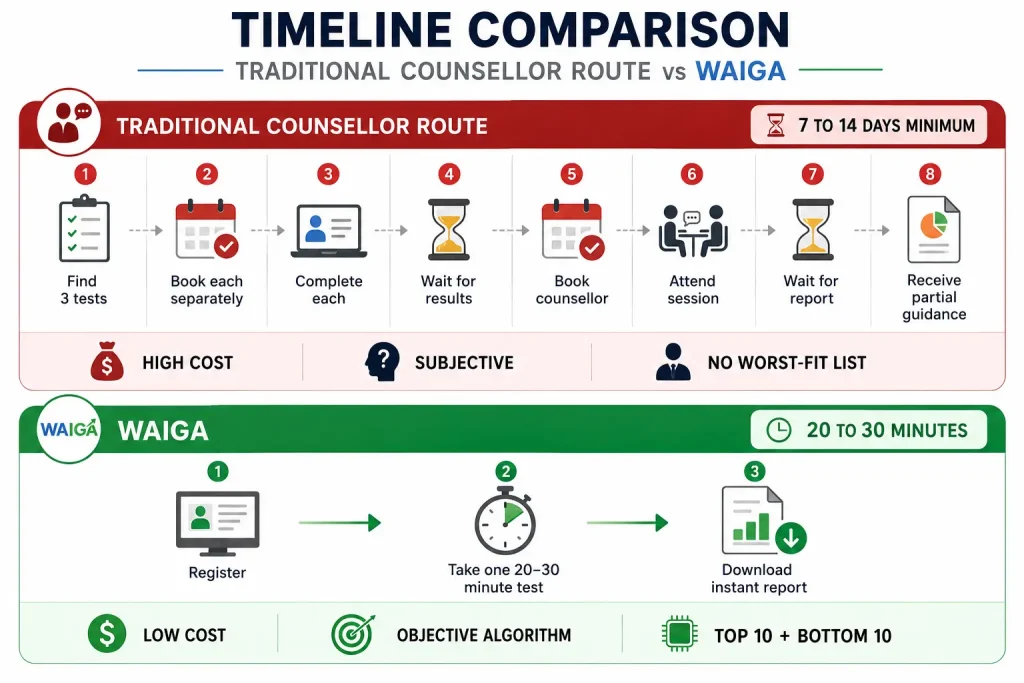
Fortunately, advances in psychometrics and technology have made it possible to integrate these dimensions into a more streamlined career assessment process.
The next section explores how modern integrated career assessment frameworks simplify this journey while preserving the depth and quality of the insights they provide.
“No single assessment can answer every career question. Career clarity comes from looking at the complete picture”
A Modern Integrated Approach to Career Assessment
As our understanding of human behaviour has evolved, so has the science of career assessment.
For many years, comprehensive career guidance typically involved taking several separate assessments, receiving individual reports, and discussing the combined findings with a career counsellor. This process often produced valuable insights, but it required considerable time, coordination, and expense.
Today, advances in psychometrics, data analysis, and technology have made it possible to bring these different dimensions together into a single, structured framework.
Rather than viewing personality, interests, aptitude, and career opportunities as separate pieces of information, modern career assessment frameworks analyse them collectively to provide a more complete picture of an individual’s career fit.
This integrated approach offers several advantages.
- It saves time by eliminating the need for multiple independent assessments.
- It combines different dimensions into one coherent interpretation.
- It reduces the possibility of drawing conclusions from only one aspect of an individual’s profile.
- It provides a clearer basis for comparing career options.
- It enables more objective and evidence-based career recommendations.
Instead of asking,
“What career matches my personality?”
or
“Which career suits my interests?”
the question becomes:
“Which careers best match the complete picture of who I am?”
That is a far more meaningful question—and ultimately, a far more useful answer.
The WAIGA Framework
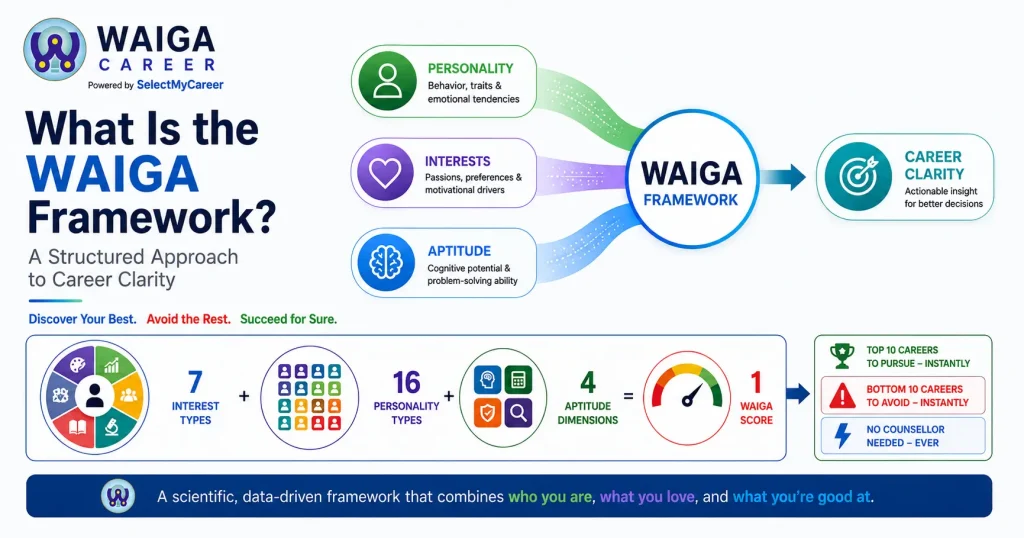
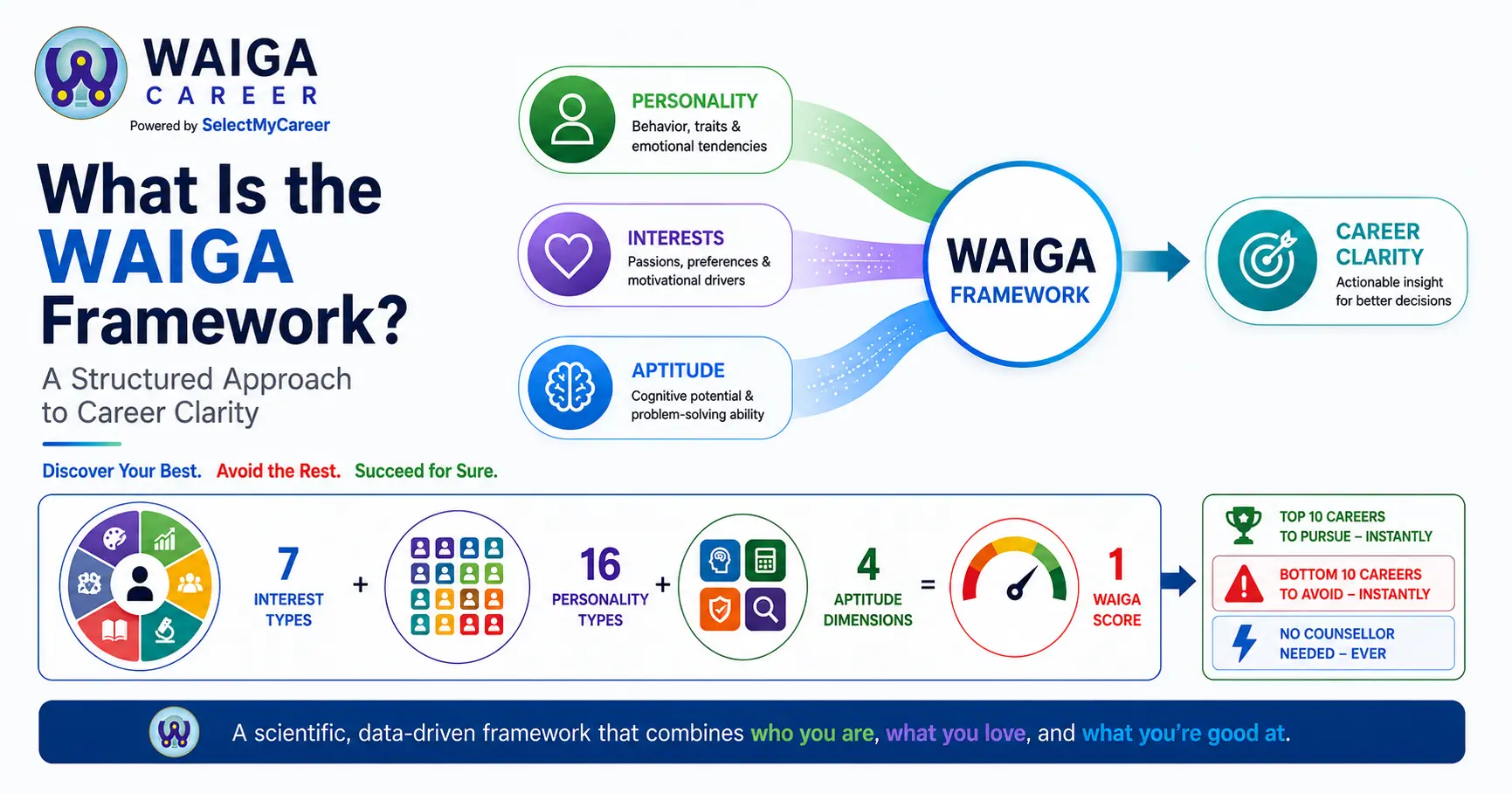
One example of this integrated approach is the WAIGA Framework.
Did You Know?
WAIGA stands for What Am I Good At?—a question at the heart of every meaningful career decision. The framework is built on the belief that the better you understand yourself, the better equipped you are to choose a career that aligns with your strengths, interests, personality, and long-term aspirations.
Developed through years of research and practical application in career guidance, the WAIGA Framework recognises that no single factor can accurately determine career suitability.
Instead, it brings together three essential dimensions of career assessment:
- Personality – How you naturally think, communicate, make decisions, and work with others.
- Interests – The types of activities, subjects, and work environments that genuinely engage and motivate you.
- Aptitude – Your natural abilities and potential to learn and perform different kinds of work.
These dimensions are then analysed together to create a comprehensive picture of career fit.
Rather than simply suggesting careers you may enjoy, the framework helps identify careers where your interests, personality, and abilities are aligned—while also highlighting careers that may be less suitable despite appearing attractive on the surface.
This integrated approach provides greater confidence because career recommendations are based on multiple dimensions instead of a single assessment.
From Assessment to Career Clarity
The ultimate objective of any career assessment is not simply to generate a report.
Its purpose is to help individuals make better career decisions.
A comprehensive assessment should help answer questions such as:
- Which careers are most closely aligned with my strengths?
- Which careers may appear attractive but are unlikely to suit me?
- What are my greatest natural strengths?
- Which work environments are likely to bring out my best performance?
- Where should I focus my education and skill development?
When these questions are answered together, career planning becomes less about guesswork and more about informed decision-making.
That is the real value of a modern career assessment framework—not replacing human judgement, but supporting it with objective, evidence-based insights.
Key Takeaway
Career assessment has evolved from isolated tests to integrated frameworks that evaluate multiple dimensions of an individual together. This provides a more complete understanding of career fit and supports better-informed career decisions.
Choosing the right career is not about finding the “perfect” profession.
It is about understanding yourself well enough to identify careers where your interests, personality, abilities, and future opportunities come together.
The better you understand yourself, the better your career decisions are likely to be.
Common Mistakes People Make When Choosing a Career
Very few people deliberately choose the wrong career.
More often, they make decisions based on incomplete information, external pressure, or common misconceptions.
The good news is that most of these mistakes are preventable once you understand what really influences long-term career satisfaction.
Let’s look at some of the most common career planning mistakes.
1. Choosing a Career Based Only on Salary
A high salary is attractive, and financial security is undoubtedly important.
However, salary alone rarely leads to long-term satisfaction.
If the work itself does not match your interests, personality, or natural strengths, the initial excitement of a good salary often fades, leaving frustration, stress, or burnout.
The objective should not be to choose the highest-paying career, but the career where you are most likely to grow, perform well, and create long-term value. Financial rewards usually follow sustained excellence.
2. Following Someone Else’s Dream
Parents, relatives, teachers, and friends genuinely want the best for us.
However, their advice is often influenced by their own experiences, beliefs, or perceptions of success.
A career that perfectly suits one person may be completely unsuitable for another.
Listening to advice is valuable.
Allowing others to make the decision for you is not.
Ultimately, you are the one who will live with that decision every working day.
3. Following Friends
Many students choose the same course or college simply because their friends are going there.
While friendships are important, careers last much longer than college.
People grow, interests change, and career paths diverge.
Choosing a profession simply to stay with friends can become an expensive mistake.
4. Confusing Passion with Career Fit
“Follow your passion.”
It is one of the most common pieces of career advice.
Unfortunately, it is also one of the most misunderstood.
Passion is important, but it is only one part of the equation.
A sustainable career also requires the right abilities, personality, opportunities, and commitment to continuous learning.
For many people, passion develops after they become competent and successful—not before.
5. Ignoring Your Natural Strengths
Every individual has areas where learning feels easier and performance comes more naturally.
Ignoring these strengths often means working much harder than necessary to achieve similar results.
Understanding your natural abilities does not limit your options—it helps you identify careers where your potential is most likely to flourish.
6. Assuming Good Marks Mean the Right Career
Academic performance reflects many things, including hard work, discipline, quality of teaching, and examination skills.
It does not automatically determine career suitability.
A student who scores highly in mathematics may not enjoy engineering.
Similarly, someone with average school grades may excel in entrepreneurship, design, leadership, or creative professions.
Marks are only one piece of the puzzle.
7. Ignoring Future Career Trends
Some careers are expanding rapidly.
Others are changing because of automation, artificial intelligence, and technological innovation.
Choosing a career without considering future opportunities may limit long-term growth.
Labour market trends published by the International Labour Organization (ILO) also highlight the importance of developing transferable skills that remain valuable as industries continue to evolve.
Career planning should balance personal suitability with an understanding of how the world of work is evolving.
8. Not Understanding Yourself First
Perhaps the biggest mistake of all is making career decisions before understanding yourself.
Without knowing your interests, personality, abilities, and preferred work environment, career selection becomes little more than educated guesswork.
Self-awareness is not the final step in career planning.
It is the first.
Key Takeaway
Wrong career decisions rarely happen because people lack ambition or intelligence. They happen because important decisions are made without understanding the complete picture. The better you understand yourself, the more confident and informed your career choices become.
Fortunately, avoiding these mistakes does not require guessing or relying on luck.
A structured career planning process can significantly improve the quality of your decisions.
In the next section, we’ll bring everything together into a practical step-by-step framework that anyone can follow to choose the right career with greater confidence.
“Most people don’t choose the wrong career because they lack talent—they choose it because they make one of life’s biggest decisions with incomplete information”
A 7-Step Scientific Process for Choosing the Right Career
Choosing the right career is not about finding the “perfect” profession overnight. It is a process of understanding yourself, exploring opportunities, and making informed decisions based on evidence rather than assumptions.
The following seven-step framework can help anyone—whether a student, graduate, or working professional—approach career planning with greater confidence.
Step 1: Understand Yourself
Every successful career journey begins with self-awareness.
Before exploring careers, take time to understand:
- What genuinely interests you?
- What kind of work do you naturally enjoy?
- What are your strengths?
- What motivates you?
- How do you prefer to work—with people, ideas, data, or things?
The better you understand yourself, the easier it becomes to identify careers that fit your unique profile.
Step 2: Identify Your Natural Strengths
Interests are important, but they should be supported by your natural abilities.
Ask yourself:
- Which subjects or activities come naturally to me?
- What do others frequently appreciate or compliment me for?
- Which tasks do I learn quickly?
- What kinds of problems do I enjoy solving?
Choosing a career that aligns with both your interests and your strengths significantly improves the likelihood of long-term success.
Step 3: Explore Career Options with an Open Mind
Many people limit themselves to careers they already know.
In reality, thousands of occupations exist across industries, many of which receive little attention in schools or colleges.
Explore careers beyond the obvious.
Read about emerging professions, attend career webinars, watch interviews with professionals, and learn how different industries operate.
Often, the right career is one you had never previously considered.
Step 4: Shortlist Careers That Match Your Profile
After exploring different options, prepare a shortlist of careers that genuinely interest you and appear compatible with your personality, strengths, and aspirations.
Rather than trying to choose one career immediately, narrow your choices to five or ten realistic possibilities.
This makes further research much more focused and manageable.
Step 5: Research Before You Decide
Before committing to any profession, understand what the job actually involves.
Research questions such as:
- What does a typical working day look like?
- What qualifications are required?
- Which skills are essential?
- What are the opportunities for growth?
- How is the profession changing?
- Is there likely to be strong demand in the future?
Avoid making decisions based solely on job titles or public perception.
Understanding the reality of a profession is just as important as finding it interesting.
Step 6: Learn from People Who Are Already There
One conversation with someone working in a profession can often provide insights that no website or brochure can offer.
If possible, speak with professionals, teachers, mentors, alumni, or family friends working in careers you are considering.
Ask about:
- What they enjoy most.
- The challenges they face.
- Skills they wish they had developed earlier.
- What they would do differently if starting again.
Real-world experiences help transform career information into practical understanding.
Step 7: Validate Your Decision Before You Commit
Before making a final decision, gather as much objective information as possible.
This may include:
- Career assessments
- Career counselling
- Internships
- Job shadowing
- Volunteering
- Short projects or online courses
The goal is simple:
Reduce uncertainty before making a long-term commitment.
A small investment of time in validation today can prevent years of dissatisfaction later.
Bringing It All Together
Career planning is rarely a one-time decision.
It is a journey of discovering who you are, understanding the opportunities available, and making informed choices as you grow.
The people who make the best career decisions are not necessarily those who have all the answers from the beginning.
They are the ones who ask the right questions, remain open to learning, and make decisions based on evidence rather than assumptions.
By following this structured process, you greatly increase your chances of choosing a career that aligns with your strengths, interests, personality, and long-term aspirations.
Career Decision Checklist
Before making one of the most important decisions of your life, take a few minutes to reflect on the following questions.
You don’t need to answer “Yes” to every question immediately. Instead, use this checklist to identify areas where you may need more information before making your final decision.
Self-Understanding
☐ I understand my interests and the kind of work I genuinely enjoy.
☐ I understand my personality and the type of work environment where I perform best.
☐ I have identified my natural strengths and abilities.
☐ I know my personal values and what I want from my career (for example, financial security, creativity, helping others, leadership, work-life balance, or continuous learning).
Career Exploration
☐ I have explored a wide range of career options instead of focusing on only a few familiar professions.
☐ I have shortlisted careers based on my own profile—not simply because they are popular or recommended by others.
☐ I understand what people working in these careers actually do on a day-to-day basis.
Research
☐ I know the education, qualifications, and skills required for my shortlisted careers.
☐ I have researched future demand, career growth, and employment opportunities.
☐ I understand both the advantages and the challenges of these professions.
Validation
☐ I have spoken to teachers, mentors, career counsellors, or professionals working in careers that interest me.
☐ I have completed a structured career assessment to better understand my interests, personality, and abilities.
☐ Wherever possible, I have gained practical exposure through projects, internships, volunteering, or job shadowing.
Decision Readiness
☐ My career choice reflects who I am—not simply what others expect from me.
☐ My decision is based on evidence and self-understanding rather than assumptions or trends.
☐ I feel confident explaining why this career is a good fit for me.
Your Score
13–15 ✓
Excellent. You have gathered substantial information and are well prepared to make an informed career decision.
9–12 ✓
You’re on the right track. Before making a final decision, spend a little more time researching and validating your shortlisted careers.
5–8 ✓
You may be making decisions with incomplete information. Consider exploring additional career options and developing a deeper understanding of yourself.
Below 5 ✓
This is a good time to pause rather than rush into a decision. Investing time in self-understanding now can save years of uncertainty later.
Remember
There is no universally “best” career.
There is only the career that best aligns with who you are, what you enjoy, what you do well, and where you can continue to grow.
The more clearly you understand yourself, the more confidently you can choose your future.
Continue Your Career Journey
You may also find these guides helpful:
- How to Choose the Right Career — 7 Proven Assessment Tools Explained
- WAIGA Framework Explained
- For Students
- For Parents
- For Professionals
“Your future doesn’t depend on choosing the most popular career. It depends on choosing the career that is right for you”
Your Next Step Towards Career Clarity
If you’ve read this guide from beginning to end, you’ve already done something many people never do—you’ve taken the time to understand that choosing the right career is not about luck, trends, or following someone else’s path.
Instead, you’ve learned that meaningful career decisions are built on understanding yourself.
Your interests, personality, natural abilities, values, and career aspirations all play an important role. Looking at only one of these factors provides an incomplete picture. Considering them together creates far greater confidence and clarity.
That is precisely the philosophy behind the WAIGA Framework.
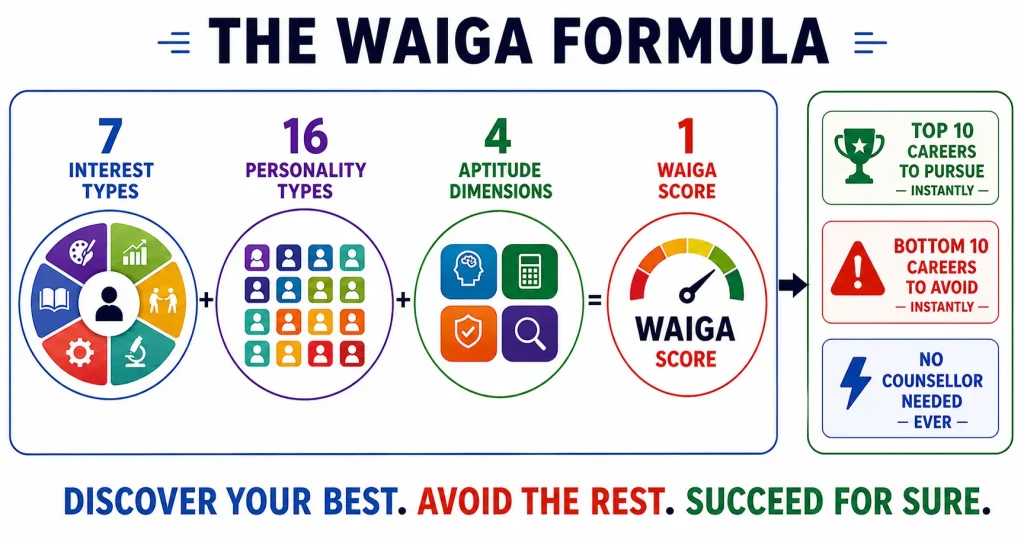
Rather than relying on a single assessment or one-dimensional recommendation, the WAIGA Framework combines multiple scientifically recognised dimensions—including Personality, Interests, and Aptitude—to provide a comprehensive understanding of career fit.
The outcome is not simply a list of careers. It is a structured insight into:
- Careers that closely match your unique profile.
- Careers that may appear attractive but are less likely to suit you.
- Your strengths and development areas.
- Career pathways aligned with your natural potential.
Whether you are a student choosing your first career, a graduate exploring opportunities, or a professional considering a career change, understanding yourself objectively is one of the most valuable investments you can make.
A career decision influences years—often decades—of your life.
It deserves more than guesswork.
It deserves clarity.
If you’re ready to move beyond general guidance and discover careers that truly fit your unique profile, the WAIGA Career Assessment can help you take that next step with confidence.
Because the right career isn’t simply the one that looks successful. It’s the one that is right for you.
Ready to Choose a Career with Confidence?
Instead of relying on a single aptitude test or personality quiz, discover your complete career profile through the WAIGA Career Assessment.
WAIGA combines Interests, Personality, Aptitude, and the WAIGA Scoring Framework into one integrated assessment—helping you identify careers that genuinely fit you while also highlighting careers to avoid.
Whether you’re a student choosing your first career, a graduate exploring opportunities, or a professional considering a career change, WAIGA provides structured guidance in about 20–30 minutes.
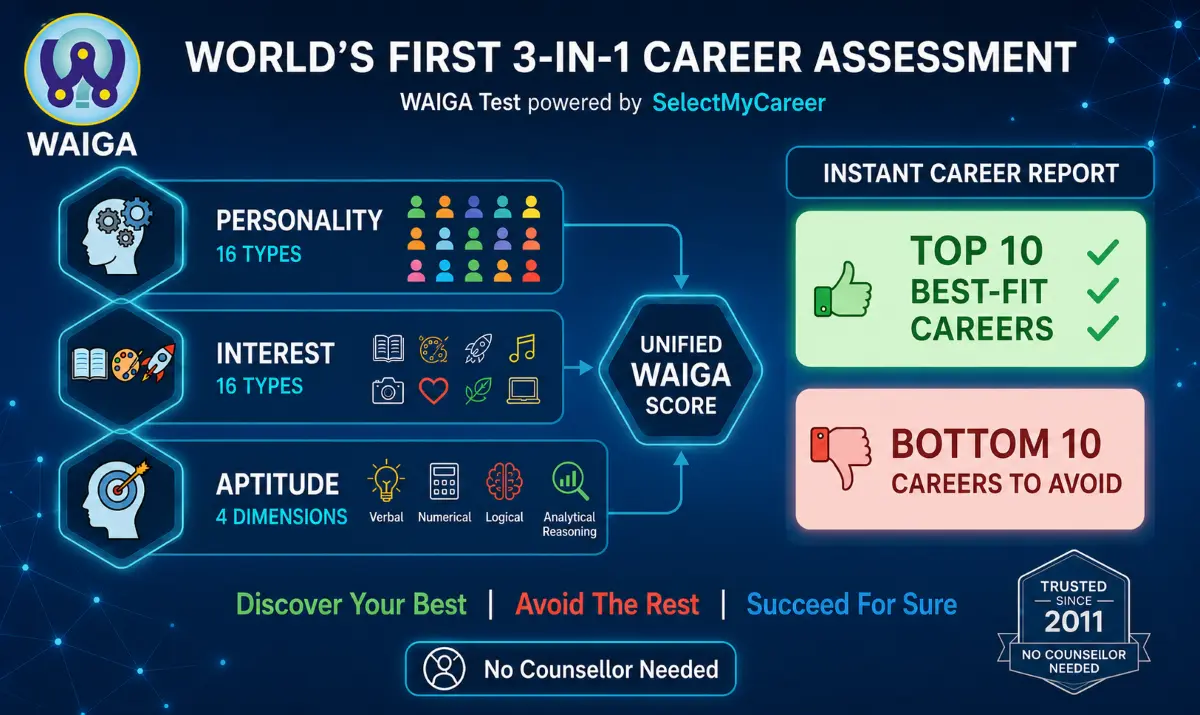
✓ One integrated assessment instead of multiple separate tests
✓ Instant personalised report
✓ No counsellor needed — ever
✔ Best on laptop or desktop | ✔ Takes 20-30 minutes | ✔ Instant report — 3 ways to access
✔ Registration takes 2 minutes |✔ Purchased test stays in dashboard — take it anytime
Frequently Asked Questions About Choosing the Right Career
There is no single factor that determines the right career. The best career matches your interests, personality, aptitude, values and long-term goals. Looking at only one dimension often leads to incomplete decisions. The more complete the picture of who you are, the more confident your career decision becomes.
No.
Aptitude tests measure what you’re naturally good at, but they don’t tell you what you’ll enjoy or whether your personality fits that career. A reliable career decision combines aptitude, interests and personality instead of relying on only one assessment.
Not by themselves.
Personality tests explain how you prefer to work, communicate and make decisions. They don’t measure your abilities or your interests. They are most useful when interpreted alongside aptitude and interest assessments.
Because they measure different things.
Some tests measure interests, others measure personality, and others measure aptitude. Since each focuses on only one part of who you are, their recommendations can differ. A comprehensive assessment combines multiple dimensions before recommending suitable careers.
A comprehensive career assessment evaluates the three core dimensions that influence career success:
- Interests – What motivates and excites you.
- Personality – How you naturally behave and work with others.
- Aptitude – What you’re capable of learning and performing well.
Combining these dimensions provides far more reliable guidance than any single test.
Career assessments are valuable at almost every stage of life.
Students can use them to choose subjects and courses. Graduates can identify suitable career paths. Working professionals can use them before changing careers, pursuing higher education or planning long-term growth.
It depends on the approach.
Traditional career guidance often involves multiple tests followed by counselling sessions spread over several days. Modern integrated assessments can provide comprehensive insights much faster by combining multiple dimensions into a single structured evaluation.
Choose an assessment that evaluates more than one dimension of career fit. A high-quality assessment should be evidence-based, easy to understand, provide personalised recommendations, and explain why certain careers are a better match than others. Assessments that consider interests, personality and aptitude together generally provide more balanced guidance than those focusing on a single factor.
Unlike traditional approaches that often require multiple separate tests for interests, personality and aptitude, the WAIGA Career Assessment combines these dimensions into a single structured framework. It generates personalised career recommendations based on your overall profile, helping you identify careers that fit your strengths while also highlighting options that may not be a good match.
Written by the WAIGA Career Guidance Team