Introduction
Choosing a career is one of the biggest decisions a person will ever make.
Yet many students make this decision with surprisingly little information about the one person who matters most—themselves.
They may know their examination marks. They may know which careers are popular. They may even know what their friends or family recommend.
But they often do not know:
- What are my natural strengths?
- What kind of work will I genuinely enjoy?
- Which careers match both my abilities and my personality?
- Am I choosing a career because it suits me—or because it seems popular?
This is where a career assessment becomes valuable.
A career assessment is not about predicting your future or telling you which profession to choose. Instead, it provides structured insights into different aspects of who you are, helping you make career decisions based on evidence rather than assumptions.
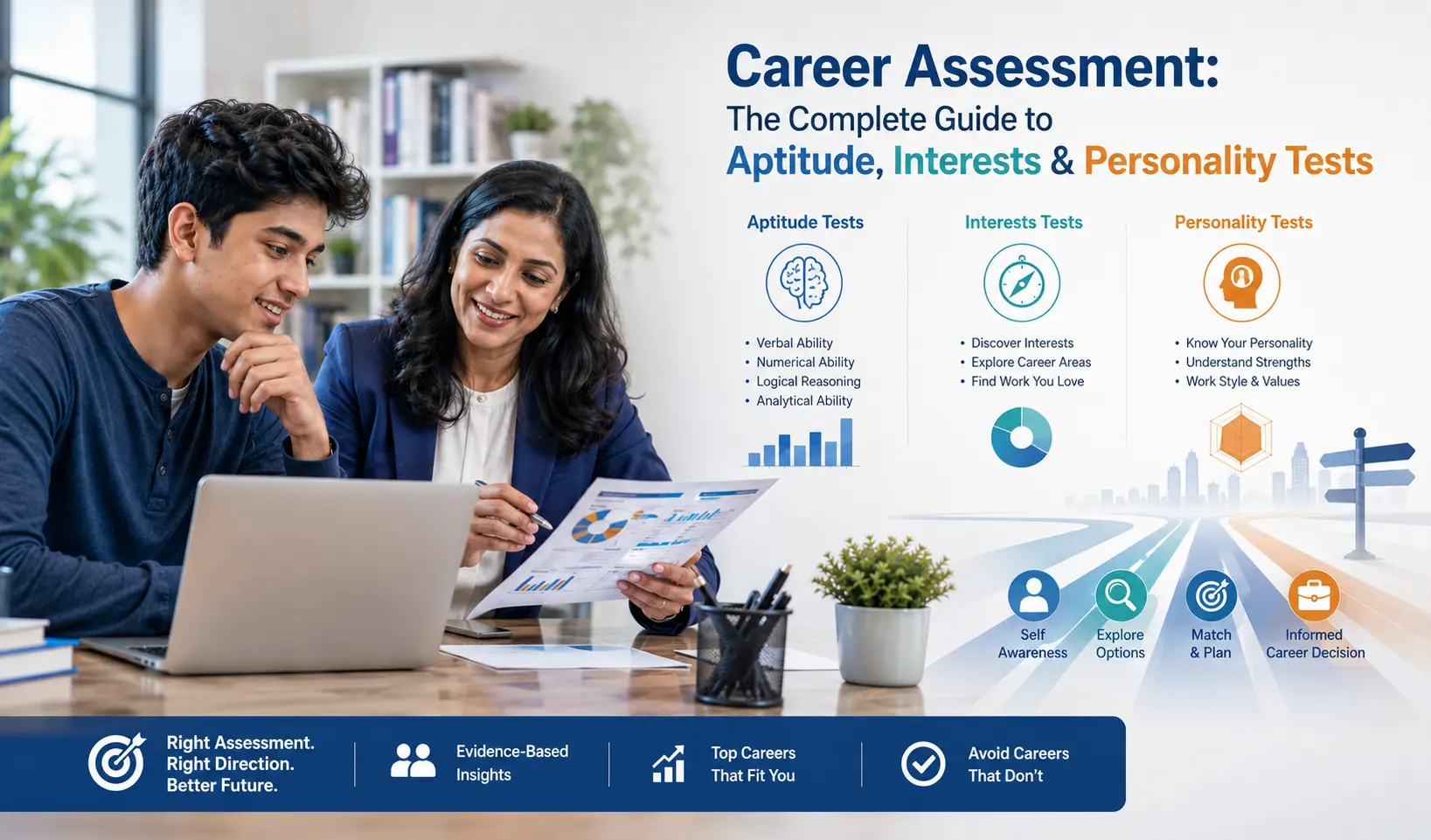
Modern career assessments can evaluate areas such as aptitude, interests, personality and career preferences. When these insights are interpreted together, they provide a much clearer picture of careers that are likely to suit an individual.
However, not all career assessments are the same.
Some measure only aptitude. Others focus only on interests or personality. While each provides useful information, relying on a single assessment can present only part of the picture.
This guide explains what career assessments are, how they work, the different types of assessments available, their strengths and limitations, and how combining multiple dimensions leads to better career decisions.
Whether you are a student planning your future, a parent supporting your child or a professional considering a career change, understanding career assessments is one of the most effective ways to make informed career decisions with greater confidence.
What Is a Career Assessment?
A career assessment is a structured process used to help individuals understand their strengths, preferences and potential career pathways. It uses scientifically developed assessment tools to evaluate different aspects of an individual and provide insights that support informed career decisions.
Unlike casual online quizzes or personality tests found on social media, a professional career assessment is designed to answer important questions about an individual’s suitability for different types of work.
A comprehensive career assessment may help answer questions such as:
- What are my natural abilities?
- Which activities genuinely interest me?
- What type of work environment suits my personality?
- Which careers align with my strengths and preferences?
- What career options should I explore further?
The purpose of a career assessment is not to tell someone exactly what career they must choose.
Instead, it helps narrow the possibilities by identifying careers that are more likely to align with an individual’s unique profile. The final career decision should always take into account personal aspirations, educational opportunities, family circumstances and evolving career goals.
It is also important to understand that a career assessment is a decision-support tool—not a decision-making tool.
A good assessment provides reliable information about the individual. It does not replace thoughtful reflection, career exploration or professional guidance. Instead, it provides a stronger foundation on which better career decisions can be made.
When interpreted correctly, career assessments help individuals move from uncertainty to clarity, replacing assumptions with evidence and helping them make career choices with greater confidence.
Why Career Assessments Matter
Choosing a career is a high-stakes decision.
The course you choose influences the skills you develop, the opportunities available to you and, in many cases, the profession you eventually enter. While career paths can change over time, making an informed decision from the beginning often saves years of uncertainty, unnecessary course changes and avoidable frustration.
Unfortunately, many career decisions are still based on factors that have little to do with an individual’s true potential.
Some students choose careers because they scored well in a particular subject. Others follow family traditions, social expectations or the choices their friends are making. Some simply pursue careers that appear prestigious or financially rewarding without asking whether those careers genuinely suit them.
A career assessment provides a more objective starting point.
Instead of asking, “Which career is the most popular?”, it begins with a far more important question:
“What careers are most suitable for me?”
By understanding your natural abilities, interests and personality, a career assessment helps you focus on career options where you are more likely to learn effectively, perform confidently and remain motivated over the long term.
This does not guarantee success.
Success always depends on effort, continuous learning and perseverance.
However, choosing a career that aligns with your strengths significantly increases the likelihood that you will enjoy the work, overcome challenges more effectively and build a fulfilling professional life.
In other words, a career assessment does not determine your future—it helps you make better decisions about it.
Career guidance and informed career decision-making are recognised internationally as important contributors to better educational and employment outcomes. The OECD (Organisation for Economic Co-operation and Development) highlights the role of quality career guidance in helping individuals make informed choices throughout their education and working lives.
That is why career assessments should be viewed not as shortcuts, but as valuable decision-support tools that reduce guesswork and bring greater clarity to one of life’s most important choices.
The Different Types of Career Assessments
There is no single assessment that can fully understand an individual.
Human beings are complex. Our abilities, interests, personalities and motivations all influence the careers in which we are most likely to succeed and find satisfaction.
This is why professional career guidance uses different types of assessments, each measuring a different aspect of an individual.
1. Aptitude Assessments
Aptitude assessments measure an individual’s natural ability to learn, solve problems and perform different types of tasks.
Depending on the assessment, aptitude may include areas such as numerical reasoning, verbal ability, logical reasoning, spatial thinking, abstract reasoning and attention to detail.
Aptitude answers questions like:
- What am I naturally good at?
- Which types of work are likely to suit my abilities?
- Where am I likely to learn and perform more effectively?
It is important to remember that aptitude measures potential, not knowledge.
A student may perform well in mathematics because of hard work, while another may have a natural aptitude for mathematical reasoning that allows them to learn the subject more easily.
2. Interest Assessments
Interest assessments explore the kinds of activities that naturally attract and motivate an individual.
Some people enjoy solving technical problems. Others enjoy helping people, creating new ideas, organising information or leading teams.
Interest assessments help answer questions such as:
- What kind of work do I genuinely enjoy?
- Which activities keep me engaged over time?
- Which career fields match my interests?
While interests are important, they should never be considered in isolation. Enjoying an activity does not automatically mean it is the right career choice.
3. Personality Assessments
Personality assessments help individuals understand how they typically think, communicate, make decisions and interact with others.
Some people thrive in structured environments with clear procedures, while others prefer creativity, flexibility and innovation. Some enjoy constant interaction with people, whereas others perform their best in independent, focused work.
Personality assessments help identify work environments where an individual is more likely to feel comfortable, productive and fulfilled.
4. Career Awareness and Exploration
Even if someone understands their aptitude, interests and personality, they still need accurate information about careers.
Career awareness involves learning about different professions, educational pathways, future opportunities, work environments, required qualifications and emerging industries.
Many students simply do not know how many career options actually exist.
Expanding career awareness ensures that good career decisions are based not only on self-understanding but also on a realistic understanding of the opportunities available.
Each of these assessments contributes an important piece of the puzzle.
However, none of them tells the complete story on its own.
That is why relying on a single assessment can sometimes lead to incomplete or even misleading career recommendations.
Why One Career Test Is Not Enough
One of the most common misconceptions about career assessments is the belief that a single test can accurately identify the perfect career.
Unfortunately, career decisions are far more complex than that.
Imagine trying to understand a person by asking only one question.
You might learn something useful, but you certainly would not understand the whole individual.
Career assessments work in much the same way.
No single career test can understand a complete human being.
An aptitude assessment tells you what you are naturally good at.
An interest assessment tells you what you enjoy.
A personality assessment explains the environments in which you are most likely to thrive.
Career awareness helps you understand the opportunities available and how different professions actually work.
Each assessment answers a different question.
None answers every question.
For example, a student may have strong aptitude for engineering but little interest in working with machines or technical systems. Another student may love psychology but also possess exceptional analytical ability that opens opportunities in several other fields.
If decisions are made using only one assessment, important pieces of the puzzle may be overlooked.
This is why experienced career guidance professionals rarely rely on a single career test.
Instead, they combine multiple assessments and interpret the results together, looking for patterns that consistently point towards suitable career pathways.
Think of it like visiting a doctor.
A diagnosis is rarely based on a single measurement. Doctors consider symptoms, medical history, physical examination and diagnostic tests before recommending treatment.
Career decisions deserve the same thoughtful approach.
Career decisions deserve the same careful evaluation that we expect from any other high-stakes decision
The objective is not to find a test that magically provides the answer.
The objective is to develop a comprehensive understanding of the individual so that career decisions are based on multiple sources of evidence rather than a single score or report.
This integrated approach is the foundation of modern career guidance—and it is also the philosophy behind the WAIGA Framework, which combines multiple dimensions to provide a more complete understanding of an individual’s career potential.
How to Choose a Good Career Assessment
A quick internet search for “career test” produces hundreds of results.
Many promise to identify your ideal career in just a few minutes.
The best career assessment doesn’t give you the fastest answer.
It helps you ask the right questions.
While some of these tools can be entertaining or thought-provoking, they should not be confused with comprehensive career assessments used for important educational and career decisions.
When choosing a career assessment, it is worth asking a few important questions.
Is the Assessment Scientifically Developed?
A good career assessment is based on established psychological and educational principles rather than random questions or internet trends.
Professionally developed assessments are designed to measure specific characteristics consistently and objectively.
Does It Measure More Than One Dimension?
No single assessment can fully understand an individual.
The most effective career assessments evaluate multiple dimensions such as aptitude, interests and personality, then interpret these results together rather than relying on a single score.
Does It Explain the Results Clearly?
Receiving a report filled with graphs and scores is not enough.
A valuable career assessment helps individuals understand what the results actually mean and how those insights relate to different career pathways.
The goal is not simply to generate information but to provide meaningful guidance.
Does It Encourage Career Exploration?
A good assessment should expand possibilities rather than limit them.
Instead of saying, “You should become a doctor,” it should help individuals understand why certain careers may suit them and encourage them to explore multiple compatible options.
Career assessments should open doors—not close them.
Is Professional Interpretation Available?
Assessment results are most valuable when they are interpreted within the context of an individual’s goals, educational background and personal circumstances.
A report full of scores is useful.
Understanding what those scores mean is invaluable.
Professional guidance helps transform assessment results into practical career decisions by answering questions, clarifying uncertainties and discussing realistic career pathways.
Choosing a career assessment should be approached with the same care as choosing a university or a career itself.
The quality of the assessment influences the quality of the insights—and better insights lead to better decisions.
Rather than looking for the quickest career test, look for an assessment that helps you understand yourself more completely and supports informed, evidence-based career planning.
The WAIGA Framework: A More Complete Approach to Career Assessment
Throughout this guide, one idea has appeared repeatedly:
No single assessment can provide a complete understanding of an individual.
Aptitude explains what you are naturally capable of doing.
Interests reveal the kinds of activities that genuinely motivate you.
Personality helps identify the work environments in which you are most likely to thrive.
Career awareness connects these personal insights with real educational pathways, professions and future opportunities.
Meaningful career decisions happen when all of these pieces come together.
That belief forms the foundation of the WAIGA Framework.
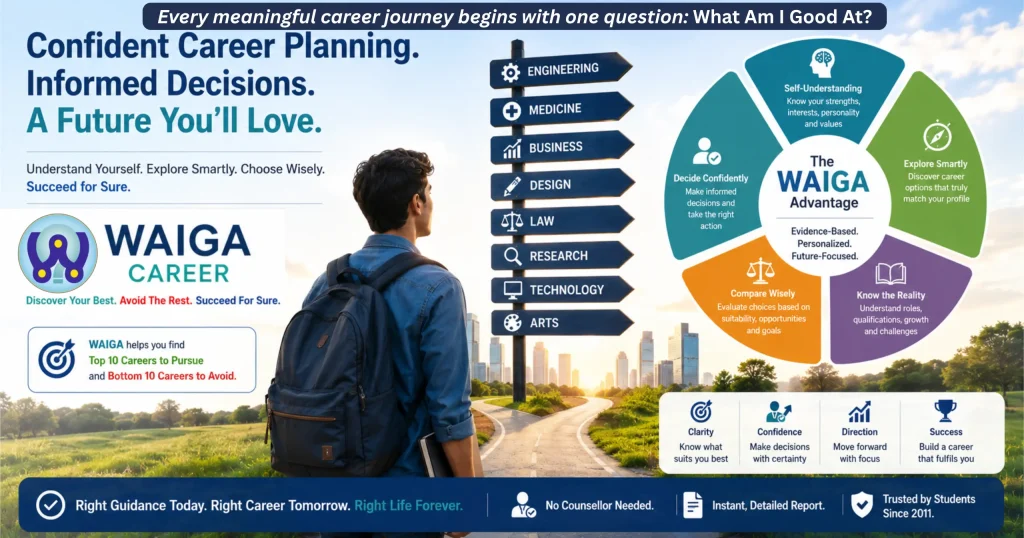
The name WAIGA stands for “What Am I Good At?”—a question that sits at the heart of every successful career decision.
Before deciding which career to pursue, it is important to understand:
- What am I naturally good at?
- What kind of work do I genuinely enjoy?
- What type of environment brings out my best?
- Which careers align with all of these factors together?
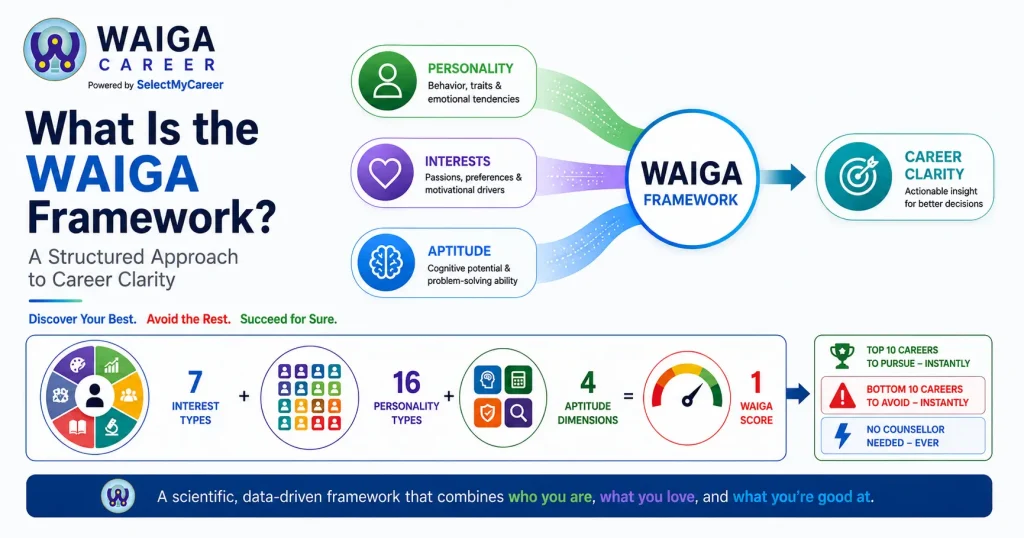
Instead of relying on a single career test, the WAIGA Framework combines multiple evidence-based assessment dimensions to develop a more complete understanding of the individual.
This integrated approach helps reduce the risk of making career decisions based on only one factor, such as examination marks, interests alone or personality alone.
The objective is not to tell someone what they must become.
The objective is to help them understand themselves well enough to make informed decisions with confidence.
Every career journey is unique.
A framework cannot replace personal effort, curiosity or lifelong learning.
However, it can provide something equally valuable:
Clarity before commitment.
When individuals understand both themselves and the opportunities available to them, they are far better equipped to make career decisions they are likely to value not only today, but many years into the future.
Key Takeaways
- A career assessment is a decision-support tool, not a decision-making tool. It provides insights to help you make informed career choices—it does not choose a career for you.
- No single career test can fully understand an individual. Aptitude, interests, personality and career awareness each provide different but equally important insights.
- Aptitude measures potential, not knowledge. It identifies natural strengths and abilities rather than what you have already learned.
- Interests and personality matter just as much as ability. Long-term career satisfaction comes from choosing work that suits both your strengths and the kind of work you genuinely enjoy.
- Career decisions should never be based solely on marks, trends or social expectations. Understanding yourself is the foundation of choosing a career that fits you.
- A comprehensive career assessment combines multiple dimensions. Looking at aptitude, interests, personality and career awareness together provides a much clearer picture than relying on any one assessment alone.
- Every meaningful career journey begins with one question: “What Am I Good At?” Answering that question thoughtfully is often the first step towards making confident and informed career decisions.
Conclusion: Understanding Yourself Is the First Step Towards the Right Career
Every important career decision begins with a simple but powerful question:
“What Am I Good At?”
Unfortunately, many people try to answer that question by looking only at their marks, following popular career trends or relying on the opinions of others.
A professional career assessment takes a different approach.
It begins by helping you understand yourself—your natural abilities, interests, personality and the environments in which you are most likely to succeed. When these insights are combined with accurate career information, they provide a far stronger foundation for making informed career decisions.
No assessment can predict your future.
No report can guarantee success.
Ultimately, success depends on your willingness to learn, grow and work consistently towards your goals.
However, understanding yourself before making one of life’s biggest decisions can help you choose a path with greater confidence, clarity and purpose.
The objective is not simply to find a career.
The objective is to find a career that fits you.
If you are ready to move beyond guesswork and gain a deeper understanding of your strengths and potential, the WAIGA Career Assessment offers a comprehensive framework that combines aptitude, interests, personality and career awareness to support informed career decisions.
Because the better you understand yourself today, the better your career decisions will be tomorrow.
Ready to Discover What You’re Good At?
Take the WAIGA Career Assessment and discover how a comprehensive, evidence-based approach can help you make confident career decisions.
Your future deserves more than guesswork. It deserves clarity, confidence and informed decisions.
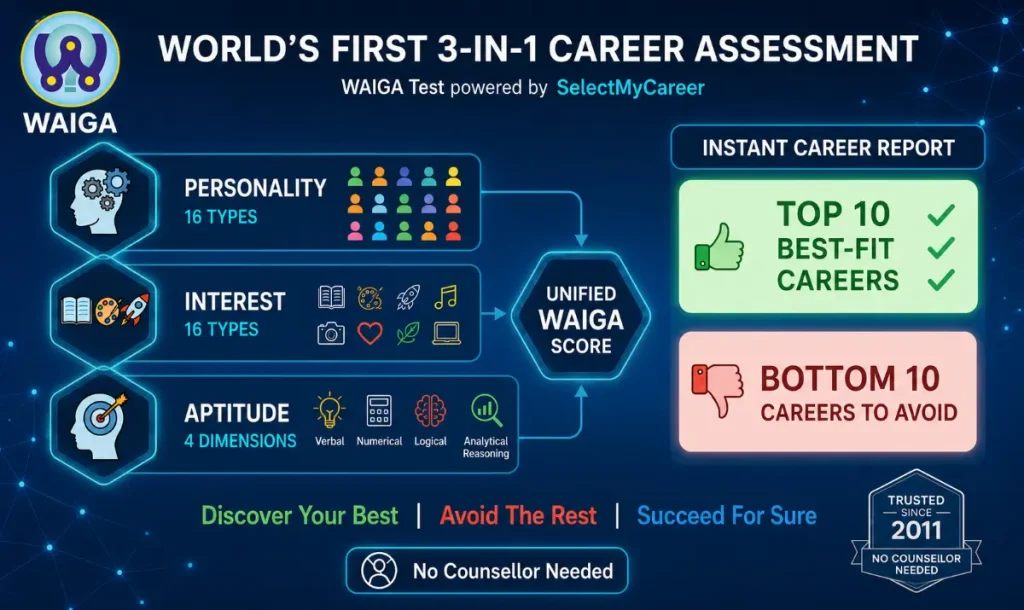
✓ One integrated assessment instead of multiple separate tests
✓ Instant personalised report
✓ No counsellor needed — ever
✔ Best on laptop or desktop | ✔ Takes 20-30 minutes | ✔ Instant report — 3 ways to access
✔ Registration takes 2 minutes |✔ Purchased test stays in dashboard — take it anytime
You can also begin with our Free Career Test if you’d like an introduction before taking the full assessment.
If you still have questions, feel free to contact us.
Frequently Asked Questions
A career assessment is a structured process that helps individuals understand their aptitude, interests, personality and career preferences. It provides evidence-based insights that support informed career decisions rather than relying on guesswork or assumptions.
A career assessment helps individuals make career decisions based on self-understanding rather than examination marks, social pressure or popular career trends. It provides greater clarity and confidence when choosing educational and career pathways.
A comprehensive career assessment may evaluate several areas, including aptitude, interests, personality and career awareness. Each provides different insights that contribute to a more complete understanding of an individual’s career potential.
No. An aptitude test measures natural abilities and problem-solving potential, whereas a career assessment combines multiple dimensions such as aptitude, interests, personality and career awareness to provide broader career guidance.
No single career test can determine the perfect career. Effective career guidance combines information from multiple assessments and considers individual goals, educational opportunities and career aspirations before making recommendations.
Career assessments can be valuable whenever important educational or career decisions need to be made. Many students benefit before choosing subjects, selecting a stream or applying for higher education, but assessments are equally useful for graduates and professionals considering career changes.
Some online career tests can provide useful insights, but many are designed for entertainment rather than professional guidance. A scientifically developed career assessment that evaluates multiple dimensions generally provides more reliable and meaningful results.
Yes. Career assessments are valuable not only for students but also for professionals who wish to understand their transferable strengths, explore new opportunities and make confident career transitions.
The time varies depending on the assessment framework. Comprehensive assessments that evaluate aptitude, interests and personality typically take longer than simple online quizzes because they collect more detailed information and provide richer insights.
The WAIGA Career Assessment follows a comprehensive framework that combines aptitude, interests, personality and career awareness rather than relying on a single assessment. This integrated approach provides a deeper understanding of the individual and supports more informed career decisions.
Written by the WAIGA Career Guidance Team