
Choosing a career has never been more challenging.
Students today have access to thousands of career options, endless advice on social media, countless online quizzes, and rapidly changing job markets. At the same time, parents want to help but often rely on information that was relevant when they made their own career choices—sometimes decades ago.
The result is confusion.
Many students choose careers because their friends are choosing them. Others follow family expectations, chase popular professions, or select a course simply because they scored well in a particular subject. Some postpone the decision altogether, hoping clarity will come later.
Unfortunately, career decisions made without proper guidance can lead to years of dissatisfaction, repeated course changes, wasted time, and the feeling of being trapped in a profession that never truly suited them.
This is why career guidance matters.
Good career guidance is not about telling someone what career to choose. It is about helping them understand themselves, understand the opportunities available, and make informed decisions with confidence.
If you’re ready to apply these principles, read our guide on How to Choose the Right Career.
At WAIGA, we believe that every student deserves career guidance that is objective, personalised, and evidence-based. Instead of relying on assumptions or trends, the right career decision should be built on four essential foundations:
- Aptitude — what you are naturally good at.
- Interests — what genuinely engages and motivates you.
- Personality — the environments and ways of working where you perform best.
- Career awareness — understanding the realities, opportunities, and future of different professions.
When these four elements come together, career decisions become clearer, more confident, and far more likely to lead to long-term satisfaction.
This guide explains what career guidance really means, why it is more important than ever, and how students and parents can approach one of life’s most important decisions with clarity rather than confusion.
Career guidance is not about choosing a course. It’s about choosing the life you will live for the next 30–40 years.
What Is Career Guidance?
Career guidance is the process of helping individuals understand themselves, explore career opportunities, and make informed decisions about their education and professional future.
It is not about telling someone what career to choose.
Instead, effective career guidance helps people answer three fundamental questions:
- Who am I?
What are my strengths, interests, personality, values and natural abilities? - What opportunities are available?
Which careers exist today, what do they involve, and how are they changing? - Which career is the right fit for me?
Among all the available options, which ones best match my unique profile and long-term aspirations?
Good career guidance combines self-understanding with career awareness. Both are equally important.
Effective career guidance is recognised worldwide as an important part of helping people make informed education and employment decisions. Research by the OECD highlights its role in improving career readiness and lifelong learning.
A student may be naturally gifted in analytical thinking but know very little about careers in data science, actuarial science or engineering. Another student may dream of becoming a doctor without fully understanding the academic demands, lifestyle and responsibilities of the profession. In both cases, better career guidance leads to better decisions.
Career guidance is also not a one-time event.
A student’s interests may evolve, new career opportunities emerge, and industries transform with advances in technology and society. Career guidance is therefore an ongoing process of learning, evaluating and making informed decisions at different stages of life.
At WAIGA, we view career guidance as a structured journey rather than a single conversation. It begins with understanding the individual, expands through exploring suitable career pathways, and ends with making confident, well-informed choices that align personal strengths with real-world opportunities.
Why Career Guidance Is More Important Today Than Ever Before
Choosing a career has never been a simple decision—but today’s students face a level of complexity that previous generations rarely experienced.
A few decades ago, career choices were relatively limited. Students typically considered a small number of well-known professions, and information about those careers often came from family members, teachers or people within the local community.
Today, the situation is very different.
Students have access to hundreds of career paths across science, technology, business, healthcare, design, education, public service, entrepreneurship and many emerging fields that did not even exist a generation ago. While this abundance of opportunities is exciting, it can also make decision-making overwhelming.
At the same time, the nature of work itself is changing.
Technology continues to reshape industries. New roles are emerging while others are evolving rapidly. Employers increasingly value problem-solving, adaptability, communication, creativity and continuous learning alongside technical knowledge. Choosing a career is therefore no longer just about selecting a profession—it is about preparing for a lifetime of learning and growth.
Unfortunately, many students still make career decisions based on factors that have little to do with long-term success or satisfaction. Some choose careers because they are popular. Others follow friends, family expectations or social media trends. Many assume that high-paying careers automatically lead to fulfilling lives.
These approaches may work for a few people, but they often result in disappointment because they ignore the most important factor: the individual.
Every student has a unique combination of abilities, interests, personality and aspirations. A career that is deeply rewarding for one person may be frustrating for another, even if both are equally capable.
This is why career guidance has become more valuable than ever.
Rather than encouraging students to follow trends, effective career guidance helps them understand themselves first. It enables them to evaluate career options objectively, recognise where they are most likely to thrive, and make decisions based on evidence instead of assumptions.
In a world where opportunities continue to expand and careers continue to evolve, clarity has become one of the most valuable advantages a student can have.
Most students spend more time choosing a smartphone than choosing a career.
Yet only one of those decisions will shape the next four decades of life.
Common Myths About Career Guidance
Despite becoming increasingly important, career guidance is still widely misunderstood. Many students—and even parents—hold beliefs that can prevent them from making well-informed career decisions.
Let’s look at some of the most common myths.
Myth 1: Career Guidance Is Only for Confused Students
One of the biggest misconceptions is that only students who are unsure about their future need career guidance.
In reality, even students who have already decided on a career can benefit from understanding whether their chosen path genuinely aligns with their aptitude, interests and personality. Career guidance is about making informed decisions—not simply resolving confusion.
Myth 2: Good Marks Automatically Mean the Right Career
Academic performance is important, but marks only indicate how well a student has performed in specific subjects under certain conditions.
They do not reveal whether a person will enjoy a particular profession, thrive in its working environment or remain motivated over the long term.
Myth 3: There Is Only One Perfect Career
Many students worry about finding the one “correct” career.
The truth is that most people are well suited to several careers rather than just one. Effective career guidance helps identify a range of suitable options, allowing students to choose the path that best matches their aspirations and circumstances.
Myth 4: Career Guidance Is Just Taking an Online Test
Many websites offer quick career quizzes that promise instant answers in just a few minutes.
While such quizzes may be interesting, meaningful career guidance goes much deeper. It involves understanding multiple aspects of an individual, interpreting the results carefully and connecting them with real-world career opportunities.
Myth 5: Career Guidance Ends Once a Career Is Chosen
Choosing a career is only one milestone in a much longer journey.
Students continue making important decisions about subjects, higher education, specialisations, skill development and career progression. Career guidance remains valuable at each stage because informed decisions build upon one another throughout life.
Understanding these myths is the first step towards recognising what effective career guidance truly involves: helping individuals make thoughtful, evidence-based decisions that are aligned with both their personal strengths and the opportunities available to them.
Before exploring career options, there is one question every student should ask themselves:
“What Am I Good At?”
It sounds simple, but it is one of the most important—and often the most overlooked—questions in career decision-making.
Most people begin by asking:
- Which course should I study?
- Which career pays the most?
- Which profession is in demand?
Few begin with the question that matters most.
What am I good at?
At WAIGA, this question forms the foundation of our philosophy. In fact, the name WAIGA itself stands for “What Am I Good At?”
We believe meaningful career guidance begins by answering that question objectively. Once you understand what you are naturally good at—and combine that understanding with your interests, personality and awareness of career opportunities—you can make career decisions with far greater confidence.
The Four Pillars of Effective Career Guidance
At WAIGA, we believe that meaningful career guidance cannot be based on a single test, a popular career list or someone’s opinion.
Every individual is unique, and understanding that uniqueness requires looking at multiple dimensions together. Effective career guidance is built on four essential pillars.
1. Aptitude – What Are You Naturally Good At?
Aptitude refers to your natural ability to learn, understand and perform different types of tasks. Some people have strong analytical abilities, while others excel in communication, creativity, spatial reasoning or problem-solving.
Understanding your aptitude helps identify careers where you are more likely to perform well and achieve long-term success.
2. Interests – What Genuinely Engages You?
Interests reflect the activities and subjects that naturally capture your attention and keep you motivated.
When your work aligns with your genuine interests, learning becomes more enjoyable, motivation remains higher and long-term career satisfaction becomes more likely.
However, interests alone should never determine a career choice. They are one important piece of the puzzle—not the complete picture.
3. Personality – Where Will You Thrive?
Different careers require different ways of thinking, communicating and working.
Some people enjoy leading teams and interacting with others. Some prefer independent research and deep concentration. Others thrive in fast-paced environments, while some perform best in structured and predictable settings.
Understanding your personality helps identify work environments where you are most likely to feel comfortable, productive and fulfilled.
4. Career Awareness – What Does the Career Really Involve?
Even if a career appears attractive, it is important to understand what it actually involves.
What qualifications are required?
What does a typical working day look like?
What skills will be important in the future?
What opportunities and challenges does the profession offer?
Career awareness helps students move beyond assumptions and make decisions based on realistic expectations rather than stereotypes or popular opinion.
Why All Four Pillars Matter
Many career decisions fail because they are based on only one of these pillars.
Choosing a career only because you enjoy a subject may ignore whether you have the aptitude for it.
Choosing only because you are good at something may overlook whether you will enjoy doing it every day.
Choosing based solely on salary or popularity ignores both your personality and the realities of the profession.
The most confident career decisions are made when aptitude, interests, personality and career awareness are considered together.
This integrated approach forms the foundation of effective career guidance and helps students choose careers that are not only achievable, but also meaningful and sustainable over the long term.
How Effective Career Guidance Works
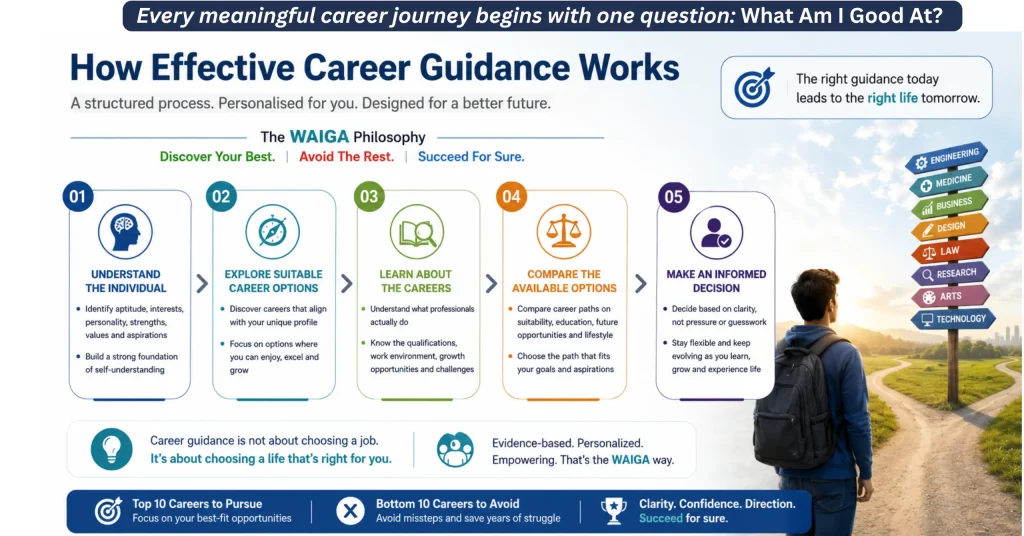
Effective career guidance is not about predicting the future or telling someone which profession they should choose.
Instead, it is a structured process that helps students make informed decisions based on evidence rather than assumptions.
While every individual is different, meaningful career guidance generally follows these five steps.
Step 1: Understand the Individual
Every career decision should begin with self-understanding.
This involves identifying a student’s aptitude, interests, personality, strengths, values and aspirations. Without this foundation, choosing a career often becomes little more than educated guesswork.
Step 2: Explore Suitable Career Options
Once the individual’s profile is understood, the next step is to explore careers that genuinely align with it.
Rather than considering every possible profession, students can focus on careers where they are more likely to enjoy the work, perform well and find long-term satisfaction.
Step 3: Learn About the Careers
A career should never be chosen based only on its title or reputation.
Students need to understand what professionals in that field actually do, the qualifications required, the work environment, opportunities for growth, and the challenges they may encounter throughout their careers.
Step 4: Compare the Available Options
It is perfectly normal to have more than one suitable career option.
At this stage, students compare different pathways by considering factors such as personal suitability, educational requirements, future opportunities, lifestyle preferences and long-term career goals.
Step 5: Make an Informed Decision
The final decision should never be based on fear, pressure or guesswork.
Instead, it should reflect a balanced understanding of both the individual and the career itself. Even then, career planning remains flexible. As people gain new experiences and develop new skills, they continue refining their career journey throughout life.
Career guidance is therefore not about finding a shortcut or a perfect answer.
It is about following a thoughtful process that reduces uncertainty, increases confidence and helps individuals make decisions they are far less likely to regret.
A wrong career rarely feels wrong on Day 1.
It usually becomes obvious after years of frustration, lost motivation and wondering, “What if I had chosen differently?”
Who Can Benefit from Career Guidance?
One of the biggest misconceptions about career guidance is that it is only meant for students who have just completed school.
In reality, career guidance can be valuable at many different stages of life. Whenever an important educational or career decision needs to be made, objective guidance can help reduce uncertainty and improve confidence.
School Students
Students often begin making career-related decisions much earlier than they realise. Choosing subjects, selecting a stream and planning for higher education all influence future opportunities.
Career guidance helps students understand themselves before making these important decisions, allowing them to build a stronger foundation for the future.
Students Completing Secondary Education
This is one of the most significant transition points in a student’s life.
With hundreds of courses, colleges and career pathways available, many students feel overwhelmed by the number of choices. Career guidance provides a structured way to evaluate these options and identify those that genuinely align with their strengths and aspirations.
Students who have recently completed school can also explore our guide on Career Options After 12th.
University Students and Graduates
Many students reach university only to discover that the course they selected doesn’t fully match their interests or career goals.
Career guidance can help them explore specialisations, postgraduate opportunities, internships and alternative career paths that better suit their evolving ambitions.
Professionals Considering a Career Change
Career decisions do not end with the first job.
Many professionals eventually reach a stage where they seek greater fulfilment, new challenges or a complete career transition. Understanding their transferable strengths, personality and long-term goals helps them make these changes more confidently and strategically.
Parents
Parents play one of the most influential roles in a student’s career journey.
The most effective support, however, comes not from deciding on behalf of a child, but from encouraging exploration, asking thoughtful questions and helping them make informed decisions based on their individual strengths rather than comparisons or expectations.
Career guidance is not about a particular age or stage of life.
It is about making better decisions whenever important career choices arise. Whether you are a student planning your future, a graduate exploring new opportunities, a professional considering change or a parent supporting your child, the principles of effective career guidance remain the same.
The biggest career mistake isn’t choosing a difficult career.
It’s choosing the wrong career and realising it only after investing years of effort.
Common Mistakes to Avoid While Choosing a Career
Choosing a career is one of the most important decisions a person makes. While there is no single “perfect” career, there are several common mistakes that can lead to unnecessary confusion, dissatisfaction and regret.
Being aware of these mistakes is often the first step towards making a better decision.
Choosing a Career Based Only on Marks
Good academic results create opportunities, but they do not determine which career is the best fit.
Marks reflect performance in examinations. They do not measure your interests, personality, natural strengths or long-term motivation.
Following Friends or Family Expectations
It is natural to seek advice from people you trust, but choosing a career simply because your friends are choosing it—or because someone else expects you to—can result in pursuing a path that doesn’t truly suit you.
Advice should guide your thinking, not replace your decision.
Chasing Prestige Instead of Personal Fit
Many students believe that success lies only in a handful of well-known professions.
In reality, almost every field offers rewarding opportunities for individuals who genuinely enjoy the work, continue developing their skills and perform at a high level.
The most respected career is not necessarily the most suitable career.
Ignoring Your Natural Strengths
Every profession demands a different combination of abilities.
Some careers require analytical thinking, others creativity, communication, leadership, empathy or attention to detail.
Ignoring your natural strengths often makes both learning and working more difficult than they need to be.
Making Decisions Without Sufficient Information
Choosing a career based on assumptions can be risky.
Before making a decision, it is important to understand what professionals in that field actually do, the qualifications required, the work environment, future opportunities and the challenges involved.
The more informed your decision, the more confident you are likely to feel about it.
Believing One Decision Determines Your Entire Future
Many students worry that choosing the “wrong” career will permanently ruin their future.
Fortunately, this is rarely true.
People continue learning, developing new skills and changing career directions throughout their lives. While making a thoughtful decision from the beginning is valuable, career development is a journey rather than a single moment.
The purpose of career guidance is not to eliminate every uncertainty.
Its purpose is to help individuals avoid avoidable mistakes, make informed decisions and move forward with greater confidence, clarity and self-awareness.
High-stakes decisions deserve high-quality thinking.
Career decisions made in haste often become regrets carried for decades.
Bringing Everything Together: A More Complete Approach to Career Guidance
Throughout this guide, one message has remained consistent: meaningful career decisions cannot be based on a single factor.
Knowing your interests is valuable—but interests alone are not enough.
Being naturally good at something is important—but aptitude alone cannot determine whether you will enjoy a career.
Understanding your personality helps identify environments where you are most likely to thrive—but personality alone cannot tell you which profession is right for you.
Likewise, understanding career opportunities is essential—but even the best career option on paper may not be the best choice if it doesn’t align with who you are.
This is why effective career guidance looks at the complete picture.
Rather than asking a single question, it asks many.
- What are your natural strengths?
- What genuinely motivates you?
- What kind of work environment suits you best?
- Which careers match all of these factors together?
- What qualifications, skills and opportunities do those careers involve?
The more comprehensive the understanding, the better the career decision.
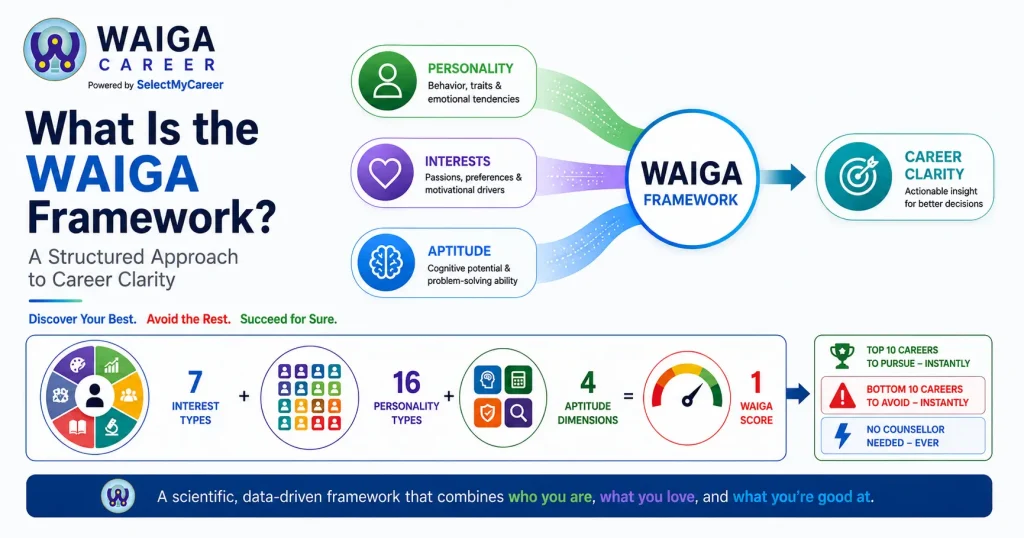
This integrated philosophy forms the foundation of the WAIGA Framework.
Instead of relying on a single assessment or a one-size-fits-all recommendation, the WAIGA Framework combines multiple dimensions—including aptitude, interests, personality and career awareness—to help individuals identify career paths that genuinely align with who they are.
The objective is not to predict the future or make decisions on someone’s behalf.
The objective is to replace uncertainty with clarity, assumptions with evidence, and confusion with confidence—so that every individual can make career decisions based on a deeper understanding of both themselves and the opportunities available to them.
The best career decision is not the one that impresses others.
It’s the one that allows you to grow, contribute and enjoy your work for a lifetime.
Key Takeaways
- Career guidance is a process, not a one-time counselling session.
- A good career choice balances aptitude, interests, personality and opportunities.
- Choosing based only on marks, trends or social pressure often leads to regret.
- The question “What Am I Good At?” should come before “Which career should I choose?”
- The earlier you seek career guidance, the more options you preserve.
The Right Career Begins with the Right Guidance
Every career journey begins with a decision.
For some, that decision comes after completing school. For others, it comes while choosing a university course, considering a career change or helping a child plan for the future.
Whatever the stage, one thing remains true:
The quality of your decision depends on the quality of the guidance you receive.
Good career guidance does not promise certainty, nor does it tell you exactly what to do. Instead, it helps you understand yourself more deeply, evaluate opportunities more objectively and make decisions with greater confidence.
The goal is not simply to choose a career.
The goal is to choose a career that aligns with your strengths, interests, personality and aspirations—one that allows you to grow, contribute and find long-term satisfaction.
If you’re feeling uncertain about your next step, remember that uncertainty is not a weakness. It is often the starting point of meaningful exploration.
The important thing is not to leave one of life’s biggest decisions to chance.
Take the time to understand yourself, explore your options thoughtfully and seek guidance based on evidence rather than assumptions.
If you’re looking for a structured and comprehensive approach, the WAIGA Career Assessment combines aptitude, interests, personality and career awareness to help you identify career paths that genuinely fit who you are.
Your future deserves more than guesswork. It deserves clarity, confidence and informed decisions.
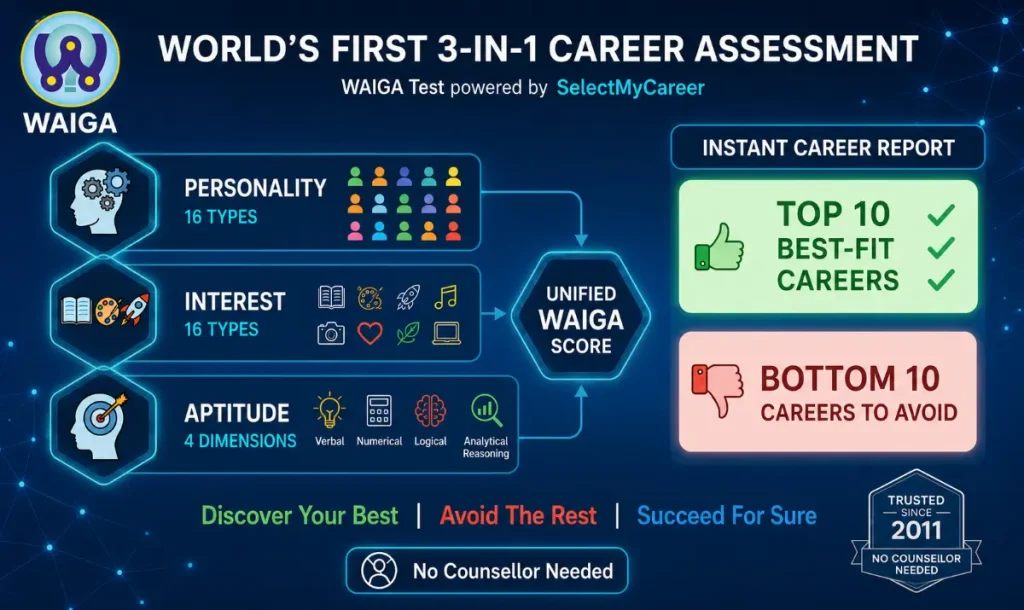
✓ One integrated assessment instead of multiple separate tests
✓ Instant personalised report
✓ No counsellor needed — ever
✔ Best on laptop or desktop | ✔ Takes 20-30 minutes | ✔ Instant report — 3 ways to access
✔ Registration takes 2 minutes |✔ Purchased test stays in dashboard — take it anytime
You can also begin with our Free Career Test if you’d like an introduction before taking the full assessment.
If you still have questions, feel free to contact us.
Frequently Asked Questions
Career guidance is the process of helping individuals understand themselves, explore career opportunities and make informed decisions about their education and professional future. It combines self-understanding with reliable career information to support better decision-making.
Career guidance helps individuals make career decisions based on their strengths, interests, personality and aspirations rather than guesswork, social pressure or popular trends. This increases the likelihood of long-term career satisfaction and success.
Career guidance is valuable for school students, university students, graduates, professionals considering a career change and parents supporting their children’s career decisions. Anyone facing an important education or career decision can benefit from structured guidance.
The earlier students begin understanding themselves, the better prepared they are to make informed decisions. Career guidance can be useful before choosing subjects, selecting a stream, applying for higher education or considering future career pathways.
Career guidance is a broader process that includes self-understanding, career exploration and informed decision-making. Career counselling is often one part of that process, involving discussions with a trained professional to interpret information and support decision-making.
A career assessment is a structured tool that helps individuals understand different aspects of themselves, such as aptitude, interests and personality. When interpreted correctly, these insights can help identify careers that are more likely to be a good fit.
Usually not. Every assessment measures only certain aspects of an individual. The most effective career guidance considers multiple dimensions—including aptitude, interests, personality and career awareness—rather than relying on a single test.
Yes. Career guidance is valuable at every stage of life. Professionals considering a career change can use it to understand their transferable strengths, explore suitable career options and make more confident transition decisions.
Parents can provide encouragement, ask thoughtful questions and create opportunities for exploration rather than making decisions on behalf of their child. The most effective support helps students discover careers that genuinely match their individual strengths and aspirations.
The WAIGA Framework takes a comprehensive approach by combining four essential pillars: aptitude, interests, personality and career awareness. Rather than relying on a single assessment or opinion, it helps individuals make informed career decisions based on a complete understanding of themselves and the opportunities available to them.
Written by the WAIGA Career Guidance Team