

Introduction
Every year, thousands of students search online for a simple answer to one of life’s biggest questions:
“Which career is right for me?”
In that search, one term appears again and again:
Career Aptitude Test.
Many people hope that taking an aptitude test will provide a clear answer—perhaps even identify the one perfect career they should pursue.
Unfortunately, career decisions are rarely that simple.
A career aptitude test is an extremely valuable tool because it helps identify your natural abilities and strengths. It can reveal the kinds of tasks your mind is naturally suited to perform and the areas in which you are likely to learn and perform more effectively.
However, aptitude is only one part of the picture.
Being naturally good at something does not automatically mean you will enjoy doing it every day. Likewise, enjoying an activity does not always mean you possess the aptitude required to excel in that field.
Successful career decisions require a deeper understanding of the individual.
Along with aptitude, factors such as interests, personality, values, motivation and career awareness all influence whether a particular career is likely to be both successful and personally fulfilling.
This is why relying on an aptitude test alone can sometimes lead to incomplete or misleading career recommendations.
In this guide, you will learn what a career aptitude test measures, why aptitude is important, its limitations, common misconceptions and how aptitude fits into a more comprehensive approach to career decision-making.
Because choosing a career is not about finding what you are capable of doing.
It is about discovering the career that is most likely to fit who you are.
What Is a Career Aptitude Test?

A career aptitude test is a scientifically designed assessment that measures an individual’s natural abilities and potential to perform different types of tasks. Rather than testing what you have already learned, it evaluates how your mind naturally processes information, solves problems and responds to different kinds of challenges.
This distinction is important.
Many people confuse aptitude with knowledge or academic performance.
Knowledge reflects what you have learned through education, practice and experience.
Aptitude reflects your natural capacity to learn and perform in particular areas.
For example, two students may score equally well in mathematics. One may achieve those marks through consistent hard work, while the other may grasp mathematical concepts quickly because of a natural aptitude for numerical reasoning.
Both students deserve credit for their achievement, but their underlying abilities may be different.
A career aptitude test helps identify these natural strengths so that individuals can better understand the kinds of careers where they are likely to learn more effectively, solve problems confidently and perform at a higher level.
A career aptitude test therefore provides valuable insights into what you are naturally capable of doing.
However, it does not answer another equally important question:
“Is this the kind of work I will enjoy doing for the next 30 or 40 years?”
That question requires looking beyond aptitude alone.
Aptitude tells you what comes naturally.
It doesn’t tell you what will make you happy.
What Does a Career Aptitude Test Measure?
Most professionally developed career aptitude tests measure an individual’s reasoning abilities rather than their acquired knowledge. These reasoning abilities provide valuable insights into how a person naturally thinks, learns and solves problems.
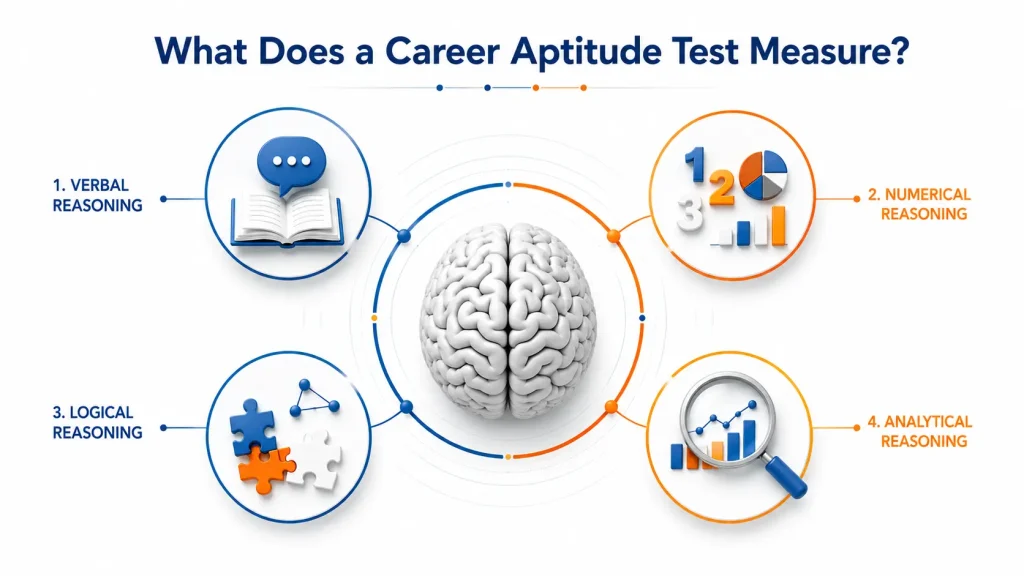
Although different aptitude assessments vary in their design and purpose, four reasoning dimensions are widely recognised as the foundation of career-related aptitude assessment.
1. Verbal Reasoning
The ability to understand, analyse and communicate through language.
This aptitude is particularly relevant for careers such as law, journalism, management, education, counselling, human resources and public relations, where effective communication and language-based reasoning are essential.
2. Numerical Reasoning
The ability to work with numbers, data, patterns and mathematical relationships.
This dimension is especially valuable in careers such as finance, engineering, data science, accounting, actuarial science and economics, where quantitative thinking and numerical analysis play a central role.
3. Logical Reasoning
The ability to identify patterns, evaluate arguments and work through structured if–then relationships to reach valid conclusions.
Logical reasoning is fundamental in careers such as law, engineering, programming, strategy and other professions that require rigorous, structured thinking.
4. Analytical Reasoning
The ability to break down complex information into its component parts, evaluate relationships between elements, and synthesise information from multiple sources into well-reasoned conclusions.
This aptitude is particularly important in careers involving research, consulting, medicine, policy analysis and strategic decision-making, where complex problems must be analysed before sound decisions can be made.
These four reasoning dimensions provide a strong understanding of an individual’s natural cognitive strengths and their potential to succeed in different kinds of work.
Some specialised aptitude assessments may also measure additional abilities such as spatial reasoning, mechanical reasoning, perceptual speed, clerical accuracy or psychomotor coordination, particularly when assessing suitability for specific professions such as architecture, aviation, defence, manufacturing or skilled technical trades.
However, regardless of how many dimensions are measured, a career aptitude test answers only one important question:
“What am I naturally capable of doing?”
It does not answer another equally important question:
“Is this the kind of work I will enjoy, value and remain motivated to do over the long term?”
Why Aptitude Alone Cannot Predict Career Success
A career aptitude test provides valuable insights into an individual’s natural abilities.
It helps answer an important question:
“What am I naturally good at?”
However, choosing a career involves answering several other equally important questions.
Imagine a student with exceptional numerical and logical reasoning.
An aptitude assessment may indicate that the student has the potential to succeed in fields such as engineering, finance or data science.
But what if that student has little interest in working with numbers every day?
Or prefers creative expression over analytical problem-solving?
Or thrives in highly social environments rather than technical ones?
In such cases, aptitude alone cannot predict whether the individual will find long-term satisfaction in that career.

Similarly, consider another student who is deeply interested in psychology and enjoys helping people but demonstrates only average aptitude for scientific reasoning. That student may still build a highly successful and fulfilling career through motivation, perseverance, continuous learning and choosing a role that aligns with their broader strengths.
Career success depends on much more than natural ability.
This broader approach to career decision-making is increasingly recognised worldwide. The OECD (Organisation for Economic Co-operation and Development) emphasises that effective career guidance considers multiple factors—including an individual’s abilities, interests and aspirations—to support informed education and career decisions.
Long-term satisfaction is influenced by several factors, including:
- Your interests and what genuinely motivates you.
- Your personality and preferred work environment.
- Your values and what you want from your career.
- Your willingness to learn and develop new skills.
- Your understanding of different career options and opportunities.
Aptitude is one important piece of this puzzle—but it is not the complete picture.
Being capable of doing a job is not the same as wanting to build your life around it.
This is why making a career decision based solely on an aptitude test can sometimes lead to choices that appear suitable on paper but may not feel satisfying in real life.
The most effective career decisions are made by combining aptitude with other important dimensions of self-understanding.
Because the best career is not simply one that matches your abilities.
It is one that aligns with your abilities, your interests, your personality and your aspirations.
Common Myths About Career Aptitude Tests
Despite their growing popularity, career aptitude tests are often misunderstood. Unrealistic expectations and common misconceptions can lead individuals to either overestimate or underestimate their value.

Let’s examine some of the most common myths.
Myth 1: A Career Aptitude Test Will Tell Me the Perfect Career
This is perhaps the biggest misconception.
A career aptitude test does not identify one “perfect” career.
Instead, it identifies your natural strengths and the types of work where those strengths are likely to be an advantage. In most cases, the results point towards multiple career options, not a single predetermined profession.
Career decisions still require careful consideration of interests, personality, values and long-term goals.
Myth 2: High Marks Mean High Aptitude
Academic performance and aptitude are related—but they are not the same.
Good marks often reflect hard work, effective study habits, quality teaching and consistent effort.
Aptitude reflects your natural ability to learn and solve particular types of problems.
A student may achieve excellent grades through determination, while another may possess strong natural aptitude but underperform because of poor motivation or ineffective study habits.
Myth 3: Low Aptitude Means I Cannot Succeed
Absolutely not.
Aptitude indicates your natural starting point—not your ultimate potential.
People develop skills through education, practice, discipline and experience.
Aptitude may influence how quickly you learn, but long-term success also depends on perseverance, continuous learning, adaptability and commitment.
Myth 4: Aptitude Never Changes
Natural reasoning abilities tend to remain relatively stable over time, but people continue to develop new knowledge, skills and experience throughout their lives.
Career success depends not only on natural aptitude but also on your willingness to grow, learn and adapt to changing opportunities.
Myth 5: One Test Is Enough to Make a Career Decision
No single assessment can fully understand an individual.
Aptitude is only one important dimension of career decision-making.
The most reliable career decisions consider aptitude alongside interests, personality, values and career awareness to develop a more complete understanding of the individual.
An aptitude test provides direction.
It does not make the decision for you.
A career aptitude test is an excellent starting point—but it should never be the only basis for making one of the most important decisions of your life.
The purpose of an aptitude assessment is not to choose your career for you.
Its purpose is to help you understand yourself better so that you can make better career decisions.
What Else Should You Consider Besides Aptitude?
Choosing a career is one of the most significant decisions you will make in your life.
It is therefore important to base that decision on a comprehensive understanding of yourself rather than on a single assessment score.
While aptitude helps answer the question, “What am I naturally good at?”, several other questions are equally important.

What Interests You?
Interests reflect the kinds of activities you genuinely enjoy and are naturally motivated to pursue.
People are more likely to remain engaged and committed when their work aligns with their interests. A career that matches both your aptitude and your interests is often more satisfying than one that matches aptitude alone.
What Kind of Person Are You?
Your personality influences how you prefer to work, communicate and make decisions.
Some people enjoy working independently, while others thrive in highly collaborative environments. Some are energised by interacting with people, while others prefer analysing data or solving technical problems.
Choosing a career that complements your personality often leads to greater job satisfaction and long-term success.
What Are Your Values?
For some individuals, financial security is the highest priority.
Others may value creativity, social impact, stability, innovation, continuous learning or work-life balance.
Understanding your personal values helps you choose a career that aligns not only with your abilities but also with what matters most to you.
How Well Do You Understand Different Careers?
Many students choose careers based on limited information, popular opinion or social expectations.
Career awareness involves understanding what professionals actually do, the qualifications required, future opportunities, working conditions and long-term career prospects.
The better informed you are, the better your career decisions are likely to be.

Bringing Everything Together
No single factor can determine the right career.
Natural ability, interests, personality, values and career awareness each provide a different perspective.
When these insights are considered together, they create a much clearer understanding of which careers are most likely to suit an individual—not only in terms of performance, but also long-term satisfaction and growth.
That is why career decision-making should never depend on aptitude alone.
The most confident career decisions are made when multiple dimensions of self-understanding come together to form one complete picture.
The right career is rarely discovered by looking at one factor.
It is discovered by understanding the complete individual.
The WAIGA Perspective: Looking Beyond Aptitude
At WAIGA, we believe that every meaningful career decision begins with understanding yourself—but no single assessment can tell your complete story.
Aptitude is an important part of that story because it helps answer one fundamental question:
“What am I naturally good at?”
However, career decisions require answers to several other equally important questions.
- What kind of work genuinely interests me?
- Which working environments suit my personality?
- What do I value most in a career?
- How well do I understand the careers I am considering?
Each of these questions provides a different piece of the puzzle.
Looking at only one dimension—whether aptitude, interests or personality—can lead to an incomplete understanding of an individual. Looking at all of them together provides a much stronger foundation for making informed career decisions.
This philosophy forms the basis of the WAIGA Career Decision Framework™, which views career choice as a process of understanding the complete individual rather than relying on a single test or assessment.
Because choosing a career is not about finding one “perfect” answer.
It is about making an informed decision based on a balanced understanding of your abilities, your interests, your personality, your values and your aspirations.
That is how career decisions become more confident, more informed and more likely to lead to long-term success and satisfaction.
Key Takeaways
- A career aptitude test measures your natural reasoning abilities, not your acquired knowledge or academic performance.
- Aptitude helps answer an important question: “What am I naturally good at?”
- Strong aptitude in a particular area increases the likelihood of learning and performing well in related careers, but it does not guarantee long-term career satisfaction.
- Interests, personality, values and career awareness are equally important when making informed career decisions.
- No single assessment can determine the “perfect” career. The most reliable decisions are based on a comprehensive understanding of the individual.
- Career assessments should be viewed as decision-support tools, not decision-making tools.
- The best career decisions are those that align your abilities, your interests, your personality and your aspirations.
Aptitude tells you what you can do.
A wise career decision considers who you are.
Ready to Make a More Informed Career Decision?
A career aptitude test is an excellent starting point—but as you’ve seen throughout this guide, aptitude alone cannot predict career success.
The most confident career decisions come from understanding your natural abilities, your interests, your personality and the careers that align with all of them.
That is the philosophy behind the WAIGA Career Decision Framework™.
The WAIGA Career Assessment brings these dimensions together in one comprehensive assessment, helping students understand themselves before making one of life’s most important decisions.
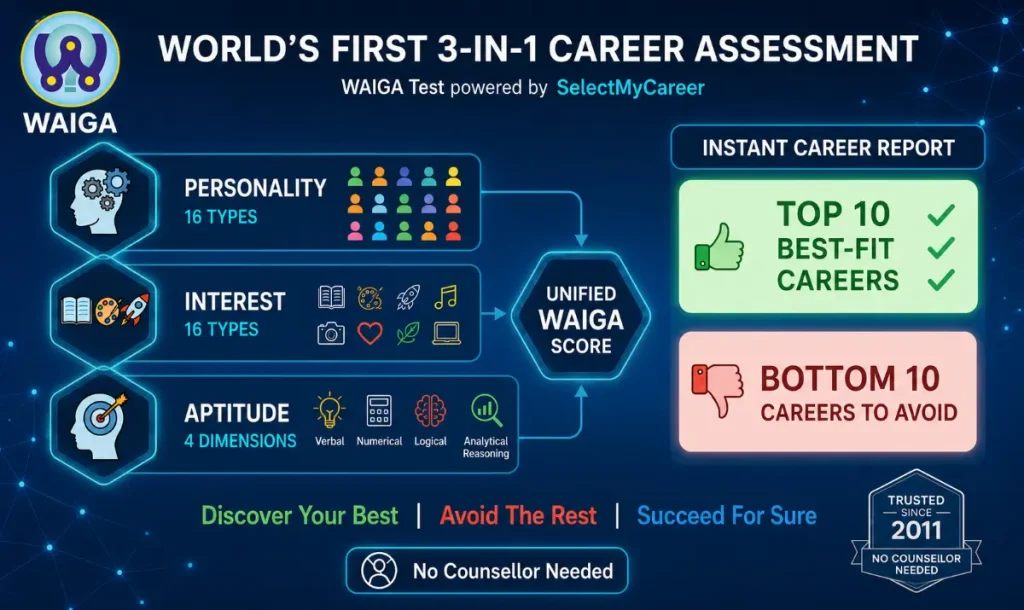
The WAIGA Career Assessment includes:
✔ 7 Interest Types
✔ 16 Personality Types
✔ 4 Aptitude Dimensions
✔ 1 WAIGA Score
✔ Instant Report
✔ No Counsellor Needed—Ever
If you’re ready to move beyond guesswork and make career decisions based on evidence rather than assumptions, explore the WAIGA Career Assessment and discover your unique career profile.
✓ One integrated assessment instead of multiple separate tests
✓ Instant personalised report
✓ No counsellor needed — ever
✔ Best on laptop or desktop | ✔ Takes 20-30 minutes | ✔ Instant report — 3 ways to access
✔ Registration takes 2 minutes |✔ Purchased test stays in dashboard — take it anytime
You can also begin with our Free Career Test if you’d like an introduction before taking the full assessment.
If you still have questions, feel free to contact us.
Frequently Asked Questions (FAQs)
A career aptitude test is a scientifically designed assessment that measures an individual’s natural reasoning abilities and cognitive strengths. It helps identify the types of careers in which a person is likely to learn, solve problems and perform effectively.
Although related, aptitude and intelligence are not the same. Intelligence refers to overall cognitive ability, while aptitude focuses on specific natural abilities that influence performance in particular types of tasks or careers.
No. A career aptitude test identifies your natural strengths, but it cannot determine the perfect career. Career decisions should also consider your interests, personality, values and career awareness.
Professionally developed aptitude assessments can provide valuable insights into an individual’s natural abilities. However, their usefulness depends on the quality of the assessment and how the results are interpreted alongside other important factors.
Many students benefit from taking an aptitude assessment during Classes 8–12, particularly before choosing subjects, streams or planning higher education. However, aptitude assessments can also be useful for graduates and working professionals considering career changes.
Natural reasoning abilities tend to remain relatively stable, but knowledge, skills, confidence and experience continue to develop throughout life. Career success depends on continuous learning as well as natural aptitude.
Not necessarily. Academic performance reflects many factors, including effort, study habits and learning opportunities. Aptitude reflects natural ability and may not always correspond directly with examination marks.
Neither is more important than the other. Aptitude indicates what you are naturally capable of doing, while interests influence what you enjoy doing. Long-term career satisfaction often depends on finding careers where both align.
Because career success depends on multiple factors. While aptitude identifies natural strengths, interests, personality, values and career awareness all influence whether a particular career is likely to be both successful and personally fulfilling.
Traditional aptitude tests primarily measure natural reasoning abilities. The WAIGA Career Assessment takes a more comprehensive approach by combining 4 Aptitude Dimensions, 7 Interest Types, 16 Personality Types and 1 WAIGA Score, providing a broader understanding of the individual to support informed career decisions—without requiring a career counsellor.
Written by the WAIGA Career Guidance Team