

Choosing a career often creates a difficult question:
Table of Contents
Should you choose a career based on what you enjoy, or based on what you are naturally good at?
This is where the difference between aptitude and interest becomes important.
You may be highly interested in technology but discover that the type of technical work you imagined is not a strong match for your abilities. You may also have excellent analytical aptitude but have little interest in spending your working life doing highly analytical tasks.
Neither situation automatically means you have chosen the wrong direction.
The challenge is that career fit is rarely determined by one factor.
Interest can tell you what attracts your attention and what you enjoy exploring. Aptitude can provide information about the kinds of abilities you may be able to develop and apply effectively. Personality, values, work environment, skills and practical career realities add further pieces to the picture.
So, when comparing aptitude vs interest, the more useful question is not:
Which one matters more?
It is:
How do your interests and aptitudes work together to identify careers worth exploring?
Understanding that difference can help you make a more informed career decision instead of choosing purely on passion, perceived ability, family expectations or a quick online quiz.
1. What Is Aptitude?
Aptitude refers to an individual’s potential or relative ability in particular areas.
In career assessment, aptitude is generally concerned with how effectively someone can work with certain types of information, problems or tasks.
Depending on the assessment, aptitude may involve areas such as:
- Numerical reasoning
- Verbal reasoning
- Logical reasoning
- Abstract reasoning
- Spatial reasoning
- Mechanical reasoning
- Problem solving
- Pattern recognition
- Data interpretation
For example, someone may find that they are relatively comfortable identifying patterns, working with numbers and solving structured problems.
That does not automatically mean they should become an accountant, engineer, programmer or data analyst.
It simply provides evidence about certain kinds of ability.
This distinction matters.
Aptitude is not the same as a job title.
Having strong numerical aptitude does not mean there is only one career you should choose. Similarly, having lower aptitude in one area does not automatically eliminate every career associated with that area.
Aptitude is better understood as one source of information about your potential fit with different kinds of work.
Aptitude can answer questions such as:
- What types of problems do I appear to handle well?
- Which forms of reasoning come more naturally to me?
- Where might I have potential to develop further?
- Which kinds of work may align with my cognitive strengths?
- What abilities might I want to investigate more closely?
These answers can be useful when exploring career options.
But aptitude alone does not tell you whether you will actually enjoy the work.
That is where interest becomes important.
2. What Is Career Interest?
Career interest refers to the kinds of activities, subjects, topics, environments or work areas that naturally attract your attention.
Interest can influence what you enjoy learning about, what activities you voluntarily spend time on and what kinds of work you find engaging.
For example, someone might have strong interests in:
- Technology
- Healthcare
- Business
- Design
- Education
- Research
- Communication
- Working with people
- Working with data
- Working with physical objects
- Creative activities
- Social or community work
Interest is important because a career is not simply a list of tasks you are capable of completing.
You are likely to spend significant amounts of time learning about your field, solving problems, dealing with routine responsibilities and developing expertise.
If the underlying subject matter or type of activity holds no interest for you, maintaining long-term engagement may become difficult.
However, there is an important distinction between being interested in a subject and being interested in doing the actual work associated with it.
Someone may love the idea of medicine without enjoying the day-to-day responsibilities of clinical work.
Someone may enjoy photography without wanting photography to become a full-time profession.
Someone may be fascinated by technology but dislike spending hours debugging software.
Interest is therefore valuable—but it needs to be connected to the reality of the work.
3. Aptitude vs Interest: The Key Difference
The simplest way to understand the difference is this:
Interest is about what attracts you. Aptitude is about the kinds of abilities you may have.
They answer different questions.
| Aptitude | Interest |
|---|---|
| What kinds of abilities do I demonstrate? | What kinds of activities attract me? |
| What types of problems may suit my strengths? | What subjects or activities do I enjoy exploring? |
| Where may I have potential? | What motivates my attention? |
| What kinds of reasoning feel more natural? | What kinds of work do I want to learn more about? |
| What can provide evidence about ability? | What can provide evidence about engagement? |
Neither one should automatically override the other.
Imagine two people.
Person A: High interest, weaker current aptitude
Someone may be deeply interested in programming but currently struggle with logical problem solving.
That does not necessarily mean programming is impossible.
Aptitude is not a fixed prediction of what someone can ever learn. Skills can develop through education, deliberate practice and experience.
But the aptitude information is still useful.
It may suggest that the person should investigate:
- Whether they enjoy learning programming in practice
- Which areas of technology suit them
- What skills need development
- Whether another technology-related role might provide a better fit
Person B: Strong aptitude, low interest
Another person may have excellent numerical and analytical abilities but have very little interest in working with numbers.
That does not mean they must pursue a highly quantitative career.
Their aptitude may identify capabilities they could use in many different contexts.
For example, analytical ability can potentially be useful in areas involving:
- Business decisions
- Research
- Operations
- Technology
- Strategy
- Problem solving
- Planning
- Data-informed decision-making
The question becomes how to apply the ability in a context that also provides sufficient interest and engagement.
4. Why Interest Alone Can Be Misleading
One of the most common pieces of career advice is:
“Follow your interests.”
There is some value in this idea.
But interest alone can be an incomplete career strategy.
Why?
Because you are not choosing a hobby.
You are choosing a direction that may involve years of education, training, work experience and professional development.
Consider someone who says:
“I love animals, so I should become a veterinarian.”
The interest is real.
But veterinary work involves much more than liking animals. It can require scientific knowledge, medical decision-making, emotional resilience, communication, practical skills and a willingness to deal with difficult situations.
Similarly:
“I love computers, so I should become a software developer.”
Again, the interest may be genuine.
But software development also involves sustained problem solving, debugging, learning technical concepts and spending considerable time working with code.
The same principle applies across careers.
Being interested in the subject is not necessarily the same as being suited to the work.
Interest should therefore be treated as an important starting point—not the entire decision.
5. Why Aptitude Alone Is Not Enough
The opposite mistake is assuming:
“I’m good at something, therefore I should make it my career.”
That can also create problems.
Imagine a student who consistently performs well in mathematics.
They may have strong numerical aptitude.
But what if they dislike working with numbers for long periods?
What if they are much more interested in communicating with people, designing solutions or building something practical?
Choosing a career solely because a person has demonstrated ability in one area may create a mismatch between capability and motivation.
Being good at something can make a career easier to enter.
It does not necessarily make the career meaningful or satisfying.
There is another issue.
People often become good at things because they have had years of practice, encouragement or exposure.
What looks like “natural ability” may sometimes be a combination of aptitude, experience, education and opportunity.
This is another reason not to treat an aptitude result as a fixed instruction.
Aptitude can provide useful evidence.
It should not become a label that limits exploration.
6. What If Your Aptitude and Interests Point in Different Directions?
This is where career decisions become more interesting.
Suppose your interests and aptitude appear to point toward different areas.
What should you do?
First, do not assume that one result must be wrong.
Instead, investigate the difference.
Ask yourself:
1. What exactly am I interested in?
Don’t stop at broad labels.
Instead of saying:
“I like business.”
Ask:
- Do I like selling?
- Do I like analysing markets?
- Do I like managing people?
- Do I like starting projects?
- Do I like negotiating?
- Do I like financial decision-making?
- Do I like building products?
A broad interest can contain many different types of work.
2. What exactly does my aptitude suggest?
Instead of saying:
“I’m good at numbers.”
Ask:
- Am I good at numerical calculation?
- Logical reasoning?
- Data interpretation?
- Pattern recognition?
- Structured problem solving?
Again, a broad result can contain several possibilities.
3. Can the two areas overlap?
Often they can.
Someone interested in healthcare and strong in analytical reasoning might explore areas such as health research, healthcare technology, health analytics or other roles depending on their education and qualifications.
Someone interested in creativity with strong technical aptitude might explore areas where design and technology overlap.
Someone interested in people with strong analytical ability might explore roles involving research, consulting, management, organisational work or other people-focused applications of analytical thinking.
The goal is not always to choose between two boxes.
Sometimes the better approach is to find the intersection.
7. Why Personality Adds Another Layer
Aptitude and interest are important, but they still do not describe the whole person.
Two people can have similar interests and similar aptitude while preferring very different working environments.
For example, both may enjoy technology.
One may prefer:
- Independent work
- Quiet environments
- Deep concentration
- Technical problem solving
The other may prefer:
- Teamwork
- Client interaction
- Presentations
- Fast-moving projects
The subject is similar.
The preferred way of working is different.
This is where personality can provide another useful perspective.
Personality assessment can help explore patterns in areas such as:
- How you tend to interact with others
- How you approach decisions
- How you respond to structure
- How you prefer to work
- How you approach problems
- What kinds of environments may feel more natural
Personality should not be used as a rigid career label either.
Instead, it can add context to the other information.
This is one reason a broader career assessment can be more informative than a test that measures only one dimension.
8. Why Career Fit Requires More Than One Factor
A career decision becomes more meaningful when you look at several dimensions together.
Think of career fit as a combination of questions:
Interest
Do I want to engage with this type of work?
Aptitude
Do my abilities appear compatible with the demands of this work?
Personality
Does the way this work is performed suit how I tend to operate?
Skills
What can I already do, and what do I need to learn?
Values
Does this career support what matters to me?
Work environment
Do I prefer the conditions in which this work is normally performed?
Practical reality
Does the career fit my educational path, circumstances, financial needs and long-term goals?
No single factor answers all of these questions.
That is why the question “Should I follow my passion or my aptitude?” can be too narrow.
A better question is:
What combination of interests, abilities, personality, values, skills and real-world conditions creates a career direction worth exploring?
9. A Simple Way to Compare Aptitude and Interest
If you are currently deciding between career options, create a simple comparison.
Choose three to five careers you are considering.
Then examine each one across several dimensions.
| Factor | Career A | Career B | Career C |
|---|---|---|---|
| Interest in the work | |||
| Relevant aptitude | |||
| Current skills | |||
| Skills I need to develop | |||
| Personality fit | |||
| Work environment | |||
| Values and priorities | |||
| Education required | |||
| Real-world job expectations |
You don’t need to turn this into a mathematical score.
The purpose is to make your assumptions visible.
You may discover that a career you were initially excited about has practical characteristics you had never considered.
You may also discover that a career you dismissed deserves another look because several aspects of the work fit you well.
The exercise changes the question from:
“Which career sounds best?”
to:
“Which career appears to fit the evidence I have gathered about myself and the actual work?”
That is a much more useful question.
10. How Career Assessments Can Help
If you are struggling to connect your aptitude and interests, a structured career assessment can provide another source of evidence.
This is particularly useful when your own answers feel contradictory.
For example:
- You are interested in several unrelated fields.
- You are good at something you don’t particularly enjoy.
- You enjoy something but are unsure whether your abilities fit it.
- Your academic performance does not seem to match your interests.
- You have too many career options.
- You have very few ideas about what to pursue.
- You are considering changing direction after discovering that your original career choice does not fit.
A broader assessment can help organize information across multiple dimensions.
The WAIGA framework, for example, brings together personality, interests and aptitude to create a more comprehensive career profile.
That can be useful because these dimensions answer different questions.
The purpose, however, should not be to hand over the career decision to a test.
A test result is evidence to consider, not an instruction you are required to follow.
Your own goals, circumstances, research, education, experience and understanding of the work still matter.
11. What to Do When You Still Aren’t Sure
Sometimes you will do the research, consider your aptitude and interests, and still not know what to choose.
That is normal.
Career decisions often involve uncertainty because you cannot completely understand a career until you experience some version of the work.
When possible, reduce uncertainty through action.
Talk to people doing the work
Ask professionals what their typical day looks like.
Find out:
- What do they actually spend their time doing?
- What do they enjoy?
- What do they find difficult?
- What skills matter most?
- What did they wish they knew before entering the field?
Try a small version of the work
Depending on the field, this might involve:
- A short course
- A project
- Volunteering
- Job shadowing
- An internship
- Freelance work
- A practical assignment
- A portfolio project
- A relevant club or activity
This gives you information that a questionnaire cannot always provide.
Research the actual career
Look beyond attractive job descriptions.
Investigate:
- Typical responsibilities
- Required qualifications
- Skills
- Working conditions
- Career progression
- Entry routes
- Employment opportunities
- Potential challenges
The more realistic your picture becomes, the better your career decision can become.
12. Don’t Confuse Potential With Experience
Another important point is that aptitude and skill are not identical.
You may have the potential to perform well in an area but have little experience.
Likewise, you may currently perform well because you have had extensive practice.
This means a career decision should not be based entirely on your current skill level.
Ask:
If this career genuinely interests me, am I willing to develop the skills it requires?
That question is often more useful than asking whether you are already perfect at the work.
For students especially, current ability can change considerably through education, practice and experience.
Aptitude provides information.
It does not define the limits of your future.
13. The Goal Is Not to Find a Perfect Match
It is tempting to search for a career where:
- You love every task.
- You are naturally excellent at everything.
- Your personality matches perfectly.
- The work environment is ideal.
- The salary is excellent.
- There are no difficult days.
Real careers rarely work that way.
Every career contains tasks you enjoy and tasks you don’t.
Every profession requires learning.
Every workplace has constraints.
The objective is not to find a career with zero mismatch.
The objective is to find career directions where the overall combination makes sense for you.
A career may be worth pursuing when:
- You have genuine interest in the work.
- Your abilities are reasonably compatible with its demands.
- You are willing to develop the required skills.
- The work environment suits you reasonably well.
- The career aligns with important values and goals.
- The practical requirements are realistic for your situation.
This is a much more realistic definition of career fit.
14. So, What Matters More: Aptitude or Interest?
There is no universal rule that says aptitude should always come first or interest should always come first.
They serve different purposes.
Interest helps you understand what you want to engage with.
Aptitude helps you understand where certain abilities may support you.
The most useful career decisions consider both.
If interest is high but aptitude appears weaker, investigate whether the gap can be addressed through learning and practice—and whether you genuinely enjoy the work once you experience it.
If aptitude is high but interest is low, don’t assume that ability alone means you should choose the career. Explore whether there are other ways to use that ability in areas that interest you more.
If both aptitude and interest point in the same direction, that can provide a useful reason to investigate that career more deeply.
And if they point in different directions, don’t treat the conflict as a failure.
The conflict itself is information.
It may help you discover a career that combines different parts of your profile.
Final Takeaway: Aptitude and Interest Work Better Together
The aptitude vs interest debate can make career choice sound like a competition.
But it doesn’t have to be.
Your interests can show you where your curiosity and motivation are pointing.
Your aptitudes can provide information about the kinds of abilities you may be able to apply and develop.
Your personality can add information about how you prefer to work.
Your skills show what you can currently do.
Your values and goals help determine what matters to you.
And real-world research tells you whether the career actually matches what you imagine it to be.
That is why choosing a career based on a single factor can be risky.
Instead of asking:
“Should I follow my interests or my aptitude?”
ask:
“Where do my interests, aptitudes, personality, skills, values and real-world career requirements come together?”
That question leads to a much broader understanding of career fit.
A structured career assessment can help you organize some of this information, but it should be used as evidence—not as a substitute for your own decision.
The goal is not to find a test that tells you exactly what to become.
The goal is to understand yourself well enough to make a career decision with better information.
Ready to Understand Your Career Fit?
If you’re unsure whether your interests and abilities point toward the same career direction, a structured assessment can give you another useful perspective.
Choosing a career does not begin with finding the perfect answer.
It begins with understanding yourself.
What are your natural strengths?
What kinds of work genuinely interest you?
How do you naturally prefer to work?
What possibilities might fit the person you are—and the life you want to build?
The WAIGA Career Assessment is designed to help you answer those questions with structured information rather than guesswork.
The most confident career decisions come from understanding what you enjoy, what you are naturally good at, how you prefer to work and which careers align with all of these dimensions.
WAIGA helps you understand your interests, personality and aptitude together, giving you structured information to consider as you explore your next career direction.
That is the philosophy behind the WAIGA Career Decision Framework™.
The WAIGA Career Assessment includes:
✔ 7 Interest Types
✔ 16 Personality Types
✔ 4 Aptitude Dimensions
✔ 1 WAIGA Score
✔ Instant Report
✔ No Counsellor Needed—Ever
If you’re ready to move beyond simply following your interests and start making career decisions based on a comprehensive understanding of yourself, explore the WAIGA Career Assessment and discover your unique career profile.
Your future deserves more than guesswork. It deserves clarity, confidence and informed decisions.
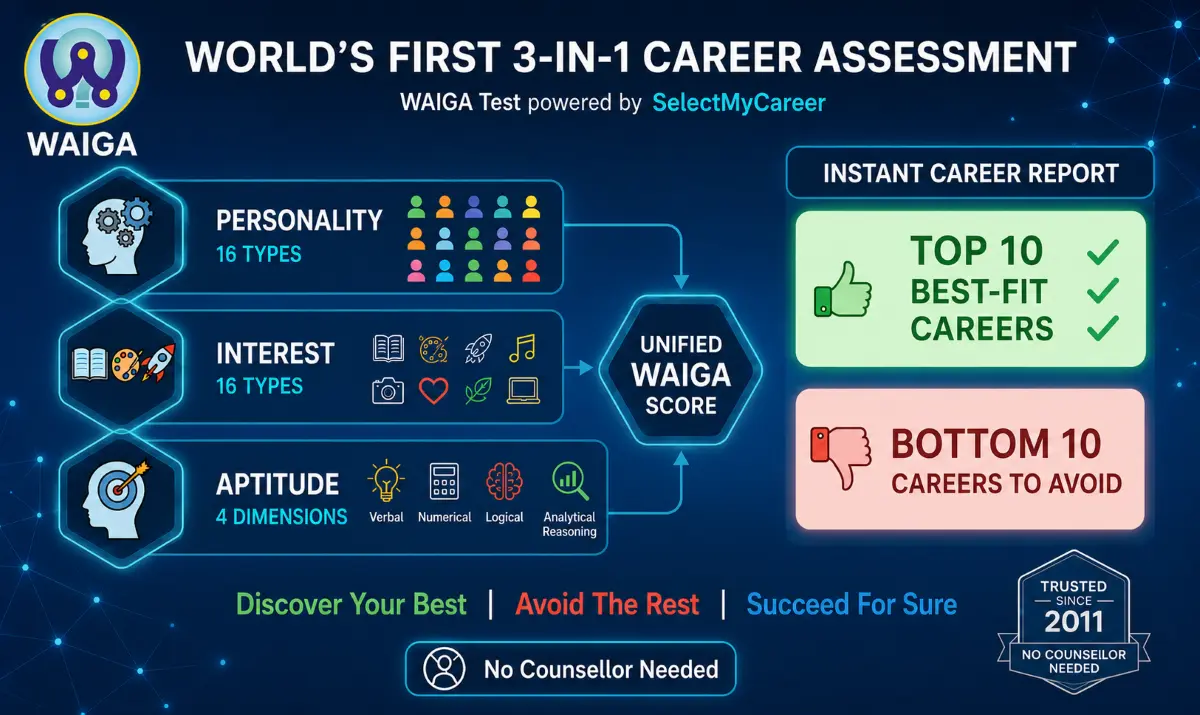
✓ One integrated assessment instead of multiple separate tests
✓ Instant personalised report
✓ No counsellor needed — ever
✔ Best on laptop or desktop | ✔ Takes 20-30 minutes | ✔ Instant report — 3 ways to access
✔ Registration takes 2 minutes |✔ Purchased test stays in dashboard — take it anytime
You can also begin with our Free Career Test if you’d like an introduction before taking the full assessment.
If you still have questions, feel free to contact us.
Frequently Asked Questions (FAQs)
Neither should automatically be treated as more important. Interest provides information about what attracts and engages you, while aptitude provides information about certain abilities and potential. Looking at both together can provide a more complete starting point for career exploration.
Don’t immediately rule it out. First understand what the aptitude result actually measures and whether the relevant abilities can be developed through education and practice. You should also explore the actual demands of the career before making a decision.
Being good at something does not mean you must turn it into a career. Your ability may still be valuable, but you may find a better fit by applying that ability in an area that interests you more.
Your measured performance can change as you gain knowledge, experience and practice. Aptitude assessments provide information about performance and potential at a particular point in time; they should not automatically be treated as permanent limits.
Not necessarily. Interest can be a strong attraction toward a subject or activity without being a lifelong passion. You can be interested in a career while still needing to investigate whether you actually enjoy the day-to-day work involved.
A career assessment can provide useful information about your interests, aptitudes, personality or other characteristics, but it should not replace your own decision-making. Results are most useful when combined with career research, experience, goals and practical considerations.
Treat the difference as information rather than a problem. Examine the specific aptitude and interest areas involved, research careers where they may overlap, identify skills you could develop and gain some real-world exposure before making a major decision.
Written by the WAIGA Career Guidance Team