
Choosing a career is one of the most important decisions you can make, but finding the answer to the question “How to Know If a Career Is Right for You” can be surprisingly difficult.
A career may look attractive because it offers good income, social recognition or strong employment opportunities. You may also have the qualifications needed to enter it. But those things alone do not necessarily mean the career is a good personal fit.
So, how do you know if a career is right for you?
Table of Contents
A good career fit usually involves more than one factor. Your interests, aptitude, personality, skills, values, preferred work environment and long-term goals can all influence how well a career matches you. Practical considerations such as education requirements, working conditions and financial needs also matter.
The good news is that you do not have to rely entirely on instinct.
By looking at specific signs of career fit—and testing your assumptions against the reality of the work—you can make a more informed decision about whether a career deserves further exploration.
In this guide, we will look at 10 signs that a career may be a good fit for you, along with questions you can ask yourself before committing to a particular career path.
1. You Are Genuinely Interested in the Work
One of the first signs of potential career fit is genuine interest in the work itself.
This sounds obvious, but there is an important distinction between being interested in a career’s image and being interested in its actual work.
For example, you might like the idea of being a lawyer because you enjoy watching courtroom dramas. You might like the idea of being a doctor because you are interested in medicine. Or you might like the idea of being a software developer because you enjoy technology.
But what matters is whether you are interested in the activities that make up the real job.
Ask yourself:
- What would I actually be doing most days?
- Do I find the subject matter interesting?
- Would I enjoy learning more about this field?
- Am I curious about how the work is done?
- Do I remain interested after learning about the less glamorous parts of the job?
This last question is particularly important.
Every career has routine tasks, administrative responsibilities, difficult situations and aspects that may not be exciting.
A career does not have to fascinate you every minute.
But if you find the fundamental nature of the work interesting, that can be an encouraging sign.
Interest is a starting point, not a complete answer
Interest matters because sustained engagement is difficult when you have no genuine connection to what you are doing.
However, interest alone does not guarantee career fit.
You should also consider whether your abilities, personality, values and practical circumstances align with the career.
That is why career fit is better understood as a combination of factors rather than one perfect test result.
2. The Work Uses Abilities You Are Good At—or Willing to Develop
Another important sign is that the career makes reasonable use of your abilities.
This does not mean you need to be naturally excellent at every aspect of the job.
Almost every worthwhile career requires learning.
Instead, ask whether your current strengths—or abilities you are willing to develop—are compatible with the work.
For example, different careers may place different demands on:
- Numerical reasoning
- Verbal communication
- Logical thinking
- Creativity
- Spatial reasoning
- Problem solving
- Organisation
- Attention to detail
- Interpersonal skills
- Practical skills
This is where aptitude can provide useful information.
An aptitude assessment may help you understand areas where you demonstrate particular strengths or potential. It should not be treated as a command telling you which career to choose, but it can provide another piece of evidence when evaluating career options.
Consider two questions:
Am I capable of developing the abilities this career requires?
and
Am I willing to put in the effort required to develop them?
Both matter.
A career can still be worth exploring even if you are not currently skilled in every required area.
What matters is whether the gap is realistic to address.
3. The Career Fits Your Personality and Preferred Way of Working
Two people can have the same interests and similar abilities but still be suited to very different careers.
Why?
Because they may prefer different ways of working.
One person may enjoy spending most of the day working independently. Another may become energized by constant interaction with colleagues, customers or clients.
One person may prefer predictable routines. Another may enjoy variety and changing priorities.
One person may prefer making decisions independently. Another may enjoy working within a clearly defined structure.
These differences can have a major effect on career satisfaction.
Ask yourself:
- Do I prefer working alone or with others?
- Do I enjoy frequent interaction with people?
- Do I prefer structure or flexibility?
- How comfortable am I with uncertainty?
- Do I enjoy taking responsibility for decisions?
- Do I prefer detailed work or big-picture work?
- Do I like predictable routines or frequent variety?
- What kind of workplace environment helps me perform well?
There is no universally correct answer.
A personality characteristic is not automatically good or bad for a particular career.
The important question is whether your preferred way of working is reasonably compatible with the environment in which the career is normally performed.
4. The Career Matches Your Important Values
A career can look excellent on paper and still feel wrong if it conflicts with things that matter deeply to you.
These underlying priorities are often described as career values.
Your values might include:
- Financial security
- Independence
- Creativity
- Helping others
- Achievement
- Recognition
- Stability
- Flexibility
- Work-life balance
- Learning
- Leadership
- Social contribution
- Intellectual challenge
Suppose you place a very high value on flexibility.
A career with rigid schedules and limited control over your working hours may eventually become frustrating, even if you enjoy the actual tasks.
Likewise, someone who strongly values stability may find an unpredictable career environment difficult.
Someone who values creativity may become dissatisfied in a role where most decisions are tightly constrained.
This does not mean you should reject every career that contains one undesirable feature.
Real jobs involve compromise.
The important question is:
Does this career support the values that matter most to me?
Understanding your values can help you distinguish between a career that simply looks attractive and one that fits your broader priorities.
5. You Like the Reality of the Job—not Just the Job Title
Job titles can be misleading.
Two jobs with impressive-sounding titles can involve completely different responsibilities.
Likewise, a career that sounds exciting from the outside may involve a large amount of routine work.
This is why one of the best ways to evaluate career fit is to investigate what professionals actually do.
Look beyond:
- Job titles
- Salary figures
- Social status
- Promotional descriptions
- Popular stereotypes
Instead, investigate:
- Typical daily responsibilities
- Working hours
- Common challenges
- Required skills
- Work environment
- Career progression
- Qualification requirements
- Amount of independent work
- Amount of teamwork
- Customer or client interaction
- Administrative responsibilities
For example, someone interested in becoming a manager may enjoy the idea of leadership but dislike the reality of managing conflict, conducting performance discussions, handling budgets and dealing with administrative responsibilities.
Someone interested in journalism may love writing but dislike deadlines, constant revisions or the pressure of finding stories.
The closer your understanding of the actual work becomes, the more accurately you can evaluate career fit.
6. You Are Willing to Develop the Skills the Career Requires
You do not need to arrive at your future career fully prepared.
In fact, that is rarely possible.
Most careers involve a learning curve.
The better question is whether you are willing to learn what the career requires.
Imagine that you are interested in a career but discover that it requires skills you currently lack.
That does not automatically mean the career is unsuitable.
Instead, identify:
- What skills are required?
- Which ones do I already have?
- Which ones need development?
- How difficult would it be to develop them?
- Am I genuinely willing to put in that effort?
This distinction between current ability and willingness to develop is important.
Someone may not initially be strong at public speaking but may be willing to practise and improve.
Someone may have limited technical knowledge but be highly motivated to learn.
Someone may not have management experience but may be interested in developing leadership skills over time.
Career fit is therefore not about finding a career for which you are already perfectly prepared.
It is about finding a direction in which your current profile and your willingness to grow can reasonably meet the demands of the work.
7. You Can Imagine Yourself Doing the Work Long Enough to Build Expertise
A career is not just about getting your first job.
It is about developing expertise over time.
Ask yourself:
Can I imagine becoming genuinely good at this work over the next several years?
You do not need to imagine staying in exactly the same role forever.
Careers evolve.
People change industries, specialise, move into management, start businesses, become consultants or discover new interests.
But most meaningful professional development requires sustained effort.
If the basic activities of a career already feel deeply unappealing, it may be difficult to maintain the motivation needed to become highly skilled.
On the other hand, if you are curious about the field and can imagine enjoying the process of becoming better at it, that is useful information.
Look beyond the first job
Try to imagine several stages:
Starting:
What would I be doing as a beginner?
Developing:
What would I learn after a few years?
Advancing:
What opportunities might become available as I gain experience?
Specialising:
Are there areas of the field I might eventually want to focus on?
This exercise can reveal whether you are attracted only to the idea of entering a career or whether you are also interested in developing within it.
8. Your Career Goals and Lifestyle Goals Are Compatible
A career is part of your life—not your entire life.
That means career fit should also be considered in relation to the life you want outside work.
For example, you may eventually want:
- Flexible working arrangements
- Time for family
- Opportunities to travel
- Predictable working hours
- Financial security
- Geographic flexibility
- Opportunities for advancement
- Time for personal interests
- A stable routine
Different careers can support these priorities to different degrees.
There is no universal “ideal” lifestyle.
The important thing is understanding your own priorities.
Ask:
- What kind of lifestyle do I want?
- How much time do I want to devote to work?
- How important is location flexibility?
- How important is income?
- Am I comfortable with irregular schedules?
- Do I want rapid career progression?
- Would I accept a demanding career if it provides other benefits I value?
A career that fits your personality but consistently conflicts with your most important lifestyle priorities may not be a sustainable fit.
9. You Have Tested the Career in the Real World
Research is useful.
Self-assessment is useful.
Talking to professionals is useful.
But nothing completely replaces experience.
If possible, test your assumptions before making a major commitment.
Depending on the career, you might:
- Take a short introductory course
- Complete a practical project
- Volunteer
- Shadow a professional
- Seek an internship
- Speak to people already working in the field
- Attend industry events
- Join a relevant student or professional group
- Try freelance or part-time work
- Build a small portfolio project
These experiences can answer questions that online research cannot.
You might discover:
“I thought I would love this, but I don’t actually enjoy the daily work.”
Or:
“This is much more interesting than I expected.”
Both discoveries are valuable.
Career exploration is not wasted effort when it changes your mind.
In fact, discovering that a career does not fit you before investing years of education or training can be extremely useful.
10. You Are Choosing the Career for Yourself
Perhaps the most important sign of career fit is that the decision is actually yours.
This can be harder than it sounds.
Career decisions are often influenced by:
- Parents
- Teachers
- Friends
- Social expectations
- Academic performance
- Salary expectations
- Prestige
- Trends
- Online influencers
- What people around you consider successful
These influences are not necessarily bad.
Other people can provide valuable advice.
But there is a difference between considering advice and living someone else’s career plan.
Ask yourself:
If nobody else knew what career I chose, what would I genuinely want to explore?
And:
If salary and social status were temporarily removed from the equation, would I still be interested in this type of work?
These questions can reveal whether your motivation is internal or primarily driven by external expectations.
Of course, practical considerations still matter.
Income, employment opportunities and financial responsibilities cannot simply be ignored.
But the final career decision should reflect your own circumstances and priorities, rather than someone else’s definition of success.
A Career-Fit Checklist
If you are considering a career, use the following checklist.
Ask yourself whether you can honestly say “yes” to most of these statements:
- I am genuinely interested in the actual work.
- I understand what people in this career really do.
- My abilities are reasonably compatible with the work.
- I am willing to develop the skills I currently lack.
- The career suits my preferred way of working.
- The work environment is compatible with my personality.
- The career supports important personal values.
- The lifestyle is reasonably compatible with my goals.
- I can imagine developing expertise in this field.
- I have tested or researched the career beyond its image.
- I am considering the career because it makes sense for me—not simply because others expect it.
You do not need a perfect score.
The purpose of the checklist is to identify questions worth investigating.
If you answer “no” to several important areas, that does not automatically mean you must reject the career.
It tells you where you need more information.
What If You Like a Career but Aren’t Sure It Fits?
This is one of the most common situations in career exploration.
You may feel strongly attracted to a career but remain uncertain.
Instead of trying to make an immediate yes-or-no decision, break the uncertainty into smaller questions.
If you are unsure about your abilities
Explore your aptitude and current skills.
If you are unsure about your interest
Try a realistic sample of the work.
If you are unsure about the work environment
Talk to professionals who work in that environment.
If you are unsure about the lifestyle
Research working hours, schedules and career progression.
If you are unsure about yourself
Consider a broader career assessment that examines several dimensions rather than relying on one result.
The goal is to turn vague uncertainty into specific questions that you can actually investigate.
What If Two Careers Both Seem Like a Good Fit?
You do not always need to identify one perfect career immediately.
Sometimes you will discover two, three or even more options that appear compatible with your profile.
That is a good position to be in.
Instead of asking:
“Which career is perfect?”
compare the options.
Look at:
- Your level of interest
- Relevant aptitudes
- Skills required
- Education and training
- Work environment
- Lifestyle
- Values
- Growth opportunities
- Practical constraints
- Opportunities to gain experience
You can then investigate the strongest possibilities further.
Career choice does not always happen through one dramatic moment of certainty.
Often, it happens through a process of exploration, comparison, experience and gradual clarification.
Can a Career Assessment Tell You If a Career Is Right for You?
Career assessments can be useful, but they should be used in the right way.
A good assessment can provide structured information about areas such as:
- Interests
- Aptitudes
- Personality
- Work preferences
- Potential career themes
That information can help you identify possibilities you may not have considered.
But an assessment cannot completely understand your life.
It does not know every responsibility you have, every opportunity available to you, every experience you have had or every goal you may develop in the future.
Therefore, a career assessment should be treated as a tool for self-understanding, not a final authority.
The most useful process is:
Assessment → Research → Exploration → Experience → Decision
An assessment can start the conversation.
Real-world investigation helps continue it.
A Better Definition of “The Right Career”
There may be no single career that is objectively “right” for you for your entire life.
People change.
Interests change.
Circumstances change.
Skills develop.
Industries change.
New opportunities appear.
A career that fits you at 22 may not be the career you want at 42.
That does not mean the first decision was necessarily wrong.
Instead of searching for one permanent answer, think in terms of career fit at a particular stage of life.
The right career direction is often one that:
- Fits your current strengths
- Interests you enough to stay engaged
- Allows you to develop
- Aligns with important values
- Supports your practical needs
- Provides opportunities that matter to you
- Leaves room for future growth and change
This is a more flexible and realistic way to think about career planning.
Final Takeaway: How Do You Know If a Career Is Right for You?
Knowing whether a career is right for you is rarely about finding one magical sign.
Instead, look for a pattern of fit.
You are more likely to be moving toward a suitable career when you are genuinely interested in the work, your abilities are reasonably compatible with its demands, the working environment suits you, the career aligns with your values and lifestyle goals, and you are willing to develop the skills required.
Most importantly, investigate the reality of the career rather than relying on its image.
Talk to people who do the work.
Research the responsibilities.
Try smaller versions of the work when possible.
Reflect on your own preferences.
Use assessments as additional sources of information.
And remember that career choice does not have to be a single irreversible decision.
The goal is not to find a career that is perfect in every possible way.
The goal is to make a well-informed career choice that fits who you are, what you can offer, what you value and the life you want to build.
Ready to Explore Your Career Fit?
If you’re struggling to decide whether a particular career matches your strengths, interests and personality, a structured career assessment can give you another perspective.
Choosing a career does not begin with finding the perfect answer.
It begins with understanding yourself.
What are your natural strengths?
What kinds of work genuinely interest you?
How do you naturally prefer to work?
What possibilities might fit the person you are—and the life you want to build?
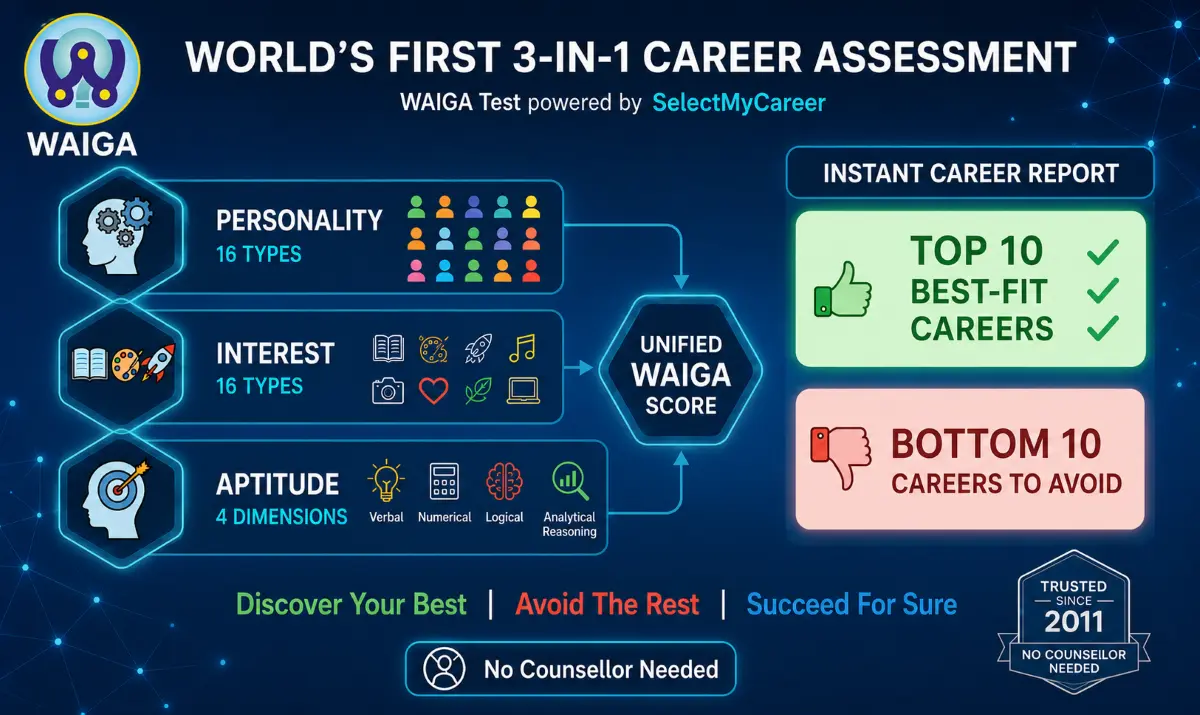
The WAIGA Career Assessment is designed to help you answer those questions with structured information rather than guesswork.
The most confident career decisions come from understanding what you enjoy, what you are naturally good at, how you prefer to work and which careers align with all of these dimensions.
WAIGA helps you understand your interests, personality and aptitude together, giving you structured information to consider as you explore your next career direction.
That is the philosophy behind the WAIGA Career Decision Framework™.
The WAIGA Career Assessment includes:
✔ 7 Interest Types
✔ 16 Personality Types
✔ 4 Aptitude Dimensions
✔ 1 WAIGA Score
✔ Instant Report
✔ No Counsellor Needed—Ever
If you’re ready to move beyond simply following your interests and start making career decisions based on a comprehensive understanding of yourself, explore the WAIGA Career Assessment and discover your unique career profile.
Your future deserves more than guesswork. It deserves clarity, confidence and informed decisions.
✓ One integrated assessment instead of multiple separate tests
✓ Instant personalised report
✓ No counsellor needed — ever
✔ Best on laptop or desktop | ✔ Takes 20-30 minutes | ✔ Instant report — 3 ways to access
✔ Registration takes 2 minutes |✔ Purchased test stays in dashboard — take it anytime
You can also begin with our Free Career Test if you’d like an introduction before taking the full assessment.
If you still have questions, feel free to contact us.
Frequently Asked Questions (FAQs)
Look at several factors together, including your interests, aptitudes, personality, skills, values, preferred work environment and lifestyle goals. Research the actual work and, when possible, gain some real-world experience before making a major commitment.
Interest is an important part of career fit, but it should not be the only factor. Consider whether your abilities, personality, values and practical circumstances are also compatible with the career.
Being good at something does not necessarily mean you should make it your career. Your abilities are important, but long-term career fit can also depend on interest, motivation, values and the type of work environment you prefer.
A career assessment can provide useful information about your interests, aptitudes, personality and other characteristics, but it cannot make the decision for you. Assessment results are most useful when combined with career research, experience and your personal goals.
Start by learning more about yourself. Explore your interests, aptitudes, personality, values and skills, then investigate careers that connect with those areas. Talking to professionals and gaining small amounts of practical experience can also help you discover what interests you.
Yes. Career interests, skills, circumstances and priorities can change over time. A career decision does not necessarily have to determine your entire working life, and changing direction can be part of normal career development.
There is no fixed number. It can be useful to identify several realistic possibilities and compare them based on interests, abilities, work environment, values, lifestyle, education requirements and practical considerations rather than trying to identify one perfect option immediately.
Written by the WAIGA Career Guidance Team