
If you have ever searched “what should I do with my life?”, you are not alone.
The question often appears when you are choosing a career for the first time. It can also appear much later—after graduation, during a difficult period at work, after years in a career that no longer feels right, or when you realise that the path you originally chose does not seem to fit anymore.
Sometimes the problem is that you have too many possibilities. Other times, you have no idea where to begin.
Table of Contents
You may be good at several things but interested in completely different areas. You may enjoy a subject but not know what careers it could lead to. You may have a degree but still feel uncertain about what to do with it. Or you may have a stable job but wonder whether you are actually building the life you want.
The good news is that you do not need to discover one perfect career that was somehow waiting for you all along.
A better approach is to understand yourself, identify realistic possibilities, investigate those options, test them where possible, and gradually make a better-informed decision.
This guide will show you how to do that.
What Should I Do With My Life? Why This Question Feels So Difficult
The question sounds simple, but it actually contains several different questions:
- What am I good at?
- What do I enjoy?
- What kind of work suits my personality?
- What matters to me?
- What skills do I have?
- What kind of lifestyle do I want?
- What careers are realistically available to me?
- Which options could provide a satisfying and sustainable future?
- How do I know which direction to choose?
That is why searching for a single answer can be frustrating.
A career is not just a job title. It is a combination of work activities, responsibilities, environment, people, skills, expectations, lifestyle and opportunities.
Someone may love the idea of being a doctor but dislike the reality of long training, high responsibility and emotionally demanding work.
Someone else may think they have no interest in technology until they discover that they enjoy solving practical problems with technology.
Another person may have excellent analytical ability but discover that a highly solitary role does not suit their preferred way of working.
The better question is therefore not:
“What is the one career I am meant to have?”
It is:
“What kinds of work could fit me, and how can I make a good decision among the realistic options?”
That shift makes career planning much more manageable.
1. Start With Yourself—Not Job Titles
When people feel career confusion, they often start by searching for jobs.
They search:
- Best careers in 2026
- Highest-paying jobs
- Best jobs for introverts
- Best careers without a degree
- Best careers after graduation
- Best careers for people who like science
These searches can produce useful information, but they can also create more confusion.
There are thousands of occupations, and lists of “best careers” are usually based on general assumptions about salary, demand or popularity.
A career that is excellent for one person may be completely unsuitable for another.
Instead of beginning with job titles, begin with your own career profile.
Consider five broad areas:
- Aptitude – What kinds of abilities come naturally to you?
- Interests – What subjects, activities or problems attract your attention?
- Personality – How do you prefer to work and interact with others?
- Values – What do you want your work and life to provide?
- Skills and experience – What can you already do, and what are you willing to learn?
These factors do not automatically produce a career answer.
They give you a better starting point for exploring careers that could make sense for you.
2. What Are You Naturally Good At?
One of the most useful questions to ask when choosing a career is:
What kinds of things am I naturally good at?
This is where aptitude becomes important.
Aptitude refers broadly to your potential or relative ability in particular areas. Depending on the assessment, this might include things such as:
- Numerical reasoning
- Verbal reasoning
- Abstract reasoning
- Logical problem solving
- Spatial thinking
- Pattern recognition
- Analytical thinking
- Working with information
Aptitude does not tell you what you will enjoy.
You can be naturally good at something and have little desire to spend your working life doing it.
But aptitude can help you identify areas where you may have useful potential.
For example, imagine two people who are both interested in business.
One may be particularly strong in numerical and analytical reasoning.
Another may be especially strong in communication, relationship building and persuasion.
Both could potentially work in business, but the roles that suit them may be quite different.
The goal is not to ask:
“What am I naturally good at?”
and stop there.
Ask:
“What am I naturally good at, and where could those abilities be useful?”
That question creates much more useful career possibilities.
3. What Are You Actually Interested In?
Interest matters because careers involve doing something repeatedly.
You may be capable of performing a particular task, but if you have no interest in it, sustaining motivation over many years can become difficult.
Think about the subjects and activities that naturally attract your attention.
Do you enjoy:
- Understanding how things work?
- Working with numbers?
- Helping people solve problems?
- Creating things?
- Writing or communicating?
- Investigating information?
- Working with technology?
- Organising people or projects?
- Working outdoors?
- Designing?
- Teaching?
- Building?
- Analysing?
- Persuading?
- Caring for others?
Career interests can sometimes be broader than individual subjects.
For example, someone may say:
“I don’t know what subject I am passionate about.”
But when they examine what they repeatedly enjoy, they may discover that they like solving problems, helping people, building things or understanding systems.
Those patterns can point toward many different careers.
This is one reason a career interest assessment can be useful: it can help you identify patterns rather than forcing you to choose one job title immediately.
4. What Kind of Work Do You Enjoy?
Knowing what you are interested in is useful, but it is not quite the same as knowing what kind of work you enjoy.
For example, you might be interested in psychology.
That does not necessarily mean you would enjoy every psychology-related career.
You might enjoy:
- Researching behaviour
- Working directly with people
- Analysing data
- Teaching
- Writing
- Organisational work
- Counselling
- Academic work
The subject is the same, but the actual work can be very different.
This is an important distinction when thinking about what career should I choose.
Do not only ask:
“What subjects do I like?”
Also ask:
“What do I want to spend my working days doing?”
Think about the activities themselves.
Would you rather:
- Work with people or information?
- Work independently or collaboratively?
- Solve new problems or follow established processes?
- Build things or analyse things?
- Communicate constantly or concentrate quietly?
- Work indoors or outdoors?
- Have predictable routines or changing challenges?
- Lead others or contribute as a specialist?
Sometimes the answer to these questions reveals more about career fit than a favourite school subject does.
5. What Does Your Personality Tell You About Work?
Personality is another important part of career exploration.
It does not mean that a certain personality type is limited to certain careers.
People are more adaptable than career stereotypes suggest.
However, your personality can provide useful information about your preferred way of working.
For example, you might prefer:
- Frequent interaction with people
- Independent concentration
- Structured environments
- Flexible environments
- Leadership responsibilities
- Supporting roles
- Competition
- Cooperation
- Planning
- Spontaneous problem solving
- Stability
- Variety
Two people may have identical qualifications and similar interests but thrive in very different work environments.
That is why personality should not be treated as an afterthought.
A career is not only about what you do.
It is also about how you do it.
Understanding your personality can help you ask better questions about the work environment, team structure, level of autonomy and responsibilities that are likely to suit you.
6. What Do You Want From Your Life and Career?
The question “What should I do with my life?” is partly a career question and partly a life question.
Your career needs to fit into the life you want to build.
Think about what matters most to you.
Perhaps you want:
- Financial security
- Flexibility
- Meaningful work
- Intellectual challenge
- Creativity
- Status
- Independence
- Family time
- Geographic freedom
- Stability
- Leadership
- Social impact
- Opportunities for advancement
- A predictable schedule
There is no universally correct answer.
One person may prioritise earning potential.
Another may prioritise flexibility.
Someone else may care most about helping people.
Another person may want a technically challenging career with continuous learning.
Career decisions become easier when you understand your own priorities.
This also prevents you from choosing a career simply because it looks impressive from the outside.
A career can be objectively successful and still be wrong for the life you want.
7. What Skills Do You Already Have?
Your current skills are another useful starting point.
Make two lists.
Skills you already have
Think about:
- Technical skills
- Communication
- Writing
- Research
- Analysis
- Organisation
- Leadership
- Problem solving
- Customer service
- Presentation
- Project management
- Technology
- Teamwork
Then make a second list.
Skills you would like to develop
This distinction matters.
You do not need to already possess every skill required for a career before considering it.
A career is not a test of what you can do today.
It is also a possible direction for what you are willing to learn.
For example, someone interested in data analysis may currently have limited technical skills but strong numerical reasoning and curiosity.
Someone interested in management may not have formal management experience but may already have strong organisation and communication skills.
Instead of asking:
“Can I do this career right now?”
ask:
“What would I need to learn, and am I willing to develop those abilities?”
That is a much more realistic way to evaluate career options.
8. Look at Real Career Options
Once you understand more about yourself, start exploring actual careers.
This is where career research becomes important.
Do not stop at the job title.
For every career you are considering, investigate:
- What does the job actually involve?
- What does a typical day look like?
- What qualifications are required?
- What skills are important?
- What work environment is common?
- What are the opportunities for progression?
- What are the challenges?
- What industries employ people in this role?
- What is the realistic earning potential?
- What is the employment outlook?
- What lifestyle does the career typically involve?
This can quickly separate an attractive idea from a realistic career option.
A job description might sound interesting, but the actual day-to-day work may be very different from what you imagined.
That is why career exploration should involve real-world information, not just inspirational career lists.
9. Don’t Choose a Career Based on Salary Alone
Salary matters.
It would be unrealistic to pretend otherwise.
Your career affects your financial security, lifestyle and future opportunities.
But salary should not be the only factor.
Suppose Career A pays significantly more than Career B.
If Career A involves work that you strongly dislike, an environment that drains you and a lifestyle that conflicts with your priorities, the higher salary may not make it the better choice.
At the same time, choosing a low-paying career simply because it sounds meaningful is not automatically wise either.
A better approach is to consider salary alongside:
- Career fit
- Skills
- Interests
- Personality
- Values
- Lifestyle
- Job stability
- Growth opportunities
- Training requirements
- Location
- Working conditions
Think of compensation as one part of the decision rather than the entire decision.
10. Don’t Choose a Career Just Because Someone Else Wants It
Family expectations can strongly influence career decisions.
Parents may recommend a particular profession.
Friends may encourage you to follow a popular path.
Teachers may notice a particular strength and suggest a career.
Society may also send strong messages about what constitutes a “good” career.
Advice from other people can be valuable.
But advice is not the same as ownership of the decision.
You are the person who will eventually have to live with the work.
Before choosing a career because someone else thinks it is right for you, ask:
- Does this career fit my interests?
- Does it suit my abilities?
- Does the work match my personality?
- Does it support the lifestyle I want?
- Have I researched the reality of the career?
- Would I still choose it if nobody else had an opinion?
The final question can be particularly revealing.
Your career should be informed by other people’s experience—but ultimately, it needs to be your decision.
11. What If You Have Too Many Interests?
Not everyone suffers from a lack of interests.
Some people have the opposite problem.
You may be interested in:
- Medicine
- Technology
- Business
- Writing
- Psychology
- Design
- Education
- Science
You may genuinely enjoy several areas.
That does not mean you are incapable of choosing.
It means you need a way to compare options.
Start by identifying what connects your interests.
For example, someone interested in technology, psychology and business may discover a broader interest in solving human problems using systems and technology.
Another person interested in biology, writing and teaching may discover an interest in explaining complex scientific ideas to other people.
Look for the common thread.
Then compare possible careers using several factors:
| Factor | Career A | Career B | Career C |
|---|---|---|---|
| Interest | High | Medium | High |
| Aptitude | High | High | Medium |
| Personality fit | Medium | High | High |
| Skills required | Manageable | Manageable | Significant gap |
| Lifestyle fit | High | Medium | High |
| Training required | Moderate | Low | High |
| Career reality | Strong | Strong | Unclear |
You do not need a mathematical formula to make the decision.
The purpose is to make your thinking visible.
12. What If You Have No Interests at All?
Some people say:
“I am not interested in anything.”
Often, this does not literally mean that they have no interests.
It may mean:
- They have not explored enough options.
- They are comparing themselves with people who seem passionate.
- They are exhausted or overwhelmed.
- They expect a career interest to feel like a strong passion.
- They have not yet connected everyday activities with career possibilities.
- They have focused too much on what they are “supposed” to like.
You do not need a lifelong passion before you can begin career exploration.
Start smaller.
Ask:
- What activities do I dislike least?
- What subjects do I find easier to concentrate on?
- What problems do I enjoy solving?
- What do people ask me for help with?
- What topics do I naturally research?
- What kind of work makes time pass quickly?
- What would I be willing to become better at?
Interest can develop through experience.
You do not necessarily need to find your passion first and then choose a career.
Sometimes you explore a field, become competent, gain confidence and gradually develop deeper interest.
13. Use Career Assessments as Evidence, Not Answers
Career assessments can be useful when you are asking:
“What career should I choose?”
But they work best when treated as a source of evidence rather than an answer generator.
Different assessments measure different things.
An aptitude test may provide information about abilities.
An interest assessment may identify areas that attract you.
A personality assessment may help you understand your preferred way of working.
These are all useful, but each provides only part of the picture.
A more complete approach considers multiple factors together.
This is the idea behind the WAIGA framework.
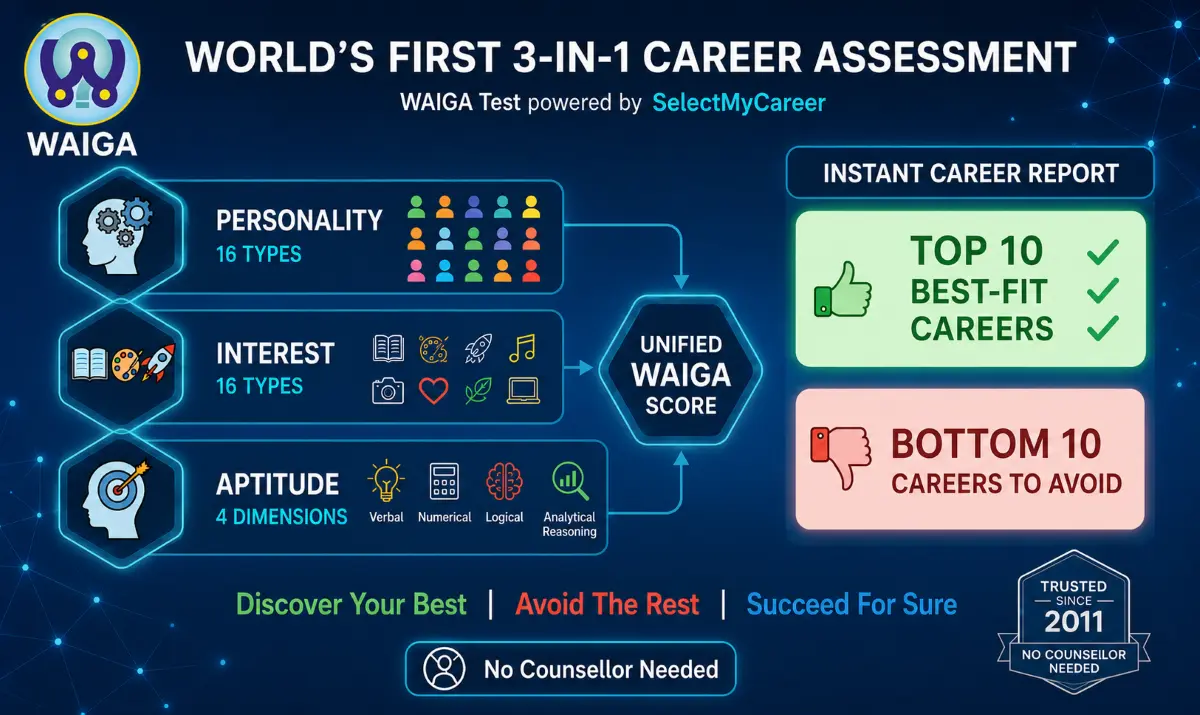
WAIGA combines personality, interests and aptitude into one broader career profile.
The purpose is not to tell you:
“This is the one career you must choose.”
Instead, the assessment can help you understand yourself and identify career directions that may deserve further investigation.
That distinction is important.
A career assessment cannot experience the job for you.
It cannot know every detail of your circumstances.
It cannot replace career research, conversations with professionals, practical experience or your own judgement.
But it can give you useful information that may otherwise be difficult to organise.
Use assessment results as evidence. Then investigate the careers in the real world.
Still Asking, “What Should I Do With My Life?”
You don’t need to have your entire future figured out before you start.
But you do need a clearer understanding of what you’re good at, what interests you, how you naturally work, and what kinds of careers may fit you.
The WAIGA Career Assessment brings personality, interests and aptitude together to give you a broader picture of your career profile.
Your results don’t tell you what you must do. They give you useful evidence to help you explore career options, compare possibilities and make a more informed decision.
Take the WAIGA Career Assessment →
Understand yourself first. Explore your options. Then choose your direction with greater confidence.
14. Test Careers Before Making a Major Commitment
One of the biggest mistakes in career planning is treating career choice as a purely theoretical exercise.
If possible, test your assumptions.
You might:
- Talk to someone working in the field.
- Shadow a professional.
- Take an introductory course.
- Complete a small project.
- Volunteer.
- Take an internship.
- Join a relevant student organisation.
- Freelance on a small scale.
- Attend industry events.
- Watch realistic day-in-the-life material.
- Read job descriptions from several employers.
- Speak to people who recently entered the profession.
The goal is not to become an expert.
The goal is to replace imagination with information.
You may discover:
“I thought I would love this, but I don’t enjoy the actual work.”
That is valuable information.
You may also discover:
“This is harder than I expected, but I actually enjoy the challenge.”
That is valuable too.
Career exploration works best when you allow reality to update your assumptions.
15. How to Narrow Your Options
At some point, exploration needs to become decision-making.
If you have a list of 20 careers, your next goal is not to research all 20 forever.
Create three groups:
Strong possibilities
Careers that appear to fit several important factors and deserve serious investigation.
Possible options
Careers with some attractive characteristics but significant questions that still need answers.
Low-priority options
Careers that clearly conflict with important requirements or preferences.
Then focus your research on the strongest possibilities.
For each one, ask:
- Does the work interest me?
- Do my abilities fit the work?
- Does the environment suit my personality?
- Does the career support my important values?
- Am I willing to develop the required skills?
- Can I accept the training required?
- Does the lifestyle work for me?
- Have I researched the actual job?
- Have I tested the career in some way?
- Can I realistically see myself developing expertise in this field?
You do not need perfect scores.
You are looking for a strong overall fit with no major deal-breakers.
16. Career Choice Is Not the Same as Finding Your Passion
The phrase “follow your passion” sounds inspiring.
But it can create unnecessary pressure.
What if you do not have one obvious passion?
What if you have several?
What if your interests change?
What if you are passionate about something that has very limited career opportunities?
A more practical approach is to think about career fit.
A good career may combine several things:
- You have useful abilities.
- You find at least some of the work genuinely interesting.
- The environment suits you.
- The career supports important values.
- You are willing to develop the required skills.
- The lifestyle is acceptable.
- The opportunities are realistic.
- You can imagine building expertise over time.
You do not need to feel passionate about every part of your work.
A career can be a good fit without being your entire identity.
17. Make a Career Decision Without Waiting for Certainty
One of the hardest parts of career planning is accepting uncertainty.
You may want to know:
“What if I choose the wrong career?”
The problem is that no assessment, article or adviser can remove all uncertainty.
Career decisions involve incomplete information.
You may not know exactly what an industry will look like five years from now.
You may discover new interests later.
Your priorities may change.
Your personal circumstances may change.
That does not mean you should avoid making a decision.
It means you should make the best decision you can with the information available.
There is a difference between:
“I know this will definitely work.”
and:
“Based on what I know now, this is the direction that makes the most sense, and I will continue learning as I go.”
The second approach is much more realistic.
18. What Should I Do With My Life? A Simple Framework
If the entire process still feels overwhelming, reduce it to six questions.
Question 1: What am I good at?
Identify your strongest abilities and skills.
Question 2: What interests me?
Look for subjects, activities, problems and themes that naturally attract your attention.
Question 3: How do I prefer to work?
Consider personality, work environment, collaboration, independence, structure and variety.
Question 4: What matters to me?
Identify your values, lifestyle priorities and long-term goals.
Question 5: What careers could realistically fit those factors?
Turn your self-understanding into a shortlist of career possibilities.
Question 6: What evidence can I gather before deciding?
Research the careers, speak to professionals, test your assumptions and use structured assessments where helpful.
This creates a simple progression:
Understand yourself → Explore careers → Compare options → Test assumptions → Make a decision → Learn and adjust
You do not need to solve your entire life in one afternoon.
You need to take the next useful step.
19. What If You Choose the Wrong Career?
Even a carefully researched career decision can turn out to be wrong.
That does not mean the decision was a failure.
You may discover that:
- The work is different from what you expected.
- Your interests have changed.
- Your priorities have changed.
- The industry has changed.
- You have developed new strengths.
- Another career has become more attractive.
- You simply learned more about yourself.
Career development is not always a straight line.
Your first career choice does not have to determine every future decision.
The skills you build, people you meet and experiences you gain can often become useful in other careers.
Instead of thinking:
“If I choose wrong, I have ruined my future.”
think:
“I want to make a thoughtful decision, and I will continue learning from the experience.”
That mindset makes career planning less frightening and more practical.
20. The Goal Is Not to Find One Perfect Career
There may not be one single career that is objectively perfect for you.
There may be several careers that could provide a satisfying and successful path.
This is an important idea because it changes what career exploration is trying to accomplish.
You are not trying to uncover a hidden answer.
You are trying to identify good possibilities.
Then you compare them.
Then you gather evidence.
Then you make a decision.
Then you build skills and experience.
Over time, your understanding of yourself becomes more accurate.
Your career can evolve with you.
The best career decision is therefore rarely the one that gives you absolute certainty.
It is the one that gives you a reasonable combination of fit, opportunity, practicality and willingness to grow.
A Better Way to Think About Your Career Direction
If you are currently asking “what should I do with my life?”, try not to interpret the question as a demand for one permanent answer.
Instead, treat it as an invitation to investigate.
Start by understanding yourself.
Look at your aptitude.
Explore your interests.
Consider your personality.
Identify your values.
Review your skills.
Research realistic careers.
Talk to people doing the work.
Test your assumptions.
Use career assessments as additional evidence.
Then narrow your options and make the best decision you can with the information available.
You do not need to know exactly where your entire life is going.
You need enough clarity to decide what direction is worth exploring next.
Ready to Understand Your Career Direction?
If you are struggling to answer “what should I do with my life?”, you do not have to rely entirely on guesswork.
A structured career assessment can give you another perspective by bringing important parts of your career profile together.
Look at the bigger picture: your strengths, interests, aptitude, personality, values, skills and preferred way of working.
A structured assessment can help you bring those pieces together and give you a clearer starting point for your career decision.
Choosing a career does not begin with finding the perfect answer.
It begins with understanding yourself.
What are your natural strengths?
What kinds of work genuinely interest you?
How do you naturally prefer to work?
What possibilities might fit the person you are—and the life you want to build?
The WAIGA Career Assessment is designed to help you answer those questions with structured information rather than guesswork.
The most confident career decisions come from understanding what you enjoy, what you are naturally good at, how you prefer to work and which careers align with all of these dimensions.
That is the philosophy behind the WAIGA Career Decision Framework™.
WAIGA helps you understand your interests, personality and aptitude together, giving you structured information to consider as you explore your next career direction.
The WAIGA Career Assessment includes:
✔ 7 Interest Types
✔ 16 Personality Types
✔ 4 Aptitude Dimensions
✔ 1 WAIGA Score
✔ Instant Report
✔ No Counsellor Needed—Ever
Understand Yourself. Explore Your Options. Make Your Decision.
A career assessment can give you a starting point.
Your exploration gives you context.
Your priorities give you direction.
And the final decision is yours.
If you’re ready to start making career decisions based on a comprehensive understanding of yourself, explore the WAIGA Career Assessment and discover your unique career profile.
Your future deserves more than guesswork. It deserves clarity, confidence and informed decisions.
✓ One integrated assessment instead of multiple separate tests
✓ Instant personalised report
✓ No counsellor needed — ever
✔ Best on laptop or desktop | ✔ Takes 20-30 minutes | ✔ Instant report — 3 ways to access
✔ Registration takes 2 minutes |✔ Purchased test stays in dashboard — take it anytime
You can also begin with our Free Career Test if you’d like an introduction before taking the full assessment.
If you still have questions, feel free to contact us.
Frequently Asked Questions (FAQs)
Start with self-understanding rather than trying to choose a job immediately. Explore your aptitude, interests, personality, values, skills and preferred work environment. Then create a shortlist of realistic career possibilities and research them. You do not need to know your final career before you begin exploring.
Look for careers that provide a reasonable combination of ability, interest, personality fit, values, skills, lifestyle and realistic opportunity. Career assessments can provide useful information, but they should be combined with career research and real-world experience.
Neither should automatically take priority. Interest can indicate what attracts and engages you, while aptitude can provide information about areas where you may have useful ability or potential. A stronger career decision considers both, along with personality, values, skills and practical career factors.
Look for common themes among your interests and compare the careers using consistent criteria. Consider aptitude, work activities, personality, lifestyle, training requirements and career opportunities. You do not need to eliminate every possibility immediately; focus on identifying the few options that deserve deeper investigation.
You may not have discovered your interests yet, or you may be expecting career interest to feel like a powerful passion. Start by identifying activities you enjoy, problems you like solving, subjects you are willing to learn and types of work you do not mind doing. Interest can also develop through experience and growing competence.
A career assessment can provide useful information about factors such as aptitude, interests and personality, but it should not be treated as a final decision-maker. The best use of an assessment is to provide evidence and career directions that you can investigate further.
Yes. Career direction can change as your interests, skills, values, circumstances and opportunities change. A career decision is not necessarily a permanent commitment. Your existing experience and transferable skills can also help you move into new roles or fields.
Final Takeaway
If you are asking “what should I do with my life?”, you probably do not need another list of supposedly perfect careers.
You need a better way to make the decision.
Start with yourself.
Understand your aptitude, interests, personality, values and skills. Explore real careers rather than relying only on job titles. Consider the lifestyle and working environment each option involves. Use assessments as evidence, not instructions. Test your assumptions whenever possible.
Most importantly, do not wait for perfect certainty.
You are not choosing your entire life in one decision.
You are choosing a direction, gathering experience, developing your abilities and learning more about yourself as you go.
The goal is not to find one perfect career. The goal is to make a thoughtful career decision that gives you a strong foundation for the future.
Written by the WAIGA Career Guidance Team