
If you are confused about your career, one of the first suggestions you may hear is:
“You should see a career counsellor.”
Sometimes that can be useful.
But is a career counsellor always necessary?
Not necessarily.
Career decisions have traditionally involved counsellors, career advisers and one-to-one guidance sessions. But today, people have access to structured career assessments, occupational information, educational resources and tools that can help them understand themselves and explore career options independently.
Table of Contents
The more important question is not:
“Do I need a career counsellor?”
It is:
“What information do I need to make a better career decision?”
You may need professional counselling in some situations. But if what you need is a clearer understanding of your aptitude, interests and personality, you may be able to get started without a counsellor.
That is the idea behind the WAIGA approach.
WAIGA is designed to bring personality, interests and aptitude together into one structured career assessment. The report is designed to be self-readable, so you can understand your career profile and explore the results yourself.
No counselor ever required.
This guide explains what career counselling is, when it may be useful, what a career assessment can do without a counsellor, and how you can take a more self-directed approach to career planning.
What Is Career Counselling?
Career counselling is a process designed to help people make decisions about education, careers and professional direction.
A traditional career counselling process may involve:
- Talking about your educational background
- Discussing your interests and goals
- Identifying strengths and weaknesses
- Completing career assessments
- Exploring possible careers
- Discussing educational pathways
- Comparing career options
- Creating an action plan
The exact process varies between counsellors.
For a student, career counselling might focus on choosing a stream after Class 10 or a degree after Class 12.
For a graduate, it might focus on identifying career options that make sense with their education and skills.
For a working professional, it might involve evaluating whether to stay in a current career or consider a change.
There is nothing inherently wrong with this approach.
The important point is that career counselling is one way of getting career information and decision support—not the only way.
A person can also begin with structured self-assessment and independent career exploration.
Why Do People Seek Career Counselling?
Career decisions can become confusing because they involve many different factors.
You may know that you enjoy something but not know which careers use it.
You may be good at something but have no interest in doing it professionally.
You may have several interests and no idea how to choose between them.
You may have chosen a degree but now be wondering what to do with it.
Or you may be under pressure from family, friends or society to choose a particular career.
This creates a natural desire for someone to provide an answer.
That is often where career counselling enters the picture.
But there is an important distinction to make.
Needing career clarity does not automatically mean needing a counsellor.
You may simply need better information about yourself.
Do You Really Need a Career Counsellor?
For many people, the answer is not necessarily.
If you are trying to understand your career direction, there are several things you can do independently:
- Understand your strengths and aptitude.
- Explore your interests.
- Understand your personality and preferred way of working.
- Clarify your values and priorities.
- Identify your existing skills.
- Research realistic career options.
- Compare those options.
- Test your assumptions through real-world exploration.
- Make a decision based on the evidence you have.
A counsellor can potentially help with some of these steps.
But the underlying information can also be gathered through structured assessments and independent research.
This is particularly important because career decisions ultimately belong to you.
A counsellor cannot live your career for you.
They cannot experience your future workplace.
They cannot know exactly how your interests will develop.
They cannot guarantee that one career will make you successful or satisfied.
You still have to understand the options and decide.
So why not start by giving yourself better information?
What Does a Career Counsellor Traditionally Provide?
A good career counsellor can provide several forms of support.
They may help you:
Organise Your Thinking
If you have many competing thoughts about your future, a structured conversation can help organise them.
Interpret Assessment Results
Some assessments produce detailed results that people may find difficult to interpret without assistance.
Explore Options
A counsellor may introduce career possibilities you had not considered.
Ask Better Questions
A good conversation can sometimes reveal assumptions you had not noticed.
Provide Accountability
Some people benefit from having another person help them stay focused on a career plan.
These can all be useful.
But they also highlight something important:
Not every person needs all of these services.
If you mainly want to understand your career profile, you may not need a series of counselling sessions before you can begin exploring your options.
The Problem With Depending Entirely on Career Counselling
There is a potential downside to treating counselling as the only route to career clarity.
It can encourage the idea that someone else has to tell you what career is right for you.
That can create an unhealthy expectation:
“Once I meet the right counsellor, they will tell me what I should do.”
But career choice does not work that way.
Even the best counsellor cannot predict your future with certainty.
A career decision involves:
- Your abilities
- Your interests
- Your personality
- Your values
- Your skills
- Your circumstances
- Your goals
- The actual realities of the career
- Opportunities available at the time
- Your willingness to learn and adapt
No person sitting across from you can perfectly predict how all of these factors will interact over the next several years.
The better goal is therefore not to find someone who can choose your career for you.
It is to get enough useful information to make a better decision yourself.
Can a Career Assessment Help You Without a Counsellor?
Yes.
A structured career assessment can be useful precisely because it gives you information that you can review yourself.
Different assessments measure different areas.
For example:
- Aptitude assessments look at abilities and reasoning areas.
- Interest assessments explore the types of activities and subjects that attract you.
- Personality assessments explore patterns in how you tend to think, interact and work.
- Values assessments explore what matters to you.
The challenge is that many career decisions require more than one of these perspectives.
If an assessment only tells you that you are interested in technology, what does that actually mean?
Technology includes:
- Software development
- Data analysis
- Cybersecurity
- Product management
- User experience
- Technical sales
- Information systems
- Research
- Education
- Entrepreneurship
Interest alone does not tell you which direction makes sense.
The same applies to aptitude and personality.
That is why a broader career profile can be more useful than a single-factor quiz.
What Should a Good Career Assessment Measure?
There is no single test that can capture everything about a person.
However, a useful career assessment should provide meaningful information about factors that influence career fit.
Aptitude
Aptitude helps you understand areas of ability and potential.
This can include different types of reasoning, problem solving and cognitive strengths.
The purpose is not to say:
“You are good at X, therefore you must become Y.”
Instead, aptitude can help identify the kinds of tasks and problems where you may have useful potential.
Interests
Interests tell you what attracts and engages you.
They can help identify themes that may be worth exploring professionally.
For example, you might repeatedly find yourself interested in:
- People
- Technology
- Business
- Science
- Creativity
- Information
- Nature
- Helping others
- Building things
- Solving problems
Understanding those patterns can broaden your career exploration.
Personality
Personality can provide insight into your preferred ways of working.
You may prefer:
- Independent work
- Team environments
- Leadership
- Structure
- Flexibility
- Stability
- Variety
- Problem solving
- Communication
- Planning
- Competition
- Collaboration
Personality should never be treated as a rigid career box.
But understanding how you naturally prefer to work can help you evaluate whether a particular work environment is likely to suit you.
Why One Factor Is Not Enough for Career Choice
Imagine three people.
Person A
High analytical aptitude, strong interest in technology and a preference for independent problem solving.
Person B
Similar analytical aptitude, but a strong preference for working with people and communicating throughout the day.
Person C
Strong interest in technology but much greater interest in creativity and design.
All three could potentially work in technology.
But they may thrive in completely different roles.
This is why statements such as:
“You are an introvert, so you should become a programmer.”
or:
“You like helping people, so you should become a doctor.”
are too simplistic.
Career fit comes from looking at multiple factors together.
Personality + Interests + Aptitude: A More Complete Career Profile
This is the principle behind the WAIGA framework.
WAIGA brings together:
- Personality
- Interests
- Aptitude
Rather than asking you to make a career decision based on one dimension, WAIGA provides a broader view of your career profile.
This matters because a career is not simply about what you are interested in.
It is also not simply about what you are good at.
And it is not simply about your personality.
The interaction between these factors can provide a much more useful starting point for career exploration.
For example, two people may have similar interests but very different aptitudes.
Two people may have similar aptitudes but different interests.
Two people may have similar interests and aptitude but prefer very different work environments.
Looking at the combination helps you ask better questions.
How WAIGA Helps You Understand Your Career Direction
WAIGA is designed around a simple idea:
You should be able to understand your career profile without needing someone else to interpret it for you.
The assessment combines personality, interests and aptitude into a structured report.
The goal is to help you understand:
- What your career profile looks like
- Where your strengths may lie
- What types of interests stand out
- How your personality may relate to work
- Which career directions may deserve further exploration
The report is designed to be self-readable.
That means you do not have to book a counselling session simply to understand what your assessment results mean.
You can read your report yourself.
You can discuss it with your parents if you are a student.
You can compare the results with your existing experience.
You can research the careers suggested.
And you can make your own decision.
No counselor ever required.
What Your WAIGA Results Can—and Cannot—Tell You
This distinction is important.
A career assessment should give you evidence, not dictate your future.
Your WAIGA results can help you understand your broader career profile and identify career directions that may deserve closer attention.
But your results cannot tell you:
- Exactly what your future will look like
- Whether you will definitely enjoy a particular job
- Whether one career is guaranteed to make you successful
- What every employer will be like
- What personal circumstances you will face years from now
That is why assessment results should be combined with real-world exploration.
Think of WAIGA as a starting point for better career decisions, not a substitute for your own judgement.
What Should You Do After Taking a Career Assessment?
This is where many people make a mistake.
They take a test, receive a list of careers and stop.
That is not enough.
Your next step should be exploration.
Suppose your results highlight several careers that appear interesting.
Research them.
Ask:
What does the work actually involve?
A job title can sound very different from the daily reality.
What qualifications are required?
Find out what education, training or certification is normally expected.
What skills matter?
Compare the career’s requirements with your current abilities.
What is the work environment like?
Consider whether you would enjoy the way the work is actually performed.
What are the challenges?
Every career has difficult aspects.
Do not research only the attractive parts.
What opportunities exist?
Look at industries, roles, progression and realistic employment possibilities.
Can you test the career?
Where possible, use internships, projects, courses, volunteering, conversations and practical experience.
The assessment gives you a direction to investigate.
You still do the investigation.
Career Counselling vs Career Assessment
It is useful to understand the difference.
| Career Assessment | Career Counselling |
|---|---|
| Provides structured information | Provides individual discussion and guidance |
| Can measure aptitude, interests and personality | May use assessments as part of the process |
| Can often be completed independently | Usually involves a counsellor |
| Produces a report or results | Helps interpret and discuss options |
| Can be self-directed | Is typically guided by another person |
| Can help you understand yourself | Can help you work through decisions |
The two approaches are not necessarily enemies.
A person who wants counselling can choose counselling.
But career assessment does not inherently require counselling.
That is an important distinction for anyone who wants to explore their career independently.
When Might You Still Want Professional Counselling?
The WAIGA philosophy is not that professional counselling is useless.
There are situations where speaking with a qualified professional may be helpful.
For example, you may want additional support if:
- You are dealing with significant personal or emotional difficulties.
- Your career decision is connected to complex family circumstances.
- You need specialised educational or professional advice.
- You have several complicated decisions that you cannot resolve independently.
- You need support with a broader personal issue that goes beyond career assessment.
- You want one-to-one accountability or discussion.
The point is not to eliminate counselling.
The point is to eliminate the assumption that everyone needs a counsellor simply to understand their career profile.
There is a difference.
Career Guidance You Can Do Yourself
A surprisingly large amount of career exploration can be self-directed.
You can begin with five questions.
1. What am I good at?
Identify your strengths, abilities and existing skills.
2. What interests me?
Look for subjects, activities and problems that naturally attract your attention.
3. How do I prefer to work?
Think about personality, environment, independence, collaboration, structure and variety.
4. What matters to me?
Consider values, lifestyle priorities, financial expectations and long-term goals.
5. What careers could bring these factors together?
Create a shortlist and investigate those careers.
A structured assessment can make the first few questions easier to answer.
Career research can help with the fifth.
And you can do both without waiting for a counsellor.
A Simple Self-Guided Career Decision Framework
If you want to explore your career direction independently, use this process.
Step 1: Understand Yourself
Look at your:
- Aptitude
- Interests
- Personality
- Values
- Skills
Do not rely on one factor.
Step 2: Create a Shortlist
Choose perhaps five to ten career directions that appear worth exploring.
Do not try to find the perfect answer immediately.
Step 3: Research the Reality
For each career, investigate:
- Daily responsibilities
- Required education
- Required skills
- Working environment
- Career progression
- Challenges
- Lifestyle
- Employment opportunities
Step 4: Eliminate Poor Fits
Some careers may look attractive initially but conflict with important requirements.
Remove options that have major deal-breakers.
Step 5: Compare the Strongest Options
Ask:
- Which interests me most?
- Where does my aptitude appear strongest?
- Which environments suit my personality?
- Which career fits my values?
- Which skills would I need to develop?
- Which training requirements am I willing to accept?
- Which career fits the life I want?
Step 6: Test Before Committing
Talk to professionals.
Take introductory courses.
Try projects.
Seek internships.
Volunteer.
Explore the field.
Turn assumptions into evidence.
Step 7: Make Your Decision
You do not need 100% certainty.
You need enough information to make a thoughtful decision.
What If You Are Still Confused?
You may still be confused after doing all of this.
That is normal.
Career decisions are rarely solved by one conversation or one assessment.
But there is an important difference between:
“I have no idea what to do.”
and:
“I understand my profile, I have three realistic options, and I know what I need to investigate next.”
The second situation is already much better.
Career clarity does not always mean discovering one perfect career.
Sometimes it means reducing uncertainty enough to take the next sensible step.
No Counselor Ever Required: The WAIGA Approach
This is one of the key ideas behind WAIGA.
You should not have to depend on another person simply to understand your own career assessment results.
WAIGA is designed to bring personality, interests and aptitude together and provide a report that you can read and understand yourself.
That gives you the freedom to:
- Take the assessment independently
- Understand your results independently
- Discuss them with your family if you choose
- Research the suggested career directions
- Explore real-world opportunities
- Make your own career decision
You remain in control.
The assessment provides information.
You provide the judgement.
The real world provides the experience.
That is a much healthier model for career decision-making than expecting someone else to tell you what you should do with your life.
No counselor ever required.
Ready to Understand Your Career Direction?
If you’re confused about your career, you don’t necessarily need to start by finding a counsellor.
Choosing a career does not begin with finding the perfect answer.
It begins with understanding yourself.
What are your natural strengths?
What kinds of work genuinely interest you?
How do you naturally prefer to work?
What possibilities might fit the person you are—and the life you want to build?
The WAIGA Career Assessment is designed to help you answer those questions with structured information rather than guesswork.
The most confident career decisions come from understanding what you enjoy, what you are naturally good at, how you prefer to work and which careers align with all of these dimensions.
WAIGA helps you understand your interests, personality and aptitude together, giving you structured information to consider as you explore your next career direction.
That is the philosophy behind the WAIGA Career Decision Framework™.
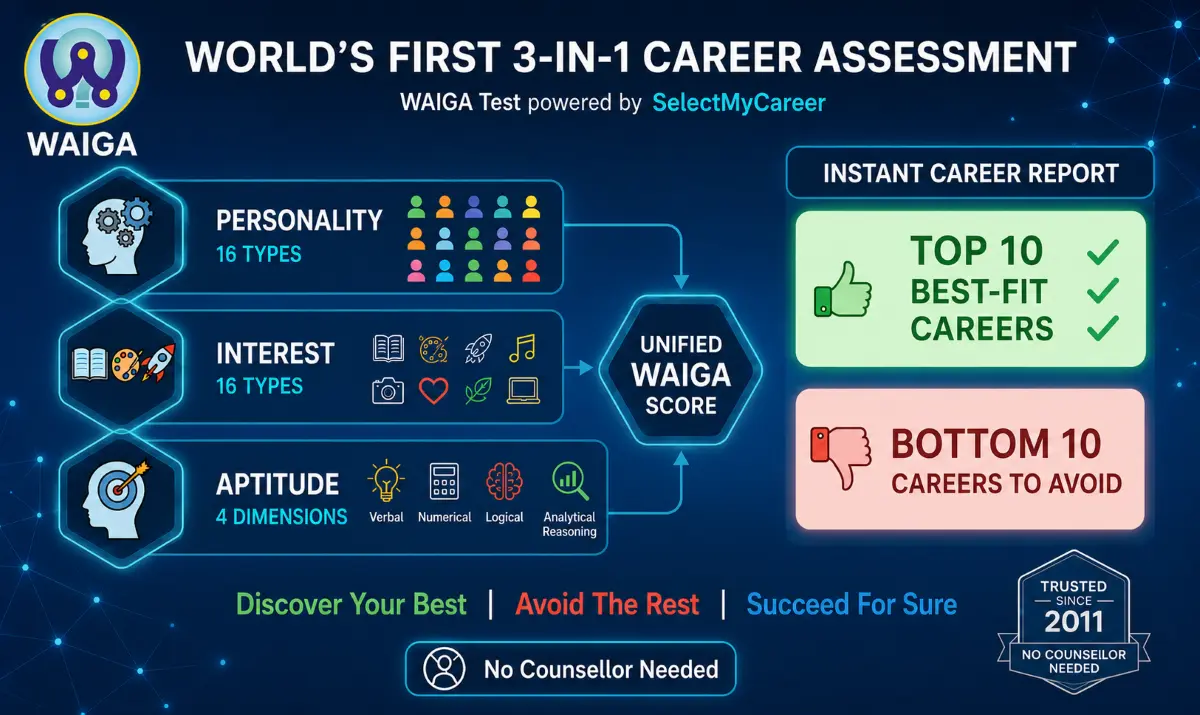
The WAIGA Career Assessment includes:
✔ 7 Interest Types
✔ 16 Personality Types
✔ 4 Aptitude Dimensions
✔ 1 WAIGA Score
✔ Instant Report
✔ No Counsellor Needed—Ever
If you’re ready to move beyond simply following your interests and start making career decisions based on a comprehensive understanding of yourself, explore the WAIGA Career Assessment and discover your unique career profile.
Your future deserves more than guesswork. It deserves clarity, confidence and informed decisions.
✓ One integrated assessment instead of multiple separate tests
✓ Instant personalised report
✓ No counsellor needed — ever
✔ Best on laptop or desktop | ✔ Takes 20-30 minutes | ✔ Instant report — 3 ways to access
✔ Registration takes 2 minutes |✔ Purchased test stays in dashboard — take it anytime
You can also begin with our Free Career Test if you’d like an introduction before taking the full assessment.
If you still have questions, feel free to contact us.
Frequently Asked Questions (FAQs)
Not necessarily. Many people can begin career exploration independently using structured assessments, career research and self-reflection. Professional counselling can be useful in more complex situations, but it is not automatically required simply because you are uncertain about your career.
A career assessment and counselling serve different purposes. An assessment can provide structured information about areas such as aptitude, interests and personality. Counselling provides individual discussion and guidance. If your main need is understanding your career profile, a self-readable assessment may provide enough information to begin exploring your options independently.
Career assessment provides structured information about you. Career counselling is a broader process that may include assessment, discussion, career exploration and decision support. An assessment does not inherently require a counsellor.
Yes. You can understand your strengths, interests, personality and values, research careers, talk to professionals, gain practical experience and compare options independently. A structured assessment can also give you additional information to support the process.
WAIGA brings together personality, interests and aptitude to provide a broader career profile. The purpose is to help you understand yourself and identify career directions that may deserve further exploration.
No. WAIGA is designed with a self-readable report, so you can understand your results yourself. You can choose to discuss your results with parents, teachers or professionals if you want additional perspectives, but a counsellor is not required to interpret the report.
It can be, particularly when a student is facing a complex educational or career decision. However, students can also begin independently by understanding their aptitude, interests and personality and then researching realistic career options.
It can be useful for professionals facing complex career decisions, especially when considering a major transition. However, professionals can also begin with self-assessment, career research and practical exploration before deciding whether additional professional support is necessary.
No assessment should be treated as a guaranteed prediction of your future. A good career assessment provides useful evidence about your profile and can identify career directions worth exploring. The final decision should consider your goals, circumstances, research and real-world experience.
Read and understand your results, identify career directions that appear relevant, research those careers in detail and test your assumptions through real-world exploration wherever possible. The assessment should be the beginning of career exploration—not the end.
Final Takeaway
Career counselling can be valuable.
But career clarity does not automatically require a counsellor.
You can begin by understanding yourself.
Look at your aptitude.
Explore your interests.
Understand your personality.
Consider your values and goals.
Review your skills.
Then research the careers that bring those factors together.
A structured career assessment can make this process easier by giving you objective information about important parts of your career profile.
That is the approach behind WAIGA.
WAIGA brings personality, interests and aptitude together and gives you a self-readable career report that you can understand yourself.
You do not need someone else to tell you what your results mean.
You do not need someone else to choose your future.
You need better information—and the confidence to use it.
Understand yourself. Explore your options. Make your own decision.
Written by the WAIGA Career Guidance Team