

Your Results Are Out. Now What?
Career Options After 12th
Completing Class 12 is a significant milestone. After years of studying, preparing for examinations and waiting for results, you finally reach the point where one question begins to matter more than any mark on your report card:
What should I do next?
For many students, this is the first major life decision they make. The choice you make now will influence not only what you study over the next few years, but also the opportunities, experiences and career paths available to you in the future.
Unfortunately, this decision is often made under pressure. Some students simply choose the course their marks allow. Others follow family expectations, popular trends or the career paths their friends have selected. While these influences are understandable, they don’t necessarily lead to the career that is right for you.
The good news is that today’s students have more career opportunities than ever before. Whether you come from the Science, Commerce or Arts stream, there are hundreds of rewarding careers across technology, healthcare, business, law, design, research, education, public service and many emerging fields that didn’t even exist a decade ago.
The real challenge is not finding career options. The real challenge is identifying the ones that genuinely match your strengths, interests and personality.
This guide explores the major career options available after Class 12 across all three streams. More importantly, it will help you understand how to evaluate those options thoughtfully, so your decision is based on who you are—not simply on what is popular, prestigious or expected.
Common Mistakes Students Make After Class 12
Choosing what to do after Class 12 can feel overwhelming. With so many courses, colleges and career paths available, it’s easy to make decisions based on incomplete information or external pressure rather than genuine self-understanding.
Before exploring different career options, it’s worth being aware of some of the most common mistakes students make.
Choosing a Career Based Only on Marks
Good marks certainly open doors, but they don’t decide which career will make you happy or successful. Two students with identical results may thrive in completely different professions because their interests, personalities and strengths are different.
Following Friends Instead of Yourself
It’s natural to want to stay with friends after school. However, choosing a course simply because your friends are choosing it can lead to years of dissatisfaction if it doesn’t match your own aspirations.
Letting Prestige Decide Everything
Many students believe that only a handful of professions guarantee success or respect. In reality, every field offers excellent opportunities for people who genuinely enjoy the work and are well suited to it.
Ignoring Your Natural Strengths
Some careers demand analytical thinking, others require creativity, communication, leadership or empathy. Ignoring your natural strengths often makes learning more difficult and work less enjoyable.
Choosing Without Understanding Yourself
Perhaps the biggest mistake is trying to choose a career before understanding who you are. Career decisions become much clearer when you first understand your interests, personality and aptitude. Once you know yourself better, evaluating career options becomes far more logical and confident.
Fortunately, avoiding these mistakes doesn’t require predicting the future. It simply requires making your decision with better information and a clearer understanding of yourself.
Before You Look at Options — Understand This First
Exploring career options is important—but choosing the right one begins with understanding yourself.
Every career demands a different combination of abilities, interests, personality traits and working styles. A career that feels rewarding and fulfilling for one person may feel stressful or uninteresting to someone else.
That’s why the question isn’t simply:
“Which career has the best future?”
The better question is:
“Which career is the best fit for me?”
A well-informed career decision considers three essential dimensions:
Interests
What activities genuinely capture your attention and keep you motivated over time?
Personality
How do you naturally think, communicate, solve problems and work with other people?
Aptitude
What are your natural strengths and abilities? Which types of work are you likely to learn quickly and perform well?
When these three dimensions work together, choosing a career becomes far more than selecting a course after Class 12—it becomes choosing a path that aligns with who you are.
Once you understand this foundation, you’re ready to explore the career opportunities available across each stream with much greater clarity and confidence.
Career Options After 12th Science
The Science stream opens the widest range of career options — but also creates the most pressure to follow conventional paths like engineering or medicine. Here is the full picture.
Engineering and Technology
One of the most chosen paths after 12th Science (PCM). Options include Computer Science, Mechanical, Electrical, Civil, Electronics, Chemical, Aerospace and many other branches.
Best suited for: Students with strong mathematical and logical aptitude, genuine interest in how systems and technology work, and a personality comfortable with analytical, structured problem-solving.
Often mismatched for: Students who chose PCM because of marks or pressure but are more naturally drawn to people, creativity or communication-oriented work.
Medicine and Healthcare
MBBS, BDS, BAMS, BHMS, Nursing, Physiotherapy, Pharmacy and allied health sciences.
Best suited for: Students with strong biological aptitude and genuine interest in human health, combined with a personality suited to high-stakes decision-making, empathy and patient interaction.
Honest note: Medicine is a decade-long commitment of education and training. Aptitude for the sciences, genuine interest in patient care and emotional resilience are all essential. Interest alone is not sufficient.
Pure Sciences
BSc in Physics, Chemistry, Mathematics, Biology, Statistics — leading to research, academia, data science or specialised industry roles.
Best suited for: Students with strong investigative aptitude who are genuinely curious about how the natural world works, and whose personality is suited to independent, deep-focus work.
Often overlooked: Pure science graduates with strong quantitative aptitude are increasingly sought after in data science, financial modelling, actuarial science and research roles that pay very well.
Computer Science and IT
Beyond engineering degrees — BSc Computer Science, BCA, and increasingly, specialised programmes in AI, Data Science and Cybersecurity.
Best suited for: Students with strong logical and analytical aptitude, genuine interest in technology and problem-solving, and a personality comfortable with continuous learning in a rapidly changing field.
Architecture and Design
For PCM students with strong spatial aptitude and creative interests — B.Arch leads to careers in architecture, urban planning and interior design.
Best suited for: The combination of mathematical aptitude AND visual-spatial creativity is rare and valuable. Students who have both should seriously consider this path.
Other Science Stream Options
- Biotechnology and Bioinformatics — growing rapidly, combines biology and data
- Environmental Science — increasingly relevant, strong global demand
- Forensic Science — investigative aptitude with science background
- Aviation — Pilot training, Air Traffic Control (strong aptitude requirements)
- Merchant Navy — for those drawn to travel and logistics
Career Options After 12th Commerce
Commerce students often feel their options are narrower than Science students. They are not — the Commerce stream feeds into some of the highest-paying and most dynamic career paths available.
Chartered Accountancy (CA)
One of the most respected and well-paid qualifications. CA is not just accounting — it covers finance, taxation, audit, corporate law and advisory.
Best suited for: Students with strong numerical aptitude, genuine interest in finance and business, and a personality suited to detail orientation, accuracy and sustained independent study.
Honest note: The CA journey is demanding — the pass rate at each level is low. Aptitude for numbers and genuine interest in the domain are both essential. Pursuing CA only for the salary without genuine fit leads to high dropout rates.
Bachelor of Commerce (BCom) + Specialisations
BCom general, BCom (Hons), BCom with specialisations in Finance, Accounting, Banking or Taxation. Often combined with professional qualifications like CMA, CS or MBA.
Company Secretary (CS)
A specialised qualification covering corporate law, compliance and governance. Less known than CA but equally structured and well-respected.
Best suited for: Students with strong verbal and analytical aptitude, interest in law and corporate governance, and a personality suited to precision and rule-based work.
Banking and Finance
BBA (Banking), BCom followed by specialised finance roles, or direct entry into banking after graduation. Investment banking, financial analysis and wealth management are growth areas.
Business Administration
BBA followed by MBA — one of the most flexible paths. Suits students with strong interpersonal aptitude, leadership interests and a personality comfortable with ambiguity and people management.
Economics
BA/BSc Economics — increasingly valued in policy, research, consulting and data analysis. Students with both quantitative aptitude and interest in social systems often thrive here.
Digital Marketing and E-Commerce
A rapidly growing field with strong demand. Suits students with creative and analytical interests, comfortable with technology and data.
Other Commerce Stream Options
- Actuarial Science — highly specialised, extremely well-paid, requires strong mathematical aptitude
- Supply Chain and Logistics Management — growing with e-commerce
- Hotel Management — for those with strong interpersonal interests
- Law (BA LLB) — Commerce background is valuable in corporate law
Career Options After 12th Arts
Arts students face the most social pressure — and the most freedom. The Arts stream feeds into careers that are increasingly in demand in a world that values creativity, communication, critical thinking and human understanding.
Law
BA LLB or BBA LLB — one of the highest-potential career paths available after Arts. Corporate law, litigation, intellectual property, human rights and international law are all growing areas.
Best suited for: Strong verbal and logical aptitude, genuine interest in justice, argument and systems, and a personality comfortable with conflict, persuasion and sustained reading.
Journalism and Mass Communication
BJMC, BA in Journalism — leading to careers in print, digital, broadcast, content creation and communications strategy.
Best suited for: Strong verbal aptitude, genuine curiosity about the world, and a personality comfortable with deadlines, public communication and ambiguity.
Psychology
BA/BSc Psychology — leading to clinical psychology, counselling, organisational psychology, HR and research.
Best suited for: Strong interpersonal aptitude and genuine interest in human behaviour. Growing rapidly as mental health awareness increases.
Design and Fine Arts
BDes, BFA — covering graphic design, product design, fashion design, illustration and visual arts.
Best suited for: Strong visual-spatial aptitude combined with genuine creative interest. Design is increasingly in demand in technology, branding and media companies.
Social Work and Development
BSW — leading to careers in NGOs, policy, community development and international organisations.
Education
BA followed by BEd — teaching and educational administration. Increasingly professionalised with growing demand for quality educators.
Political Science and Public Policy
BA Political Science, followed by civil services preparation or policy research. Suits students with strong analytical and verbal aptitude interested in governance and social change.
Other Arts Stream Options
- Sociology and Anthropology — research, policy, social consulting
- History and Heritage Management — museums, archives, tourism
- Foreign Languages — translation, diplomacy, international business
- Philosophy — surprisingly in demand in ethics, AI policy and consulting
- Event Management — for those with strong organisational and interpersonal interests
The Question Nobody Asks — Which of These Actually Fits You?
By now, you’ve seen that there is no shortage of career options after Class 12. Whether you studied Science, Commerce or Arts, there are dozens of rewarding paths you can pursue.
But here’s the question that really matters:
Which of these careers is genuinely right for you?
This is where many students struggle.
It’s relatively easy to make a list of possible careers. It’s much harder to determine which one matches your natural strengths, interests and personality. Unfortunately, many students choose a career because it appears prestigious, offers a high salary or is recommended by others—without asking whether it truly fits who they are.
The honest truth is that most of us cannot answer this question accurately through self-reflection alone.
We tend to overestimate our strengths in areas we enjoy. We sometimes dismiss careers we would actually excel in simply because we know very little about them. And we often don’t realise whether a particular working environment suits our personality until we’ve already spent years pursuing it.
That’s why understanding yourself is just as important as understanding your career options.
Choosing the right career isn’t about finding the most popular profession. It’s about finding the profession where your aptitude, interests and personality come together in a way that allows you to perform well, stay motivated and build a fulfilling career over the long term.
A Framework for Making This Decision
Before you finalise any decision, ask yourself these three questions honestly:
1. Do I have the natural aptitude this career demands? Not just whether you can pass the entrance exam — but whether the core cognitive demands of the career align with how your mind naturally works. Engineering demands sustained mathematical reasoning. Law demands verbal precision and logical argument. Medicine demands both scientific aptitude and emotional capacity for high-stakes human situations.
2. Will I remain genuinely interested in this for 10, 20, 30 years? Not just right now, when it feels exciting and new. Careers are long. Interest needs to be genuine and sustained, not just a current enthusiasm.
3. Does the working environment suit my personality? A career in research suits someone who thrives in independent, deep-focus work. A career in sales suits someone energised by human interaction and comfortable with uncertainty. A career in medicine suits someone who can make calm decisions under pressure with high emotional stakes. Know what kind of environment brings out your best — and choose accordingly.
If you can answer these three questions with confidence, you’ll already be making a far more informed career decision than many people do.
The challenge, however, is that most students find it difficult to evaluate themselves objectively. We naturally overestimate some strengths, underestimate others and often have limited exposure to the wide range of careers available today.
This is where a structured career assessment becomes valuable. Rather than relying on assumptions or opinions, it provides an objective understanding of your interests, personality and aptitude, helping you identify careers that genuinely align with who you are.
Modern career development research also recognises that effective career decisions involve understanding interests, personality and abilities together rather than relying on a single factor.
The WAIGA Career Assessment follows this integrated approach. Instead of relying on a single test, it combines these key dimensions into one comprehensive framework to generate personalised career recommendations. The goal isn’t to tell you what career to choose—it is to help you make that decision with greater clarity, confidence and self-awareness.
Your Future Deserves More Than a Guess
Choosing what to do after Class 12 isn’t simply about selecting a course—it’s about making one of the most important decisions of your life.
The good news is that you don’t have to rely on guesswork, trends or opinions. The better you understand your interests, personality and aptitude, the more confident you’ll be in choosing a career that genuinely fits you.
If you’re still unsure which path is right for you, the WAIGA Career Assessment can help. It provides personalised career recommendations based on a comprehensive understanding of who you are, helping you make informed decisions with greater clarity and confidence.
Take the first step towards a career you’ll enjoy—not just one you’ll qualify for.
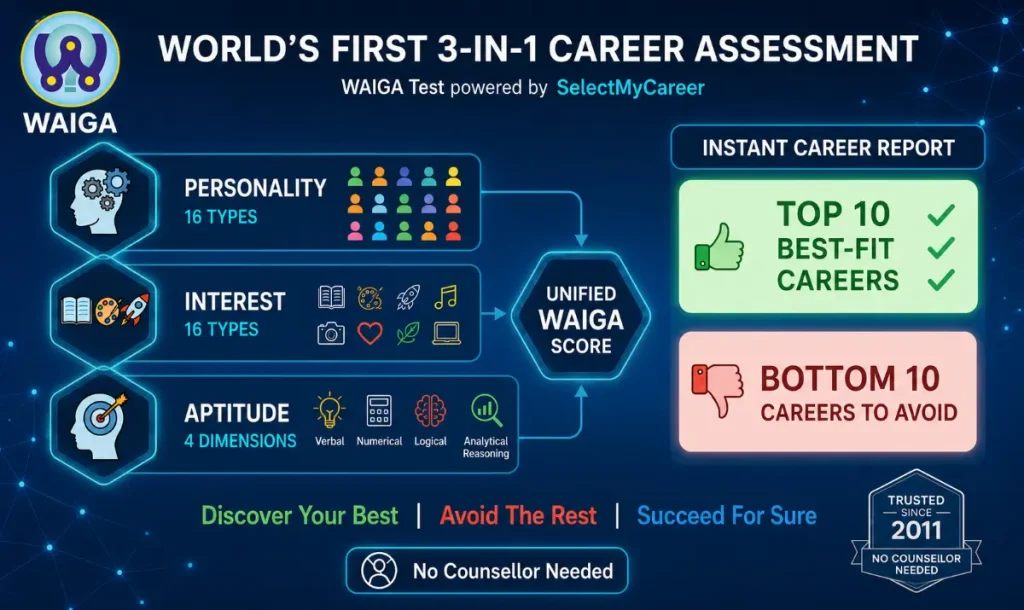
✓ One integrated assessment instead of multiple separate tests
✓ Instant personalised report
✓ No counsellor needed — ever
✔ Best on laptop or desktop | ✔ Takes 20-30 minutes | ✔ Instant report — 3 ways to access
✔ Registration takes 2 minutes |✔ Purchased test stays in dashboard — take it anytime
Frequently Asked Questions
There is no single “best” career after Class 12. The right choice depends on your interests, personality, aptitude and long-term goals. A career that is ideal for one student may not be the best fit for another.
High-paying careers exist in Science, Commerce and Arts. Your long-term success depends far more on your skills, commitment and suitability for the profession than on the stream you studied in school.
Yes. Many people successfully change careers later in life. However, choosing a course that aligns with your strengths and interests from the beginning can save time, effort and unnecessary career changes.
Salary is an important consideration, but it shouldn’t be the only one. Long-term career satisfaction usually comes from choosing work that matches your abilities, interests and personality while also providing opportunities for growth.
The best way is to first understand yourself. Evaluating your interests, personality and aptitude provides a much stronger foundation for choosing a suitable career than relying solely on marks or popular opinion.
No. Every stream offers excellent career opportunities. The right stream is the one that aligns best with your strengths, interests and future aspirations—not the one that is perceived as more prestigious.
A structured career assessment can provide valuable insights, especially if you’re unsure about your future direction. It helps you understand your natural strengths and identify careers that are more likely to suit you.
The WAIGA Career Assessment combines interests, personality and aptitude into one integrated framework instead of relying on a single test. This provides personalised career recommendations based on a more complete understanding of your overall profile.
Written by the WAIGA Career Guidance Team