

Introduction
Choosing a career is one thing. Knowing whether that career is actually right for you is something else.
A career can look excellent on paper and still be a poor fit for the person choosing it. It may offer good opportunities, attractive salaries, or strong growth prospects, yet the everyday work, environment, pressure, responsibilities, or lifestyle may not match what you need to feel satisfied and successful.
That is why career choice should not be based only on whether a profession is considered “good” or “in demand.” A more useful question is:
Table of Contents
Is this career a good fit for me?
Career fit is about the relationship between who you are and the work you are considering. Your strengths, interests, values, skills, preferred working environment, financial expectations, and the kind of life you want to build all matter. No career will match every preference perfectly, but some will fit you far better than others.
The good news is that you do not have to discover the answer through guesswork.
You can examine what a career actually involves, compare it with your own strengths and priorities, identify the skills you may need to develop, and test your assumptions before making a major commitment. The goal is not to find a mythical “perfect career.” It is to make a career decision based on evidence rather than an attractive job title, outside pressure, or a temporary feeling.
In this guide, we will look at the most important factors that determine career fit and show you how to evaluate them in a practical way.
Because the right question is not simply “Is this a good career?”
It is “Is this a good career for me?”
1. What Does Career Fit Actually Mean?
Career fit is the degree to which a career aligns with who you are, what you can do, what you enjoy, and the kind of working life you want to have.
It is easy to think about career fit in very simple terms:
“I like this career, so it must be right for me.”
But liking the idea of a career is only one part of the picture.
You might be fascinated by medicine but dislike the realities of clinical work. You might enjoy technology but prefer working with people rather than spending most of your day working independently. You might be good at mathematics but have little interest in using that ability in a highly repetitive role.
This is why career fit is better understood as a combination of factors rather than a single characteristic.
The main dimensions of career fit
When evaluating whether a career suits you, consider at least these areas:
Interests — What subjects, activities and types of work naturally attract your attention?
Aptitude — Which kinds of mental or practical tasks are you naturally better equipped to handle?
Personality — What type of working environment and interaction style suits you?
Skills — What can you already do, and what can you realistically learn?
Values — What matters most to you in your working life?
Lifestyle — How does the career fit with the way you want to live?
Practical expectations — Does the career offer realistic opportunities, income, stability and growth that fit your circumstances?
These dimensions do not always point in exactly the same direction. That is normal.
A career might score highly on your interests but poorly on your preferred lifestyle. Another might match your aptitude extremely well but offer little of the kind of work you find meaningful.
The objective is therefore not to find a career that scores perfectly on every dimension.
It is to identify a career where the overall alignment is strong enough to support a satisfying and sustainable working life.
Career fit can change
Your career fit is not necessarily fixed for your entire life.
Your interests can develop. Your priorities can change. You can acquire new skills, gain experience, take on family responsibilities, or decide that aspects of your lifestyle matter more than they once did.
A career that suited you at 22 may not be the career you want at 35. Similarly, a career that seemed unsuitable earlier may become attractive after you develop new skills or gain a better understanding of yourself.
That is why career fit should be treated as something you evaluate in the context of your current life and future goals, rather than as a permanent label.
Fit is more useful than reputation
A career can be prestigious, popular or financially attractive and still be the wrong choice for you.
Likewise, a career that receives less attention may provide an excellent fit with your strengths, interests and preferred way of working.
The important question is not:
“Is this considered a good career?”
It is:
“What makes this career a good—or poor—fit for me?”
That shift in perspective is the starting point for making a more informed career decision.
2. Start With Your Strengths, Not Your Job Title
When people begin thinking about careers, they often start with a job title.
Should I become a doctor? A software developer? A teacher? An accountant? A designer?
A better starting point is often a more fundamental question:
What am I naturally good at, and where could those strengths be useful?
A useful starting point is a career self-assessment, which can help you examine your skills, interests, values and motivations before researching specific career options.
This does not mean choosing a career simply because you are good at something. Strengths are only one part of career fit. But understanding them gives you an important foundation for evaluating whether a particular career deserves further consideration.
Your strengths are more than your academic marks
One common mistake is to equate strengths with school or college grades.
Good grades can provide useful information, but they do not capture everything a person can do well.
Someone may be particularly strong at analysing information, solving unfamiliar problems, communicating ideas, organising people, understanding patterns, working with numbers or adapting to new situations—even if those strengths are not fully reflected in their academic record.
Similarly, being successful in one subject does not automatically mean that the related profession will be a good career fit.
Being good at mathematics, for example, does not necessarily mean that you will enjoy a career that involves using mathematics every day.
Distinguish between a strength and a skill
A skill is something you can learn and develop through education, practice and experience.
A strength can describe an area in which you tend to perform effectively or have a natural inclination toward certain types of tasks.
The two overlap, but they are not identical.
You may already have a strong ability that you have never formally developed into a professional skill. Conversely, you may have acquired an important skill through years of practice even though it was not initially one of your strongest areas.
This distinction matters when evaluating career options.
A career should not automatically be rejected simply because you do not currently possess every required skill. Some skills can be learned.
The more important question is whether you have a reasonable foundation on which to build.
Look for patterns in what comes naturally
Think about situations in which you consistently perform well.
Do people come to you when they need help solving a difficult problem?
Are you good at explaining complicated ideas?
Do you quickly notice patterns that others miss?
Are you comfortable analysing information and reaching conclusions?
Do you naturally organise tasks and keep projects moving?
Do you find it easy to understand how systems work?
Do you work particularly well with people?
These patterns can provide clues about the types of work in which you may have an advantage.
But don’t stop at strengths
A strong career fit usually requires more than capability.
You might be excellent at something you have no desire to do for eight hours a day.
That is why strengths should be considered alongside interests, personality, values, lifestyle and other aspects of career fit.
The goal is not to ask:
“What am I best at?”
and immediately turn the answer into a career.
Instead, ask:
“Which of my strengths could I use in work that I would also find meaningful, interesting and suitable for the life I want?”
That question takes us from simply identifying strengths to understanding career fit.
And that is where career exploration becomes much more useful.
Next, we’ll look at interests—because being capable of doing something and actually wanting to do it are two very different things.
3. Examine What Kind of Work You Actually Enjoy
Knowing what you are good at is important. But it is only half of the career-fit question.
The next question is:
What kind of work do I actually enjoy doing?
This is where interests become important.
An interest is not simply a subject you like reading about or a hobby you enjoy in your free time. In a career context, it is useful to think about the activities, problems, subjects and types of work that naturally attract your attention.
For example, someone may enjoy technology but dislike programming. Someone else may enjoy helping people but prefer doing so through analysis rather than direct interaction. A person may love science but dislike laboratory work.
The subject alone does not tell you whether the career will fit.
Separate the idea of a career from the reality of the work
Many careers sound attractive because of the way they are presented.
A person may say:
“I want to be a lawyer.”
But what specifically attracts them?
Is it argument and debate? Research? Writing? Helping people? The intellectual challenge? The status associated with the profession?
Similarly, someone who says:
“I want to work in technology.”
may actually be interested in solving problems, creating things, working with data, understanding systems, or simply working in a fast-changing industry.
Those are very different motivations, and they can lead to very different career choices.
Ask what you enjoy doing, not just what you like
Try completing these sentences:
- I enjoy solving problems that involve…
- I like learning about…
- I would rather spend my working time…
- I enjoy working with…
- I find it satisfying when…
- I lose track of time when…
- I would willingly become better at…
The answers can reveal patterns that broad career labels may hide.
You may discover that you consistently enjoy analysing, creating, helping, organising, investigating, persuading, teaching, building, or working with people.
Those patterns are often more useful for career exploration than simply naming a profession.
Interest matters because careers contain repeated activities
A career is not one exciting job description.
It is a collection of activities that you may perform repeatedly over months and years.
That is why it is important to ask yourself whether you would actually enjoy the ordinary parts of the work, not just the exciting highlights.
A career might sound fascinating when described in a two-minute conversation. But if most of the actual work involves activities you strongly dislike, the initial attraction may not translate into long-term satisfaction.
Interest alone is not enough
There is another important distinction.
Enjoying something does not automatically mean you are suited to making it your career.
You may love photography but not want to work as a professional photographer. You may enjoy discussing financial markets but dislike the pressure of working in finance. You may love helping friends solve problems but not enjoy doing similar work in a highly structured professional environment.
That does not make your interests irrelevant.
It simply means interest is one part of career fit, not the whole answer.
The strongest career possibilities are often found where your interests and strengths overlap, and where the resulting work also fits your personality, values and desired lifestyle.
That brings us to an important question: what happens when you are interested in something but your current aptitude does not appear to match it? That’s where understanding the difference between interest and aptitude becomes particularly valuable.
4. Consider Your Values
You can be good at something and enjoy doing it, yet still find the resulting career unsatisfying.
One reason is values.
Your career does not exist separately from the rest of your life. The way you work affects your time, income, relationships, responsibilities, freedom and sense of purpose. If a career consistently conflicts with the things that matter most to you, even a strong match in skills and interests may not feel like a good fit.
So ask yourself:
What do I want my work to give me beyond a salary?
What matters most to you?
Different people place different importance on different aspects of working life.
For one person, financial security may be the highest priority. Someone else may value independence and flexibility more. Another person may want work that provides a strong sense of purpose or social impact.
Other common career values include:
- stability and security
- financial rewards
- independence
- creativity
- recognition and achievement
- learning and intellectual challenge
- helping others
- leadership
- work-life balance
- flexibility
- variety
- social interaction
- responsibility
- opportunities for advancement
There is no universally correct list.
The important thing is understanding your own priorities.
Values can change over time
What you value in your early career may not be what you value later.
A recent graduate may prioritise learning and rapid advancement. A few years later, stability, flexibility or family time may become more important.
This is one reason career fit should not be treated as a permanent label.
A career that was a good fit at one stage of your life can become less suitable when your circumstances or priorities change.
Don’t confuse values with preferences
A preference is something you would like.
A value is something that has deeper importance to you.
For example, you may prefer working from home because it is convenient. But if flexibility is essential to maintaining the lifestyle you want, it may actually represent an important career value.
Likewise, you may prefer a high salary, but if financial security is one of your central priorities, compensation may be much more than a simple preference.
Understanding that distinction helps you make better career decisions.
Career values can involve trade-offs
This is where career choice becomes more realistic.
You may want:
high income + complete flexibility + predictable hours + rapid advancement + minimal stress
But very few careers will provide all of these simultaneously.
Good career decisions therefore require you to identify which values are essential, which are important, and which are simply nice to have.
That allows you to evaluate careers more realistically instead of searching for an impossible combination of everything you want.
Ask what you would be unwilling to compromise
Sometimes your strongest values become clearer when you think about what you don’t want.
Would you be unhappy with frequent travel?
Would you strongly dislike highly unpredictable working hours?
Would you struggle in a career with little opportunity for advancement?
Would you find it difficult to work in an environment with constant competition?
Would a career feel meaningless to you if it offered no opportunity to help or serve others?
These questions can eliminate unsuitable options surprisingly quickly.
A career should fit your life, not just your résumé
Ultimately, career fit is not only about whether you can perform the work.
It is also about whether the way that work is structured is compatible with the life you want to build.
That is why values belong alongside strengths and interests when you evaluate a career.
And there is another dimension we need to consider: your personality and the kind of working environment in which you are most likely to function well.
5. Think About the Work Environment
A career can match your strengths, interests and values and still feel wrong if the working environment does not suit you.
This is an area people often overlook because career discussions tend to focus on job titles.
But two people can have the same occupation and experience completely different levels of satisfaction depending on where and how they work.
So instead of asking only:
“What career do I want?”
also ask:
“What kind of working environment brings out my best?”
Do you prefer working with people or independently?
Some careers involve constant interaction with colleagues, customers, clients or the public.
Others involve long periods of independent concentration.
Neither is inherently better.
If you gain energy from discussion, collaboration and interaction, a highly isolated role may become frustrating. Conversely, if you prefer uninterrupted concentration, a role involving constant meetings and social interaction may become exhausting.
The important thing is to recognise your preference rather than assuming that one working style is universally desirable.
How much structure do you need?
Some people perform best when expectations, procedures and responsibilities are clearly defined.
Others prefer autonomy and flexibility and enjoy deciding how to approach their work.
Consider whether you prefer:
- clear rules or freedom to experiment
- predictable routines or variety
- closely defined responsibilities or broad ownership
- regular supervision or considerable independence
A career can be an excellent match in every other respect but become uncomfortable if its level of structure is fundamentally different from what you prefer.
Consider the pace of work
Work environments also differ in their pace.
Some careers involve deadlines, competition and frequent changes in priorities. Others are more predictable and methodical.
Ask yourself:
Do I enjoy working under pressure, or do I perform better when I have time to think carefully?
Again, there is no universally correct answer.
The goal is to find an environment in which your natural working style can function effectively.
Think beyond the office
The physical setting can matter too.
Would you prefer:
- working primarily at a desk?
- travelling regularly?
- working outdoors?
- working in a laboratory or workshop?
- working remotely?
- working across different locations?
Lifestyle and working environment often overlap. A career that requires frequent travel may be exciting to one person and deeply inconvenient to another.
The people around you matter
Your preferred environment also includes the people you work with.
Some people thrive in highly collaborative teams. Others prefer smaller teams or independent responsibilities.
You may also have preferences regarding:
- leadership style
- organisational culture
- competition versus cooperation
- client-facing versus behind-the-scenes work
- formal versus informal communication
These factors rarely appear in a simple job title, yet they can have a significant effect on your everyday experience.
Don’t confuse discomfort with poor fit
One caution is important.
A new environment may feel uncomfortable simply because it is new.
Being challenged, learning unfamiliar processes or adapting to different colleagues does not automatically mean that a career is a poor fit.
The question is whether the environment is fundamentally incompatible with your preferred way of working—not whether everything feels comfortable from day one.
Look for the environment, not just the occupation
When researching a career, try to discover what the actual working conditions are like.
Talk to people already doing the work. Read realistic job descriptions. Look beyond promotional descriptions and investigate the ordinary working day.
You may discover that what attracted you to a particular career is only a small part of what the job actually involves.
And that is exactly why career fit requires looking at the whole picture, not just the profession’s name.
Next, we’ll examine another important distinction: having the skills a career requires today versus having the capacity and willingness to develop the skills you don’t yet have.
6. Match the Career With Your Skills—and Identify the Gaps
Once you understand your strengths, interests, values and preferred working environment, there is another practical question to answer:
What does this career actually require, and how closely do my current skills match those requirements?
This is where career exploration becomes more concrete.
A career may sound like a good fit in theory, but you also need to understand what you would actually be expected to do and what capabilities you would need to develop.
Don’t expect to have every skill already
One of the most common mistakes in career exploration is assuming:
“I don’t have all the required skills, so this career isn’t for me.”
That is rarely a useful way to think about career fit.
People develop professionally over time. Education, training, practice and experience can change what you are capable of doing.
Instead, divide the requirements into two groups:
What you already have
and
What you need to develop.
This creates a much more realistic picture of the transition.
Identify your transferable skills
Your existing experience may contain skills that are valuable in a different career.
For example, you may already have experience with:
- communication
- leadership
- problem-solving
- analysis
- project management
- research
- organisation
- relationship building
- presentation
- negotiation
- technology
- customer interaction
The job title attached to your current experience may be different, but the underlying capabilities can still be relevant.
This is particularly important for professionals considering a career change because changing careers does not necessarily mean starting from zero.
Separate essential requirements from learnable skills
Not every requirement has the same importance.
Some may be essential qualifications or capabilities that you must possess before entering the field.
Others may be skills that employers expect you to develop through training or experience.
When researching a career, ask:
- Which qualifications are mandatory?
- Which skills are commonly expected?
- Which skills can be learned?
- How long would it realistically take to develop them?
- Can I gain experience while remaining in my current career?
This helps you distinguish between a genuine barrier and a development opportunity.
Look honestly at your skill gaps
Being optimistic is useful, but so is being realistic.
If a career requires capabilities that you currently lack, don’t simply assume that motivation will solve everything.
Estimate the actual investment required.
You may need:
- formal education
- professional certification
- technical training
- supervised experience
- portfolio development
- practical projects
- industry exposure
The size of the gap matters.
A small, manageable skills gap may be a reason to explore the career further. A large gap requiring many years of expensive preparation may change the practical attractiveness of the option.
Your current skill level is not your final skill level
Career fit should not be judged entirely by what you can do today.
Consider your ability and willingness to learn.
Someone who does not yet have a particular technical skill but enjoys learning and has demonstrated an ability to master related subjects may have a very different career outlook from someone who has the skill but strongly dislikes using it.
That is why skills should be considered alongside aptitude, interests and motivation.
Look for the overlap
The strongest career possibilities often lie where three things come together:
What you are good at
- what you want to do
- what the career actually requires
The larger the useful overlap, the more promising the career may be.
But even a strong overlap needs to be tested against the realities of the occupation.
Because before deciding that a career fits you, you need to understand what the career really looks like in everyday life—not just how attractive it sounds from the outside.
7. Look at the Reality Behind the Career
A career can look like an excellent fit when you read about it online. The reality can be quite different.
This is one of the most important stages of evaluating career fit because people often choose careers based on an idealised picture of the profession rather than the work they would actually be doing every day.
Before deciding that a career is right for you, investigate what it really involves.
Look beyond the job title
A job title tells you very little about the actual experience of doing the work.
Two people with the same professional title can have very different responsibilities depending on their organisation, industry, seniority and role.
Instead of asking only:
“Would I like to be a software developer?”
ask:
“What would I actually spend most of my working day doing?”
That question forces you to examine the activities behind the title.
Understand the everyday responsibilities
Find out what professionals in the field actually do.
Consider:
- What tasks occupy most of their time?
- How much of the work is independent?
- How much involves meetings, clients or colleagues?
- What kinds of problems do they solve?
- How repetitive or varied is the work?
- What are the most demanding parts?
- What responsibilities increase as you become more experienced?
The ordinary parts of a career matter more than the occasional exciting moments.
Research qualifications and entry requirements
A career may appeal to you, but entering it may require specific education, certification, licensing or experience.
Find out what is genuinely required and distinguish mandatory requirements from preferences.
This prevents a common mistake: either assuming that entering the field is impossible when it is not, or underestimating the preparation required when it is substantial.
Consider income realistically
Money is not the only measure of career fit, but it is a legitimate consideration.
Look beyond an attractive headline salary.
Consider:
- typical starting income
- how earnings develop with experience
- geographic differences
- employment type
- additional qualifications
- earning variability
- the cost of entering the profession
Your financial expectations should be part of the decision rather than something considered only after you have committed to the career.
Investigate the employment outlook
A career can be personally attractive but difficult to enter or sustain in a particular market.
Look at the demand for the occupation, the types of employers hiring, geographic opportunities and how the field may change over time.
This does not mean trying to predict the future perfectly.
It means making sure that your career decision is informed by the current reality of the occupation rather than assumptions.
Talk to people who actually do the work
One of the most valuable forms of career research is conversation.
If possible, speak with people who currently work in the field and ask questions such as:
- What does a normal day look like?
- What do you enjoy most?
- What do you find most difficult?
- What surprised you after entering the profession?
- What skills matter most?
- What do you wish you had known before choosing this career?
These conversations can reveal aspects of a career that job descriptions and promotional material rarely communicate.
Research the career you would actually have
The objective is not to find reasons to reject a career.
It is to replace an imagined version of the career with a realistic one.
If you still find the work attractive after understanding its ordinary responsibilities, challenges, requirements and lifestyle implications, you have much stronger evidence that the career may genuinely fit you.
And if the reality changes your mind, that is valuable information too.
The earlier you discover that a career does not suit you, the less costly it is to change direction.
Next, we’ll look at how to go one step further: testing a career before making a major commitment.
Want More Evidence About Your Career Fit?
If you’re still unsure whether a career matches your strengths, interests, personality and aptitude, a structured career assessment can give you another useful perspective.
The WAIGA assessment brings these areas together to help you understand your overall career profile and identify careers that may be a stronger fit.
It isn’t about letting a test make the decision for you. It’s about having better information to consider alongside your own research, experience and goals.
8. Test a Career Before Making a Major Commitment
You don’t always have to make a career decision by choosing between “commit” and “don’t commit.”
Sometimes the better approach is to test the career first.
This is particularly valuable when a career looks promising on paper but you have limited experience with the actual work. A small amount of real-world exposure can tell you things that personality quizzes, job descriptions and online research cannot.
Start with low-risk experiments
Before investing several years in a new degree or making a major career move, look for ways to experience the work on a smaller scale.
Depending on the career, you might:
- take a short introductory course
- complete a practical project
- volunteer
- shadow someone working in the field
- speak with experienced professionals
- take on freelance or part-time work
- attend industry events
- participate in an internship
- work on a realistic simulation or case study
The objective is not to become an expert.
It is to gather evidence about your own response to the work.
Pay attention to the ordinary experience
Suppose you are considering a career in data analysis.
You might enjoy reading about data, watching videos about analytics and imagining yourself working with sophisticated datasets.
But what happens when you actually spend several hours cleaning data, checking errors, interpreting results and explaining your findings?
That experience is much more informative.
The same principle applies to almost any career.
Don’t test only the most exciting part. Try to experience some of the ordinary tasks that professionals perform repeatedly.
Ask yourself what you learned
After an experiment, don’t simply ask:
“Did I enjoy it?”
Ask better questions:
What parts did I find interesting?
What parts did I find frustrating?
Did I want to become better at the work?
Did the difficulty motivate me or discourage me?
Could I imagine doing similar work regularly?
Did the reality match what I expected?
Your answers can provide valuable evidence about career fit.
A small experiment can prevent a large mistake
Career decisions can involve substantial investments of time, money and effort.
A short course or practical project may require only a few hours or weeks.
That makes experimentation particularly useful when you are uncertain.
You don’t need absolute certainty before exploring a career. Instead, you can reduce uncertainty gradually.
Research gives you information.
Conversation gives you perspective.
Practical experience gives you evidence.
Together, they create a much stronger foundation for a career decision.
Testing a career does not guarantee certainty
Even after trying a career-related activity, you may still be unsure.
That’s perfectly normal.
Some aspects of professional work cannot be experienced until you have spent significant time in the field.
The purpose of testing is therefore not to produce a perfect prediction.
It is to answer a more practical question:
“Do I have enough evidence to investigate this career further?”
If the answer is yes, continue exploring.
If the answer is no, you may have saved yourself from making a much larger commitment based on an assumption.
And there is one more distinction worth making: a career can be a good fit even when it challenges you. Difficulty alone is not evidence that you have chosen the wrong path.
9. Don’t Confuse Difficulty With Poor Career Fit
One of the easiest mistakes to make when evaluating a career is assuming that something difficult must be something that doesn’t suit you.
It isn’t.
Almost every worthwhile career involves tasks that are demanding, unfamiliar or occasionally frustrating. You may struggle while learning a new skill, feel uncomfortable during your first few months, or discover that certain responsibilities require considerably more effort than you expected.
None of these things automatically mean that the career is wrong for you.
A good fit can still be challenging
Consider someone who is naturally suited to analytical work but has never used a particular software platform.
They may initially find the technology difficult.
That doesn’t necessarily indicate poor career fit. It may simply indicate a skills gap.
The more useful question is:
“Do I dislike this type of work, or am I simply not good at it yet?”
Those are very different situations.
If the difficulty comes from a skill you can reasonably learn, it may be worth investing the time to improve.
Look at your response to the challenge
Your reaction to difficulty can provide useful information.
When something is challenging, do you:
- become curious about how to improve?
- enjoy solving the problem once you understand it?
- feel motivated by gradual progress?
- remain interested despite the learning curve?
Or do you consistently find yourself thinking:
- “I don’t want to do this.”
- “I have no interest in becoming better at this.”
- “I dislike the nature of this work, not just the difficulty.”
- “Even when I’m capable of doing it, I don’t want to spend my working life doing it.”
The second group may indicate a deeper mismatch.
Don’t use “passion” as the only test
There is also a danger in expecting the right career to feel exciting all the time.
No profession is enjoyable every day.
There will be routine tasks, difficult colleagues, deadlines, administrative work and periods of stress.
A career can still be an excellent fit even if you don’t love every part of it.
What matters is whether the overall nature of the work aligns with you.
Separate temporary frustration from persistent mismatch
Suppose you have recently started a new role and feel overwhelmed.
It would be premature to conclude that the entire career is wrong.
You may simply be adjusting to:
- unfamiliar responsibilities
- a new organisation
- a steep learning curve
- increased expectations
- a different working environment
Give yourself enough time to distinguish temporary adjustment difficulties from a persistent lack of fit.
On the other hand, if the same fundamental problems remain after you have gained experience and developed your skills, they deserve closer examination.
Difficulty can sometimes be a positive sign
There is an interesting paradox in career development.
Sometimes the work that challenges you the most is also the work that gives you the greatest sense of achievement.
Learning something difficult can be satisfying when the underlying activity genuinely interests you.
So don’t ask only:
“Is this career easy for me?”
Ask:
“Is this a challenge I am willing to take on because the work itself matters to me?”
That is a much better test of career fit.
The real warning sign
The strongest warning sign is not simply difficulty.
It is a persistent combination of:
low interest + poor alignment with your strengths + conflict with your values + an unsuitable working environment + no desire to develop the required skills.
When several of these appear together, the career deserves serious reconsideration.
But if the career aligns with your interests and values, suits your preferred environment and gives you a reason to keep learning, difficulty by itself should not disqualify it.
A career that fits you well may stretch you. It simply shouldn’t require you to become someone you fundamentally don’t want to be.
Next, we’ll turn this into a practical exercise: how to build a career-fit scorecard so you can compare a career against your own priorities instead of relying on a vague feeling.
10. Watch for These Signs That a Career May Not Fit
Sometimes career fit becomes clearer when you look at the opposite question:
What might tell me that this career is probably not a good fit?
A single concern does not necessarily mean you should abandon a career. Every career has difficult aspects, and everyone has preferences that will not be perfectly satisfied.
The concern becomes more meaningful when several signs point in the same direction and continue over time.
1. You dislike the core activities of the work
If the central activities of a career consistently drain you, that matters.
For example, if a career involves extensive client interaction but you strongly dislike client-facing work, or it requires continuous analysis but you have little interest in analytical tasks, the mismatch may be fundamental rather than temporary.
2. The career conflicts with your important values
A career may offer good opportunities but still conflict with what matters most to you.
If flexibility is essential to you but the occupation requires rigid schedules, or if meaningful social impact is a major priority but the work provides little opportunity for it, the mismatch deserves attention.
3. The working environment consistently feels wrong
You may discover that the profession itself is interesting but the typical working environment does not suit you.
Perhaps you prefer independence but the role requires constant collaboration. Or you thrive on variety while the work is highly repetitive.
These differences can have a significant effect on long-term satisfaction.
4. You are attracted mainly to the image of the career
Ask yourself whether you like the career itself or the idea of being someone who has that career.
Status, salary, prestige or social recognition can be powerful influences.
But if those external rewards disappeared, would you still want to do the actual work?
That question can reveal whether your interest is genuine.
5. You repeatedly avoid developing the required skills
A skills gap is not necessarily a problem.
But if you repeatedly have opportunities to develop an essential skill and have absolutely no interest in doing so, that may be useful evidence.
A career does not require you to love every skill you need to learn. However, you should be willing to become competent at the core capabilities the work demands.
6. The lifestyle is fundamentally incompatible with yours
Some career characteristics cannot easily be separated from the profession.
Frequent travel, irregular hours, relocation, long training periods or demanding schedules may be unavoidable in certain fields.
If those characteristics conflict with your non-negotiable lifestyle priorities, the career may not be a practical fit even if you enjoy the work itself.
7. Your expectations don’t match reality
Perhaps you expected creativity but discovered that the role is largely administrative.
Perhaps you expected independence but found constant supervision.
Perhaps you expected rapid progression but the typical career path is much slower.
A mismatch between expectations and reality is not necessarily a reason to quit. But it is a reason to re-evaluate your assumptions.
Don’t make a decision based on one bad day
This is important.
A difficult day, disappointing manager or stressful project does not tell you whether an entire career is wrong for you.
Look for patterns rather than isolated experiences.
If the same fundamental concerns continue across different situations, become clearer with experience, and affect several dimensions of career fit, they deserve serious consideration.
Poor fit is information, not failure
Discovering that a career does not suit you is not a wasted exercise.
In fact, it can be one of the most valuable outcomes of career exploration.
Knowing what doesn’t fit helps narrow the field and prevents you from investing further in a direction that is unlikely to work.
The objective is not to force yourself into a career simply because you once chose it.
The objective is to make increasingly informed decisions about where your abilities, interests, values and circumstances are most likely to come together.
And now we can make that evaluation much more practical by putting these factors into a career-fit scorecard.
11. Use a Career Fit Scorecard
When you are considering a career, it is easy to rely on an overall feeling:
“This sounds right for me.”
That feeling can be useful, but it can also be influenced by salary, prestige, family expectations, social trends or a particularly attractive description of the profession.
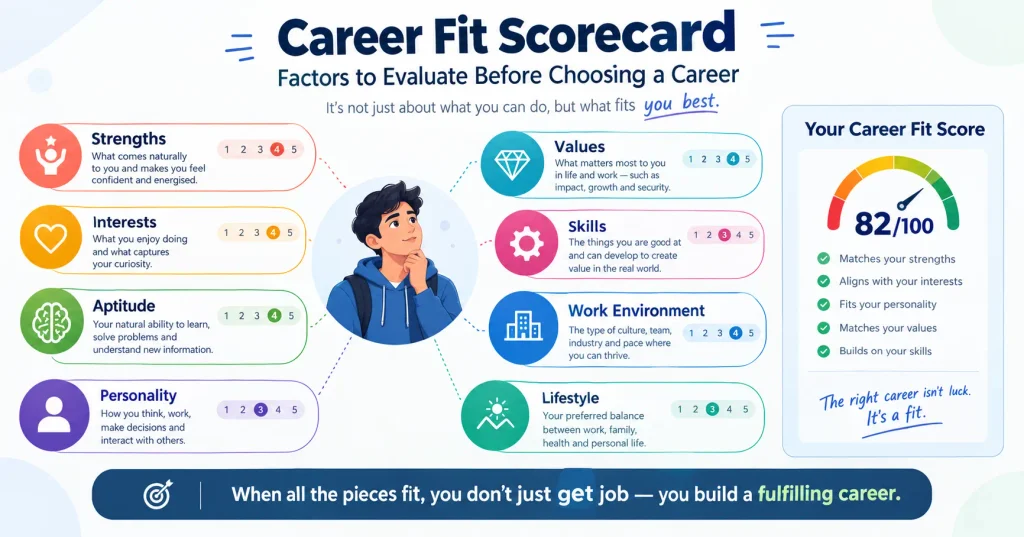
A simple career fit scorecard can make the decision more deliberate.
The idea is not to produce a magical number that tells you which career to choose. Instead, it helps you examine the different dimensions of fit separately and identify where the strongest matches—and biggest concerns—actually are.
Rate the career across several dimensions
Take the career you are considering and evaluate it against factors such as:
| Career-fit factor | Ask yourself |
|---|---|
| Strengths | Does this career make good use of what I am naturally good at? |
| Interests | Do I genuinely enjoy the activities involved? |
| Aptitude | Do I have the underlying ability to learn and perform the required work? |
| Values | Does the career support what matters most to me? |
| Personality | Does the working style suit how I naturally operate? |
| Skills | Do I have the required skills, or can I realistically develop them? |
| Work environment | Would I be comfortable in the typical working environment? |
| Lifestyle | Does the career fit the kind of life I want? |
| Practical reality | Are the income, opportunities, qualifications and career path realistic for me? |
You can rate each area, for example, from 1 to 5:
1 = Very poor fit
2 = Weak fit
3 = Moderate fit
4 = Strong fit
5 = Excellent fit
The numbers themselves are not the important part.
The value comes from forcing yourself to explain why you gave each rating.
Don’t simply add the numbers
It may be tempting to calculate a total and declare that the highest-scoring career wins.
Don’t.
A career could score highly overall while having one serious weakness that you cannot accept.
For example, imagine a career receives strong scores for interests, strengths and aptitude but scores very poorly for a lifestyle requirement that is non-negotiable for you.
A simple average could hide that problem.
Instead, identify your non-negotiables.
If a particular career requirement is essential to you, a major mismatch in that area deserves more attention than several minor advantages elsewhere.
Compare alternatives
The scorecard becomes even more useful when you compare two or three realistic career options.
You might discover that:
- Career A matches your interests extremely well but has a lifestyle you don’t want.
- Career B matches your skills and lifestyle but offers less of the work you find interesting.
- Career C provides a strong balance across most areas but requires additional training.
This is much more informative than asking which career sounds most exciting.
It also reduces the pressure to find one perfect answer.
Use evidence for your ratings
Your scorecard should not simply record your assumptions.
For each important rating, ask:
“What evidence do I have for this?”
If you give a career a 5 for work environment, but you have never spoken to anyone in that profession or experienced the environment yourself, that rating may simply reflect an assumption.
Likewise, if you give yourself a low score for skills, determine whether the gap is genuinely significant or simply something that could be addressed through training.
The more evidence you collect, the more useful your scorecard becomes.
Revisit the scorecard as you learn
Your first version does not need to be final.
After speaking with professionals, taking a course, completing a practical project or researching the occupation more deeply, update your ratings.
You may discover that an assumption was wrong.
That is not a problem.
Changing your assessment as you gain better information is exactly what good career decision-making looks like.
The scorecard is a decision aid—not a decision maker
This distinction is especially important for career choices.
No spreadsheet, quiz or assessment can completely determine what you should do with your working life.
A scorecard helps you structure your thinking.
It can reveal:
- where the career fits you strongly
- where the gaps are
- which assumptions need testing
- what you need to learn
- what trade-offs you may have to accept
- whether you need more information before deciding
The final decision still belongs to you.
And that is ultimately what a good career-fit process should achieve: not telling you what career to choose, but helping you make a better-informed choice.
12. Give Yourself Time to Validate the Decision
Even after researching a career, assessing your strengths, testing the work and completing a career-fit scorecard, you may still feel uncertain.
That is normal.
A career decision does not always become obvious in a single moment. Sometimes confidence develops gradually as you collect more evidence and see whether your expectations continue to match reality.
Don’t demand absolute certainty
One of the biggest problems with career decisions is the expectation that you should somehow become 100% certain before moving forward.
That standard is unrealistic.
You cannot know everything about a career before experiencing it. You may not know exactly how your interests will change, what opportunities will appear, or how your priorities will evolve.
A better goal is reasonable confidence based on good evidence.
Instead of asking:
“How can I be completely certain this is the right career?”
Ask:
“Do I have enough evidence to believe this career is a sensible direction for me?”
That is a much more achievable question.
Let evidence accumulate
Your confidence can become stronger as you move through different stages:
Self-assessment → research → conversations → practical experience → reflection → decision
Each stage gives you a different kind of information.
For example, an assessment might reveal that your strengths and interests appear compatible with a particular career. Research can then show you what the occupation actually involves. Speaking with professionals can add perspective, while practical experience can reveal how you personally respond to the work.
You don’t need one source of information to answer everything.
The goal is to see whether different sources of evidence point in roughly the same direction.
Give yourself permission to revise your thinking
You may begin this process believing that one career is perfect for you and later discover that another option makes more sense.
That’s not a failure.
It means your decision improved as your information improved.
The same applies after you enter a career. Your first job does not have to determine the next 30 years of your life.
You can develop new skills, discover new interests, change responsibilities or move into a different direction later.
Career fit is therefore not a one-time calculation. It is something you can continue to evaluate as your circumstances change.
Know when you have enough information
There is also a danger on the other side: endless analysis.
You can keep taking assessments, reading articles and comparing careers indefinitely.
At some point, additional research produces less value than actually taking a small step.
If you have:
- examined your strengths
- considered your interests and values
- researched the real career
- identified important skill requirements
- considered the working environment and lifestyle
- tested the career where possible
- compared your options honestly
then you may already have enough information to make a reasonable decision.
You don’t need perfect certainty.
You need enough clarity to take the next sensible step.
Career decisions are allowed to evolve
Choosing a career is not necessarily choosing one unchangeable path.
Your first decision may lead to another opportunity. A skill you develop in one profession may become valuable somewhere else. An interest you discover later may open a completely different direction.
That is why a good career decision should give you both direction and room to adapt.
The purpose of evaluating career fit is not to predict your entire future.
It is to make your next major career decision more informed, realistic and aligned with who you are now.
And that leads to one final idea that is worth remembering: the right career does not have to be perfect.
13. The Right Career Does Not Have to Be Perfect
After everything we have covered, it is worth stepping back from the idea of finding the perfect career.
It may not exist.
A career can be a very good fit without matching every single preference, strength, interest and expectation you have.
Look for a strong overall fit
The goal is not to find work that is perfect in every dimension.
Instead, look for a career where the important pieces fit together reasonably well:
- You can use your strengths.
- You have genuine interest in the work.
- Your personality is reasonably compatible with the environment.
- The career supports your important values.
- You can develop the skills it requires.
- The lifestyle is acceptable to you.
- The practical realities are realistic for your circumstances.
- You can see yourself growing within the field.
There may still be difficult tasks.
There may be stressful periods.
There may even be parts of the job you dislike.
That does not automatically make the career a poor choice.
Career fit involves trade-offs
Every career involves trade-offs.
One profession may offer excellent income but less flexibility. Another may provide meaningful work but require longer training. Another may offer independence but less predictable employment.
The question is not:
“Which career has no disadvantages?”
A better question is:
“Which combination of advantages and disadvantages makes the most sense for me?”
Your answer will depend on your circumstances and priorities.
Your definition of a good career can change
What fits you at 18 may not be exactly what fits you at 30.
Your financial responsibilities may change. Your interests may develop. Your family situation may change. You may discover strengths you didn’t recognise earlier.
That doesn’t mean your previous career decision was necessarily wrong.
It means you changed—and your career priorities can change with you.
Good career planning therefore leaves room for adaptation rather than treating one decision as permanent.
Don’t wait for a perfect feeling
You may never reach a point where you think:
“There is absolutely no doubt. This is definitely the perfect career for me.”
Waiting for that feeling can keep you stuck.
Instead, aim for something more practical:
enough evidence + reasonable fit + manageable trade-offs + willingness to learn.
That combination can provide a much stronger foundation for a career decision than trying to eliminate every uncertainty.
Career fit is about alignment, not perfection
Ultimately, the right career is not necessarily the one that looks best from the outside.
It is the one where your strengths, interests, personality, values, abilities, skills, environment and practical expectations come together in a way that makes sense for your life.
And that is why asking “Is this a good career?” is often less useful than asking:
“Is this a good career for me?”
Once you approach the decision that way, career choice becomes less about finding a universally perfect profession and more about finding a direction that genuinely fits you.
14. Final Takeaway: How to Know If a Career Is Right for You
Knowing whether a career is right for you is rarely about finding one perfect answer.
It is about looking at the whole picture.
A career may be a strong fit when your strengths can be used meaningfully, your interests are connected to the actual work, your values are respected, your personality suits the environment, and the skills required are realistic for you to develop.
At the same time, practical realities matter.
The career should make sense for the kind of lifestyle you want, the opportunities available to you, the training you are willing to pursue, and the expectations you have about income, growth and work.
Look for alignment, not perfection
You don’t need every factor to score a perfect 5 out of 5.
Instead, look for a strong overall pattern of alignment.
Ask yourself:
- Does this career use my strengths?
- Do I genuinely have interest in the work itself?
- Does it suit my personality and preferred working environment?
- Does it support my most important values?
- Can I realistically develop the skills I need?
- Does the lifestyle work for me?
- Have I researched what the career is actually like?
- Have I tested my assumptions where possible?
- Are the disadvantages acceptable to me?
- Do I have enough evidence to move forward?
If most of these answers are positive, you may have a strong foundation for exploring the career further.
If several answers are negative, that doesn’t automatically mean you must reject the career. It means you have identified areas that deserve closer examination.
Use assessment as evidence—not as your final answer
This is where a structured career assessment can be useful.
Your own reflection can reveal what you think about yourself. Practical experience can show you how you respond to real work. Career research can reveal what an occupation actually demands.
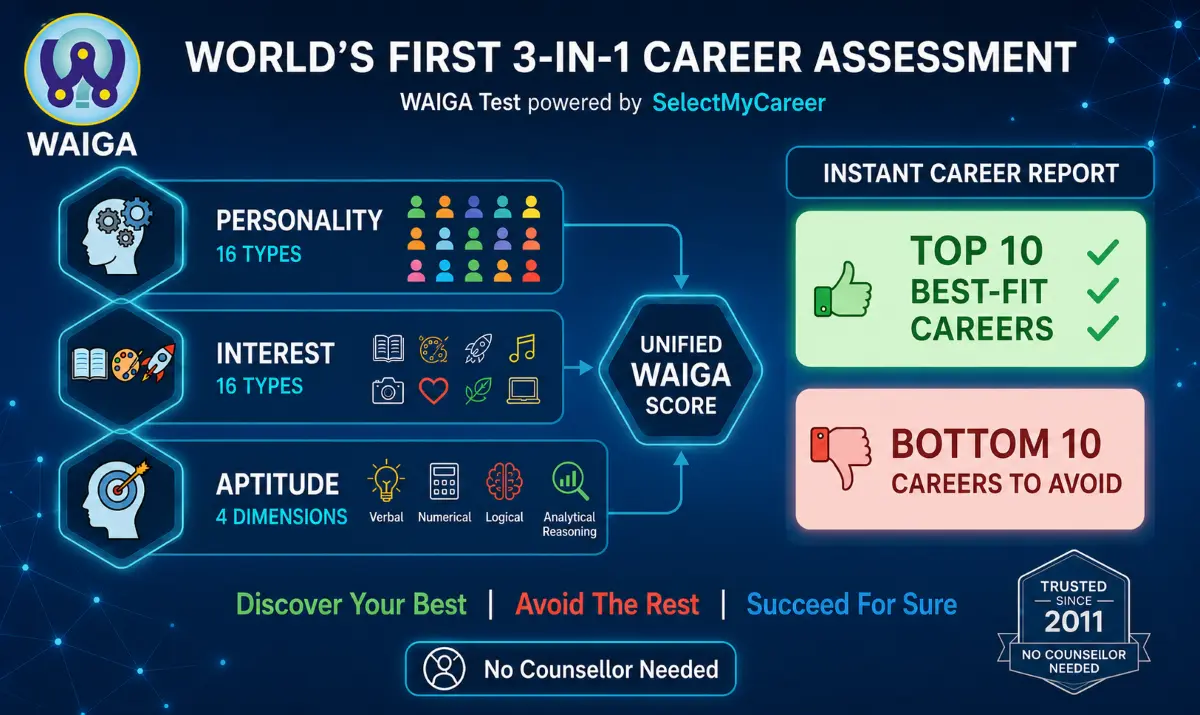
A structured assessment can add another layer of evidence by examining characteristics such as personality, interests and aptitude together.
The purpose is not to hand you a career and tell you to follow it blindly.
The purpose is to help you understand yourself more clearly and compare that information with potential career paths.
Your career decision still belongs to you
No career test can completely understand your circumstances, ambitions, responsibilities and changing priorities.
And no assessment can guarantee that a particular career will make you happy.
What it can do is reduce some of the uncertainty.
The strongest career decisions usually come from combining different types of evidence:
Know yourself → understand the career → test your assumptions → compare the fit → make an informed decision.
That is a much stronger process than choosing a career because it is popular, prestigious, recommended by someone else, or simply because an online quiz gave you an interesting result.
The question to remember
When you are evaluating your next career direction, don’t ask only:
“Is this a good career?”
Ask:
“Is this a good career for me?”
That small change in perspective can completely change the way you approach career choice.
You are not looking for the career that is universally best.
You are looking for a career where who you are, what you can do, what you value and the way you want to live can come together in a realistic and sustainable way.
And the more evidence you gather before making a major commitment, the more confident and informed your decision can become.
Ready to Understand Your Career Fit?
If you’re asking yourself, “Is this career really right for me?”, don’t rely on one factor—or one quick online quiz—to find the answer.
Look at the bigger picture: your strengths, interests, aptitude, personality, values, skills and preferred way of working.
A structured assessment can help you bring those pieces together and give you a clearer starting point for your career decision.
Choosing a career does not begin with finding the perfect answer.
It begins with understanding yourself.
What are your natural strengths?
What kinds of work genuinely interest you?
How do you naturally prefer to work?
What possibilities might fit the person you are—and the life you want to build?
The WAIGA Career Assessment is designed to help you answer those questions with structured information rather than guesswork.
The most confident career decisions come from understanding what you enjoy, what you are naturally good at, how you prefer to work and which careers align with all of these dimensions.
That is the philosophy behind the WAIGA Career Decision Framework™.
WAIGA helps you understand your interests, personality and aptitude together, giving you structured information to consider as you explore your next career direction.
The WAIGA Career Assessment includes:
✔ 7 Interest Types
✔ 16 Personality Types
✔ 4 Aptitude Dimensions
✔ 1 WAIGA Score
✔ Instant Report
✔ No Counsellor Needed—Ever
Understand Yourself. Explore Your Options. Make Your Decision.
A career assessment can give you a starting point.
Your exploration gives you context.
Your priorities give you direction.
And the final decision is yours.
If you’re ready to start making career decisions based on a comprehensive understanding of yourself, explore the WAIGA Career Assessment and discover your unique career profile.
Your future deserves more than guesswork. It deserves clarity, confidence and informed decisions.
✓ One integrated assessment instead of multiple separate tests
✓ Instant personalised report
✓ No counsellor needed — ever
✔ Best on laptop or desktop | ✔ Takes 20-30 minutes | ✔ Instant report — 3 ways to access
✔ Registration takes 2 minutes |✔ Purchased test stays in dashboard — take it anytime
You can also begin with our Free Career Test if you’d like an introduction before taking the full assessment.
If you still have questions, feel free to contact us.
FAQs
Frequently Asked Questions About Career Fit
A career is more likely to be a good fit when it aligns with your strengths, interests, aptitude, personality, values, skills, preferred work environment and lifestyle. Researching the actual work and gaining practical experience can help you test whether your expectations match reality.
Career fit involves several factors, including your strengths, interests, aptitude, personality, values, skills, work environment, lifestyle preferences and practical expectations. Looking at these factors together gives you a more complete picture than focusing on just one.
Yes. Difficulty does not automatically mean poor career fit. A career can challenge you while still matching your interests, strengths and values. The important question is whether you are willing to develop the skills required and whether you find the underlying work meaningful or interesting.
No. Interest is one part of career fit, but it is not the whole picture. You may be interested in a particular career but find that its required skills, working environment, values or lifestyle do not suit you. Strong career fit considers multiple factors together.
A structured career assessment can provide additional evidence about your personality, interests and aptitude and help you understand how these characteristics relate to potential career options. It should be used as one part of the decision-making process alongside research, reflection and real-world experience.
Yes. Your interests, skills, values, responsibilities and lifestyle priorities can change as you gain experience and move through different stages of life. A career that fits you well today may not be exactly what you want later, which is why career planning should allow room for adaptation.
Start by identifying what you are uncertain about. Research the career, speak with people who work in the field, test the work through a practical project or short experience where possible, and review your strengths, interests, values and skills. You do not need absolute certainty—you need enough evidence to make a reasonable next decision.
Written by the WAIGA Career Guidance Team