
Changing careers is rarely as simple as deciding that you no longer like your current job. For many professionals, the uncertainty is much deeper: Is the problem my current workplace, my role, or the career itself? And if a career change really is necessary, how do you know which direction to take next?
Table of Contents
A career transition can feel especially difficult when you have already invested years in education, experience and professional development. Starting over may seem risky, while staying where you are may feel increasingly unfulfilling. The good news is that a career change does not always mean throwing away everything you have built. In many cases, your existing skills, experience and knowledge can become valuable foundations for a different career direction.
The challenge is identifying what needs to change and what should remain.
Before making a major career decision, it helps to look beyond job titles and salary. Your interests, personality, aptitudes, skills, values, preferred working environment and long-term priorities can all influence whether a career is likely to suit you. A structured career assessment can provide useful information, but the assessment is only one part of a much broader decision-making process.
This guide explains how to think through a career change systematically—from identifying whether you actually need a new career to exploring alternatives, evaluating your options and planning a realistic transition. It also explains how understanding your personality, interests and aptitude together can provide a more complete starting point for evaluating potential career directions.
The U.S. Bureau of Labor Statistics’ Occupational Outlook Handbook is a useful starting point for comparing occupations, including typical duties, education and training requirements, pay, and job outlook.
The goal is not to find a perfect career with absolute certainty. It is to make a better-informed career decision based on a clearer understanding of yourself, your options and the direction you want your working life to take.
1. Should You Change Careers—or Just Change Jobs?
One of the most important questions to answer before planning a career change is whether you actually need to change careers.
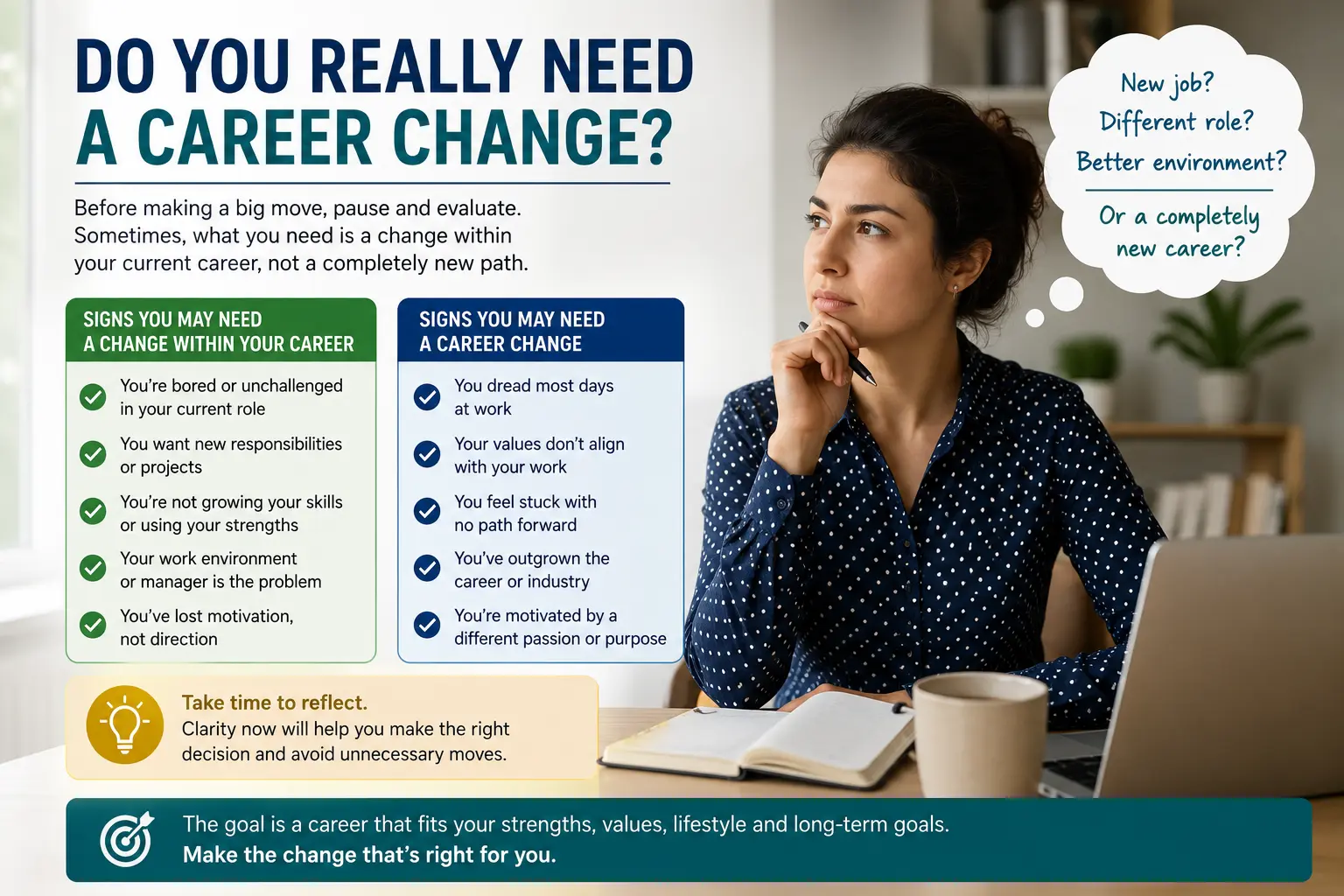
A difficult manager, unhealthy workplace, long commute, poor work-life balance or lack of recognition can make a job feel wrong even when the underlying career is still a good fit. Changing employers or moving into a different role within the same field may solve the problem without requiring a complete career transition.
A career change is different. It usually means moving into a substantially different professional direction—often involving a different type of work, industry, role or set of responsibilities.
Signs that the problem may be your job
Consider whether your dissatisfaction is mainly connected to:
- your manager or team
- workplace culture
- compensation
- workload or working hours
- lack of flexibility
- commuting or location
- limited opportunities for advancement
- a particular employer or organisational environment
If most of your concerns would disappear by changing employers or roles, a job change may be the more appropriate solution.
Signs that the problem may be your career
The situation may be different if you consistently feel that:
- the actual work does not interest you
- the core responsibilities of the profession do not suit you
- your natural strengths are rarely used
- the working environment required by the career conflicts with how you prefer to work
- you have little interest in developing further in the field
- you have explored different employers or roles but continue to experience the same fundamental dissatisfaction
These patterns can suggest that the issue is deeper than one particular job.
However, dissatisfaction alone does not automatically mean you have chosen the wrong career. Temporary stress, burnout, personal circumstances and a difficult period at work can all affect how you perceive your career.
The first step in a career transition is therefore diagnosis, not resignation.
Before deciding what career to move into, understand what is actually causing you to want to move away from your current one. This distinction can prevent you from making a major career change when what you really need is a different employer, role or working environment.
2. Understand What Is Driving Your Career Dissatisfaction
Once you have established that the problem may be deeper than your current job, the next step is to understand what is actually missing from your present career.
It is easy to describe a career as “wrong” without identifying why it feels wrong. A more useful approach is to break the experience down into specific dimensions.
Start with your interests
Ask yourself:
- Which parts of my work do I genuinely enjoy?
- Which tasks make me curious enough to keep learning?
- Which responsibilities do I consistently avoid or postpone?
- Do I still find the subject matter of my profession interesting?
A lack of interest does not necessarily mean you need a new career, but persistent disengagement from the core activities of your profession is worth examining.
Consider your personality and preferred way of working
The same occupation can feel very different depending on the working environment.
You might prefer:
- working independently or collaborating closely with others
- predictable routines or varied responsibilities
- analytical work or people-focused work
- structured environments or greater autonomy
- deep concentration or frequent interaction
If your career repeatedly requires you to work in ways that conflict with your natural preferences, the problem may be one of career or work-environment fit.
Examine your aptitudes and strengths
Being experienced in something does not necessarily mean it is the kind of work in which you have the strongest natural aptitude.
Consider:
- What types of problems do I solve relatively easily?
- Which activities require less effort for me than they seem to require for others?
- Which capabilities have consistently helped me perform well?
- Am I using my strongest abilities in my current career?
This is also where it is important to distinguish aptitude from qualifications or experience. A person can acquire competence through education and practice without that competence necessarily representing their strongest underlying aptitude.
Look at your values and priorities
Your priorities can also change over time.
Perhaps earlier in your career you prioritised:
- salary
- status
- rapid advancement
- professional recognition
Later, you may place greater importance on:
- flexibility
- meaningful work
- stability
- autonomy
- family time
- learning
- social impact
A career that once suited your priorities may no longer fit the life you want to build.
Look for patterns rather than one bad experience
One frustrating project, difficult manager or disappointing year should not automatically trigger a career change.
Instead, ask:
“If the circumstances around my current job changed, would I still want to do this kind of work?”
If the answer is consistently no, you may be dealing with a career-fit issue rather than a temporary workplace problem.
This kind of self-examination creates a much better foundation for the next stage: identifying what you might want from your next career.
3. Identify What You Want From Your Next Career
Once you understand what is not working in your current career, the next question is more constructive:
What do you want your next career to provide that your current one does not?
This is where a career change becomes more than an escape from dissatisfaction. Instead of choosing something simply because it is different, you can begin defining what a better direction would look like.
Define your preferred work
Think about the type of work you would like to do regularly, not just the job title you find attractive.
Consider:
- What kinds of problems would I like to solve?
- Would I prefer working with people, information, ideas, systems or practical tasks?
- Do I want more creativity, analysis, interaction or independence?
- Would I prefer predictable responsibilities or greater variety?
- What kinds of activities give me a sense of accomplishment?
These questions help shift your attention from “What career should I leave?” to “What kind of work do I want to move toward?”
Think about the environment in which you work best
The right career is not only about what you do. It is also about how and where you do it.
You might prefer:
- a collaborative or independent environment
- a structured or flexible workplace
- office-based, remote or field work
- a specialist role or broader responsibilities
- a stable environment or one with frequent change
Two careers may look similar on paper but provide very different working experiences.
Consider your longer-term priorities
Your next career should also fit the life you want outside work.
Think about the importance you place on:
- income and financial security
- flexibility
- work-life balance
- location
- advancement
- learning opportunities
- meaningful contribution
- stability
- independence
There may not be one career that maximises all of these factors. The goal is to understand which ones matter most to you.
Separate preferences from non-negotiables
Not every preference has equal importance.
For example, you might prefer remote work but consider financial stability a non-negotiable. You might like rapid advancement but consider predictable working hours more important at this stage of your life.
Making this distinction helps you evaluate career options realistically rather than searching for an imaginary career that satisfies every requirement.
Don’t choose a new career yet
At this stage, resist the temptation to immediately search for a job title.
First understand the characteristics of the career you want.
Once those characteristics are clearer, you can compare them with your abilities, interests, personality and existing experience—and then begin exploring careers that may provide a better overall fit.
That leads to an important next step: understanding what you already bring to a career transition.
4. Take Stock of the Skills and Experience You Already Have
A career change does not necessarily mean starting from zero. Before deciding what to pursue next, take a realistic inventory of what you have already developed through education, work and life experience.
This step is important because professionals often underestimate how transferable their existing capabilities can be.
Separate your job title from your actual skills
Your current job title describes your position, but it does not fully describe what you can do.
For example, a professional may have developed experience in:
- analysing information
- solving problems
- managing projects
- communicating with clients
- leading teams
- writing and presenting
- using specialised software
- organising complex processes
- making decisions under pressure
- training or mentoring others
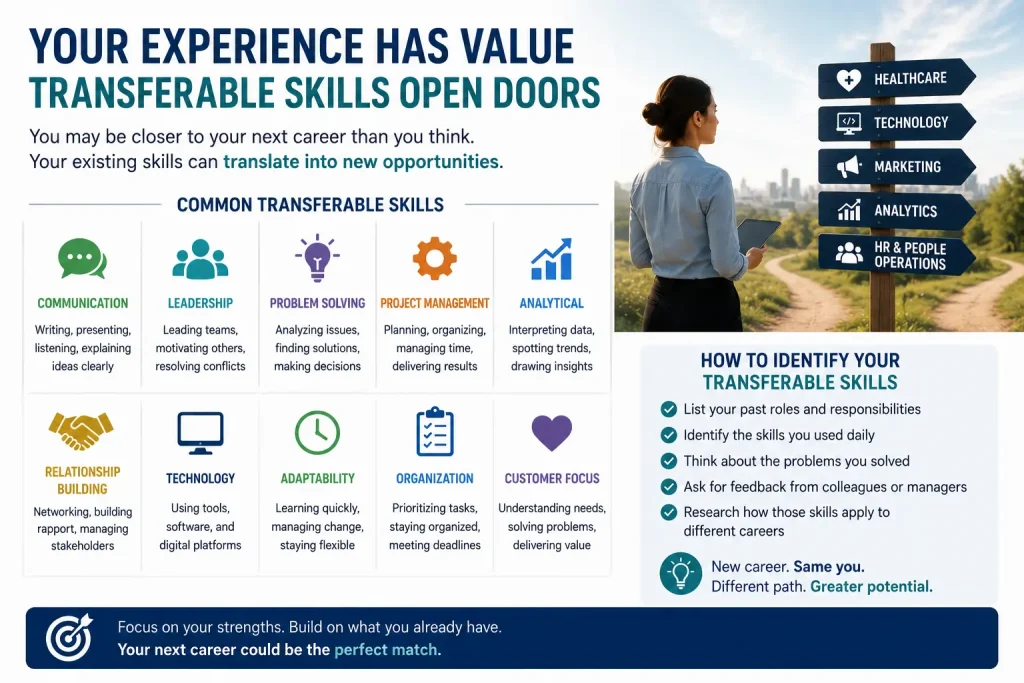
Some of these capabilities may remain valuable even when you move into a different industry or occupation.
Identify your strongest capabilities
Ask yourself:
- What am I consistently good at?
- What responsibilities have I performed successfully?
- What do colleagues or managers usually rely on me for?
- Which skills have I developed repeatedly throughout my career?
- Which activities feel relatively natural to me?
It can also help to look beyond your own perception. Performance reviews, feedback from colleagues and examples of successful projects can reveal strengths that you may take for granted.
Distinguish skills from aptitude
Skills are capabilities you have developed through learning and experience. Aptitude is different: it relates to your underlying ability in particular areas.
This distinction matters during a career transition.
You may have become highly competent at a task because you have performed it for ten years. That does not necessarily mean it represents your strongest natural aptitude—or that you want to continue doing it.
Conversely, you may have strong aptitude in an area that your current career has never given you much opportunity to use.
A career change can therefore involve transferring existing skills while discovering where your broader abilities may be better utilised.
Look for transferable experience
Instead of asking:
“What jobs can I get with my current job title?”
try asking:
“Where else could my existing capabilities be useful?”
A sales professional may have developed negotiation, communication and relationship-building skills. A project manager may have planning, coordination and problem-solving capabilities. A teacher may have communication, presentation, organisation and mentoring experience.
The same capability can have value across multiple occupations.
Don’t assume experience determines your future
Your previous career is an important source of information, but it does not have to dictate your next one.
The objective is to understand what you are carrying forward:
experience + skills + strengths + interests + personality + priorities
Once you have this clearer picture, you can begin exploring career options that build on what you already have rather than assuming that a career transition requires a complete reset.
5. Explore Career Options Before You Commit to a Change
Once you understand your strengths, preferences, experience and priorities, you can begin exploring careers that might offer a better overall fit.
This is where many career changes go wrong. A professional becomes interested in one occupation, sees a few appealing aspects of it and starts planning the transition before finding out what the work is actually like.
Career exploration should come before commitment.
Look beyond job titles
A job title can sound attractive without telling you much about the day-to-day reality of the work.
For each career you are considering, investigate:
- What does the work involve on a typical day?
- What skills are used most frequently?
- What type of working environment is common?
- What qualifications or training are normally required?
- What are the likely entry routes?
- What opportunities exist for progression?
- What challenges or less attractive aspects come with the work?
The more realistic your picture of the career becomes, the less likely you are to make a decision based on an idealised description.
Explore several alternatives
Avoid replacing one narrow career choice with another narrow career choice.
Instead, create a shortlist of several possibilities and compare them.
For example, if you enjoy analytical problem-solving but want more interaction with people, there may be several careers worth investigating rather than one obvious answer.
This approach also helps you identify patterns. You may discover that several different careers appeal to you for similar reasons.
Talk to people who actually do the work
Research is useful, but conversations with professionals can provide context that job descriptions cannot.
Ask people about:
- what they actually do during a normal week
- what they enjoy and dislike
- which skills matter most
- what surprised them after entering the field
- how they entered the profession
- what they would recommend to someone considering a transition
Where possible, speak with people at different stages of the career. Someone new to a profession may have a very different experience from someone who has been in it for ten years.
Consider the transition requirements
A career can look like a good fit and still require a difficult transition.
For each option, identify:
- additional qualifications
- certifications or licences
- training requirements
- financial implications
- likely entry-level expectations
- time required to become established
- whether your existing experience can transfer
This doesn’t mean avoiding careers that require additional preparation. It simply means understanding the investment before committing to it.
Use assessment as one source of evidence
A structured career assessment can help you generate or evaluate possibilities by providing information about characteristics such as interests, personality and aptitude.
But an assessment should support your exploration—not replace it.
A career appearing high on an assessment does not automatically make it the right choice. Likewise, a career that interests you should still be examined against your abilities, preferences, circumstances and the realities of the work.
The strongest career-transition decisions come from combining self-understanding with real-world career exploration.
Once you have a realistic shortlist, the next challenge is to compare those options systematically rather than choosing the first one that seems attractive.
6. Evaluate Your Career Options Before Making the Move
Exploring several careers gives you possibilities. Evaluation helps you decide which of those possibilities is actually worth pursuing.
At this stage, try to move beyond the question:
“Which career sounds most interesting?”
and ask:
“Which option offers the strongest overall fit with who I am, what I can do and the life I want to build?”
Compare the options against the same criteria
Create a simple comparison for each career on factors such as:
- Interest: Would I genuinely enjoy the core activities?
- Aptitude: Do my abilities align with the demands of the work?
- Personality: Does the typical working environment suit how I prefer to work?
- Skills: Which of my existing capabilities can I carry into the new career?
- Values: Does the work align with what matters to me?
- Lifestyle: Does it fit my preferred working hours, location and flexibility?
- Growth: Are there realistic opportunities to learn and progress?
- Transition: What additional training, time or investment would be required?
- Practicality: Does the change make sense for my current financial and personal circumstances?
No single factor should necessarily determine the decision.
A career may be highly interesting but require a transition that is currently unrealistic. Another may make excellent use of your skills but provide little satisfaction. A third may offer a better balance between interest, ability, personality, lifestyle and practical requirements.
Look for overall alignment
This is where understanding multiple dimensions together becomes particularly useful.
Your interests can indicate the kinds of activities and subjects that naturally attract you. Your personality can provide insight into how you may prefer to work and interact with your environment. Your aptitude can provide information about areas in which you may have stronger underlying capabilities.
Looking at these dimensions together can give you a broader basis for evaluating career possibilities than relying on any one of them alone.
That does not mean that an assessment can make the decision for you. It means that assessment information can become one part of a more informed evaluation.
Consider trade-offs honestly
Every career involves compromises.
You may have to balance:
interest vs. income
flexibility vs. stability
meaning vs. convenience
existing experience vs. a new direction
short-term cost vs. long-term opportunity
There is no universal formula for resolving these trade-offs. Their importance depends on your circumstances and priorities.
The objective is not to find a career with zero disadvantages. It is to identify an option whose overall advantages and trade-offs make sense for you.
Test your assumptions before committing
Before making a major transition, look for opportunities to validate your assumptions.
Depending on the career, this might involve:
- speaking with professionals
- taking a short course
- completing a small project
- volunteering
- shadowing someone
- freelancing or taking on related work
- participating in professional communities
Small experiments can provide valuable information before you make a large commitment.
Once you have evaluated your options realistically, you are in a much stronger position to decide whether, when and how to make the transition.
7. Plan the Transition Before You Leave Your Current Career
Once you have identified a promising direction, resist the temptation to make an immediate leap.
A career transition is usually easier to manage when you treat it as a process rather than a single decision.
Understand what the transition will require
For your preferred career options, identify the practical steps between where you are now and where you want to be.
These may include:
- additional education or training
- professional certifications
- building new technical or specialist skills
- gaining relevant experience
- developing a portfolio
- expanding your professional network
- adapting your CV or professional profile
- understanding the expectations of employers in the new field
The requirements will vary considerably from one career to another. Some transitions may build directly on your existing experience, while others may require more substantial preparation.
Look for ways to transition gradually
Where practical, consider whether you can test or begin developing the new direction without immediately leaving your current career.
For example, you might:
- take a relevant course while working
- work on projects related to the new field
- volunteer or freelance in a relevant area
- speak with professionals already working in the field
- build relevant skills outside your normal job
- explore internal opportunities within your current organisation
A gradual transition can reduce uncertainty and give you additional evidence about whether the new career is actually right for you.
Consider the financial implications
Career changes can involve temporary financial costs.
You may need to account for:
- training expenses
- reduced income during a transition
- relocation
- a period of job searching
- loss of certain benefits
- time required to become established in the new field
Understanding these factors in advance does not mean allowing money to determine your entire decision. It means making the transition with realistic expectations.
Don’t assume you have to start at the bottom
One of the biggest misconceptions about career change is that changing fields automatically means abandoning everything you have achieved.
In many cases, transferable skills and experience can help you enter a new career at a level that reflects at least some of what you already know.
The transition may still require learning and adaptation, but your previous experience can remain an asset.
Give yourself a realistic timeline
A career transition may take weeks, months or even years depending on the direction you choose.
Avoid comparing your timeline with someone else’s.
Instead, establish practical milestones:
What do I need to learn?
What experience do I need?
When can I begin testing the new direction?
What financial preparation do I need?
What would tell me that I am ready to make the move?
A well-planned transition gives you more control over the process and reduces the pressure to make one large decision all at once.
The final step is not simply deciding which career to choose, but deciding whether the evidence you have gathered is strong enough to move forward.
8. Use Career Assessment as Evidence, Not as the Decision
When you are considering a career change, it is natural to look for a test that will simply tell you what to do next. But a career assessment is more useful when you treat it as structured information about yourself, rather than as a final answer.
A good assessment can help you identify patterns that may be difficult to see on your own.
Look at more than one dimension
Career fit is rarely explained by a single characteristic.
Your interests can provide insight into the kinds of activities and subjects that attract you. Your personality can help you understand how you may prefer to work and interact with your environment. Your aptitude can provide information about areas in which you may have stronger underlying capabilities.
Looking at these dimensions together can produce a more complete picture than relying on any one assessment alone.
This is particularly relevant when considering a career transition. You may discover that your current career makes good use of one aspect of your profile while leaving other strengths or interests largely unused.
Use the results to generate questions
The most useful assessment result may not be a specific career recommendation.
Instead, it may prompt questions such as:
- Why do I consistently enjoy certain types of work?
- Why do some responsibilities feel more natural to me?
- Which of my strengths am I not currently using?
- Does my preferred working environment match my current career?
- Which alternative careers deserve further investigation?
These questions can lead to better career exploration.
Don’t treat a score as a verdict
An assessment result should not make you think:
“This is the career I must choose.”
Nor should an unexpected result automatically make you reject a career you have already considered carefully.
Assessment results need to be interpreted alongside your experience, skills, circumstances, values and knowledge of the actual career.
The purpose is to increase the quality of your decision, not to transfer responsibility for the decision to a test.
This is where a structured assessment can help
WAIGA takes a multidimensional approach by measuring interests, personality and aptitude independently and combining the results into a unified WAIGA Score. This provides structured information that can be used when exploring and evaluating potential career directions.
For someone considering a career transition, that information can serve as one additional source of evidence alongside professional experience, skills, career research and real-world exploration.
The important point is what happens after the assessment: you still need to examine the alternatives, understand the transition requirements and decide whether the direction makes sense for your life.
A career assessment can help you see possibilities more clearly. It cannot live the next career for you.
Ready to Understand Your Career Fit More Clearly?
If you’re considering a career change but aren’t sure which direction fits you best, understanding your interests, personality and aptitude can give you a more structured starting point.
The WAIGA assessment brings these dimensions together to help you develop a clearer picture of your career profile and explore career directions that may be worth considering.
9. Know When You’re Ready to Make the Career Change
After researching alternatives, evaluating your fit and planning the practical transition, you eventually reach the point where information needs to become a decision.
Being ready does not mean having complete certainty. Career decisions rarely come with guarantees.
Instead, look for evidence that you have moved beyond an emotional reaction to your current situation and have developed a reasoned case for the change.
You understand why you want to leave
You should be able to explain what is driving the change without relying solely on statements such as:
“I hate my job.”
You have identified whether the underlying issue involves your role, workplace, career direction, working environment, interests, priorities or some combination of these.
You have a credible alternative
You don’t necessarily need one perfect answer, but you should have a career direction that you have investigated beyond a job title or online description.
You should understand:
- what the work actually involves
- what skills it requires
- what the working environment is like
- how people typically enter the field
- what preparation you may need
- what opportunities and challenges exist
You have tested your assumptions
If possible, you have spoken with people in the field, developed relevant skills, taken a course, completed a project or otherwise gained some first-hand understanding.
This is valuable because an imagined career can look very different from the real thing.
You understand what you are carrying forward
You have identified which existing skills, experience and capabilities can transfer to the new direction.
You also understand what you still need to learn.
That makes the transition a planned move, rather than an attempt to escape your current situation.
Your practical circumstances support the move
You have considered the financial, educational, family, location and timing implications of the transition.
You may still have uncertainties, but you understand the major risks and have a plan for managing them.
You can explain why the new direction fits you
This is perhaps the most important test.
You should be able to explain why the new career makes sense in terms of your:
interests + aptitude + personality + skills + values + priorities + circumstances
No single factor needs to be perfect. What matters is whether the overall picture supports the direction you are considering.
Remember: confidence is not certainty
Waiting until you are 100% certain can prevent you from ever making a change.
The objective is not to eliminate every possible risk. It is to gather enough reliable information to make a decision you can reasonably defend.
A good career transition therefore does not begin with certainty.
It begins with enough understanding to make the next step deliberately.
10. Career Change in Your 30s, 40s or Later: Does Age Matter?
A career change can feel more complicated as you get older. You may have more financial responsibilities, a family to consider, established professional experience or concerns about starting again.
But age alone does not determine whether a career transition is realistic.
What matters is the fit between the direction you are considering, what you already bring to it, and what the transition will require.
Career change in your 30s
In your 30s, you may already have several years of professional experience and a clearer understanding of what you do and do not want from work.
That experience can be an advantage.
You may be able to identify transferable skills, professional networks and knowledge that can support a transition without abandoning everything you have built.
At the same time, you may have financial or family responsibilities that make a gradual transition more appropriate than an immediate leap.
Career change in your 40s
By your 40s, the question is often less about starting over and more about redirecting accumulated experience.
You may have developed substantial expertise in leadership, communication, management, problem-solving or a particular industry.
The key question becomes:
Where can these capabilities be applied in a career that is better aligned with who I am now?
A career transition at this stage may involve moving into a related profession, changing industries, specialising differently or using existing expertise in a new context.
Career change after 50
A later-career transition can involve additional considerations, including financial planning, retirement expectations and the time required to develop new expertise.
But it can also offer advantages.
Years of experience can bring:
- professional judgment
- industry knowledge
- communication skills
- networks
- leadership experience
- a clearer understanding of personal priorities
The right transition may therefore be less about becoming a completely different professional and more about using accumulated strengths in a more suitable direction.
Don’t let age become the only argument
It is easy to think:
“I’m too old to change careers.”
But age is only one variable.
A more useful evaluation asks:
- What do I want to change?
- What do I already know?
- Which skills can transfer?
- What would I need to learn?
- How long would the transition take?
- What financial and personal constraints do I need to consider?
- Does the potential long-term benefit justify the investment?
These questions produce a much more useful assessment than age alone.
Your next career does not have to erase your previous one
A successful career transition does not necessarily mean abandoning your professional identity.
In many cases, the strongest next step is one that connects your past experience with a better-aligned future.
That is why career change should be approached as a process of understanding, exploration and evaluation—not simply as an attempt to start over.
11. Make the Decision—and Give Yourself Permission to Adjust
At some point, career exploration has to become action. If you continue researching every possible alternative indefinitely, you can end up replacing one kind of uncertainty with another.
A career decision does not need to be a promise that you will stay in the same field forever. It is a decision about the next direction you are prepared to pursue based on the information available to you now.
Make the decision using the whole picture
By this stage, you should have considered:
- what is not working in your current career
- what you want from your next career
- your interests
- your personality and preferred working style
- your aptitudes and strengths
- your transferable skills and experience
- the careers you have explored
- the practical requirements of the transition
- the financial and personal implications
No single factor should automatically override everything else.
A career that looks attractive on one dimension may be less suitable when you consider the complete picture.
Choose a direction, not necessarily a perfect answer
You may still have some uncertainty when you make your decision.
That is normal.
Instead of asking:
“How can I be absolutely certain this is the right career?”
ask:
“Do I have enough evidence to believe this is a worthwhile direction to pursue?”
That is a more realistic standard for a career decision.
Start with the next practical step
Once you have chosen a direction, convert the decision into an action plan.
Your first step might be:
- enrolling in a course
- speaking with someone in the profession
- applying for an entry-level opportunity
- seeking an internal transfer
- developing a missing skill
- updating your professional profile
- taking on a project related to the new field
You do not have to solve the entire transition on day one.
Keep evaluating as you move forward
Making a decision does not mean you stop learning.
As you gain new experience, you may discover that:
- the career is a better fit than expected
- some aspects need adjustment
- a related career is more suitable
- your priorities have changed again
That information is not necessarily evidence that the original decision was a mistake. It is part of the process of building a career over time.
A career transition is a direction, not a life sentence
One of the most useful ways to think about career change is that you are choosing your next chapter, not signing a contract with the rest of your working life.
The aim is to make the best-informed decision you can, take a sensible next step and remain open to what you learn along the way.
Good career decisions are not about predicting the future perfectly. They are about understanding yourself, evaluating your options and moving forward deliberately.
12. A Career Change Should Be an Informed Decision, Not an Escape
A career transition can open an exciting new chapter, but it is worth remembering why the decision matters.
Leaving a frustrating career may provide temporary relief, but choosing a new career without understanding yourself or the alternatives can simply move the problem somewhere else.
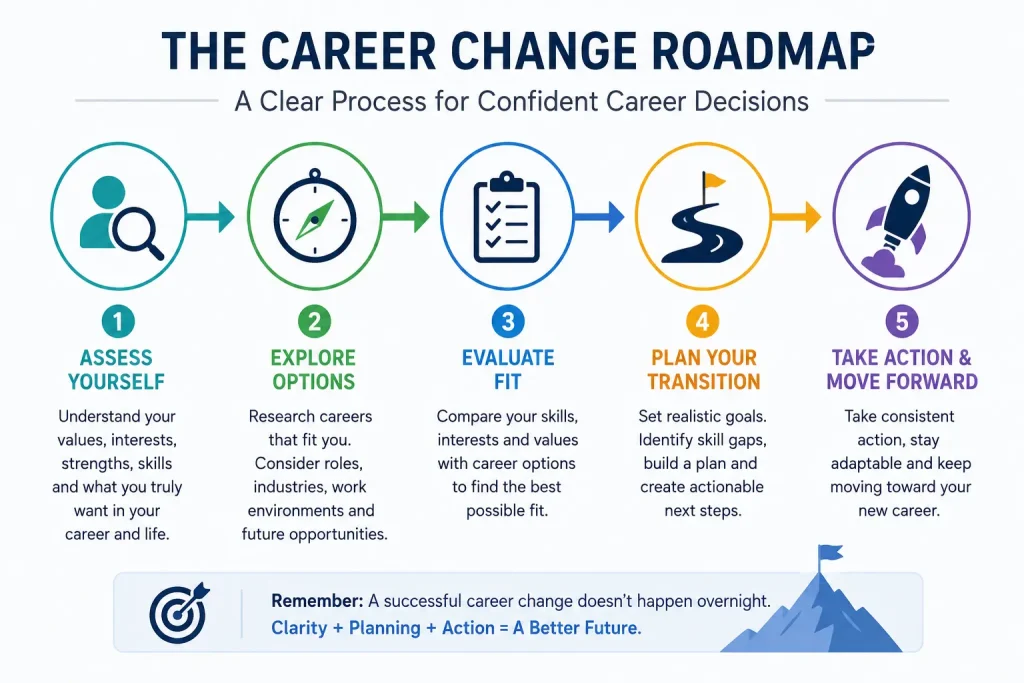
A more reliable approach is to work through the decision systematically:
Understand what is wrong → identify what you want → assess what you bring → explore alternatives → evaluate career fit → plan the transition → make an informed decision.
Career assessment can contribute useful evidence along the way, particularly when it helps you understand multiple dimensions of yourself rather than reducing career fit to a single score or characteristic.
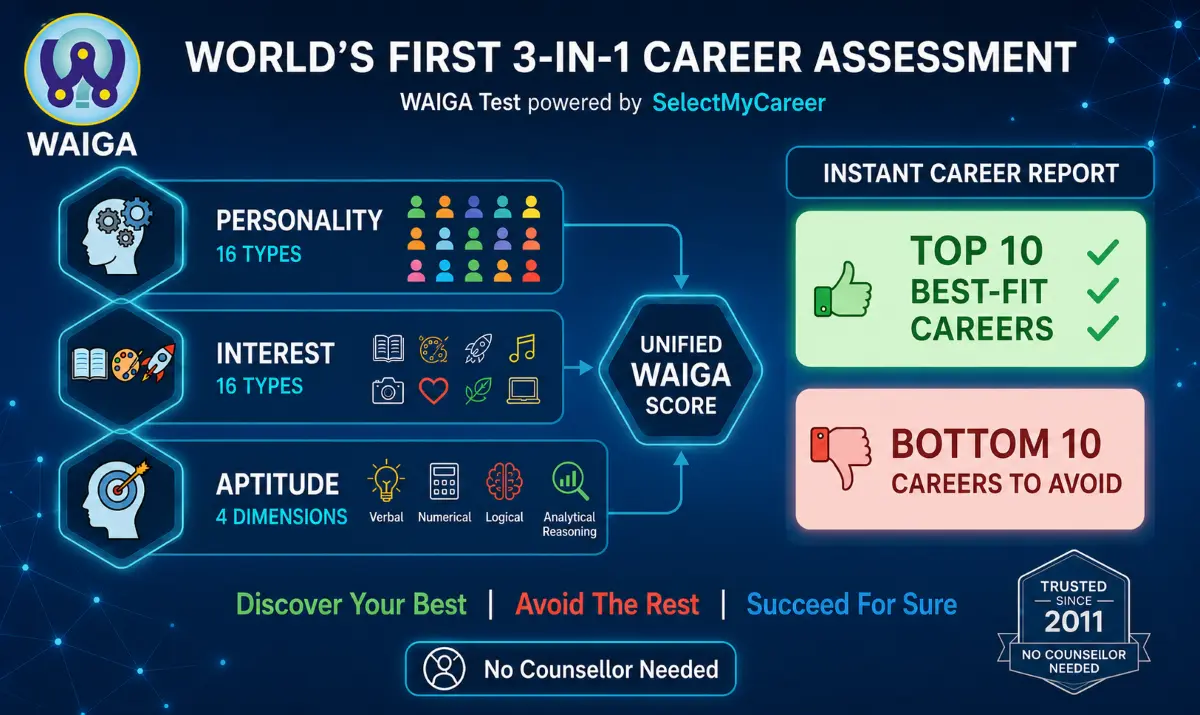
For example, understanding your interests, personality and aptitude together can help you ask better questions about potential career directions. WAIGA is designed around these three dimensions, measuring 7 Interest Types, 16 Personality Types and 4 independent Aptitude Dimensions, and combining them into a unified WAIGA Score.
But the assessment is not the end of the process.
You still need to consider your experience, transferable skills, values, financial circumstances, family responsibilities, career opportunities and the realities of the work itself.
The goal is not to find a perfect career
There may never be a career that satisfies every preference and eliminates every compromise.
The goal is to find a direction that makes sense for you, at this stage of your life, and then take practical steps to explore and pursue it.
If your current career no longer fits, you do not necessarily need to throw away everything you have built.
You may simply need to understand yourself better, identify what needs to change and find a direction where your existing strengths can be used more effectively.
A career change is not about starting over. It is about deciding what comes next.
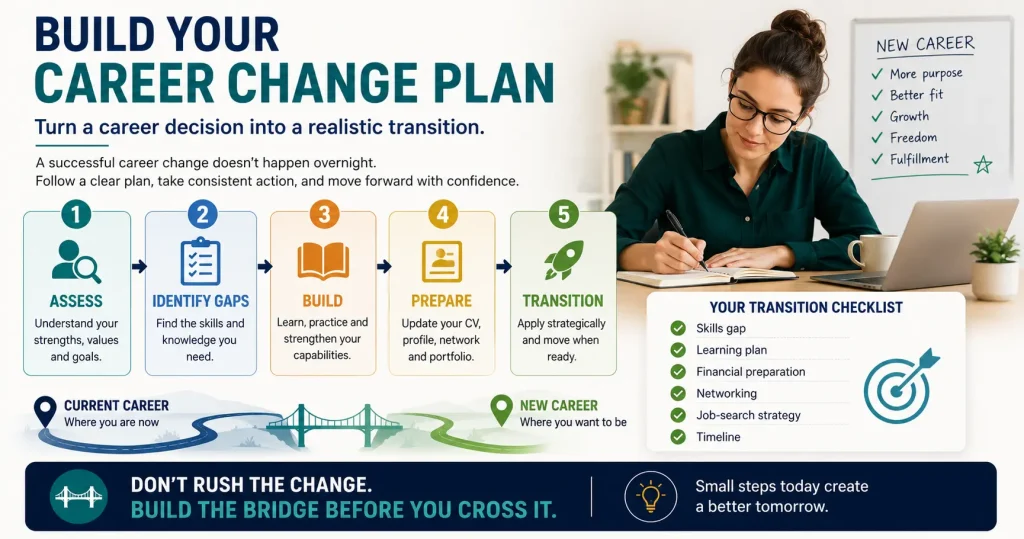
13. A Practical Career-Change Checklist
Before taking the final step, use this checklist to make sure you are changing careers for the right reasons and with a realistic plan.
Before you leave your current career
Ask yourself:
- Do I understand why I want to leave?
- Have I established whether the problem is my job or my career?
- Do I know what I want more of in my working life?
- Have I identified my strongest skills and transferable experience?
- Have I considered my interests, personality and aptitudes?
- Have I explored several possible career directions rather than choosing the first attractive option?
- Have I researched what the new career is actually like?
- Have I spoken with people who work in the field?
- Do I understand the qualifications, training or experience I may need?
- Have I considered the financial and personal implications?
- Can I make the transition gradually if that would reduce unnecessary risk?
- Do I have a practical first step and a realistic timeline?
If you cannot answer several of these questions, you may not need to abandon the idea of a career change—you may simply need to do more exploration before making the move.
A useful final question
After working through the checklist, ask yourself:
“If I were not trying to escape my current career, would I still choose this new direction?”
If the answer is yes, that is an important signal.
It suggests that your decision is being driven not only by dissatisfaction with where you are, but also by a genuine understanding of where you want to go.
And that is the foundation of a more deliberate career transition.
14. Key Takeaways: Changing Careers Without Starting Over
A career change can feel like a complete reset, but it does not have to be.
The most effective transitions usually begin with understanding rather than urgency.
Before making a major move, remember these principles:
- Identify the real problem first. A difficult job does not necessarily mean you have chosen the wrong career.
- Know what you want next. Define the type of work, environment and lifestyle you are looking for.
- Recognise what you already bring. Skills, experience and professional knowledge can often transfer into a new direction.
- Look beyond one career option. Explore several possibilities before committing to one.
- Evaluate the whole picture. Consider interests, personality, aptitude, skills, values, lifestyle and practical circumstances together.
- Use assessment as evidence, not a verdict. A structured assessment can provide useful self-understanding, but it cannot make the decision for you.
- Plan the transition realistically. Understand the training, financial, time and experience requirements before making the move.
- Don’t wait for perfect certainty. A good career decision is based on enough reliable information to take the next sensible step.
- Remember that changing careers doesn’t mean starting from zero. Your previous experience may become one of your greatest assets in the next chapter.
Ultimately, career change is not about finding a guaranteed perfect answer.
It is about developing a clearer understanding of who you are, what you can offer, what you want from work and which opportunities are worth exploring—and then using that understanding to make a deliberate decision about what comes next.
“A career change is not about starting over. It is about deciding what comes next.”
“The goal is not to find a perfect career. It is to find a direction that makes sense for you.”
Ready to Take the Next Step in Your Career?
A career change is a major decision. You don’t have to make it based on frustration, guesswork or a single career test.
Choosing a career does not begin with finding the perfect answer.
It begins with understanding yourself.
What are your natural strengths?
What kinds of work genuinely interest you?
How do you naturally prefer to work?
What possibilities might fit the person you are—and the life you want to build?
The WAIGA Career Assessment is designed to help you answer those questions with structured information rather than guesswork.
The most confident career decisions come from understanding what you enjoy, what you are naturally good at, how you prefer to work and which careers align with all of these dimensions.
That is the philosophy behind the WAIGA Career Decision Framework™.
WAIGA helps you understand your interests, personality and aptitude together, giving you structured information to consider as you explore your next career direction.
The WAIGA Career Assessment includes:
✔ 7 Interest Types
✔ 16 Personality Types
✔ 4 Aptitude Dimensions
✔ 1 WAIGA Score
✔ Instant Report
✔ No Counsellor Needed—Ever
Understand Yourself. Explore Your Options. Make Your Decision.
A career assessment can give you a starting point.
Your exploration gives you context.
Your priorities give you direction.
And the final decision is yours.
If you’re ready to start making career decisions based on a comprehensive understanding of yourself, explore the WAIGA Career Assessment and discover your unique career profile.
Your future deserves more than guesswork. It deserves clarity, confidence and informed decisions.
✓ One integrated assessment instead of multiple separate tests
✓ Instant personalised report
✓ No counsellor needed — ever
✔ Best on laptop or desktop | ✔ Takes 20-30 minutes | ✔ Instant report — 3 ways to access
✔ Registration takes 2 minutes |✔ Purchased test stays in dashboard — take it anytime
You can also begin with our Free Career Test if you’d like an introduction before taking the full assessment.
If you still have questions, feel free to contact us.
FAQs
A career change may be worth considering when dissatisfaction consistently relates to the nature of the work itself rather than only your employer, manager or workplace. Persistent lack of interest, poor alignment with your strengths or preferred working style, and little desire to continue developing in the field can all be reasons to explore alternatives.
No. Changing jobs usually means moving to a different employer or role while remaining in broadly the same career field. Changing careers involves moving toward substantially different work, responsibilities or professional direction.
Yes. Many career transitions build on transferable skills and existing experience. Communication, leadership, analysis, project management, problem-solving and industry knowledge can remain valuable even when you move into a different career.
No. Age alone does not determine whether a career change is realistic. The more important questions are what you want to change, which skills and experience you can transfer, what you need to learn, and whether the transition makes sense for your personal and financial circumstances.
A structured career assessment can provide useful information about your interests, personality and aptitude, but it should be treated as one source of evidence rather than a final answer. Career research, practical experience, transferable skills and personal circumstances should also be considered.
Consider your interests, aptitude, personality, skills, values, preferred working environment, lifestyle priorities, financial needs, growth opportunities and the practical requirements of entering the new field.
A career assessment can help identify potentially suitable directions, but it should not replace personal judgment. The final decision should also take into account your experience, circumstances, goals and understanding of the actual career.
Where possible, explore the new direction before leaving your current career. Courses, projects, volunteering, freelancing, professional conversations and gradual transitions can help you test your assumptions and develop relevant experience.
Career fit refers to how well a career aligns with characteristics such as your interests, personality, aptitude, skills and priorities. Career satisfaction is your overall experience of the career. They can overlap, but they are not exactly the same.
WAIGA provides a multidimensional assessment of interests, personality and aptitude, measuring 7 Interest Types, 16 Personality Types and 4 independent Aptitude Dimensions and combining them into a unified WAIGA Score. This can provide structured information to consider while exploring and evaluating potential career directions.
Not necessarily. Unless there are compelling personal or workplace reasons to leave immediately, it can be useful to research alternatives, develop relevant skills and plan the transition while you still have the stability of your current employment.
That is normal. Instead of forcing yourself to choose immediately, compare the options against consistent criteria such as interest, aptitude, personality, skills, lifestyle, growth opportunities and transition requirements. Exploration can help reveal which direction offers the strongest overall fit.
Written by the WAIGA Career Guidance Team