
Introduction
Have you ever wondered why some people enjoy leading teams while others prefer working independently?
Why some thrive in fast-paced, constantly changing environments while others perform best with structure and planning?
Or why two people with similar intelligence and qualifications often choose completely different careers—and are both successful?
The answer often lies in personality.
Our personality influences how we think, communicate, make decisions, solve problems and interact with the world around us. It shapes the kinds of work we naturally enjoy, the environments in which we perform best and the roles that are most likely to keep us engaged over the long term.
This is why career personality tests have become an important part of modern career planning.
Many students, parents and professionals take personality assessments hoping they will reveal the “perfect” career.
While personality assessments provide valuable insights, they cannot answer that question on their own.
A person may have a personality well suited to leadership but lack the aptitude required for a particular profession.
Another may have the personality to thrive in a helping profession but have little genuine interest in working with people every day.
Similarly, an individual may enjoy creative freedom but choose a highly structured career because of external expectations, eventually leading to dissatisfaction despite having the “right” personality profile.
Personality is an important piece of the career decision puzzle—but it is only one piece.
The most informed career decisions are made by understanding how personality interacts with aptitude, interests, values and career awareness.
In this guide, you’ll learn what career personality tests measure, why personality matters, the common myths surrounding personality assessments and why personality alone cannot predict career success.
Because choosing the right career is not about discovering who you are.
It is about understanding who you are—and how that fits with what you are capable of doing and what you genuinely want from your career.
Your personality influences how you work.
It does not decide what your career should be.
What Is a Career Personality Test?
A career personality test is a scientifically designed assessment that helps individuals understand how they naturally think, communicate, make decisions and prefer to work.
Unlike aptitude, which measures what you are naturally capable of doing, personality explores how you naturally approach different situations, people and work environments.
This distinction is important.
Two individuals may possess similar aptitude for a particular profession but differ significantly in the way they prefer to work.
For example, one person may enjoy leading teams, making quick decisions and working in dynamic environments, while another may prefer independent work, careful planning and structured routines.
Neither personality is better than the other.
They are simply different.
Understanding these differences can help individuals choose careers and work environments where they are more likely to feel comfortable, engaged and productive.
Most professionally developed career personality assessments seek to understand characteristics such as:
- Communication and interaction style
- Decision-making approach and pace
- Response to pressure, deadlines and uncertainty
- Preference for autonomy versus structure
- Working environment compatibility
- Natural leadership and collaboration tendencies
Together, these characteristics provide valuable insights into the environments in which an individual is most likely to thrive.
Some personality assessments classify individuals into broad behavioural categories, while others identify multiple personality types to capture greater depth and nuance.
Regardless of the methodology used, the purpose remains the same—to better understand how an individual naturally operates, rather than simply what they know or what they can achieve academically.
However, personality assessments answer only one part of the career decision process.
They help explain how you are likely to work.
They do not determine whether a particular career matches your aptitude, interests, values or long-term aspirations.
That is why personality is an important part of career planning—but it should never be considered in isolation.
Why Personality Alone Cannot Predict Career Success
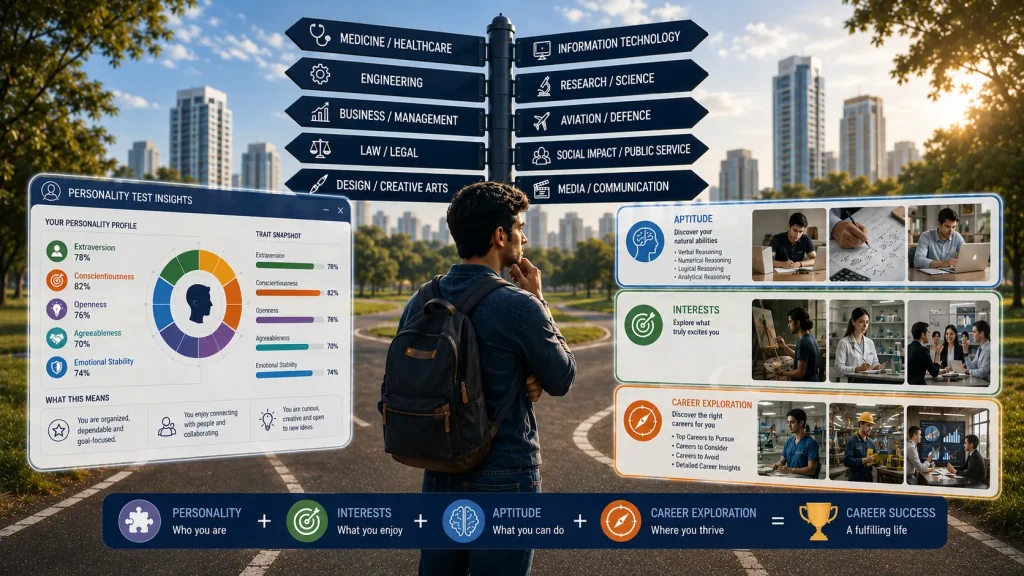
A career personality test provides valuable insights into how you naturally prefer to work.
It helps answer an important question:
“What kind of working style suits me best?”
However, choosing a career requires answering several other equally important questions.
Imagine two individuals with personalities that naturally enjoy leading people, communicating ideas and influencing decisions.
Both may thrive in collaborative environments and feel comfortable taking initiative.
Does that mean both should pursue careers in management?
Not necessarily.
One may also possess strong analytical and numerical aptitude, making management consulting or business strategy an excellent fit.
The other may have stronger creative interests and find greater satisfaction in marketing, media or entrepreneurship.
Although their personalities are similar, their overall career fit may be very different.
Similarly, consider someone whose personality prefers independent work, careful planning and structured environments.
That individual may thrive in research, software development or finance—but only if they also possess the aptitude, interests and motivation required for those professions.
Personality helps explain how you are likely to work.
It does not determine what you are naturally capable of doing, what genuinely interests you, or which careers align with your long-term aspirations.
Career success depends on the interaction of multiple factors, including:
- Your natural aptitude and reasoning abilities.
- Your interests and intrinsic motivation.
- Your personality and preferred working style.
- Your personal values and career expectations.
- Your understanding of different career opportunities.
This broader approach is increasingly recognised worldwide. The OECD (Organisation for Economic Co-operation and Development) emphasises that effective career guidance considers an individual’s abilities, interests, aspirations and informed decision-making rather than relying on any single factor.
Looking at personality in isolation may produce career recommendations that feel comfortable but fail to utilise your strengths, or careers that suit your working style but fail to keep you engaged over the long term.
The most informed career decisions are made by considering the complete individual—not a single personality profile.
Because finding the right career is not simply about discovering how you work.
It is about understanding how your personality, abilities, interests and aspirations come together to create the best career fit.
A career that matches your personality—but ignores your aptitude or interests—is only half the answer
Common Myths About Career Personality Tests
Career personality tests have become increasingly popular, but they are also widely misunderstood. Many people either expect too much from them or dismiss them altogether because of common misconceptions.

Let’s separate the myths from the reality.
Myth 1: A Personality Test Will Tell Me the Perfect Career
No personality assessment can identify one “perfect” career.
Personality helps explain your preferred working style, communication patterns and the environments in which you are likely to feel comfortable. It does not determine the only career in which you can succeed.
Career decisions should always consider aptitude, interests, values and career awareness alongside personality.
Myth 2: People with the Same Personality Should Choose the Same Career
Not necessarily.
Two individuals with similar personalities may possess completely different aptitudes, interests and career goals.
For example, two people may both enjoy leading others and making decisions. One may become an entrepreneur, while another may thrive as a school principal, military officer or hospital administrator.
Their personalities may be similar, but their career paths can be very different.
Myth 3: One Personality Type Is Better Than Another
Every personality has strengths as well as potential challenges.
Some personalities are naturally comfortable with uncertainty and rapid decision-making.
Others excel at careful planning, detailed analysis and consistency.
Neither approach is superior.
Different careers—and even different roles within the same organisation—benefit from different personality characteristics.
Myth 4: Your Personality Can Never Change
Core personality characteristics tend to remain relatively stable throughout adulthood.
However, people continue to develop new skills, behaviours and coping strategies through education, experience and personal growth.
A naturally reserved person may become an excellent public speaker through practice, while someone who prefers structure may learn to perform confidently in fast-changing environments.
Personality influences behaviour, but it does not limit personal development.
Myth 5: Personality Alone Determines Career Success
Personality is only one part of career success.
Someone may have a personality that suits leadership but lack the aptitude required for a particular profession.
Another may possess an ideal personality for research but have little interest in pursuing scientific work.
Career satisfaction and success depend on the combination of aptitude, personality, interests, values and informed career decisions.
A career personality test is an excellent tool for understanding how you naturally work and interact with the world.
It should never be used as the sole basis for choosing a career.
Its greatest value lies in helping you understand yourself better—not in making the decision for you.
No personality type is better than another.
The best personality is the one that finds the right environment to thrive
What Else Should You Consider Besides Personality?
Understanding your personality is an important step in career planning—but it is only one part of understanding yourself.
A career decision that considers personality alone may overlook other equally important factors that influence long-term success and satisfaction.
To make a truly informed career choice, it is important to ask a broader set of questions.
What Are You Naturally Good At?
Your aptitude reflects your natural reasoning abilities and learning potential.
A career may suit your personality perfectly, but if it demands abilities that do not align with your natural strengths, you may find it more challenging to perform and grow over time.
Understanding both your personality and your aptitude provides a much stronger foundation for career decision-making.
What Genuinely Interests You?
Interests influence the activities that naturally motivate and energise you.
Two people with similar personalities may have completely different interests.
One may enjoy analysing financial data, while another prefers designing products or helping people solve personal challenges.
Long-term engagement often comes from pursuing work that you genuinely enjoy—not simply work that suits your personality.
What Matters Most to You?
Every individual has different priorities.
Some value stability and job security.
Others seek creativity, continuous learning, financial growth, social impact or work-life balance.
Understanding your personal values helps ensure that your chosen career aligns not only with how you work, but also with what you want from your professional life.
How Well Do You Understand Different Careers?
Career awareness is often overlooked.
Many students make decisions based on assumptions, social influence or incomplete information rather than understanding the day-to-day reality of different professions.
Exploring career pathways, work environments, future opportunities and required qualifications helps you make decisions based on facts rather than perceptions.
Looking at the Complete Picture
No single assessment can fully understand an individual.
Personality explains how you naturally prefer to work.
Aptitude explains what you are naturally capable of doing.
Interests reveal what you genuinely enjoy.
Values help define what is important to you.
Career awareness connects these personal insights with real-world opportunities.
When these dimensions are considered together, they provide a far more complete foundation for making confident, informed and satisfying career decisions.
Because choosing the right career is not about understanding one part of yourself.
It is about understanding your complete self.
No single assessment defines you.
The complete picture does.
The WAIGA Perspective: Looking Beyond Personality
At WAIGA, we believe that understanding your personality is an important part of making informed career decisions—but it is only one part.
Personality helps answer one important question:
“How do I naturally prefer to work?”
It reveals your communication style, decision-making approach, response to pressure, preference for structure or autonomy, and the types of work environments in which you are most likely to thrive.
These insights are valuable.
However, personality alone cannot determine whether a particular career is the right choice.
A career that matches your personality but ignores your aptitude may become difficult to perform.
A career that suits your personality but does not match your interests may eventually become unfulfilling.
Similarly, a career that aligns with your personality but conflicts with your personal values or aspirations may never provide long-term satisfaction.
That is why the WAIGA Career Decision Framework™ measures personality as one independent dimension of career decision-making—not as the entire answer.
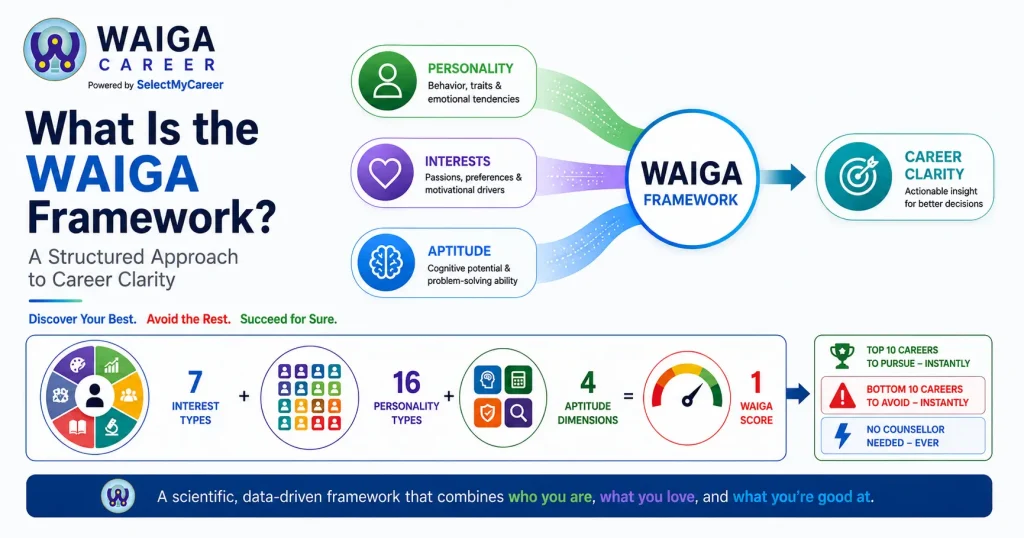
Importantly, WAIGA measures personality and interests independently, recognising that how you naturally work and what you are naturally drawn to work on are two genuinely different questions with two genuinely different answers.
Looking at these dimensions separately provides a clearer and more accurate understanding of the individual than treating them as the same thing.
Because choosing the right career is not about finding a personality type that matches a profession.
It is about understanding the complete individual—your aptitude, your personality, your interests, your values and your aspirations—before making one of life’s most important decisions.
How you naturally work and what you naturally enjoy are not the same thing.
Understanding both leads to better career decisions.
Key Takeaways
- A career personality test helps you understand how you naturally think, communicate, make decisions and prefer to work.
- Personality influences your preferred working style and work environment, but it does not determine the right career on its own.
- Two people with similar personalities may choose very different careers depending on their aptitude, interests, values and aspirations.
- No personality type is better than another. Different personalities thrive in different roles, organisations and work environments.
- Career decisions based solely on personality assessments may overlook other equally important dimensions such as aptitude and interests.
- The most informed career decisions consider personality, aptitude, interests, values and career awareness together.
- Understanding your complete self leads to more confident career choices and greater long-term career satisfaction.
The best career decisions are not based on one personality type.
They are based on understanding the complete individual.
Ready to Understand Your Personality Beyond Labels?
A career personality test can help you understand how you naturally think, communicate, make decisions and prefer to work. But as you’ve learned throughout this guide, personality alone cannot determine the right career.
The most confident career decisions come from understanding your personality, your natural abilities, your interests and the careers that align with all of them.
That is the philosophy behind the WAIGA Career Decision Framework™.
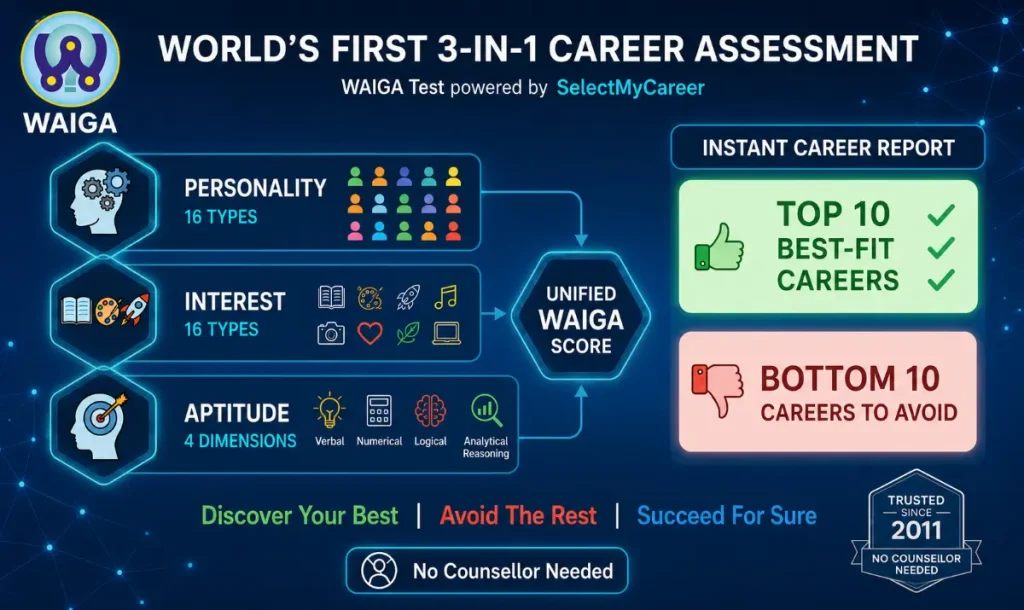
The WAIGA Career Assessment combines multiple assessment dimensions to help students gain a deeper understanding of themselves before making one of life’s most important decisions.
The WAIGA Career Assessment includes:
✔ 7 Interest Types
✔ 16 Personality Types
✔ 4 Aptitude Dimensions
✔ 1 WAIGA Score
✔ Instant Report
✔ No Counsellor Needed—Ever
If you’re ready to move beyond personality labels and make career decisions based on a comprehensive understanding of yourself, explore the WAIGA Career Assessment and discover your unique career profile.
Your future deserves more than guesswork. It deserves clarity, confidence and informed decisions.
✓ One integrated assessment instead of multiple separate tests
✓ Instant personalised report
✓ No counsellor needed — ever
✔ Best on laptop or desktop | ✔ Takes 20-30 minutes | ✔ Instant report — 3 ways to access
✔ Registration takes 2 minutes |✔ Purchased test stays in dashboard — take it anytime
You can also begin with our Free Career Test if you’d like an introduction before taking the full assessment.
If you still have questions, feel free to contact us.
Frequently Asked Questions (FAQs)
A career personality test is a scientifically designed assessment that helps you understand how you naturally think, communicate, make decisions and prefer to work. It provides insights into your preferred work style and the types of environments in which you are most likely to thrive.
No. A personality assessment provides valuable insights into your working style and behavioural preferences, but it cannot identify the “perfect” career on its own. Career decisions should also consider aptitude, interests, values and career awareness.
Your personality influences how you interact with people, approach problems, respond to pressure and adapt to different work environments. Choosing a career that aligns with your natural working style often leads to greater job satisfaction and long-term success.
Yes. Two individuals may share similar personality characteristics but have different aptitudes, interests, values and career goals. As a result, they may thrive in completely different professions.
No. Every personality type has its own strengths and challenges. Different careers, organisations and roles require different personality characteristics. Success depends on finding an environment that matches your natural working style.
Core personality characteristics tend to remain relatively stable throughout adulthood. However, people continue to develop new skills, behaviours and coping strategies through education, experience and personal growth.
Neither is more important than the other. Personality explains how you naturally prefer to work, while aptitude indicates what you are naturally capable of doing. Both are important when making informed career decisions.
Personality and interests answer two different questions. Personality explains how you naturally work, while interests reveal what you naturally enjoy doing. Measuring them independently provides a more accurate understanding of career suitability.
Because career success depends on multiple factors. While personality provides valuable insights into working style, informed career decisions also require understanding your aptitude, interests, values and knowledge of different career opportunities.
Many personality assessments focus only on behavioural preferences. The WAIGA Career Assessment takes a more comprehensive approach by combining 16 Personality Types, 7 Interest Types, 4 Aptitude Dimensions and 1 WAIGA Score, providing a broader understanding of the individual to support informed career decisions—without requiring a career counsellor.
Written by the WAIGA Career Guidance Team