
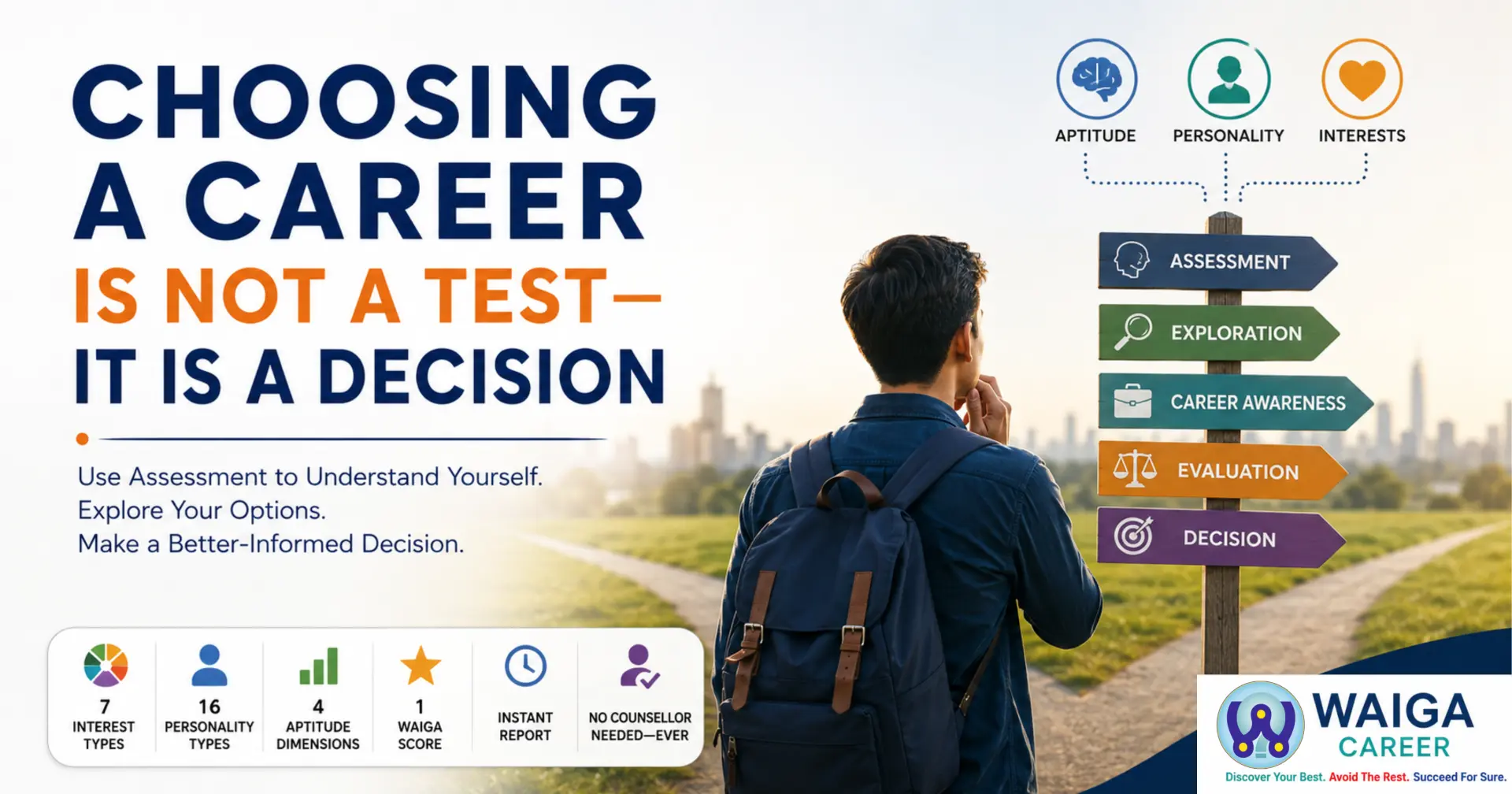
Choosing a career is one of the most important decisions a student or young professional will make. Yet many people approach it as though the answer can be found by taking the right test.
Take a career test.
Get your result.
Find the recommended careers.
Choose one.
It sounds simple. But real career decisions are rarely that simple.
Table of Contents
A career assessment can tell you valuable things about yourself. It can help you understand your natural reasoning abilities, your interests, your personality and the kinds of work environments that may suit you. It can reveal possibilities you may not have considered and help you ask better questions about your future.
But it cannot know everything that matters.
It cannot completely understand your personal aspirations, values, circumstances, opportunities, changing interests or what you will discover about yourself five years from now.
And it certainly cannot experience the day-to-day reality of a career on your behalf.
That is why a career assessment should not be treated as a machine that produces a career answer.
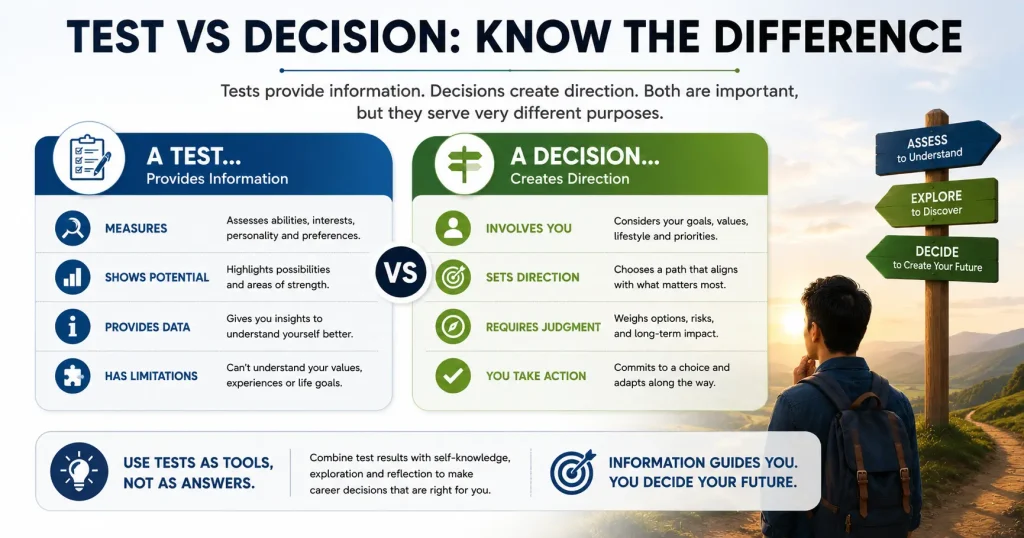
Assessment provides information. A career decision requires judgment.
The distinction is important.
The purpose of a good career assessment is not to tell you:
“This is the career you must choose.”
Its purpose is to help you understand yourself better, identify possibilities worth exploring and make a decision based on better information.
Choosing a career is therefore not a test.
It is a process of understanding, exploration, evaluation and decision-making.
And the better that process is, the better prepared you are to choose a career that is not merely attractive on paper—but one that has a genuine chance of fitting the person you are and the life you want to build.
Why We Want a Simple Answer
If choosing a career is a complex decision, why do we so often look for a simple answer?
Part of the reason is understandable.
Students are expected to make important choices at an age when they may have limited knowledge of the working world. They may be deciding which subjects to study, which course to pursue or which entrance examination to prepare for—often without having experienced what most careers actually involve.
At the same time, parents naturally want to help.
They want reassurance that their child is making the right choice. When there are hundreds of possible careers and countless courses and qualifications, the idea of taking a test that produces a clear answer can be extremely appealing.
A test appears to remove uncertainty.
“Your result says you should become a ______.”
That feels reassuring.
But career decisions do not become simple merely because we want them to be.
The Problem With Looking for One Definitive Answer
A career is not just a job title.
It is a combination of:
- The work you actually perform
- The skills you use
- The problems you solve
- The people you work with
- The environment in which you work
- The pressures and responsibilities you experience
- The opportunities available to you
- The lifestyle the career may create
- And how your own priorities evolve over time
Two people can enter the same profession and have completely different experiences.
One may find the work stimulating and meaningful.
Another may discover that the working environment, pace or responsibilities do not suit them at all.
This is why the question:
“What career should I choose?”
is often too broad to be answered by a test.
A better set of questions is:
“What do I understand about myself?”
“What career options appear compatible with that profile?”
“What do I know about the reality of those careers?”
“Which option best fits my abilities, interests, personality, values and aspirations?”
Those are questions that lead to a decision rather than simply a test result.
Uncertainty Is Part of the Process
There is another reason we should be cautious about expecting certainty from career assessments.
A student’s career journey is not static.
Interests can develop through exposure. Skills can improve through education and practice. New careers can emerge. Opportunities can change. Experiences can alter what someone values or wants from their working life.
The goal, therefore, should not be to eliminate every uncertainty before making a career decision.
That is impossible.
The goal should be to reduce avoidable uncertainty by understanding yourself, understanding your options and making the most informed decision possible with the information available at the time.
A career assessment can contribute significantly to that process.
But it is one part of the process—not the process itself.
What a Career Assessment Can Actually Tell You
Saying that a career assessment cannot make the decision for you does not mean that career assessments are not useful.
Quite the opposite.
A well-designed assessment can provide information that is difficult to obtain through casual self-reflection alone. It can help you identify patterns in your abilities, preferences and interests that may otherwise remain unclear.
The key is to understand what each type of assessment is actually measuring.
Aptitude: What May Come Naturally to You?
Aptitude assessment examines areas of reasoning ability and helps identify the kinds of cognitive tasks you may handle relatively well.
Depending on the assessment, this may include areas such as:
- Verbal reasoning
- Numerical reasoning
- Logical reasoning
- Analytical reasoning
These abilities can provide useful clues about the types of academic and professional tasks that may come naturally to you.
But aptitude does not answer the question:
“What career do I want?”
Someone may have strong numerical reasoning, for example, but that does not automatically mean that finance, engineering or data science is the right career choice for that person.
Aptitude tells you something about capability.
It does not tell you everything about choice.
Personality: How Do You Naturally Prefer to Work?
Personality assessment provides a different kind of information.
It can help you understand patterns in how you:
- Communicate and interact with others
- Make decisions
- Respond to pressure and uncertainty
- Approach structure and autonomy
- Work with others
- Approach leadership and collaboration
This can be valuable because the same career can involve very different working environments.
A person may be technically capable of performing a particular role but find its daily working style uncomfortable or draining.
Personality therefore provides insight into how you may prefer to work.
But personality alone does not tell you which career you should choose.
Interests: What Naturally Attracts You?
Interest assessment explores the kinds of activities, subjects and work that naturally attract your attention and engagement.
You may discover that you are particularly drawn to:
- Language and communication
- Creative and visual work
- Hands-on activities
- Investigation and discovery
- Systems and processes
- Business and leadership
- Helping and interpersonal work
Interests can be powerful clues because sustained engagement with work is difficult when the nature of that work holds little personal attraction.
But interest alone is not enough either.
You may be fascinated by a particular field without yet having developed the abilities it requires. Conversely, you may have strong abilities in an area that does not currently interest you.
Interests therefore tell you something about what attracts you.
Three Different Questions
This is why aptitude, personality and interests should not be treated as interchangeable.
They answer different questions:
Aptitude:
What am I naturally capable of doing?
Personality:
How do I naturally prefer to work?
Interests:
What kinds of work naturally attract me?
None of these questions, by itself, is the complete career decision.
But together, they can provide a much richer understanding of the person making the decision.
And that is where a career assessment becomes genuinely valuable—not as an answer generator, but as a source of structured information for better decision-making.
A Test Cannot Know Everything About Your Future
Even the most comprehensive career assessment has limits.
That is not a weakness of assessment. It is a recognition of something more fundamental:
Your future is not determined entirely by your current profile.
An assessment can measure particular characteristics at a particular point in time. It cannot fully predict the experiences, opportunities, decisions and circumstances that will shape your career over the years ahead.
Several important factors sit outside what a career assessment can completely capture.
Your Values
What do you want your career to give you?
Financial security? Independence? Flexibility? Recognition? Meaning? Social impact? Intellectual challenge? Stability?
Two people with very similar aptitude, personality and interests may make completely different career choices because they value different things.
Your values therefore influence which opportunities you consider worth pursuing.
Your Aspirations
What do you actually want to achieve?
You may aspire to build a business, lead an organisation, become an expert in a particular field, work internationally, contribute to society or achieve a particular lifestyle.
These aspirations can influence career choices in ways that cannot be reduced to an assessment score.
A career can appear highly compatible with your profile and still be unsuitable for the future you want to build.
Your Circumstances
Career decisions are also made within real-world circumstances.
Financial considerations, location, family responsibilities, educational access, health and wellbeing, available opportunities and many other practical factors can influence what is realistically possible.
These circumstances are not necessarily permanent. But they matter when making a decision today.
Your Career Awareness
You cannot choose intelligently from options you do not understand.
A student may have an excellent assessment profile but know very little about the actual careers that appear to match it.
What does the work involve?
What qualifications are required?
What does a normal working day look like?
What pressures come with the profession?
What opportunities exist?
What are the likely working environments?
What does the career look like after five, ten or twenty years?
Assessment can help identify possibilities.
Career exploration helps you understand those possibilities.
Your Experiences Can Change You
Perhaps the most important limitation is that your current profile is not a permanent definition of who you will become.
Education can develop abilities.
Experience can change interests.
Exposure can reveal possibilities you never knew existed.
Success can increase confidence.
Failure can change priorities.
Life circumstances can alter aspirations.
The person making a career decision today may therefore not be exactly the same person five or ten years from now.
That does not make assessment less useful.
It means the results should be treated as information about you now, not as a permanent prediction of your entire future.
The Bigger Picture
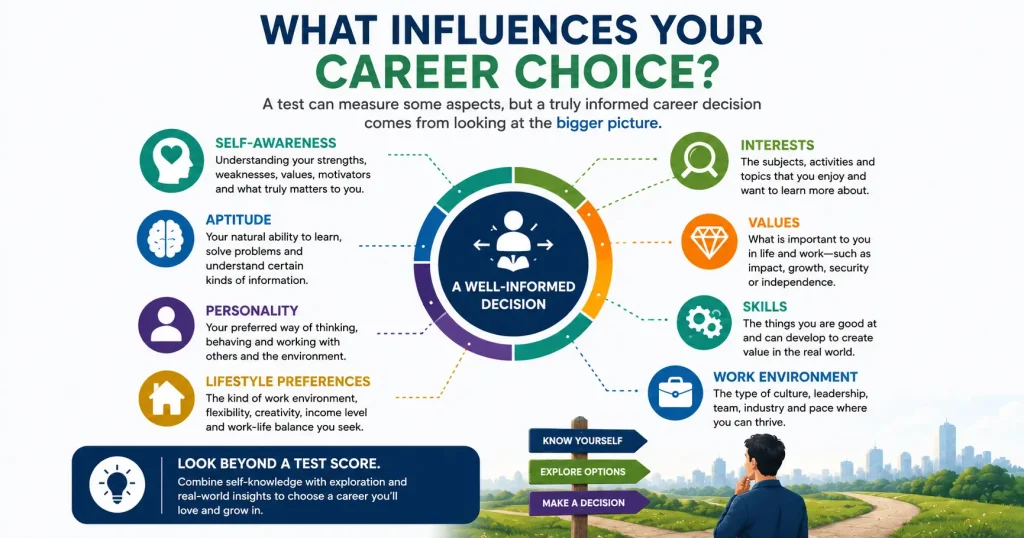
This is why a career decision needs to consider more than assessment results.
A useful way to think about it is:
Assessment tells you about yourself.
Career exploration tells you about your options.
Your values and aspirations tell you what matters to you.
Your circumstances tell you what is realistic.
Your judgment brings these elements together.
That final step is the decision.
And no test should pretend that it can make that decision for you.
The Difference Between Career Fit and Career Choice
One of the easiest mistakes to make with career assessments is to confuse career fit with career choice.
They are related, but they are not the same thing.
A career assessment may indicate that a particular career appears compatible with your abilities, interests and personality.
That tells you something useful.
But it does not automatically mean that you should choose that career.
A Career Can Fit You Without Being Your Choice
Imagine a student whose profile suggests strong analytical ability, an interest in investigation and a preference for structured problem-solving.
Several careers might appear to fit:
- Data analysis
- Engineering
- Research
- Consulting
- Medicine
- Technology
The assessment has done something valuable.
It has helped identify possibilities.
But which one should the student choose?
The assessment cannot answer that question by itself.
Perhaps the student is particularly motivated by helping people and therefore finds medicine more meaningful.
Perhaps they value flexibility and prefer a technology career.
Perhaps they want to become an entrepreneur and eventually build a business around their technical skills.
Perhaps financial considerations make one educational pathway more practical than another.
The profile has not changed.
The decision has.
That is because career choice involves factors beyond measurable personal characteristics.
And the Reverse Can Also Be True
The opposite situation is equally important.
A person may be strongly attracted to a particular career but discover that some aspects of the career do not align naturally with their current profile.
That should not automatically mean:
“You cannot do this career.”
It should lead to better questions.
What skills would need to be developed?
What aspects of the work create the mismatch?
Is the attraction based on the actual work or simply on an image of the profession?
Would another role within the same broader field provide a better fit?
Is the individual willing to invest the time and effort required to develop the necessary capabilities?
These are decision-making questions—not test questions.
Fit Is a Starting Point, Not a Verdict
This is perhaps the most important distinction:
Career fit identifies possibilities. Career choice evaluates possibilities.
A good career assessment can help you identify careers worth investigating.
But investigation comes next.
You need to understand the reality of the work, compare alternatives, consider your priorities and evaluate the trade-offs.
Only then can you decide whether a career that appears to fit is actually a career you want to pursue.
The Best Career Decision Is Not Necessarily the Highest-Matching One
This is another reason we should be cautious about treating assessment results as prescriptions.
Suppose three careers all appear reasonably compatible with your profile.
Career A may have the strongest overall match.
Career B may offer a working environment that better suits your lifestyle.
Career C may align more closely with your long-term aspirations.
Which one is the “right” answer?
There may not be one objectively correct answer.
The better question is:
Which option represents the best overall choice for me, given what I know, what I value and what I want to achieve?
That is a much more meaningful question than simply asking which career received the highest assessment match.
Assessment Should Inform Choice—Not Replace It
The purpose of career assessment is therefore not to produce a final destination.
It is to improve the quality of the journey toward that destination.
A strong assessment can help you:
Understand yourself → Identify possibilities → Ask better questions → Explore options → Make a more informed decision
The assessment provides evidence.
Career exploration provides context.
Your priorities provide direction.
And ultimately, you make the choice.
Career Choice Requires Exploration
Once you understand that assessment provides information rather than a final answer, the next question is obvious:
What should you actually do with that information?
The answer is exploration.
Career exploration is the process of moving from a general understanding of yourself to a clearer understanding of the career possibilities available to you.
A useful career decision process can be thought of as five stages.
1. Know Yourself
Start with what you can learn about yourself.
What are your strongest aptitude areas?
What kinds of activities and subjects interest you?
How do you naturally prefer to work?
What matters most to you?
What kind of future do you imagine for yourself?
Career assessment can be particularly useful at this stage because it provides structured information about dimensions that may otherwise be difficult to evaluate objectively.
But self-understanding is only the starting point.
2. Explore Career Options
Once you have a clearer understanding of yourself, identify careers that appear worth exploring.
Don’t limit yourself to the first few professions that come to mind.
A strong aptitude, personality or interest profile may connect with many different careers—and some may be careers you have never previously considered.
Explore broadly before narrowing down.
Look beyond job titles and investigate the actual nature of the work.
3. Understand the Reality
This is where career exploration becomes much more valuable than simply reading a list of recommended careers.
For each career you are considering, find out:
- What does the work actually involve?
- What does a typical working day look like?
- What skills are required?
- What qualifications or education are needed?
- What working environment is typical?
- What are the major pressures and challenges?
- What opportunities exist for growth?
- What does the career look like after several years?
There can be a significant difference between liking the idea of a career and liking the reality of doing the work.
A student may be attracted to the status of a profession without understanding its daily responsibilities.
Another may reject a career because the job title sounds uninteresting, only to discover that the actual work is highly engaging.
Understanding the reality helps separate the two.
4. Compare Alternatives
Do not evaluate careers in isolation.
If three or four options appear promising, compare them.
Consider:
Personal fit
Does the career align with your aptitude, personality and interests?
Personal priorities
Does it fit your values, aspirations and preferred lifestyle?
Practical requirements
Can you realistically pursue the necessary education and qualifications?
Career reality
Do you understand what the work actually involves?
Future possibilities
Does the career provide opportunities that matter to you?
Comparison is important because career decisions are rarely about finding a perfect option.
They are often about identifying the strongest overall option among several possibilities.
5. Make a Decision
Eventually, exploration has to lead to a choice.
You will never have complete information.
You cannot predict every opportunity, challenge or change that may occur in the future.
At some point, you have to decide based on the information available.
That does not mean making a blind decision.
It means making a reasoned decision under conditions of uncertainty.
And that is what good career decision-making is really about.
From Test Result to Career Decision
The complete process therefore looks something like this:
Assessment
→ Understand yourself
Exploration
→ Identify possibilities
Career Awareness
→ Understand the reality of those possibilities
Evaluation
→ Compare them against your profile and priorities
Decision
→ Choose the option that makes the strongest overall sense
The assessment is important.
But notice where it sits in the process.
It is the beginning—not the end.
That distinction changes how career assessment should be interpreted.
Instead of asking:
“What career did my test recommend?”
ask:
“What possibilities has this assessment helped me identify, and what should I explore next?”
That is a much more productive question.
Five Questions to Ask About Every Career
Once you have identified several careers worth exploring, it is tempting to compare them simply by asking which one appears to match your assessment results most closely.
A better approach is to ask deeper questions.
Before seriously considering any career, try to answer these five.
1. Am I Actually Interested in the Work?
Not the job title.
Not the salary.
Not the social status.
Not what other people think about the profession.
The actual work.
Ask yourself:
- What activities would I perform regularly?
- What subjects would I spend time thinking about?
- What problems would I be expected to solve?
- Would these activities hold my attention over time?
There is an important difference between being attracted to the idea of a career and being interested in doing the work that career requires.
2. Do My Abilities Support This Career?
Interest is important, but interest alone is not enough.
Ask:
- What abilities does this career require?
- Where are my current strengths?
- Which capabilities would I need to develop?
- Am I willing to invest the time and effort required to build those capabilities?
This is where aptitude information can be particularly useful.
A career does not have to match every current strength perfectly. People develop skills throughout their education and careers.
The important question is whether the demands of the career are reasonably compatible with your abilities—or whether you are prepared to develop the capabilities you currently lack.
3. Does the Working Environment Suit Me?
The work itself is only part of a career.
The environment in which you perform that work can have a major influence on whether you enjoy it.
Ask:
- Do I prefer working independently or as part of a team?
- Do I prefer structure or flexibility?
- Am I comfortable with pressure and deadlines?
- Do I enjoy frequent interaction with people?
- Would I prefer a predictable environment or constant change?
- How much autonomy would I want?
Two careers can involve similar skills but completely different working environments.
A person may enjoy the subject matter of a profession but dislike the way the work is organised.
Understanding your personality and working preferences can therefore add an important dimension to career exploration.
4. Does This Career Fit What I Want From Life?
A career is part of your life—not your entire life.
Ask:
- What do I value most?
- What kind of lifestyle do I want?
- How important are income, stability or flexibility?
- Do I want opportunities for leadership?
- Is meaningful social impact important to me?
- Do I want opportunities to work internationally?
- How important is work-life balance?
There is no universally correct answer.
A career that provides exactly what one person wants may be completely unsuitable for another.
The question is not:
“Is this a good career?”
It is:
“Is this a good career for the life I want to build?”
5. Do I Understand the Reality of This Career?
This may be the most overlooked question of all.
Before making a serious career decision, investigate the profession beyond its description in a career test.
Talk to people who actually work in the field.
Research the education and qualifications required.
Look at current job opportunities.
Understand the working environment.
Learn about the pressures and responsibilities.
Find out what the career looks like at different stages.
And ask yourself honestly:
“If I understood the reality of this career completely, would I still want to pursue it?”
That question can prevent a great deal of disappointment later.
Putting the Five Questions Together
A career becomes more compelling when several answers point in the same direction.
Interest
Do I want to do the work?
Aptitude & Capability
Can I perform it—or am I willing to develop what is required?
Working Style
Does the environment suit how I naturally prefer to work?
Life Priorities
Does it support what I want from my life?
Career Awareness
Do I understand what I am actually choosing?
↓
A Better-Informed Career Decision
This is why career choice should not be reduced to a test score.
A test can provide useful information for several of these questions.
But answering all five requires self-understanding, exploration and judgment.
What Parents Should—and Should Not—Do
For many students, career decisions are not made alone.
Parents naturally play an important role. They provide guidance, experience, financial support and perspective that a young person may not yet have.
The challenge is not whether parents should be involved.
The challenge is how they should be involved.
A career assessment can make this conversation more productive—but only if its results are treated as information rather than as a verdict.
What Parents Should Do
Help Their Child Understand the Results
Parents can encourage their child to ask:
- What do these results tell me about myself?
- Which findings feel accurate?
- Which findings surprise me?
- What careers might be worth exploring?
- What questions do these results raise?
The goal is not to decide immediately.
It is to start a better conversation.
Encourage Exploration
If an assessment identifies several promising career areas, parents can help their child investigate them.
Research courses.
Explore career pathways.
Speak to professionals.
Attend career events.
Look at the actual work involved.
The more a young person understands about a career, the more meaningful the eventual decision becomes.
Share Experience Without Imposing a Destination
Parents often have valuable knowledge about education, employment and the realities of working life.
That experience should be shared.
But there is an important difference between saying:
“Here is what I have learned. Think about whether it matters to you.”
and:
“I know what is best for you. This is the career you should choose.”
The first supports decision-making.
The second replaces it.
What Parents Should Avoid
Treating the Highest-Matching Career as the Answer
If an assessment identifies several careers and one appears to have a particularly strong match, that does not mean:
“The test says you should become this.”
It means:
“This may be worth exploring further.”
That distinction is small in language but significant in practice.
Using Assessment Results to Confirm a Pre-Existing Preference
Sometimes parents already have a career in mind for their child.
An assessment should not be used simply to find evidence supporting that preference.
Nor should a result that does not support the parent’s preferred career automatically be dismissed.
The purpose of assessment is to provide information that can improve the conversation—not to win an argument.
Comparing Children
Every child has a different combination of abilities, interests, personality, aspirations and circumstances.
Comparing one child’s assessment results with a sibling, friend or classmate can create unnecessary pressure and distract from the more important question:
“What career direction makes sense for this individual?”
The Parent’s Best Role
The most useful role a parent can play is often that of a facilitator.
Ask questions.
Encourage exploration.
Challenge assumptions respectfully.
Help investigate options.
Provide practical information.
And give the young person enough space to develop ownership of the decision.
Because ultimately, the person who will live the career is the person who must make the choice.
A Better Conversation
Instead of asking:
“So, what career did your test say you should choose?”
try asking:
“What did you learn about yourself?”
Then:
“Which careers does that make you curious about?”
And finally:
“What do we need to learn about those careers before you decide?”
That changes the role of assessment completely.
The assessment becomes the beginning of a conversation, not the end of one.
And the parent becomes a partner in exploration rather than the person making the decision.
The goal of career guidance should be to improve the quality of the young person’s decision—not to make the decision for them.
Where Career Assessment Fits Into the Process
If a career assessment does not make the decision for you, what role should it play?
A very important one.
Assessment provides structured information about the person making the decision.
That information can make career exploration more focused and productive.
Without some understanding of yourself, career exploration can become a long list of possibilities based on guesswork, popularity or external expectations.
With better self-understanding, you can begin exploring careers with more meaningful questions.
Assessment Is the Starting Point
Think of the process as a journey:
Assessment
↓
Self-Understanding
↓
Career Exploration
↓
Evaluation
↓
Decision
The assessment belongs at the beginning of this process.
It helps you understand yourself before you start making serious comparisons between career options.
That does not make the assessment less important.
It makes its role clearer.
What Should a Comprehensive Assessment Look At?
A useful career assessment should not reduce an individual to a single characteristic.
Different dimensions provide different information.
Aptitude can help you understand areas of natural reasoning ability.
Personality can help you understand how you naturally prefer to work.
Interests can help you understand the types of activities and work that naturally attract you.
Together, these dimensions can provide a richer starting point for career exploration than any one dimension considered in isolation.
This Is the Thinking Behind WAIGA
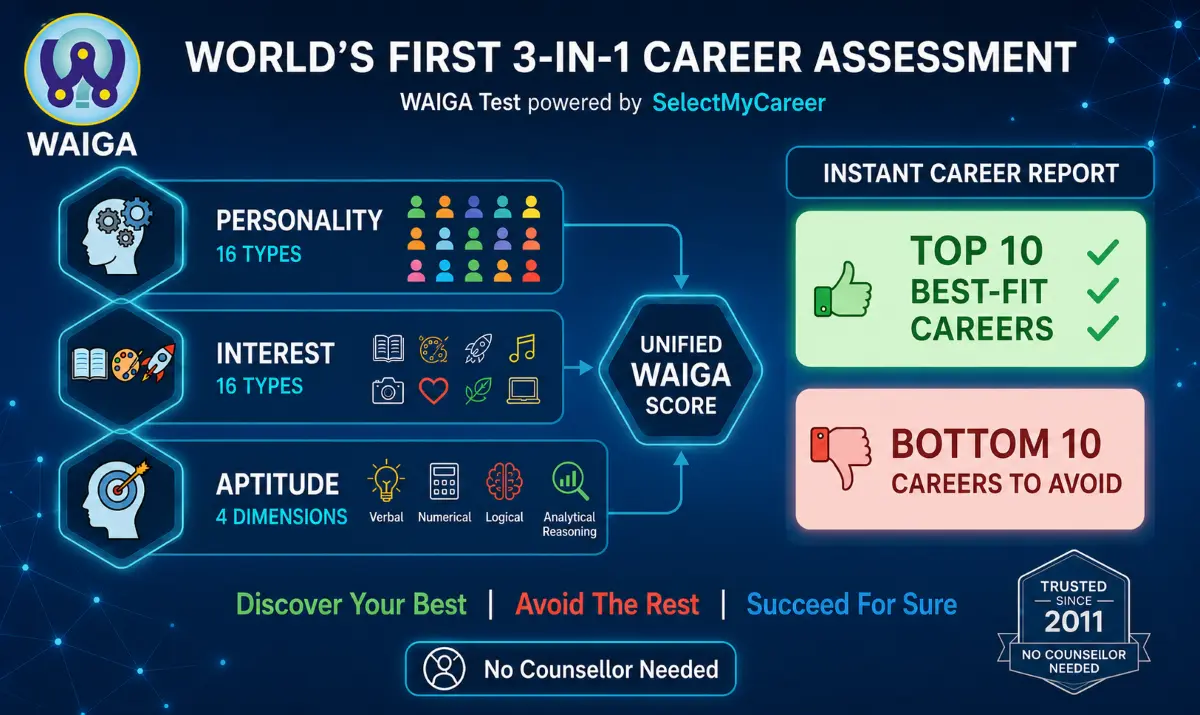
The WAIGA Career Assessment is designed around this multi-dimensional approach.
WAIGA measures:
✔ 7 Interest Types
✔ 16 Personality Types
✔ 4 Independent Aptitude Dimensions
✔ 1 WAIGA Score
✔ Instant Report
✔ No Counsellor Needed—Ever
The purpose of bringing these dimensions together is not to produce a single career prescription.
It is to give the individual a more complete picture of themselves before they begin evaluating career possibilities.
The 7 Interest Types help identify the kinds of work and activities that naturally attract and motivate you.
The 16 Personality Types provide insight into how you naturally communicate, make decisions, respond to situations and prefer to work.
The 4 Aptitude Dimensions examine different areas of reasoning ability: Verbal Reasoning, Numerical Reasoning, Logical Reasoning and Analytical Reasoning.
WAIGA measures interests across 7 types, personality across 16 types and aptitude across 4 independent dimensions, combining these into a single WAIGA Score.
And the Instant Report means that the information is available immediately, without making access to the results dependent on a counselling appointment.
But the Assessment Still Does Not Make the Decision
This point is worth stating clearly.
A comprehensive WAIGA profile does not mean:
“WAIGA has decided your career.”
It means:
“You now have better information with which to explore your career possibilities.”
That distinction is fundamental.
Your profile may identify careers worth investigating.
It may reveal strengths you had not recognised.
It may highlight interests you had previously overlooked.
It may show that a career you assumed was suitable deserves a closer look—or that other possibilities may be worth considering.
But you still need to explore those possibilities.
You still need to understand the reality of the work.
You still need to consider your values, aspirations and circumstances.
And ultimately, you make the decision.
No Counsellor Needed—Ever
This is also why WAIGA is designed to provide an instant, understandable report.
The objective is to make meaningful assessment information accessible directly to the individual.
You should not have to depend on someone else to tell you what your own results mean.
The report can give you the information.
The exploration is yours.
The evaluation is yours.
And the decision is yours.
No Counsellor Needed—Ever does not mean “No Thinking Needed.”
It means the assessment is designed to put the information directly in your hands so that you can use it as the starting point for your own career decision-making.
Assessment as a Tool for Better Decisions
This is the role career assessment should play.
Not a crystal ball.
Not a career prescription.
Not a substitute for judgment.
But a structured source of information that helps you understand yourself better and explore your options more intelligently.
Assessment should not choose your career.
It should help you make a better career decision.
A 5-Step Approach to Better Career Decisions
If a career assessment is not supposed to make the decision for you, what should the complete process look like?
At WAIGA, the answer is simple:
Use assessment to understand yourself.
Use exploration to understand your options.
Use evaluation to compare those options.
Then make the decision yourself.
This creates a fundamentally different relationship between assessment and career choice.
Step 1 — Understand Yourself
Start with a structured understanding of your own profile.
What are your natural reasoning strengths?
What kinds of activities and work attract you?
How do you naturally prefer to communicate, make decisions and work with others?
What does your profile suggest about the environments and types of work that may suit you?
This is where the WAIGA assessment provides its greatest value: structured self-understanding.
Step 2 — Explore Career Options
Once you understand yourself better, look outward.
Identify careers that appear compatible with your profile—but do not stop at the first recommendation.
Explore several possibilities.
Look for careers that connect with different combinations of your strengths, interests and working preferences.
Sometimes the most valuable outcome of an assessment is not discovering the career you expected.
It is discovering a career you had never considered.
Step 3 — Build Career Awareness
A career title tells you very little about the actual experience of doing the work.
Research the career.
Understand the education and qualifications required.
Find out what professionals actually do.
Explore the working environment.
Understand the challenges and pressures.
Look at career progression and future opportunities.
The objective is to move from:
“This career sounds interesting.”
to:
“I understand what this career actually involves.”
That is a significant difference.
Step 4 — Evaluate Your Options
Now bring the information together.
For each career you are considering, ask:
- Does it fit my aptitude?
- Does it align with my interests?
- Does the working environment suit my personality?
- Does it fit my values and aspirations?
- Can I realistically pursue the required education and pathway?
- Do I understand the realities and trade-offs involved?
- Can I see myself remaining engaged with this work over time?
You are no longer asking:
“Which career did my assessment recommend?”
You are asking:
“Which of these options makes the most sense for me?”
That is a much stronger decision-making question.
Step 5 — Make an Informed Decision
Eventually, you have to choose.
You will never have perfect information.
You cannot know every opportunity that will appear in the future.
You cannot predict exactly how your interests or circumstances will develop.
But you can make a decision based on substantially better information than you had at the beginning.
That is what informed career decision-making looks like.
The Complete Process
The WAIGA approach can therefore be expressed simply:
ASSESSMENT
Understand Yourself
↓
EXPLORATION
Understand Your Options
↓
CAREER AWARENESS
Understand the Reality
↓
EVALUATION
Compare What Matters
↓
DECISION
Choose Your Direction
Notice what sits at the end of the process.
The individual—not the assessment.
That is intentional.
Better Information Does Not Mean Perfect Certainty
There is an important distinction between making an informed decision and making a certain decision.
You can never eliminate all uncertainty from a career choice.
But you can eliminate some of the uncertainty caused by:
- Not understanding yourself
- Not knowing your options
- Relying on assumptions
- Following someone else’s expectations
- Choosing based only on popularity
- Confusing a test result with a career prescription
The objective is therefore not:
“Find the one perfect career.”
It is:
“Make the best-informed decision you can, based on who you are, what you value, what you know and what you want to explore.”
That is a much more realistic—and much more empowering—approach to career decision-making.
The Role of WAIGA
WAIGA does not claim to remove uncertainty.
It helps reduce avoidable uncertainty by giving individuals structured information about themselves.
The assessment is a tool.
The report is information.
The career possibilities are starting points for exploration.
The evaluation is personal.
And the final decision belongs to you.
Better information does not choose your career.
It helps you choose more thoughtfully.
A Career Decision Is Not Permanent
There is another misconception that can make career decisions unnecessarily stressful:
The belief that choosing a career means choosing the rest of your life.
For many students, the pressure to “get it right” comes from the assumption that one decision made at 17, 18 or 20 will permanently determine everything that follows.
Real careers rarely work that way.
People change.
They learn.
They gain experience.
They discover new interests.
They develop new capabilities.
And they encounter opportunities they could not have predicted when they first made their career choice.
Your Interests Can Develop
A student may have little exposure to a particular field today and therefore show limited interest in it.
That can change.
A university course, internship, project, teacher, mentor or real-world experience can introduce someone to an area they had never previously considered.
The reverse can happen too.
An interest that feels very strong today may become less important after greater exposure to the actual work.
That is one reason career exploration matters so much.
Interest is not necessarily a fixed label.
It can develop through experience.
Your Abilities Can Develop
Aptitude describes areas of natural reasoning ability, but a career also depends on skills.
And skills can be developed.
Someone who is not currently strong in a particular area may improve significantly through education, practice, experience and deliberate effort.
This is an important distinction.
An assessment can help you understand your current profile.
It should not convince you that your capabilities are permanently fixed.
Careers Can Change Too
The world of work does not remain static.
Technology creates new roles.
Industries evolve.
Organisations change how work is performed.
Entire professions can expand, contract or transform.
A student beginning a career today may eventually work in roles that barely existed—or did not exist at all—when they were making their original choice.
This makes precise prediction impossible.
What remains useful is developing the ability to understand yourself, evaluate opportunities and make informed decisions as circumstances change.
Career Paths Are Often Not Straight Lines
A career may begin in one field and develop in another.
Someone may move:
Engineering → Product Management
Finance → Entrepreneurship
Science → Consulting
Teaching → Educational Technology
Design → Marketing
Technology → Business Leadership
These are not necessarily signs that the original career decision was a mistake.
They can simply reflect learning, opportunity and changing priorities.
A career is often better understood as a journey of decisions rather than a single decision.
The Goal Is Not Perfect Prediction
This brings us back to the role of career assessment.
The objective of assessment is not to predict exactly where you will be twenty years from now.
That would be unrealistic.
The objective is to give you useful information about yourself now so that you can make a better decision about what to explore next.
That is a much more achievable—and much more useful—goal.
Make the Best Decision You Can With the Information You Have
A good career decision does not require certainty.
It requires thoughtful consideration.
You need enough understanding of yourself.
Enough awareness of your options.
Enough knowledge about the reality of those options.
And enough clarity about what matters to you.
Then you make the best decision you can with the information available.
And as you learn more, you can make new decisions.
That is not failure.
That is how careers actually develop.
A Better Way to Think About Career Choice
Instead of thinking:
“I must choose the perfect career.”
Think:
“I need to make a well-informed decision about the direction I want to explore.”
That change in perspective can reduce unnecessary pressure while encouraging better decision-making.
Your first career decision matters.
But it does not have to define your entire life.
A career is not a destination you select once.
It is a direction you can continue to evaluate, develop and refine as you grow.
Key Takeaways
- A career assessment provides information; it does not make the career decision for you.
- Aptitude, personality and interests answer different questions and are most useful when considered together.
- A career that appears to be a strong fit is not automatically the career you should choose.
- Career assessment can help you identify possibilities worth exploring, rather than prescribing a single destination.
- Career exploration matters. Understanding what a profession actually involves is as important as understanding yourself.
- Your values, aspirations and circumstances can influence your career decision in ways that no assessment can completely capture.
- The right question is not simply “What career did my test recommend?” but “Which career option makes the most sense for me?”
- Parents can play an important role by supporting exploration and informed decision-making rather than making the decision for their child.
- A career decision does not have to be perfect or permanent. Interests, skills, circumstances and career opportunities can change over time.
- The goal is not to eliminate all uncertainty. It is to reduce avoidable uncertainty and make the best-informed decision possible.
- WAIGA’s role is to provide structured information about 7 Interest Types, 16 Personality Types and 4 Aptitude Dimensions, helping individuals begin their career exploration with a more complete understanding of themselves.
- Ultimately, the assessment provides the information, the individual evaluates the options, and the individual makes the decision.
Don’t ask a test to choose your career. Ask it to help you understand yourself better.
Ready to Make a Better-Informed Career Decision?
Choosing a career does not begin with finding the perfect answer.
It begins with understanding yourself.
What are your natural strengths?
What kinds of work genuinely interest you?
How do you naturally prefer to work?
What possibilities might fit the person you are—and the life you want to build?
The WAIGA Career Assessment is designed to help you answer those questions with structured information rather than guesswork.
The most confident career decisions come from understanding what you enjoy, what you are naturally good at, how you prefer to work and which careers align with all of these dimensions.
That is the philosophy behind the WAIGA Career Decision Framework™.
The WAIGA Career Assessment combines multiple assessment dimensions to help students gain a deeper understanding of themselves before making one of life’s most important decisions.
The WAIGA Career Assessment includes:
✔ 7 Interest Types
✔ 16 Personality Types
✔ 4 Aptitude Dimensions
✔ 1 WAIGA Score
✔ Instant Report
✔ No Counsellor Needed—Ever
Understand Yourself. Explore Your Options. Make Your Decision.
A career assessment can give you a starting point.
Your exploration gives you context.
Your priorities give you direction.
And the final decision is yours.
If you’re ready to start making career decisions based on a comprehensive understanding of yourself, explore the WAIGA Career Assessment and discover your unique career profile.
Your future deserves more than guesswork. It deserves clarity, confidence and informed decisions.
✓ One integrated assessment instead of multiple separate tests
✓ Instant personalised report
✓ No counsellor needed — ever
✔ Best on laptop or desktop | ✔ Takes 20-30 minutes | ✔ Instant report — 3 ways to access
✔ Registration takes 2 minutes |✔ Purchased test stays in dashboard — take it anytime
You can also begin with our Free Career Test if you’d like an introduction before taking the full assessment.
If you still have questions, feel free to contact us.
Frequently Asked Questions (FAQs)
Choosing the right career involves more than taking a career test. A useful process is to understand your aptitude, personality and interests, explore different career options, understand what those careers actually involve, consider your values and aspirations, and then compare the options before making a decision.
A career assessment can provide valuable information about your abilities, interests and working preferences, but it cannot determine the one career you should choose. Assessment should be used as a starting point for career exploration and decision-making rather than as a prescription.
Consider your aptitude, interests, personality, values, aspirations and circumstances. You should also understand the education requirements, working environment, responsibilities, opportunities and challenges associated with the careers you are considering.
No. Career assessment is one important part of the process. It can improve self-understanding and help identify career possibilities, but career exploration, understanding the reality of different professions and evaluating your personal priorities are also important before making a decision.
Career fit refers to how compatible a career appears to be with your abilities, interests and personality. Career choice is the decision you make after considering that information together with your values, aspirations, circumstances and understanding of the actual career. A career can be a strong fit without necessarily being the career you choose.
Aptitude should inform your career decision, but it should not determine it by itself. Strong aptitude in an area can identify careers worth exploring, while interests, personality, values, aspirations and practical considerations also influence whether a particular career is appropriate for you.
Interests are an important part of career decision-making because they indicate the types of activities, subjects and work that naturally attract you. However, interests alone are not enough. A strong career decision considers interests alongside aptitude, personality, career requirements and personal priorities.
Parents can provide valuable guidance, experience and practical support, but the young person should ultimately have ownership of the career decision. Parents can help their child understand assessment results, explore career options and evaluate alternatives without treating an assessment result as a fixed instruction.
Your career interests can develop as you gain experience, learn new things and encounter different environments. An assessment describes your profile at the time you take it; it should inform exploration rather than become a permanent label.
Start exploring. Identify several careers that appear compatible with your profile, research what those careers actually involve, understand their education and skill requirements, consider how they align with your values and aspirations, compare your options and then make the best-informed decision you can.
No. WAIGA is designed to provide structured information about 7 Interest Types, 16 Personality Types and 4 Aptitude Dimensions, together with a WAIGA Score and an instant report. The purpose is to support self-understanding and career exploration—not to prescribe a single career.
Not necessarily. Career counselling can be useful in many situations, but people can also take an active role in their own career exploration and decision-making. WAIGA is designed to provide an understandable instant report so individuals can access their assessment information directly and use it as a starting point for further exploration.
Written by the WAIGA Career Guidance Team