
Introduction
Choosing a career can feel like a question with a simple answer.
What should I become?
A student may take an aptitude test and discover strong reasoning abilities.
Another may take a personality assessment and learn that they prefer structured, independent work.
Someone else may complete a career interest test and discover a strong attraction towards science, business, creative work or helping people.
Each of these insights can be useful.
But there is a problem.
None of them, by itself, can tell you which career is right for you.
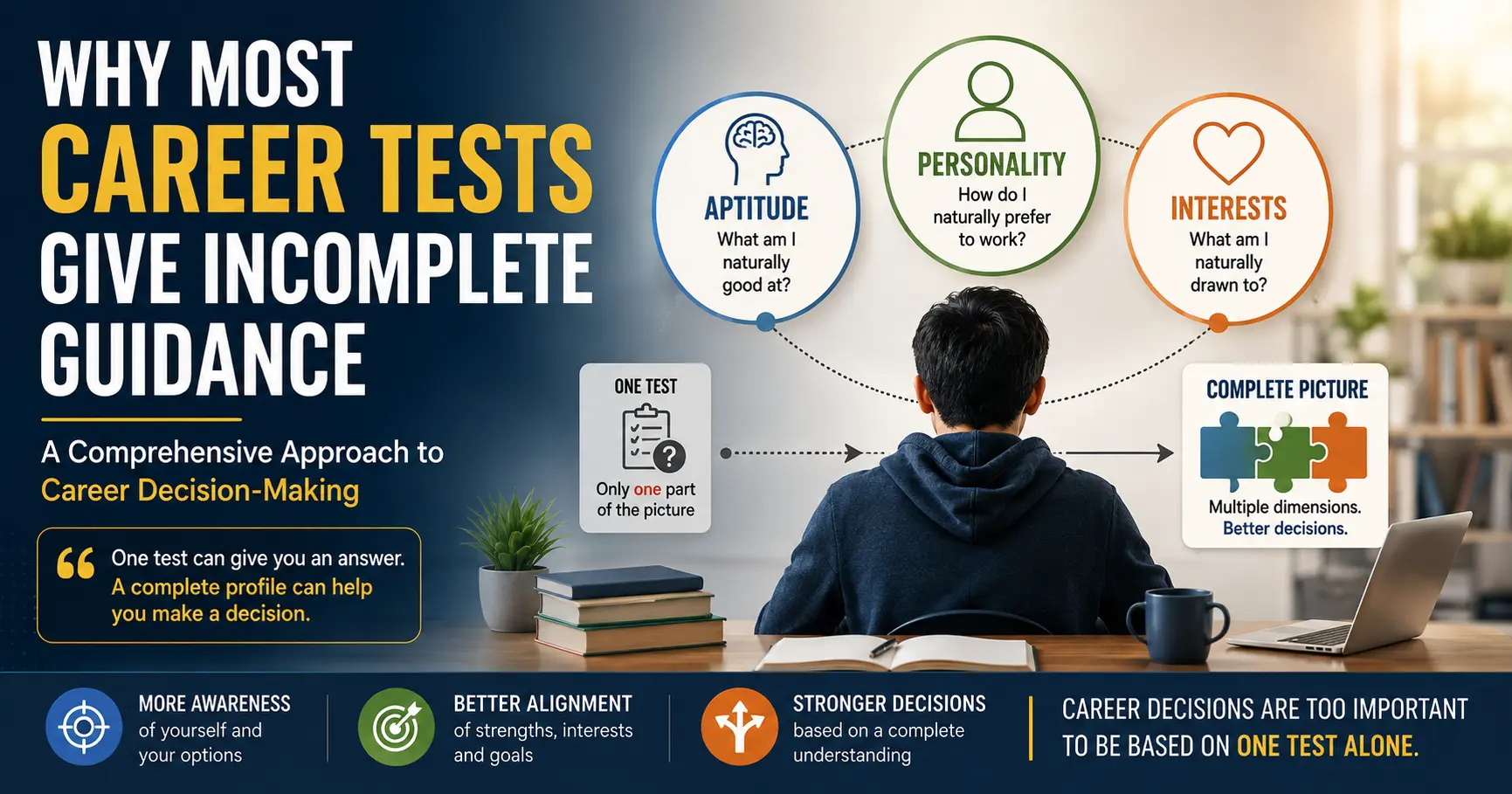
An aptitude assessment can help answer:
“What am I naturally good at?”
A personality assessment can help answer:
“How do I naturally prefer to work?”
An interest assessment can help answer:
“What kinds of work naturally attract me?”
These are three important questions—but they are not the same question.
And a career decision requires all three.
Imagine a student who has a strong interest in medicine.
That tells us something important about what attracts them.
But it does not tell us whether their aptitude aligns with the demands of the profession, whether their personality suits the realities of healthcare, or whether they understand what being a doctor actually involves.
Similarly, a student may have excellent numerical reasoning ability but have little interest in working with numbers every day.
Another may have a personality that suits leadership but discover that their strongest interests lie elsewhere.
Career fit exists at the intersection of multiple dimensions—not inside a single test result.
This is why relying on one career assessment can produce incomplete guidance.
The purpose of career assessment should not be to put a student into a box or produce a single career label.
It should be to help the individual build a clearer understanding of themselves and then connect that understanding with realistic career possibilities.
In this guide, we will examine why individual career tests provide only part of the picture, what each major assessment dimension can—and cannot—tell you, and why a comprehensive approach leads to more informed career decisions.
Because choosing a career is too important to be reduced to one test, one score or one personality type.
Table of Contents
Why Career Decisions Are More Complicated Than They Appear
Choosing a career is often presented as if there is a straightforward formula:
Find what you are good at → choose a career → succeed.
Or perhaps:
Find your passion → turn it into a career.
Or:
Take a personality test → discover which profession suits you.
Each of these approaches contains some truth.
But none tells the complete story.
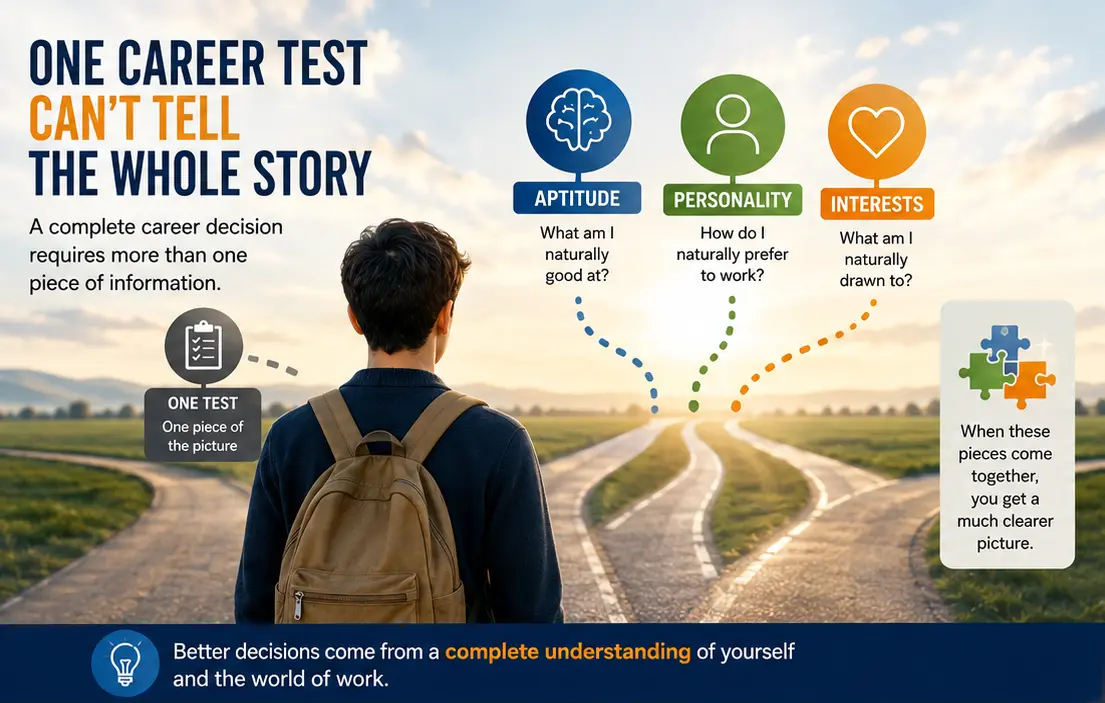
A career is not simply a subject you study or an activity you enjoy. It becomes a significant part of your everyday life—shaping what you do, who you work with, how you solve problems, what pressures you face and what opportunities you can pursue.
That makes career choice a multi-dimensional decision.
You may be good at something without wanting to do it
A student may have excellent numerical reasoning but have little interest in spending their working life analysing financial data.
Natural ability creates possibilities.
It does not automatically create motivation.
You may enjoy something without being naturally suited to it
A student may be fascinated by medicine because they genuinely want to help people.
That interest is valuable.
But becoming a doctor also requires strong reasoning abilities, extensive education, resilience and the willingness to handle the realities of clinical work.
Interest can point towards a career.
It does not establish career suitability by itself.
You may suit a career but dislike its environment
Someone may have the aptitude and interest required for a particular profession but discover that the working environment does not suit their personality.
The nature of teamwork, autonomy, deadlines, uncertainty, hierarchy and interaction with people can significantly influence whether someone actually enjoys the work.
You may know yourself but not know the career
There is another problem that is often overlooked.
Even when students understand their own strengths and preferences, they may have limited awareness of the careers available to them.
They may know what subjects they like but not know what professionals in those fields actually do.
They may be familiar with a few popular careers but unaware of dozens of alternatives that could suit them equally well—or better.
This means that effective career decision-making requires two kinds of understanding:
Understanding yourself.
and
Understanding the world of work.
The first comes from self-assessment and self-reflection.
The second comes from career exploration and awareness.
Neither is sufficient on its own.
Career choice is therefore a process—not a test result
A useful career assessment can provide valuable information.
But the assessment is only one stage of a much larger process.
You need to understand:
- What you are naturally capable of doing
- What you are interested in
- How you naturally prefer to work
- What matters to you
- What different careers actually involve
- Which opportunities are realistically available to you
Only when these pieces begin to come together can you move from self-discovery towards an informed career decision.
That is why the goal of career assessment should not be to find one magical answer.
It should be to provide enough meaningful information to help you make a better decision.
A career decision is not a test result. It is a decision informed by multiple pieces of evidence.
What Career Tests Usually Measure
Career assessments can examine different aspects of an individual. The most useful distinction is understanding what question each assessment is actually trying to answer.
Three major dimensions are particularly important in career decision-making:
1. Aptitude — What Am I Naturally Good At?
Aptitude refers to natural reasoning abilities and the capacity to learn, understand and work with different types of information.
A career aptitude assessment may examine abilities such as:
- Verbal reasoning
- Numerical reasoning
- Logical reasoning
- Analytical reasoning
Aptitude helps identify areas in which a person may have natural strengths and learning potential.
But aptitude does not tell you whether you will actually enjoy using those abilities every day.
Someone may be naturally strong at numerical reasoning without wanting a career centred around numbers.
Aptitude therefore provides an important part of the picture—but not the whole picture.
2. Personality — How Do I Naturally Prefer to Work?
Personality assessments explore characteristics related to how people typically approach work and interact with their environment.
They may provide insights into:
- Communication and interaction style
- Decision-making approach
- Response to pressure and uncertainty
- Preference for structure or autonomy
- Leadership and collaboration tendencies
- Preferred working environments
Personality can help answer:
“What kind of work environment is likely to suit how I naturally operate?”
But personality does not tell you what you are naturally capable of doing or what types of work genuinely interest you.
Someone may have a personality well suited to leadership, for example, but have very different career interests and aptitudes from another person with a similar working style.
3. Interests — What Am I Naturally Drawn Towards?
Interest assessments explore the kinds of activities, subjects and work that naturally attract a person’s attention and motivation.
Interests may include areas such as:
- Language and communication
- Visual creativity and design
- Hands-on and practical work
- Science, investigation and discovery
- Systems, structure and organisation
- Business, commerce and leadership
- Helping, teaching and working with people
Interests help answer:
“What kinds of work am I naturally drawn towards?”
But being interested in an area does not automatically mean that a person has the aptitude required to succeed in it professionally.
Three Different Questions. Three Different Answers.
These dimensions are valuable precisely because they measure different things.
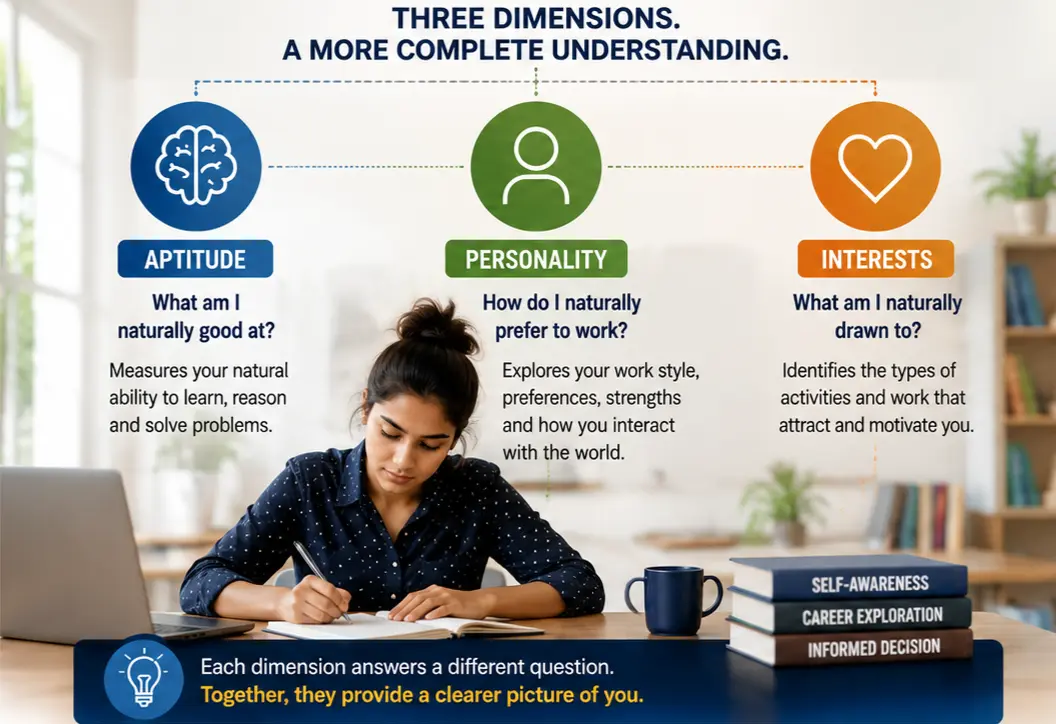
| Dimension | The Question It Helps Answer |
|---|---|
| Aptitude | What am I naturally good at? |
| Personality | How do I naturally prefer to work? |
| Interests | What kinds of work naturally attract me? |
The distinction is important.
Aptitude tells you about natural ability.
Personality tells you about working style.
Interests tell you about motivation and attraction.
None of these dimensions makes the others unnecessary.
In fact, their greatest value emerges when they are considered together.
Because the real career question is not simply:
“What does this test say about me?”
It is:
“What does the complete picture tell me about the careers that may fit me best?”
Aptitude tells you what you can do. Personality tells you how you work. Interests tell you what draws you in.
Why One Assessment Cannot Tell the Whole Story
A single career assessment can provide useful information.
The problem begins when that information is treated as the complete answer.
Imagine a student takes an aptitude assessment and discovers exceptional numerical reasoning ability.
The immediate conclusion might be:
“You are good with numbers, so you should choose finance, engineering or data science.”
But what if the student has little interest in working with numbers?
What if they strongly prefer working with people rather than data?
What if their personality is better suited to highly collaborative environments than to the day-to-day reality of the career being considered?
The aptitude result is not wrong.
It is simply incomplete.
The same problem occurs with personality
Suppose another student discovers that they are naturally confident, persuasive and comfortable leading others.
They may receive recommendations involving management, sales, consulting or entrepreneurship.
But what if their strongest interests are scientific research and investigation?
Or what if their aptitude is particularly strong in analytical reasoning rather than the abilities demanded by their suggested career?
Again, the personality assessment has not failed.
It has answered one question.
It has simply not answered all the questions required to make a career decision.
Interests can create the same problem
Now consider a student with a strong interest in medicine.
That interest is meaningful.
It tells us that healthcare and the human body may genuinely fascinate them.
But interest alone cannot tell us whether they possess the aptitude required for the profession, whether their personality suits the demands of clinical work, or whether they understand the realities of a medical career.
The interest result is valuable.
But it is only one piece of evidence.
The danger is not the test
This distinction is important.
The problem is not that aptitude tests, personality assessments or interest assessments are useless.
Quite the opposite.
Each can provide valuable information about an individual.
The problem occurs when we ask one assessment to answer questions that it was never designed to answer.
Aptitude cannot tell you what you will enjoy.
Personality cannot tell you what you are naturally capable of doing.
Interests cannot tell you whether you have the abilities required for a particular profession.
Each dimension has a different purpose.
The complete picture is more informative
Consider the difference between these two approaches.
Single-dimensional approach:
“Your strongest result is X, therefore you should choose career Y.”
Multi-dimensional approach:
“Your aptitude, personality and interests together suggest that these career areas may be worth exploring further.”
The second approach does not pretend to produce a magical answer.
Instead, it provides better evidence for making a decision.
And that distinction matters.
Career assessment should not eliminate the need for thinking.
It should make the thinking better informed.
The goal is therefore not to find the one test that tells you everything.
The goal is to bring together different pieces of meaningful information so that you can see the individual more completely.
Because:
One assessment can give you insight.
Multiple dimensions can give you perspective.
The problem is not that one career test is wrong. The problem is expecting one test to answer every question.
Aptitude: What Am I Naturally Good At?
Aptitude is one of the most valuable pieces of information in career decision-making because it helps answer a fundamental question:
“What am I naturally good at?”
It provides insight into a person’s natural reasoning abilities and learning potential across different areas.
For example, a student may demonstrate particular strength in:
- Verbal Reasoning — understanding, analysing and communicating through language.
- Numerical Reasoning — working with numbers, data, patterns and mathematical relationships.
- Logical Reasoning — identifying patterns, evaluating arguments and working through structured relationships.
- Analytical Reasoning — breaking down complex information, evaluating relationships and synthesising information into reasoned conclusions.
These abilities can provide useful clues about the types of academic and professional tasks a person may find more natural.
But aptitude has an important limitation.
Being good at something does not necessarily mean you want to spend your career doing it.
A student may have exceptional numerical reasoning but prefer working with people.
Another may have excellent analytical ability but be much more motivated by creative work.
Aptitude therefore helps identify capability, but capability alone does not determine career preference.
This is why aptitude should be viewed as an important component of career decision-making rather than a career prescription.
The better question is not:
“What career does my aptitude test tell me to choose?”
It is:
“Which career possibilities make sense when my aptitude is considered alongside my personality, interests and other priorities?”
Aptitude tells you where you may have natural strengths.
The next question is whether the way you naturally work is compatible with those possibilities.
Aptitude tells you what you may be capable of. It does not tell you what you will want to do every day.
Personality: How Do I Naturally Prefer to Work?
Personality adds another important layer to career decision-making.
While aptitude helps answer what you may be naturally good at, personality helps explore how you naturally prefer to work.
It can provide insights into characteristics such as:
- How you communicate and interact with others.
- How you approach decisions and problem-solving.
- How you respond to pressure, deadlines and uncertainty.
- Whether you prefer autonomy or greater structure.
- How comfortable you are leading, collaborating or working independently.
- Which types of working environments may feel more natural to you.
These differences can matter considerably in the workplace.
Two people may have similar aptitude and be equally capable of performing a particular type of work, yet have very different experiences because their preferred working styles differ.
For example, one person may enjoy a highly collaborative environment with frequent interaction and changing priorities.
Another may prefer independent work, predictable processes and extended periods of concentration.
Neither approach is inherently better.
The important question is whether the working environment matches the way the individual naturally operates.
But personality also has a limitation.
A personality profile cannot tell you what you are naturally capable of doing or what you genuinely want to spend your working life doing.
Someone may have a personality well suited to leadership but have little interest in management.
Another may prefer independent, analytical work but have very different aptitude strengths and career interests from someone else with a similar personality.
Personality therefore helps us understand work-style fit, but it does not determine career fit by itself.
The better question is not:
“Which career matches my personality?”
It is:
“Which career possibilities make sense when my personality is considered alongside my aptitude, interests and other priorities?”
Personality tells you how you may prefer to work.
The next question is what kind of work you are actually drawn towards.
Personality influences how you work. It does not decide what you should work on.
Interests: What Am I Drawn To?
Interests provide the third major piece of the career decision puzzle.
While aptitude helps answer what you may be naturally good at, and personality helps explain how you naturally prefer to work, interests help answer:
“What kinds of work naturally attract me?”
Career interest assessments can reveal preferences across different areas of work, such as:
- Language, writing and verbal communication
- Visual creativity and design
- Hands-on, mechanical and practical work
- Investigation, science and discovery
- Structure, systems and organised processes
- Commerce, leadership and business
- Helping, teaching and working with people
These preferences can provide valuable clues about the subjects, activities and work environments that are most likely to capture a person’s attention and motivation.
For example, someone may be strongly drawn towards scientific investigation and discovery.
Another person may be much more attracted to business, leadership and strategy.
A third may find the greatest satisfaction in teaching, counselling or helping others.
These differences matter because motivation matters in a career.
People are generally more likely to remain engaged when their work connects with activities and subjects they genuinely find meaningful or interesting.
But interests have an important limitation too.
Being interested in something does not automatically mean you are suited to it as a profession.
A student may love the idea of becoming a doctor but discover that the demands of medical education and clinical practice do not align with their aptitude or preferred working style.
Someone may be fascinated by architecture but find that the technical and analytical demands of the profession do not match their natural strengths.
Another may enjoy business but discover that they prefer working independently rather than managing teams or dealing with constant commercial pressure.
Interest therefore helps identify what attracts you, but it does not establish complete career suitability.
The better question is not:
“What career matches my interests?”
It is:
“Which career possibilities emerge when my interests are considered alongside my aptitude, personality and other priorities?”
Interests tell you where your curiosity and motivation may lead you.
A comprehensive career decision asks whether that direction also aligns with your abilities, your working style and the realities of the career itself.
Interests tell you what draws you in. They do not tell you whether you will thrive there.
Why These Three Dimensions Must Be Considered Together
Aptitude, personality and interests each provide valuable information, and career assessment can become more informative when these different dimensions are considered together.
But their real value becomes apparent when they are considered together.
Imagine three students.
Student A: Strong Aptitude, Low Interest
A student may have excellent numerical and analytical reasoning abilities.
They could potentially perform well in engineering, finance, data science or other analytical careers.
But suppose they have little genuine interest in working with numbers and strongly prefer working with people.
Their aptitude creates possibilities—but it does not automatically create motivation.
If career selection is based only on aptitude, important information is missing.
Student B: Strong Interest, Different Aptitude Profile
Another student may have a deep interest in medicine.
They enjoy biology, are fascinated by healthcare and genuinely want to help people.
That interest deserves to be taken seriously.
But the career decision should also consider whether their natural reasoning strengths, personality and preferred way of working align with the demands of the profession.
Interest can identify a direction worth exploring.
It does not automatically establish suitability.
Student C: Strong Personality Fit, Different Interests
A third student may have a personality that suits leadership, communication and collaboration.
Management, consulting, sales or entrepreneurship might appear to be obvious choices.
But what if the student has little interest in business?
Perhaps their strongest interests lie in scientific investigation, education or creative work.
Their personality may fit many environments—but personality alone cannot tell us which work they actually want to do.
What Happens When the Dimensions Converge?
Now consider a different situation.
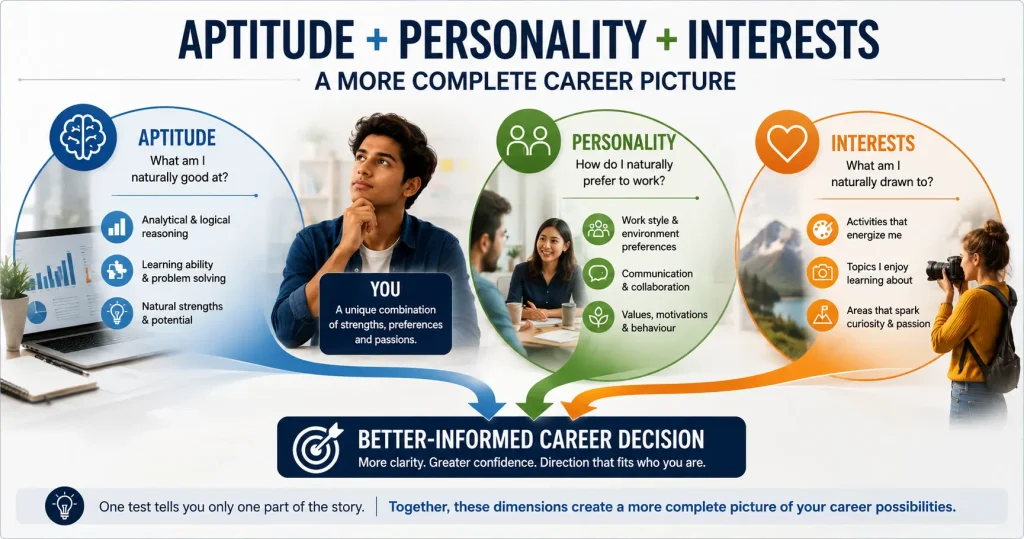
A student demonstrates:
Strong aptitude in analytical and logical reasoning.
A personality that is comfortable with structured problem-solving and independent work.
Strong interest in investigation, technology and discovery.
These three dimensions begin to point in a similar direction.
That does not mean a test should declare:
“You must become a data scientist.”
Instead, it provides a much stronger basis for exploring career areas involving analysis, technology, research and problem-solving.
The difference is subtle but important.
The purpose of multiple assessments is not to create a more complicated way of producing one predetermined answer.
It is to identify where different aspects of the individual converge and where they diverge.
Convergence Can Reveal Stronger Career Fit
When aptitude, personality and interests point towards similar career environments, the individual may have a stronger foundation for exploring those areas.
For example:
Interest may say:
“I want to investigate and discover.”
Aptitude may say:
“I am naturally good at analysing complex information.”
Personality may say:
“I prefer independent, structured problem-solving.”
Together, these provide considerably more information than any one result could provide.
Divergence Is Valuable Too
Perhaps even more importantly, the dimensions do not always have to agree.
A student may have strong aptitude for a particular field but little interest in it.
Another may have a strong interest in an area but discover that their aptitude profile points towards different kinds of work.
These differences are not failures.
They are information.
They can prompt better questions:
Why am I interested in this career?
What aspects of it appeal to me?
Which parts might be challenging?
Are there related careers that better align with my complete profile?
This is where career assessment becomes genuinely useful.
It does not simply tell you where to go.
It helps you understand why certain directions may—or may not—fit you.
The Goal Is Alignment, Not a Perfect Match
There may never be a career in which every single dimension aligns perfectly.
And that is okay.
The objective is not to find a mathematically perfect match.
The objective is to identify career possibilities where your abilities, interests, personality and priorities are sufficiently aligned to make further exploration worthwhile.
That is a much more realistic—and much more useful—way to think about career assessment.
Because the best career decisions are rarely based on the strongest score in one category.
They are based on the quality of the overall fit.
Convergence can reveal possibilities. Divergence can reveal questions. Both are valuable.
The Missing Pieces: Values, Aspirations & Career Awareness
Aptitude, personality and interests provide a powerful foundation for understanding an individual.
But they still do not answer every question involved in choosing a career.
A person may have the ability, interest and personality to succeed in several different career areas.
So how do you decide between them?
This is where other factors become important.
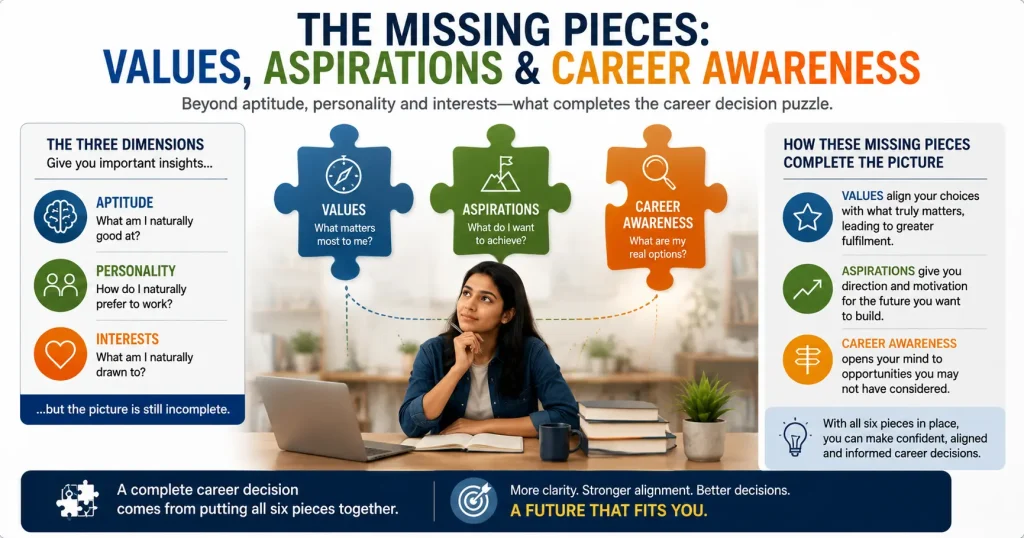
What Matters Most to You?
Your personal values influence what you expect from your working life.
For some people, financial growth may be a major priority.
Others may value stability, independence, creativity, social impact, recognition, flexibility or continuous learning.
Two people with very similar aptitude, personality and interests may therefore make completely different career decisions because what they want from their careers is different.
Understanding your values helps answer:
“What do I want my career to give me?”
What Do You Want to Become?
Career aspirations are another important consideration.
A student may be interested in science and have the aptitude required for several scientific careers.
But their personal aspirations may differ.
One may dream of becoming a researcher.
Another may want to work in healthcare.
Someone else may want to build a technology company.
Assessment can help identify possibilities, but the individual still has an important role in deciding what kind of future they want to create.
How Well Do You Understand the World of Work?
There is one more factor that is frequently overlooked:
Career awareness.
You cannot make a good career decision about options you do not know exist.
Many students are familiar with a relatively small number of popular professions—doctor, engineer, lawyer, teacher, accountant, designer or software developer.
But modern careers extend far beyond these familiar labels.
There are specialised roles, emerging professions, interdisciplinary careers and multiple pathways within almost every field.
Understanding what different careers actually involve—including their education requirements, working environments, responsibilities, opportunities and challenges—is essential.
A student’s assessment results may identify several promising directions.
Career exploration helps determine which of those directions are actually worth pursuing.
Assessment Is the Beginning of a Decision—Not the End
This leads to an important distinction.
A comprehensive career assessment can help you understand yourself.
Career exploration helps you understand your options.
Decision-making brings the two together.
The process can therefore be thought of as:
Understand Yourself
↓
Explore Career Possibilities
↓
Evaluate the Fit
↓
Make an Informed Decision
This is why even a sophisticated assessment should not be treated as a crystal ball.
Its purpose is not to eliminate uncertainty completely.
Its purpose is to reduce avoidable uncertainty by giving you better information to work with.
Ultimately, career decisions remain personal decisions.
The assessment provides evidence.
Career exploration provides context.
Your values and aspirations provide direction.
And you make the decision.
Assessment helps you understand yourself. Career exploration helps you understand your options. The decision brings the two together.
The WAIGA Career Decision Framework™
The limitations of single assessments point towards a simple but important principle:
A career decision should be based on more than one dimension of who you are.
This is the thinking behind the WAIGA Career Decision Framework™.
Rather than treating aptitude, personality or interests as separate answers to a career question, WAIGA brings these dimensions together to create a more complete picture of the individual.
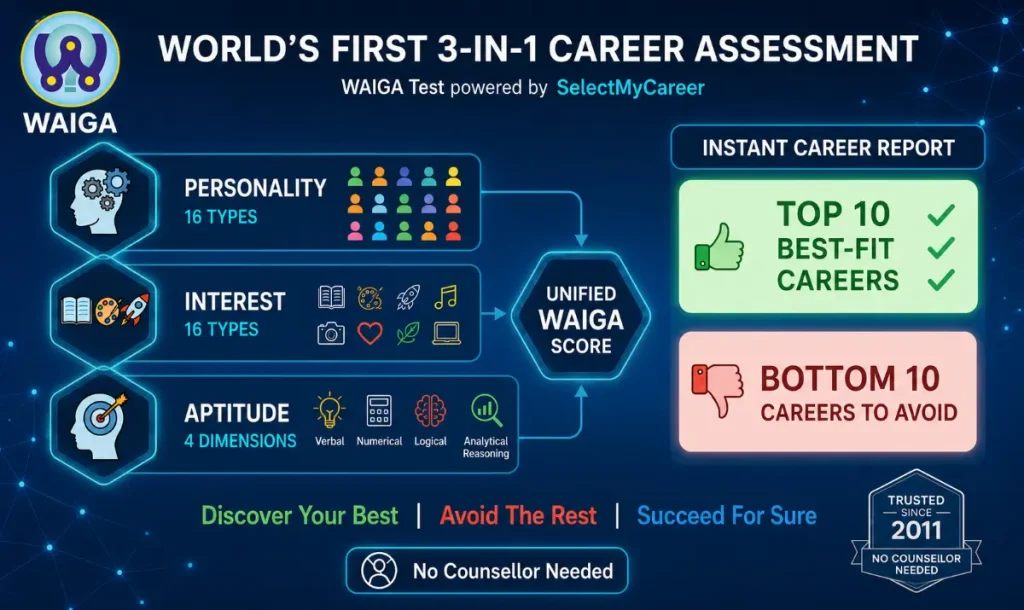
The framework measures:
7 Interest Types
Interests help identify what naturally attracts and motivates you.
WAIGA measures vocational interests across 7 distinct types, covering areas such as language and communication, visual creativity, hands-on work, investigation and discovery, structure and systems, commerce and leadership, and helping and interpersonal work.
The purpose is not simply to identify one broad area of interest, but to distinguish between different types of work that may lead towards very different career directions.
16 Personality Types
Personality helps reveal how you naturally prefer to work.
WAIGA measures personality across 16 distinct types, providing insights into communication style, decision-making, response to pressure, preference for autonomy or structure, and natural approaches to leadership and collaboration.
Importantly, personality is measured independently from interests.
What you enjoy doing and how you naturally operate are related—but they are not the same thing.
4 Aptitude Dimensions
Aptitude helps identify what you may be naturally capable of doing.
WAIGA measures aptitude across four independent dimensions:
- Verbal Reasoning — understanding, analysing and communicating through language.
- Numerical Reasoning — working with numbers, data, patterns and mathematical relationships.
- Logical Reasoning — identifying patterns, evaluating arguments and working through structured relationships.
- Analytical Reasoning — breaking down complex information, evaluating relationships and synthesising information into reasoned conclusions.
These dimensions help reveal areas of natural reasoning strength without assuming that a particular strength automatically determines a particular career.
1 WAIGA Score
The individual dimensions provide detailed information.
The WAIGA Score provides an additional way of bringing the assessment results together into a single overall indicator.
It is not intended to replace the underlying assessment dimensions.
Instead, it provides a concise summary alongside the more detailed profile.
The Complete Picture
The result is a career profile that looks at several important dimensions together:
INTERESTS
What attracts and motivates me?
↓
PERSONALITY
How do I naturally prefer to work?
↓
APTITUDE
What am I naturally capable of doing?
↓
WAIGA SCORE
A concise overall indicator of my assessment profile.
This does not produce a magical answer to the question:
“What career should I choose?”
And that is deliberate.
The purpose of the framework is to provide better information for a better decision.
A student can use the results to understand where their interests, abilities and working preferences converge, identify areas where they may need further exploration, and investigate career possibilities with greater self-awareness.
The framework therefore shifts the question from:
“Which career does my test recommend?”
to:
“What does the complete picture of me suggest I should explore?”
That is a much more useful question when making a decision that can influence years—or even decades—of a person’s life.
WAIGA does not tell you what career to choose. It helps you understand yourself well enough to make a better career decision.
Why WAIGA Uses Multiple Independent Dimensions
There is an important difference between measuring several things and blending several things into one indistinguishable result.
WAIGA deliberately keeps its major assessment dimensions independent.
Why?
Because aptitude, personality and interests answer different questions.
Aptitude asks:
“What am I naturally capable of doing?”
Personality asks:
“How do I naturally prefer to work?”
Interests ask:
“What kinds of work naturally attract me?”
These answers should not be treated as interchangeable.
Consider Two Students with Similar Interests
Imagine two students who are both strongly interested in business and leadership.
At first glance, they may appear to be equally suited to careers in management, consulting, sales or entrepreneurship.
But their underlying profiles may be very different.
One may have particularly strong numerical and analytical reasoning and prefer structured decision-making.
The other may have stronger verbal reasoning, enjoy frequent interpersonal interaction and prefer a highly collaborative environment.
Their shared interest does not make them identical career profiles.
The distinction between the dimensions helps reveal why they may be drawn towards the same broad area while potentially being better suited to different roles within it.
Independence Prevents One Dimension from Hiding Another
Suppose someone has a very strong interest in a particular career area but relatively little aptitude for some of the tasks that career requires.
That is important information.
If the dimensions were simply blended into one broad result, that difference could become difficult to see.
Similarly, a person may have excellent aptitude for an area but low interest in doing that type of work.
That is also meaningful.
The individual should not necessarily ignore the aptitude—but neither should they assume that ability automatically makes the career desirable.
Keeping the dimensions visible allows these convergences and divergences to be understood.
Different Results Do Not Mean the Assessment Has Failed
This is an important point.
A career profile does not need to produce identical signals across every dimension.
In fact, differences can sometimes be more informative than similarities.
For example:
High aptitude + high interest + compatible personality
may indicate an area worth exploring strongly.
Whereas:
High aptitude + low interest
may suggest a capability that could be useful in several different career directions but should not automatically determine the choice.
And:
High interest + different aptitude profile
may encourage exploration of related careers where the person’s strengths and interests can come together more effectively.
The purpose is therefore not to force every dimension to agree.
It is to understand what each dimension contributes to the decision.
A More Complete Picture
This is why WAIGA does not treat career assessment as a search for one dominant characteristic.
A person is more than their aptitude.
They are more than their personality.
And they are more than their interests.
A meaningful career profile needs to preserve these distinctions while allowing them to be considered together.
The result is not necessarily a single predetermined answer.
It is something more useful:
a clearer picture of the individual and the career possibilities worth exploring.
That is the fundamental idea behind a multi-dimensional approach to career decision-making.
The goal is not to make every result agree. The goal is to understand what each result contributes.
From Assessment to Decision: How to Use the Results
A comprehensive career assessment is valuable only when its results are used thoughtfully.
The purpose of assessment is not to replace career exploration or personal judgment. It is to provide better information from which to begin exploring.
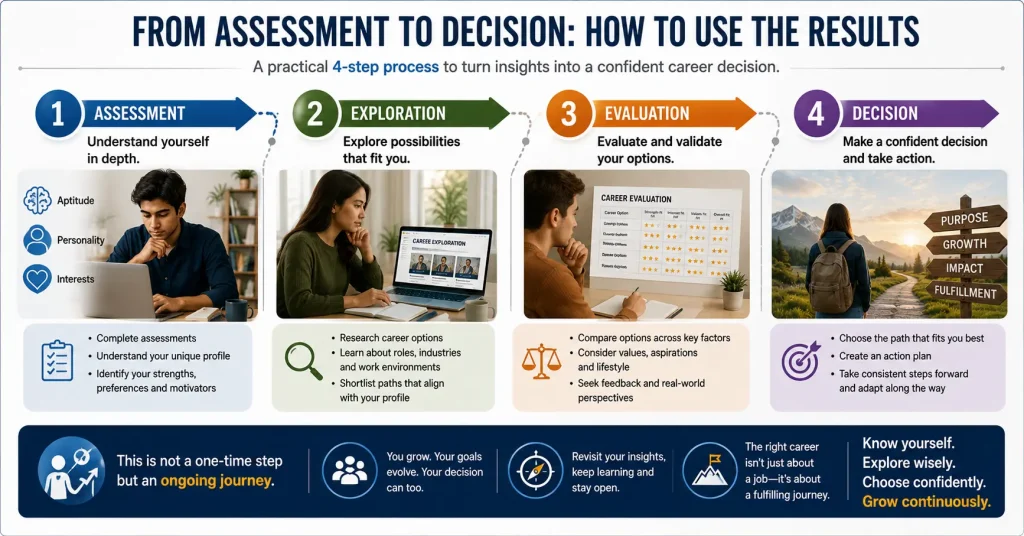
A useful process can be viewed in four stages.
Step 1: Understand Your Profile
Begin by looking at the results across all dimensions rather than focusing on a single score or type.
Ask:
- What are my strongest aptitude dimensions?
- What kinds of work interest me most?
- How do I naturally prefer to work?
- Where do these dimensions appear to reinforce each other?
- Where do they appear to differ?
The objective at this stage is self-understanding, not career selection.
Step 2: Identify Career Areas Worth Exploring
Once you understand your profile, look for career areas that connect with multiple aspects of it.
For example, a student with strong analytical reasoning, an interest in investigation and discovery, and a preference for independent structured work may want to explore careers involving research, data, technology or scientific analysis.
This does not mean one of those careers is automatically the right choice.
It means there is enough alignment to make further exploration worthwhile.
Think of assessment results as a way of narrowing a very large landscape into a more manageable set of possibilities.
Step 3: Test the Possibilities Against Reality
This is where career awareness becomes essential.
For each career you are considering, ask:
- What does the work actually involve every day?
- What education or qualifications are required?
- What skills are essential?
- What kind of working environment does it involve?
- What pressures and challenges are common?
- What opportunities exist in the field?
- Would I actually enjoy performing the work—not simply the idea of the career?
This step can change your thinking significantly.
A career may initially appear attractive but become less appealing once you understand its day-to-day reality.
Another career you had never considered may become surprisingly attractive once you discover what it actually involves.
Step 4: Make an Informed Decision
After exploring the possibilities, compare the options against your complete profile and your personal priorities.
You may find that:
One career aligns strongly with your interests and aptitude.
Another offers a better personality and environment fit.
A third aligns particularly well with your values and long-term aspirations.
There may not be one objectively perfect answer.
The goal is to identify the options that offer the strongest overall fit and then make a thoughtful decision based on the evidence available to you.
Assessment Should Reduce Uncertainty—Not Pretend to Eliminate It
No assessment can predict the future with certainty.
People grow.
Interests change.
Skills develop.
Career opportunities evolve.
Life circumstances change.
That is why responsible career assessment should not promise:
“This is the one career you are meant to pursue.”
Instead, it should help you say:
“I understand myself better, I understand my options better, and I have stronger reasons for the decision I am about to make.”
That is a much more realistic definition of successful career guidance.
The purpose of assessment is not to make the decision for you.
It is to help you make the decision with better information.
Don’t choose a career because a test told you to. Explore it because your complete profile gives you a reason to.
Key Takeaways
- No single career test can tell you everything you need to know about your future career.
- Aptitude helps you understand what you may be naturally capable of doing.
- Personality helps you understand how you naturally prefer to work.
- Interests help you understand what kinds of work naturally attract and motivate you.
- These dimensions answer different questions and should not be treated as interchangeable.
- A strong result in one dimension does not automatically mean that a particular career is the right choice.
- Differences between aptitude, personality and interests are not necessarily problems—they can reveal important questions worth exploring.
- Values, career aspirations and career awareness also matter when evaluating career options.
- A career assessment should help you identify possibilities and ask better questions, rather than dictate a single career.
- The most useful career decisions come from combining self-understanding, career exploration and informed judgment.
- The WAIGA Career Decision Framework™ brings multiple independent dimensions together to provide a more complete picture of the individual.
- Ultimately, a career test should inform your decision—not make the decision for you.
One test can give you an answer.
A complete profile can help you make a decision.
Don’t let a test choose your career.
Let better information help you choose it.
Ready to See the Complete Picture?
A career decision is too important to be based on a single test, a single score or a single personality label.
You need to understand:
What attracts you.
How you naturally prefer to work.
Where your natural abilities lie.
And how these dimensions come together.
The most confident career decisions come from understanding your personality, your natural abilities, your interests and the careers that align with all of them.
That is the philosophy behind the WAIGA Career Decision Framework™.
The WAIGA Career Assessment combines multiple assessment dimensions to help students gain a deeper understanding of themselves before making one of life’s most important decisions.
The WAIGA Career Assessment includes:
✔ 7 Interest Types
Discover the kinds of work and activities that naturally attract and motivate you.
✔ 16 Personality Types
Understand how you naturally communicate, make decisions and prefer to work.
✔ 4 Aptitude Dimensions
Explore your natural strengths in Verbal, Numerical, Logical and Analytical Reasoning.
✔ 1 WAIGA Score
Get a concise overall indicator alongside your detailed assessment profile.
✔ Instant Report
Receive your results immediately, without waiting for an appointment.
✔ No Counsellor Needed—Ever
Understand your assessment results directly and use them as a foundation for your own career exploration and decision-making.
The goal is not for WAIGA to tell you:
“This is the career you must choose.”
The goal is to help you understand yourself well enough to ask better questions, explore better possibilities and make a more informed decision.
If you’re ready to move beyond single dimension tests and make career decisions based on a comprehensive understanding of yourself, explore the WAIGA Career Assessment and discover your unique career profile.
Your future deserves more than guesswork. It deserves clarity, confidence and informed decisions.
Start With Understanding Yourself
If you are a student deciding what to study, a parent helping your child explore career possibilities, or simply someone reconsidering your own career direction, the first step is understanding the person at the centre of the decision:
You.
✓ One integrated assessment instead of multiple separate tests
✓ Instant personalised report
✓ No counsellor needed — ever
✔ Best on laptop or desktop | ✔ Takes 20-30 minutes | ✔ Instant report — 3 ways to access
✔ Registration takes 2 minutes |✔ Purchased test stays in dashboard — take it anytime
You can also begin with our Free Career Test if you’d like an introduction before taking the full assessment.
If you still have questions, feel free to contact us.
Frequently Asked Questions (FAQs)
No. A single career test can provide useful information, but no individual assessment can capture every factor involved in a career decision. Aptitude, personality and interests each provide different insights, and they are best considered together with values, aspirations and career awareness.
Different career tests measure different things. An aptitude test may measure reasoning abilities, while a personality assessment examines working preferences and an interest assessment explores the types of work that naturally attract you. Different results do not necessarily mean that a test is wrong—they may simply be answering different questions.
An aptitude test focuses primarily on natural reasoning abilities and learning potential, while a personality test explores how you typically communicate, make decisions, respond to situations and prefer to work. Both can provide useful information, but they measure different dimensions.
A career interest test explores the types of activities, subjects and work that naturally attract and motivate you. An aptitude test examines areas of natural reasoning ability. You may be highly interested in something without having the strongest aptitude for it, or have strong aptitude in an area that does not particularly interest you.
Neither should automatically be considered more important. Aptitude, personality and interests provide different types of information. A career decision is stronger when these dimensions are considered together rather than relying on one dimension alone.
No personality assessment can reliably predict career success on its own. Personality can provide useful insights into preferred working styles, communication, decision-making and workplace environments, but career success also depends on abilities, interests, skills, opportunities, motivation and many other factors.
Interests can show what kinds of work naturally attract you, but they do not necessarily indicate whether you have the aptitude required for a particular profession or whether its working environment suits your personality. Interests are therefore an important part of career planning, but not the complete picture.
Interests can show what kinds of work naturally attract you, but they do not necessarily indicate whether you have the aptitude required for a particular profession or whether its working environment suits your personality. Interests are therefore an important part of career planning, but not the complete picture.
You should consider your aptitude, personality, interests, values, aspirations, skills, educational opportunities and understanding of different careers. Exploring what careers actually involve is particularly important because knowing yourself is only one part of making an informed career decision.
Use the results as a starting point for self-understanding and career exploration rather than as a fixed prescription. Look for areas where your aptitude, personality and interests converge, investigate the careers associated with those areas, understand their real-world requirements and then evaluate which options align with your priorities and aspirations.
The WAIGA Career Assessment measures 7 Interest Types, 16 Personality Types and 4 Aptitude Dimensions, and provides 1 WAIGA Score alongside an instant report. The assessment is designed to provide a multi-dimensional profile that can support informed career exploration and decision-making rather than prescribing a single career.
No. WAIGA is designed to provide information that can help you understand yourself and explore career possibilities more effectively. The assessment does not replace personal judgment or career exploration. Its purpose is to help you make a better-informed career decision.
WAIGA is designed to provide an instant report that can be understood directly, supporting independent career exploration without requiring a counsellor. This reflects the WAIGA philosophy of making meaningful career assessment accessible without making professional counselling a mandatory step.
Written by the WAIGA Career Guidance Team