

Choosing the right career becomes easier when you understand your strengths. Yet many people struggle to answer a seemingly simple question:
What am I actually good at, and how can I use that to choose a career?
Table of Contents
You might perform well in certain subjects but have no interest in building a career around them. You might enjoy helping people, solving problems, organising projects or creating things without knowing which professions use those abilities. Or you may feel that you have no exceptional talent at all.
These situations are more common than you might think.
Understanding your strengths is not simply about identifying what you do well today. It also involves recognising your natural tendencies, learning preferences, problem-solving abilities, interests and the kinds of activities you may be able to develop through practice.
Most importantly, your strengths are only one part of career fit. A career that uses your abilities but holds no interest for you may not be satisfying. A career you love may require skills you still need to develop. And a job that looks attractive from the outside may involve daily responsibilities that do not suit your personality.
A better career decision comes from understanding how your strengths connect with your interests, aptitude, personality, values and realistic opportunities.
In this guide, you will learn how to identify your strengths, distinguish them from skills and interests, connect them with career options, and use a practical framework to make a more informed decision about your future.
1. What Are Personal Strengths?
Personal strengths are the abilities, qualities and tendencies that help you perform certain activities effectively.
They can include how you think, solve problems, communicate, organise information, learn new things, work with others or respond to challenges.
Some strengths are easy to recognise. You might be good at explaining complicated ideas, noticing patterns in data, writing clearly or organising a group project.
Others are less obvious.
Perhaps you notice when people feel uncomfortable. Maybe you can remain calm when plans change. You might be good at understanding how different parts of a system work together, or you may find it easy to learn unfamiliar tools.
These qualities can be valuable even when they do not appear as formal subjects on a school report or as technical skills on a résumé.
Common types of strengths
Analytical strengths
- Identifying patterns and relationships
- Evaluating evidence
- Understanding numbers and data
- Breaking complex problems into smaller parts
- Comparing alternatives logically
Creative strengths
- Generating new ideas
- Imagining different possibilities
- Communicating through words or visuals
- Finding original approaches to problems
- Improving existing products or processes
Communication strengths
- Explaining information clearly
- Writing for different audiences
- Listening carefully
- Presenting ideas
- Persuading or negotiating
Interpersonal strengths
- Understanding other people’s perspectives
- Building relationships
- Collaborating effectively
- Supporting and motivating others
- Resolving disagreements
Organisational strengths
- Planning and prioritising
- Coordinating tasks
- Managing details
- Tracking progress
- Establishing reliable processes
Practical and technical strengths
- Working with tools, equipment or systems
- Understanding how things operate
- Troubleshooting problems
- Learning technical procedures
- Applying knowledge to practical situations
Self-management strengths
- Working independently
- Maintaining focus
- Adapting to change
- Managing time
- Persisting through challenges
You may recognise yourself in several categories. That is normal.
The objective is not to select one label and define your entire identity around it. It is to understand which strengths are most relevant to the kinds of work you are considering.
2. Why Identifying Your Strengths Matters When Choosing a Career
Career decisions often begin with job titles, salaries, popular industries or other people’s recommendations.
Those factors can provide useful information, but they do not tell you whether the work is suitable for you.
Understanding your strengths gives you a different starting point.
Instead of asking only, “Which career is popular?” you can ask:
- What kinds of problems do I handle well?
- Which activities feel relatively natural to me?
- What do I learn quickly?
- Which tasks do people consistently trust me to do?
- What abilities could become valuable in a professional setting?
- Which careers use these abilities regularly?
Consider two students.
One enjoys analysing information, working with numbers and identifying patterns. Another enjoys explaining concepts, organising activities and helping people understand unfamiliar subjects.
Both may perform well academically, but their strongest abilities may point toward different kinds of work.
The first student might investigate data analysis, research, finance or technical roles. The second might explore education, communication, training, project coordination or people-focused roles.
These are starting points, not definitive matches. Each student would still need to investigate the actual work, qualifications, interests and working environments involved.
The key advantage is that they are beginning with evidence about themselves rather than relying entirely on job titles or external expectations.
3. Strengths, Skills, Interests and Aptitude: What Is the Difference?
These concepts overlap, but they answer different questions. Understanding the differences can help you avoid choosing a career based on incomplete information.
Strengths: What do I tend to do well?
Strengths describe areas in which you may perform effectively or demonstrate useful personal qualities.
For example, you may be good at identifying inconsistencies, communicating clearly or coordinating people.
Skills: What can I do?
Skills are abilities developed through learning, training, practice or experience.
Examples include programming, accounting, graphic design, public speaking, spreadsheet analysis and operating specialised equipment.
A strength can help you develop a skill, but the two are not identical.
You might have a strong analytical tendency but need formal training to become a competent data analyst.
Interests: What attracts and engages me?
Interests describe the subjects, activities and areas of work that you find appealing.
You may be fascinated by psychology, technology, business, biology, design or education.
However, enjoying a subject does not automatically mean you will enjoy the daily work associated with a career in that field.
Aptitude: What abilities or potential do I demonstrate?
Aptitude concerns abilities or potential relevant to particular types of learning, reasoning and problem-solving.
Depending on the assessment, this may involve numerical reasoning, verbal reasoning, spatial thinking, logical problem-solving or other dimensions.
Aptitude information can help you understand which kinds of tasks may suit your current abilities and where further development might be worth investigating.
Personality: How do I tend to think and work?
Personality can offer insight into your preferences, behavioural tendencies and approach to work.
For example, you might prefer independent analysis, collaborative projects, structured routines or environments involving frequent interaction.
No personality characteristic automatically determines the right career, but understanding your preferences can help you compare working environments.
Why the distinction matters
Imagine that you are interested in architecture.
Your interest explains why the field attracts you. Your aptitude may provide information about relevant spatial or analytical abilities. Your strengths may include visual thinking or attention to detail. Your skills may include drawing or computer-aided design. Your personality and preferences may influence whether you enjoy collaborative design work, technical documentation or client interaction.
These are different pieces of information.
The more complete your understanding, the better equipped you are to investigate whether a career fits you.
4. Start With Evidence From Your Everyday Life
You do not need to wait for a formal assessment to begin identifying your strengths.
Your everyday experiences can provide useful clues.
Think about school, college, work, hobbies, volunteering, family responsibilities, personal projects and situations in which you have helped other people.
Look for recurring patterns rather than isolated successes.
Ask yourself these questions
- What do people regularly ask me to help them with?
- Which tasks do I complete confidently?
- What kinds of problems do I enjoy solving?
- Which subjects or activities have I learned relatively quickly?
- What have I improved at through practice?
- When have I helped a group make progress?
- Which accomplishments am I proud of?
- What do I do well even when nobody is supervising me?
- Which activities leave me feeling engaged rather than merely relieved that they are over?
Write down your answers without worrying about whether they sound impressive.
For example:
| Experience | Possible strength to investigate |
|---|---|
| Classmates ask you to explain difficult topics | Communication and explanation |
| You notice errors others overlook | Attention to detail |
| You enjoy solving unfamiliar puzzles | Analytical problem-solving |
| You coordinate group assignments | Organisation and collaboration |
| You regularly create visual projects | Visual thinking and creativity |
| You help people compare difficult choices | Listening and structured reasoning |
| You learn unfamiliar software quickly | Technical learning and adaptability |
These are hypotheses, not final conclusions. One experience may reflect several abilities, and a single example does not establish a permanent strength.
Your next task is to look for repeated evidence.
5. Use Past Achievements to Discover Your Strengths
Past achievements can reveal more than the final result.
Instead of asking only whether you received a good grade, completed a project or won a competition, examine how you achieved it.
Suppose you performed well in a group project.
What contributed to the result?
Perhaps you:
- researched the subject thoroughly,
- identified the central problem,
- explained the findings clearly,
- coordinated everyone’s responsibilities,
- designed the presentation,
- or resolved disagreements.
The achievement itself is only the starting point. The process reveals the abilities you used.
Try this exercise
Choose three experiences you consider successful.
For each one, answer:
- What was the situation?
- What did I personally contribute?
- Which tasks did I handle particularly well?
- What feedback did I receive?
- Which abilities helped me achieve the result?
- Have I demonstrated those abilities elsewhere?
Look for strengths that appear in more than one situation.
For example, if you repeatedly organise information, clarify complex problems and help people make decisions, you may have a useful combination of analytical, organisational and communication strengths.
That combination may be relevant across several industries.
You do not need a long list of extraordinary achievements. Ordinary experiences can provide meaningful evidence when you examine them carefully.
6. Ask Other People What They Notice About You
Self-reflection is useful, but it has limitations.
You may overlook abilities that feel ordinary because they come naturally to you. Alternatively, you may overestimate a strength because you enjoy the activity or have received praise for it once.
Feedback from other people can provide another perspective.
Consider asking two or three people who have seen you in different situations:
- What do you think I do particularly well?
- Which tasks would you trust me to handle?
- When have you seen me solve a problem effectively?
- What qualities do you notice when I work with others?
- Which abilities do you think I could develop further?
Choose people who can give specific examples rather than general compliments.
“You’re intelligent” is less useful than “You are good at comparing different explanations and spotting where the reasoning breaks down.”
Likewise, “You’re a natural leader” becomes more useful when someone can explain how you organise people, communicate expectations or help a group make progress.
Treat feedback as evidence, not a verdict
Different people may notice different strengths because they see different sides of you.
One person might value your creativity, while another notices your reliability.
You do not need to accept every opinion.
Compare feedback with your own experience and look for recurring patterns.
The aim is to improve your understanding of yourself, not allow other people to choose your career for you.
7. Identify the Activities You Learn Quickly
One useful clue is the rate at which you learn unfamiliar tasks.
Some people quickly understand numerical relationships. Others learn languages, visual tools, practical procedures or interpersonal techniques relatively easily.
Notice where you tend to make progress when learning something new.
Ask yourself:
- Which concepts do I understand after relatively little explanation?
- What can I improve at with practice?
- Which types of problems do I approach confidently?
- Where do I notice patterns before they become obvious to me?
- Which learning activities make me curious enough to keep practising?
However, be careful not to confuse early ease with guaranteed long-term success.
A task may initially feel easy but become frustrating at advanced levels. Another task may feel difficult at first because you have little experience, yet become a genuine strength through sustained practice.
Aptitude is not a fixed limit on your future.
It is one source of information about your current abilities and potential. Skills, knowledge, experience and deliberate practice also matter.
Use your learning patterns to identify promising areas, then investigate what further development would require.
8. Distinguish Natural Strengths From Developed Skills
You may already possess valuable skills without recognising the strengths that helped you develop them.
For example, someone who has learned video editing may also demonstrate:
- visual judgement,
- patience,
- attention to detail,
- storytelling,
- technical learning,
- and persistence.
Someone who has developed strong spreadsheet skills may also demonstrate numerical reasoning, logical thinking and systematic problem-solving.
This matters because your existing skills are not the only assets you can use in a new career.
The underlying strengths may transfer to other activities.
Build a strengths-and-skills inventory
Create three columns:
| Existing skill | Strengths used | Other possible applications |
|---|---|---|
| Writing reports | Research, structure, communication | Content strategy, technical writing, research |
| Coordinating events | Organisation, planning, collaboration | Project coordination, operations |
| Analysing spreadsheets | Numerical reasoning, accuracy | Business analysis, finance, reporting |
| Creating presentations | Visual communication, synthesis | Training, marketing, communication |
| Troubleshooting devices | Practical reasoning, persistence | Technical support, diagnostics |
These examples are illustrative, not automatic career recommendations.
Before pursuing a new direction, investigate the qualifications, technical skills and experience required.
The purpose of the inventory is to help you see that your experience may be more transferable than you first assumed.
9. Understand What You Enjoy Doing, Not Just What You Do Well
A strength can be useful without being something you want to use every day.
You might be excellent at organising complex tasks but dislike spending most of your time coordinating other people.
You might be good at mathematics but prefer a career that uses numerical reasoning as one component rather than the central activity.
You might communicate well but dislike constant public interaction.
This is why strengths and interests should be considered together.
For each strength you identify, ask:
- Do I enjoy using this ability?
- Do I find the activity meaningful?
- Would I like to improve further?
- Do I enjoy the process, or only the recognition?
- Would I want to use this strength regularly at work?
The distinction can change your career shortlist considerably.
Consider two people who are both good at communication.
One enjoys presenting ideas to large groups. The other prefers writing carefully structured explanations and working independently.
Their communication strengths overlap, but their preferred activities differ.
They might investigate different roles even if their underlying ability is similar.
A career should not merely use what you do well. It should also provide a working pattern you can reasonably see yourself sustaining.
10. Look for the Problems You Naturally Enjoy Solving
Job titles can be misleading because the same title may involve different responsibilities in different organisations.
A more revealing question is:
What kinds of problems do I enjoy working on?
For example:
- Understanding why something happens
- Designing something new
- Helping people overcome difficulties
- Improving how a process works
- Persuading others to consider an idea
- Finding errors and inconsistencies
- Organising people and resources
- Repairing or building practical systems
- Explaining information clearly
- Discovering patterns in data
These preferences can help you explore different careers without becoming attached to one particular job title.
Someone who enjoys investigating causes might explore research, diagnostics, analysis or troubleshooting.
Someone who enjoys improving systems might investigate operations, engineering, process improvement or business analysis.
Someone who enjoys explaining ideas might investigate education, training, communication or technical writing.
These categories overlap. The important question is what the actual work requires and whether you would enjoy doing it.
11. Match Your Strengths With Real Career Options
Once you have identified a few likely strengths, begin exploring careers that use them.
Do not try to find a perfect one-to-one match. Most careers require combinations of abilities.
A career in marketing, for example, may involve communication, research, creativity, analytical thinking and collaboration. Different marketing roles emphasise those abilities in different proportions.
Similarly, a software-related role may involve logical reasoning, technical learning, collaboration, communication and problem-solving.
The table below provides starting points for exploration.
| Strengths you notice | Career areas worth investigating |
|---|---|
| Analytical reasoning and pattern recognition | Data analysis, research, finance, business analysis |
| Creativity and visual thinking | Design, media, advertising, creative production |
| Communication and explanation | Education, training, writing, communications |
| Interpersonal understanding | Human resources, customer success, community programmes |
| Planning and coordination | Project coordination, operations, logistics |
| Technical troubleshooting | IT support, technical operations, engineering-related roles |
| Practical problem-solving | Skilled technical work, maintenance, production, technical services |
| Persuasion and relationship building | Sales, partnerships, business development |
| Scientific curiosity and systematic investigation | Laboratory work, research support, quality assurance |
| Organisational thinking and attention to detail | Administration, compliance, documentation, process management |
These are possibilities to investigate, not prescriptions.
A strength rarely determines a single career. The same strength may be useful in dozens of roles, and the same career may suit people with different combinations of strengths.
Investigate the daily work
For every career that interests you, research:
- What do professionals actually do each day?
- Which tasks take up most of their time?
- What education or training is required?
- Which skills are essential at entry level?
- What working conditions are typical?
- What are the likely opportunities for progression?
- What challenges do people in the field commonly face?
This prevents you from choosing a career based on an attractive title while overlooking the work itself.
12. Consider Personality Alongside Your Strengths
Your strengths help explain what you may do well. Personality can add information about how you prefer to approach work.
For example, you may be good at analysing problems but prefer doing so independently rather than in frequent meetings.
You may have strong interpersonal abilities but prefer one-to-one conversations to public speaking.
You may be highly organised but enjoy flexible projects more than repetitive administrative tasks.
These distinctions can influence which roles and environments deserve your attention.
Consider the following questions:
- Do I prefer independent work or frequent collaboration?
- Do I enjoy making quick decisions or examining details first?
- Do I prefer clear procedures or open-ended problems?
- Do I like leading, supporting or specialising?
- Do I enjoy frequent interaction or longer periods of concentration?
- Do I prefer predictable routines or changing responsibilities?
There are no universally superior answers.
An outgoing personality does not automatically mean you should work in sales. A preference for independent work does not rule out leadership. A structured approach does not prevent creativity.
Personality information is most useful when it helps you compare actual work environments rather than placing you inside a rigid category.
13. Consider Your Interests and Values
Even a career that uses your strongest abilities may not be right for you if it conflicts with what matters most.
Interests help you identify subjects and activities that attract you.
Values help you understand what you want your work to provide.
You might value:
- financial security,
- independence,
- creativity,
- social contribution,
- intellectual challenge,
- recognition,
- flexibility,
- stability,
- collaboration,
- or opportunities to keep learning.
Not every career can provide all these things equally.
For example, a role may offer excellent opportunities for advancement but require long hours. Another may provide more flexibility but slower progression. A third may offer meaningful work but require additional qualifications.
The right trade-offs depend on your circumstances and priorities.
Write down your three to five most important career values. Then consider whether your leading career options can realistically support them.
This step helps you move beyond asking, “Am I good at this?” toward the more complete question:
“Can I use my strengths in work that matters to me and fits the life I want to build?”
14. What If You Don’t Think You Have Any Strengths?
Many people struggle with this question, particularly students, recent graduates and people entering a new field.
You may compare yourself with classmates, colleagues or people who appear exceptionally talented.
You might conclude that because you are not the best at anything, you have no meaningful strengths.
That conclusion is usually premature.
Strengths do not have to be extraordinary to be useful.
Being dependable, learning steadily, noticing details, explaining information clearly, asking good questions or approaching problems systematically can all contribute to effective work.
You may also be overlooking strengths because you judge yourself only by formal achievements.
Consider other evidence:
- Have you improved at something through practice?
- Do you handle certain tasks with less difficulty than you expected?
- Do people rely on you for particular kinds of help?
- Have you solved a problem that initially seemed difficult?
- Do you demonstrate patience, curiosity or persistence?
- Are there activities you would like to develop further?
If you are still unsure, gather more evidence rather than forcing yourself to produce an impressive strengths list.
Try new activities, volunteer for unfamiliar responsibilities, complete small projects or ask for specific feedback.
Sometimes strengths become clearer through experience rather than reflection alone.
15. What If Your Strengths and Interests Point in Different Directions?
This is an important situation to examine carefully.
Suppose you are naturally good at mathematics but are more interested in design.
Or perhaps you enjoy working with people but demonstrate stronger current skills in technical tasks.
You do not necessarily need to choose one side immediately.
First, identify the nature of the mismatch.
Scenario A: You have an interest but lack experience
You may simply need to learn more about the field before judging your abilities.
Explore introductory courses, small projects or practical experiences.
Scenario B: You have a strength but little interest
Consider whether you want to use that strength as the main focus of your work, or whether it would be better as a supporting skill.
Being good at something does not obligate you to build a career around it.
Scenario C: You enjoy the field but need to develop important abilities
Investigate the learning requirements and decide whether you are willing and able to invest the necessary time.
A skill gap is not automatically a reason to reject a career.
Scenario D: The actual work does not match your expectations
You may be interested in the subject but dislike the day-to-day responsibilities.
Explore other roles within the same broad field before abandoning the entire area.
For example, someone interested in technology might prefer technical communication, product operations or user research over programming.
The goal is to understand the mismatch before deciding what it means.
16. Use a Structured Career Assessment to See the Bigger Picture
Self-reflection, past experiences and feedback are valuable, but they can leave gaps.
You may not know how your abilities compare across different dimensions. You may overlook patterns in your interests, or you may have difficulty separating what you want from what other people expect.
A structured career assessment can provide another source of information.
The most useful approach is to look beyond one isolated dimension.
An interest-only assessment can help you explore what attracts you. An aptitude assessment can provide information about specific abilities. A personality assessment can help you reflect on your working preferences.
Each answers a different question.
When these dimensions are considered together, they can provide a broader perspective on possible career fit.
Why WAIGA takes a combined approach
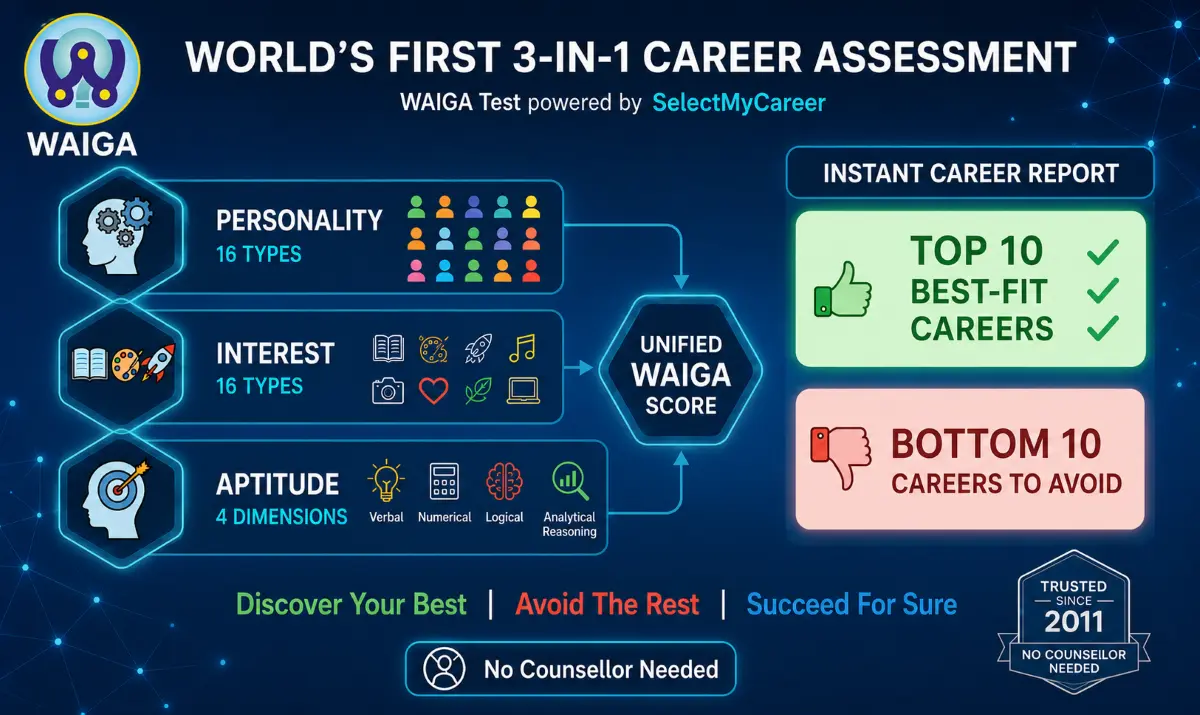
WAIGA brings together three important dimensions:
- Personality — how you tend to think, behave and approach work
- Interests — the kinds of subjects and activities that attract you
- Aptitude — abilities relevant to different types of reasoning and problem-solving
The purpose is to provide a broader career profile rather than relying on a single score or one appealing interest.
This can help you identify career directions worth exploring and consider how different parts of your profile interact.
WAIGA also provides a self-readable report, allowing you to review and understand your results independently.
No counselor ever required.
The assessment is not a command to follow a particular career. It is a source of structured information you can use alongside your experience, skills, values, research and goals.
17. How to Use Assessment Results Without Letting Them Define You
A career assessment should help you think more clearly—not make you feel limited by a label.
If your results indicate strengths in a particular area, ask how those strengths might apply to real work.
If the results suggest career directions you had not considered, investigate them.
If a result surprises you, compare it with your actual experiences.
And if a result does not seem to fit, do not automatically ignore your own evidence. Consider what the assessment measures, how you understood the questions and whether the finding deserves further investigation.
Use this process:
- Understand the result. Read the explanation rather than focusing only on a score or label.
- Look for patterns. Consider how personality, interests and aptitude relate to one another.
- Generate possibilities. Identify career areas that might use your strengths.
- Research the reality. Examine job responsibilities, qualifications and working conditions.
- Test the possibilities. Use projects, courses, internships or conversations with professionals.
- Make your own decision. Combine the evidence with your circumstances and goals.
No assessment can fully account for every personal circumstance or predict every future outcome.
Its value lies in helping you ask better questions and make a more informed choice.
18. A Practical Strengths-to-Career Exercise
You can use the following exercise to turn self-reflection into an actionable career shortlist.
Step 1: Write down five strengths
Choose strengths supported by examples rather than simply selecting qualities that sound impressive.
For example:
- Analytical thinking
- Written communication
- Organisation
- Visual creativity
- Learning technical tools
Your list may be completely different.
Step 2: Identify the evidence
For each strength, write down one or two occasions when you demonstrated it.
For example:
| Strength | Evidence |
|---|---|
| Analytical thinking | Compared several explanations and identified the strongest one |
| Communication | Explained a difficult concept clearly to a classmate |
| Organisation | Coordinated tasks and deadlines for a group project |
| Creativity | Developed an original design for a project |
| Technical learning | Learned unfamiliar software to complete a task |
If you cannot find evidence for a strength, mark it as something you want to investigate rather than treating it as established.
Step 3: Add your interests
List the subjects and activities you genuinely enjoy.
Do not restrict yourself to school subjects or careers you already know.
Include activities from hobbies, personal projects, work and everyday life.
Step 4: Add your work preferences
Describe the working conditions you prefer.
For example:
- independent or collaborative,
- structured or flexible,
- practical or theoretical,
- people-focused or information-focused,
- predictable or varied.
You may prefer different conditions for different tasks, so avoid treating these as rigid categories.
Step 5: Generate career possibilities
Use your strengths, interests and preferences to identify five career areas worth investigating.
Do not try to make the list perfect.
At this stage, breadth is useful.
Step 6: Research the actual work
For each option, investigate the responsibilities, entry requirements, skills, work environment and opportunities.
Remove options that no longer look suitable, or move them to a separate list for future exploration.
Step 7: Choose two or three options to test
Select the most promising directions based on the evidence you have gathered.
Try a relevant project, introductory course, volunteer activity or conversation with someone in the field.
Your goal is to learn more before making a major commitment.
19. Create a Career Fit Scorecard
When several careers appear promising, use a scorecard to compare them.
Rate each factor from 1 to 5:
- 1 = poor fit or very limited evidence
- 3 = mixed fit or uncertain evidence
- 5 = strong fit supported by evidence
You can adapt the factors to your circumstances.
| Factor | Career A | Career B | Career C |
|---|---|---|---|
| Uses my strengths | |||
| Matches my interests | |||
| Fits my aptitude and learning goals | |||
| Suits my work preferences | |||
| Aligns with my values | |||
| Offers a realistic development path | |||
| Fits my practical circumstances | |||
| I understand the actual work |
Fill in the scores only after researching each career.
You can total them if that helps you compare options, but do not assume the highest number automatically determines the best career.
A low score on a critical factor—such as an essential qualification you cannot currently pursue—may matter more than several high scores elsewhere.
Likewise, a low score based on missing information may mean you need to investigate further rather than reject the career.
The scorecard is a decision aid, not a scientific prediction of career success.
20. Test Your Strengths in the Real World
Reflection can generate useful hypotheses, but real experience helps you evaluate them.
If you think you are good at research, try completing a small research project.
If you believe you have a strength in communication, explain a complex topic to a new audience or create a short presentation.
If you enjoy technical problem-solving, work through a practical technical task.
If you think you may enjoy design, create a small design project and seek feedback.
If you are interested in teaching, try explaining a subject to someone who is learning it.
Notice both your performance and your experience.
Ask yourself:
- Did I enjoy the task?
- What did I find difficult?
- What did I learn quickly?
- What feedback did I receive?
- Would I want to improve further?
- Does the activity resemble the actual work in the career I am considering?
You do not need to be immediately good at every task.
The purpose is to gather more realistic evidence about your interests, strengths and willingness to develop relevant skills.
21. Avoid These Common Mistakes When Identifying Strengths
Mistake 1: Choosing strengths because they sound impressive
You may be tempted to write “leadership,” “creativity” or “strategic thinking” because they sound valuable.
Instead, look for examples that demonstrate the ability.
Mistake 2: Confusing confidence with competence
Feeling confident about a task does not always mean you perform it well. Equally, feeling nervous does not mean you lack ability.
Look at results, feedback and progress.
Mistake 3: Assuming one poor result reveals a permanent weakness
A disappointing grade or difficult project may reflect preparation, teaching methods, circumstances or lack of experience.
Examine patterns across multiple situations before drawing conclusions.
Mistake 4: Assuming your strengths cannot change
Skills and abilities can develop. Your current performance is not necessarily your future potential.
Mistake 5: Choosing a career based on strengths alone
A career also needs to be considered in relation to interests, personality, values, qualifications, lifestyle and opportunities.
Mistake 6: Ignoring weaknesses that matter for a particular career
You do not need to be excellent at everything. However, if a career depends on a skill you currently lack, understand the training required and whether you are prepared to pursue it.
Mistake 7: Letting someone else decide your future
Feedback and assessments can be useful, but other people do not have complete knowledge of your goals, preferences or circumstances.
Use their input as evidence rather than an instruction.
22. What If Your Strengths Change Over Time?
Your strengths and career priorities may evolve as you gain experience.
A student may discover an ability through a college project. A graduate may develop strong analytical skills in an entry-level role. A working professional may realise that communication, mentoring or strategic planning has become one of their most valuable contributions.
New responsibilities can reveal abilities you did not previously recognise.
Likewise, an activity that once suited you may become less appealing as your goals change.
This does not mean your earlier career decisions were necessarily mistakes.
It means career development is a process of learning about yourself and the world of work.
Review your strengths periodically.
Consider what you have learned, which skills you have developed, what activities you now enjoy and what you want from your next stage of work.
You can use that information to make better decisions about training, specialisation, promotion or career change.
23. How to Turn Your Strengths Into a Career Plan
Identifying strengths is only useful if you connect them to action.
Once you have a shortlist of possible career directions, create a simple plan.
Your next 30 days
Week 1: Understand yourself
List your strengths, interests, skills, work preferences and values. Gather evidence from past experiences and feedback.
Week 2: Explore careers
Research three to five career options. Learn about their daily responsibilities, entry requirements, skills and working conditions.
Week 3: Test your assumptions
Choose a small practical activity related to your leading option. This could be a project, short course, volunteer task or conversation with a professional.
Week 4: Review and decide on the next step
Compare what you have learned. Decide which direction deserves further exploration and what you need to do next.
Your next step might be choosing a course, building a skill, applying for an internship, completing a project or researching another career.
The goal is not to finalise your entire future in 30 days.
It is to move from vague self-reflection toward a more informed and realistic decision.
Final Takeaway: Understand Your Strengths Before Choosing Your Direction
Choosing a career becomes more manageable when you understand what you bring to the world of work.
But identifying your strengths is not about finding one extraordinary talent or discovering a single career that determines your future.
It is about gathering evidence.
Look at what you do well. Examine how you learn. Notice the problems you enjoy solving. Ask for specific feedback. Consider your interests, personality, values and practical circumstances. Then investigate the careers that make use of your strengths.
If you are uncertain, a structured career assessment can give you another perspective by bringing important dimensions of your profile together.
Use that information to generate possibilities, research the actual work and test your assumptions.
You do not need to have every answer before you begin.
You need a clearer understanding of yourself, realistic options to explore and a practical next step.
Ready to Understand Your Career Strengths and Career Fit?
If you’re struggling to decide whether a particular career matches your strengths, interests and personality, a structured career assessment can give you another perspective.
Choosing a career does not begin with finding the perfect answer.
It begins with understanding yourself.
What are your natural strengths?
What kinds of work genuinely interest you?
How do you naturally prefer to work?
What possibilities might fit the person you are—and the life you want to build?
The WAIGA Career Assessment is designed to help you answer those questions with structured information rather than guesswork.
The most confident career decisions come from understanding what you enjoy, what you are naturally good at, how you prefer to work and which careers align with all of these dimensions.
WAIGA helps you understand your interests, personality and aptitude together, giving you structured information to consider as you explore your next career direction.
That is the philosophy behind the WAIGA Career Decision Framework™.
The WAIGA Career Assessment includes:
✔ 7 Interest Types
✔ 16 Personality Types
✔ 4 Aptitude Dimensions
✔ 1 WAIGA Score
✔ Instant Report
✔ No Counsellor Needed—Ever
If you’re ready to move beyond simply following your interests and start making career decisions based on a comprehensive understanding of yourself, explore the WAIGA Career Assessment and discover your unique career profile.
Your future deserves more than guesswork. It deserves clarity, confidence and informed decisions.
✓ One integrated assessment instead of multiple separate tests
✓ Instant personalised report
✓ No counsellor needed — ever
✔ Best on laptop or desktop | ✔ Takes 20-30 minutes | ✔ Instant report — 3 ways to access
✔ Registration takes 2 minutes |✔ Purchased test stays in dashboard — take it anytime
You can also begin with our Free Career Test if you’d like an introduction before taking the full assessment.
If you still have questions, feel free to contact us.
Frequently Asked Questions (FAQs)
Start by reviewing your everyday experiences, achievements, feedback and learning patterns. Look for abilities you demonstrate repeatedly, such as analytical thinking, communication, creativity, organisation or practical problem-solving. Then consider whether you enjoy using those abilities and investigate careers that require them.
Begin with small examples rather than trying to identify exceptional talents. Notice what people ask you to help with, which tasks you learn relatively quickly and where you have made progress through practice. Ask trusted people for specific feedback, try unfamiliar activities and consider a structured assessment for additional information.
Strengths are an important part of career choice, but they should not be the only factor. Consider your interests, aptitude, personality, skills, values, preferred working environment and realistic opportunities. The aim is to find careers that offer a strong overall fit.
Strengths are abilities or qualities that help you perform certain activities effectively. Aptitude refers to abilities or potential relevant to particular types of learning, reasoning and problem-solving. They overlap, but they are not identical. A structured aptitude assessment may provide information about selected ability dimensions, while everyday experience can reveal other strengths.
Yes. A structured career assessment can provide additional information about selected aspects of your profile. Assessments differ in what they measure, so it is important to understand the results and combine them with your experience, interests, skills and career research rather than treating a score as a final answer.
Not necessarily. You can begin with self-reflection, practical exercises, feedback, career research and a self-readable career assessment. Professional guidance may be useful in some complex circumstances, but understanding your strengths does not automatically require a counsellor.
Investigate the mismatch rather than immediately choosing one over the other. You may need more experience in the area that interests you, or you may prefer to use your existing strengths in a different kind of role. Consider the training required, the daily work involved and whether the career aligns with your priorities.
Many abilities can improve through learning, practice, feedback and experience. Some tasks may come more naturally than others, but current performance does not establish a permanent limit. Investigate the level of skill a career requires and consider whether you are willing and able to develop it.
There is no required number. Start with around three to five strengths supported by examples, then explore how they interact with your interests, skills and work preferences. A smaller list with good evidence is more useful than a long list of qualities you have not examined.
Written by the WAIGA Career Guidance Team
Explore our latest articles:
- How to Find Your Career Path When You Feel Lost: A Practical Guide
- How to Identify Your Strengths and Choose a Career That Fits
- How to Choose a Career When You Have Too Many Interests
- Do You Need Career Counselling? A Better Way to Find Career Direction
- What Should I Do With My Life? A Practical Guide to Finding the Right Career