

Introduction
Have you ever heard someone say,
“I love drawing, so I should become an architect.”
Or,
“I’m interested in computers, so software engineering must be the right career for me.”
Many career decisions begin with a simple question:
“What am I interested in?”
It is an important question.
After all, we are naturally more motivated to learn, practise and grow in areas that genuinely interest us. When our work aligns with our interests, we are often more engaged, enthusiastic and satisfied.
This is why career interest tests have become one of the most widely used tools in career planning.
They help individuals identify the types of activities, subjects and work environments that naturally attract them.
However, there is one important misconception.
Interests alone cannot determine the right career.
A student may love science but struggle with the analytical reasoning required for scientific research.
Another may enjoy helping people but lack interest in the daily responsibilities of healthcare or counselling.
Someone fascinated by business may discover that they prefer studying entrepreneurship more than actually managing a business.
Interests are powerful because they influence motivation.
But successful career decisions require more than motivation alone.
They also depend on aptitude, personality, values and a realistic understanding of different careers.
In this guide, you’ll learn what career interest tests measure, why interests matter, the common myths surrounding career interests and why interests alone cannot predict long-term career success.
Because choosing the right career is not simply about asking,
“What do I enjoy?”
It is about understanding what you enjoy, what you are naturally capable of doing and where those strengths come together to create meaningful career opportunities.
What Is a Career Interest Test?
A career interest test is a scientifically designed assessment that helps individuals understand the types of activities, subjects and work they are naturally drawn towards.
Unlike aptitude, which measures what you are naturally capable of doing, and personality, which explains how you naturally prefer to work, interests answer a different question:
“What kinds of work genuinely motivate and engage me?”
This distinction is important.
Two individuals may possess similar aptitude and similar personalities, yet be interested in completely different careers.
For example, two students may both have strong analytical ability and enjoy structured work.
One may be fascinated by scientific discovery and research, while the other is far more interested in business strategy and entrepreneurship.
Although their abilities are similar, their interests naturally guide them towards different career paths.
Professionally developed career interest assessments seek to identify the kinds of work that individuals are most likely to enjoy over the long term.
These interests often relate to areas such as:
- Language, writing and verbal communication.
- Visual creativity, design and artistic expression.
- Hands-on, mechanical and practical work.
- Investigation, science and discovery.
- Structure, systems and organised processes.
- Commerce, leadership and business.
- Helping, teaching and working with people.
Understanding these preferences helps individuals explore careers that are more likely to keep them engaged, motivated and satisfied throughout their professional lives.
However, interests alone do not determine career suitability.
Enjoying an activity does not necessarily mean you possess the aptitude required to excel in it, nor does it guarantee that the day-to-day reality of the profession will match your expectations.
Career interest tests therefore provide valuable guidance—but they should always be considered alongside aptitude, personality, values and career awareness when making important career decisions.
Why Interests Alone Cannot Predict Career Success
Interests play an important role in career satisfaction because they influence what naturally captures your attention, curiosity and enthusiasm.
When people enjoy what they do, they are generally more motivated to learn, practise and improve.
However, enjoying an activity is not the same as being well suited to it as a career.
Consider someone who loves watching crime investigation shows and reading detective novels.
They may have a genuine interest in law enforcement or forensic science.
But success in those careers also depends on analytical reasoning, decision-making under pressure, emotional resilience and many other abilities beyond interest alone.
Similarly, a student may enjoy painting and visual design but may discover that a professional career in architecture requires strong mathematical reasoning, technical knowledge and years of specialised training.
Interest creates motivation.
It does not automatically create competence.
Likewise, someone may enjoy helping people and naturally feel drawn towards healthcare or counselling.
Yet the daily realities of these professions—handling responsibility, making critical decisions and working under emotional pressure—require far more than simply having an interest in helping others.

Career success depends on the interaction of multiple factors.
Modern career guidance increasingly encourages individuals to make informed career decisions by combining self-understanding with exploration of education, occupations and labour market opportunities. Rather than relying on a single assessment, a broader understanding of the individual helps support better career decisions.
Interests help answer:
“What kind of work am I naturally drawn towards?”
But equally important questions remain:
- Do I have the aptitude required for this career?
- Does my personality suit the day-to-day work environment?
- Does this career align with my personal values and long-term goals?
- Do I fully understand what this profession actually involves?
Looking at interests in isolation may encourage people to pursue careers they enjoy thinking about but may not enjoy practising every day.
The most informed career decisions are made by understanding what you enjoy, what you are naturally capable of doing and the environments in which you are most likely to thrive.
Because a fulfilling career is built not only on passion—
but on the combination of interest, aptitude, personality, values and informed decision-making.
Interest creates motivation.
It does not automatically create competence.
Common Myths About Career Interest Tests
Career interest tests are valuable tools for self-discovery, but they are often misunderstood. Many people assume that identifying their interests automatically reveals the ideal career.

Let’s examine some of the most common myths.
Myth 1: If I Enjoy Something, It Must Be the Right Career
Enjoying an activity is an excellent starting point—but it is not enough to determine career suitability.
Many people enjoy photography, cooking or sports as hobbies, yet may not enjoy the demands, pressures or responsibilities of pursuing them professionally.
A career should match not only your interests but also your aptitude, personality and long-term aspirations.
Myth 2: My Interests Never Change
Interests are not fixed for life.
They often evolve through education, exposure, life experiences and new opportunities.
A student who has never explored programming may discover a genuine interest in technology after completing a coding project.
Similarly, someone interested in medicine may later realise they are more drawn towards healthcare management or medical research.
Career decisions should therefore consider both current interests and the willingness to explore new possibilities.
Myth 3: People with the Same Interests Should Choose the Same Career
Not necessarily.
Two individuals may both have a strong interest in science.
One may become a medical doctor.
Another may pursue biotechnology, pharmaceutical research, environmental science or data science.
Shared interests do not automatically lead to identical career paths because aptitude, personality and values differ from person to person.
Myth 4: Interests Are More Important Than Aptitude
Interests and aptitude complement each other.
Interest creates enthusiasm and motivation.
Aptitude influences how easily you learn, solve problems and perform in a particular field.
The most satisfying careers often combine both.
Myth 5: A Career Interest Test Can Tell Me My Ideal Career
No career interest assessment can identify one perfect career.
Instead, it helps you discover the kinds of work that naturally appeal to you.
These insights become far more valuable when considered alongside your aptitude, personality, values and understanding of different career opportunities.
A career interest test should be viewed as a guide—not a final answer.
Its greatest value lies in helping you explore career possibilities with greater self-awareness, rather than limiting you to a single career choice.
Your interests open doors.
They do not choose your destination.
What Else Should You Consider Besides Interests?
Discovering your interests is an important step in career planning—but it should never be the final step.
The careers that genuinely suit you are usually those where your interests align with your abilities, your personality and your long-term goals.
To make an informed career decision, it is important to ask a broader set of questions.
What Are You Naturally Good At?
Interest creates enthusiasm.
Aptitude determines how naturally you learn, solve problems and perform in a particular field.
You may enjoy engineering, but if your natural strengths lie in language and communication rather than numerical and analytical reasoning, you may find other career paths more rewarding.
Similarly, someone interested in journalism should also possess the verbal reasoning skills needed to analyse information and communicate effectively.
Understanding your aptitude helps you distinguish between what you enjoy and what you are naturally equipped to excel at.
How Do You Naturally Prefer to Work?
Your personality influences the environments in which you are most likely to thrive.
Some people enjoy leading teams and making quick decisions.
Others prefer independent work, detailed analysis or structured routines.
Even when two people share similar interests, their personalities may lead them towards very different careers within the same field.
What Matters Most to You?
Every individual values different aspects of work.
Some prioritise creativity and independence.
Others seek stability, financial security, social impact, continuous learning or work-life balance.
A career that matches your interests but conflicts with your personal values may not provide long-term satisfaction.
How Well Do You Understand Different Careers?
Many students choose careers based on subjects they enjoy without fully understanding what professionals actually do every day.
Liking biology, for example, does not necessarily mean you will enjoy working as a doctor.
Similarly, enjoying business studies does not automatically mean entrepreneurship is the right path.
Developing career awareness—through research, conversations with professionals and exploring real career pathways—helps transform interests into informed career choices.
Looking at the Complete Picture
Interests answer an important question:
“What kinds of work naturally attract me?”
But successful career decisions require answering several questions together.
- What am I naturally good at?
- How do I naturally prefer to work?
- What genuinely interests me?
- What do I value most in a career?
- Which career environments best align with all of these dimensions?
When these questions are considered together, career decisions become far more balanced, confident and sustainable.
Because lasting career success is rarely built on interest alone.
It is built on the alignment of interests, aptitude, personality, values and informed career exploration.
The right career begins where your interests, abilities and personality come together
The WAIGA Perspective: Looking Beyond Interests
At WAIGA, we believe that understanding your interests is an essential part of making informed career decisions—but it is only one part.
Interests help answer an important question:
“What kinds of work naturally attract me?”
They reveal the activities, subjects and work environments that are most likely to keep you motivated and engaged.
These insights are valuable.
However, interests alone cannot determine whether a particular career is the right choice.
A person may have a strong interest in science but prefer research over clinical practice.
Another may enjoy business but be more interested in strategy than entrepreneurship.
Similarly, someone drawn towards creative work may enjoy writing and communication far more than visual design or artistic expression.
These differences matter because they often lead to very different career paths.
That is why the WAIGA Career Decision Framework™ measures interests as one independent dimension of career decision-making—not as the complete answer.
Importantly, WAIGA measures 7 distinct interest types, recognising that interests which appear similar on the surface can actually represent very different career preferences.
For example, an interest in language, writing and verbal communication often aligns with careers such as journalism, law, publishing or teaching.
An interest in visual creativity and artistic expression, on the other hand, may lead towards careers such as graphic design, architecture, fashion or visual arts.
Although both are often described broadly as “creative” interests, they represent different strengths, motivations and career opportunities.
By measuring interests with greater precision—and considering them alongside aptitude, personality and values—WAIGA helps build a more complete understanding of the individual before career decisions are made.
Because choosing the right career is not about identifying one interest.
It is about understanding how your interests, abilities, personality and aspirations come together to create the best career fit.
Not all creativity is the same.
Writing and visual design may both be creative—but they can lead to entirely different careers.
Key Takeaways
- A career interest test helps you understand the types of activities, subjects and work environments that naturally motivate and engage you.
- Interests influence motivation and career satisfaction, but they do not determine the right career on their own.
- Enjoying an activity does not automatically mean you have the aptitude, personality or skills required to succeed in it professionally.
- Interests often evolve over time through education, exposure, experience and personal growth.
- Two individuals with similar interests may choose very different careers depending on their aptitude, personality, values and career aspirations.
- Career decisions based solely on interests may overlook other equally important dimensions such as aptitude and personality.
- The most informed career decisions consider interests, aptitude, personality, values and career awareness together.
- Understanding your complete self leads to more confident career choices, better career fit and greater long-term satisfaction.
Interests tell you what excites you.
The right career is where your interests, abilities and personality work together.
Ready to Discover What Truly Interests You?
Your interests provide valuable clues about the kinds of work that are most likely to keep you engaged, motivated and fulfilled. But as you’ve learned throughout this guide, interests alone cannot determine the right career.
The most confident career decisions come from understanding what you enjoy, what you are naturally good at, how you prefer to work and which careers align with all of these dimensions.
That is the philosophy behind the WAIGA Career Decision Framework™.
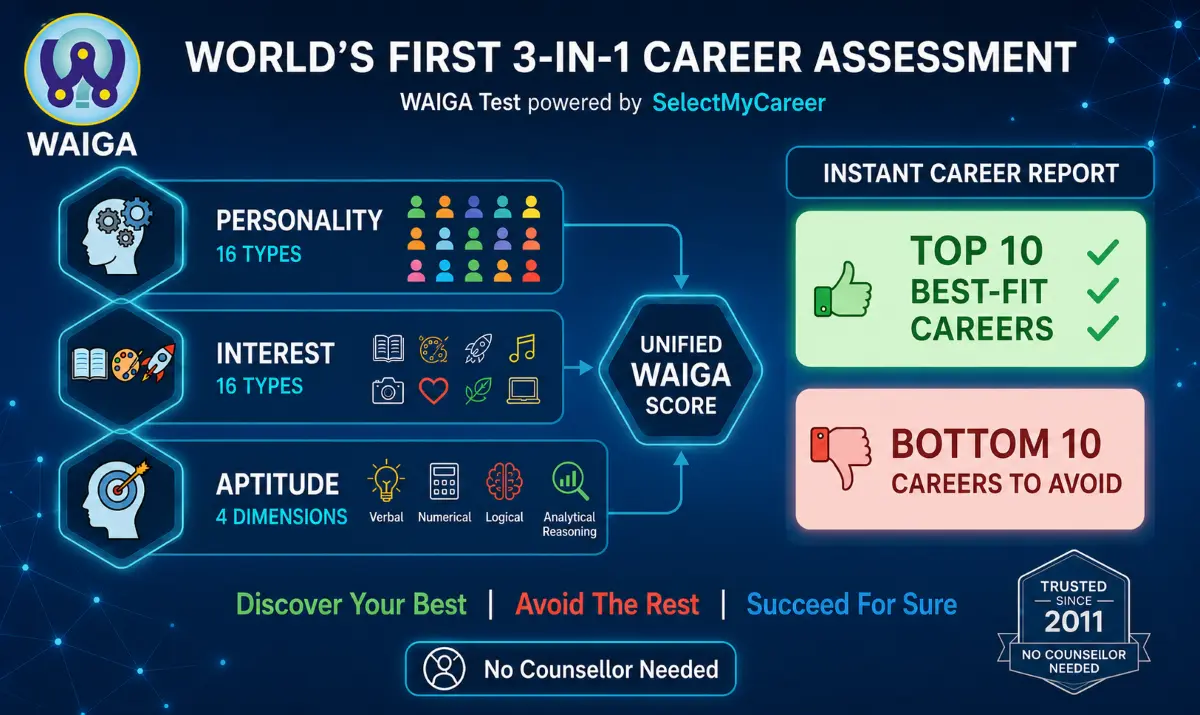
The WAIGA Career Assessment combines multiple assessment dimensions to help students gain a deeper understanding of themselves before making one of life’s most important decisions.
The WAIGA Career Assessment includes:
✔ 7 Interest Types
✔ 16 Personality Types
✔ 4 Aptitude Dimensions
✔ 1 WAIGA Score
✔ Instant Report
✔ No Counsellor Needed—Ever
If you’re ready to move beyond simply following your interests and start making career decisions based on a comprehensive understanding of yourself, explore the WAIGA Career Assessment and discover your unique career profile.
Your future deserves more than guesswork. It deserves clarity, confidence and informed decisions.
✓ One integrated assessment instead of multiple separate tests
✓ Instant personalised report
✓ No counsellor needed — ever
✔ Best on laptop or desktop | ✔ Takes 20-30 minutes | ✔ Instant report — 3 ways to access
✔ Registration takes 2 minutes |✔ Purchased test stays in dashboard — take it anytime
You can also begin with our Free Career Test if you’d like an introduction before taking the full assessment.
If you still have questions, feel free to contact us.
Frequently Asked Questions (FAQs)
A career interest test is a scientifically designed assessment that helps you identify the types of activities, subjects and work environments that naturally interest and motivate you. It helps you explore careers that are more likely to keep you engaged and satisfied over the long term.
No. A career interest test identifies your areas of interest, but it cannot determine the ideal career on its own. Career decisions should also consider your aptitude, personality, values and understanding of different career options.
Interests influence motivation, engagement and job satisfaction. People are generally more enthusiastic about careers that align with the kinds of work they naturally enjoy. However, interests should always be considered alongside other important factors before making career decisions.
Yes. Interests often develop and evolve through education, exposure, new experiences and changing life goals. Exploring different subjects and activities can help you discover interests you may never have considered before.
Absolutely. Two individuals may share similar interests but have different aptitudes, personalities and career aspirations. As a result, they may succeed in very different professions despite enjoying similar activities.
Neither is more important than the other. Interests help explain what you enjoy, while aptitude indicates what you are naturally capable of doing. The most informed career decisions consider both together.
Passion creates motivation, but professional success also requires the necessary abilities, suitable personality traits, continuous learning and an understanding of what a career actually involves. Enjoying something as a hobby does not always mean you will enjoy it as a profession.
Interests answer what you naturally enjoy doing, while personality explains how you naturally prefer to work. Measuring them independently provides a more complete and accurate understanding of career suitability.
Interests represent only one dimension of career planning. Successful career decisions also depend on aptitude, personality, personal values and informed career exploration. Looking at all these factors together leads to better long-term career outcomes.
Many career interest tests focus only on identifying areas of interest. The WAIGA Career Assessment takes a more comprehensive approach by combining 7 Interest Types, 16 Personality Types, 4 Aptitude Dimensions and 1 WAIGA Score, helping students make informed career decisions based on a complete understanding of themselves—without requiring a career counsellor.
Written by the WAIGA Career Guidance Team