
You worked hard to earn your degree.
But after graduation, you may discover that one question is surprisingly difficult to answer:
Table of Contents
What can I do with my degree?
The answer is usually much broader than the job title printed beside your degree subject.
A degree can give you knowledge, technical abilities, problem-solving skills, communication skills, research experience, analytical ability and many other capabilities that can be useful across different occupations and industries.
At the same time, having many options can create a different problem.
You may have too many possibilities and no clear way to decide among them.
You might wonder whether you should work in the field you studied, pursue a related career, switch industries, continue your education or explore something completely different.
The right question is therefore not simply:
“What jobs can I get with my degree?”
A better question is:
“What career options does my degree make possible, and which of those options actually fit me?”
That distinction matters.
Your degree can help open doors, but it does not have to determine your entire working life. To make a good career decision, you also need to consider your interests, strengths, aptitude, personality, values, skills, preferred work environment and the kind of life you want to build.
This guide will show you how to move from degree → possible careers → realistic options → personal fit → next step.
1. Your Degree Is Not a Single Career
One of the most common mistakes graduates make is assuming that a degree automatically points to one obvious profession.
Sometimes it does.
A professional degree may prepare you directly for a particular occupation. But many degrees are much broader than that.
A graduate with a degree in economics, for example, might work in finance, research, consulting, business, government, analytics or other areas.
Someone who studied English might explore publishing, communications, content, education, marketing, public relations or roles that value strong writing and communication.
A computer science graduate might work in software development, data, cybersecurity, product roles, technology consulting or other technology-related areas.
The important point is not the individual example.
It is this:
A degree is often a platform, not a destination.
Your degree tells you something about what you studied and the knowledge you developed.
It does not necessarily tell you what your entire career must look like.
That means graduating with uncertainty does not automatically mean that you chose the wrong degree.
It may simply mean that you have reached the stage where you need to translate your education into career possibilities.
2. What Can You Actually Do With Your Degree?
Start by separating three different things:
What you studied.
What you can do.
What employers need.
These are connected, but they are not identical.
Your degree subject may give you particular knowledge.
During your education, you may also have developed broader capabilities such as:
- researching information
- analysing problems
- writing clearly
- presenting ideas
- working with data
- managing projects
- using software or technical tools
- organising information
- collaborating with others
- learning independently
- solving unfamiliar problems
Some of these abilities may be obvious.
Others may be hidden inside assignments, projects, presentations, internships, laboratory work or group activities.
That is why a useful first exercise is to write down everything your degree has actually taught you—not just the subjects you studied.
For example:
Degree subject: Psychology
Possible knowledge:
- human behaviour
- research methods
- statistics
- assessment concepts
- psychological theory
Possible capabilities:
- analysing information
- conducting research
- interpreting data
- interviewing or communicating
- writing reports
- understanding human behaviour
Potential career areas could therefore extend beyond the most obvious psychology-related jobs.
The same principle applies to almost every degree.
Before asking, “What jobs can I get?”, ask:
“What capabilities do I now have that could be useful in the workplace?”
That creates a much larger and more realistic career map.
3. Start With What Your Degree Has Taught You
Your degree is more than a certificate.
It represents a collection of knowledge and capabilities that may be useful in different contexts.
Take some time to identify four categories:
Subject knowledge
What do you understand because of your degree?
This could include finance, biology, engineering principles, communication, economics, design, law, computing, mathematics or another specialised subject.
Technical skills
What can you actually do?
Perhaps you can analyse datasets, write code, conduct experiments, use design software, prepare financial models, perform laboratory procedures or carry out research.
Transferable skills
What abilities could be useful across different occupations?
These might include communication, organisation, problem-solving, teamwork, critical thinking, project management or presenting information.
Evidence of ability
Where have you demonstrated these capabilities?
Your evidence may come from:
- university projects
- internships
- placements
- dissertations
- competitions
- volunteering
- part-time work
- student organisations
- freelance projects
This last category is especially important.
Knowing that you have a skill is useful.
Being able to demonstrate that skill is much more valuable when you begin applying for work.
4. Look Beyond the Most Obvious Career
Once you understand your capabilities, resist the temptation to consider only the career most closely associated with your degree.
Your first list should be broad.
Think in terms of career families rather than individual job titles.
For example, a business-related graduate might explore:
- finance
- marketing
- sales
- operations
- consulting
- human resources
- customer success
- project coordination
- business analysis
- entrepreneurship
A science graduate might explore:
- research
- laboratory work
- quality assurance
- healthcare-related roles
- data analysis
- technical support
- environmental work
- education
- scientific communication
A humanities graduate might consider:
- writing
- communications
- publishing
- marketing
- education
- research
- public relations
- policy
- administration
These examples are not intended to tell you which careers to choose.
They demonstrate a method:
Start broad, then narrow.
You do not need to decide immediately.
First, create a realistic list of possibilities.
Then evaluate which ones deserve deeper investigation.
5. Identify Your Transferable Skills
One of the most valuable things you can do after graduation is learn to describe your skills without tying them too tightly to your degree subject.
Employers often care about what you can contribute, not simply what your degree is called.
Suppose you completed a university project that required you to:
- collect information
- evaluate sources
- analyse findings
- prepare a report
- present your conclusions
You might think:
“That was just a university assignment.”
But the underlying capabilities may include research, critical thinking, analysis, written communication, presentation and project management.
Those capabilities can potentially be relevant in many workplaces.
Build a transferable-skills inventory
Write down the major projects and experiences you have completed.
For each one, ask:
What did I actually do?
Then ask:
What skill does that demonstrate?
Then ask:
Where else could that skill be useful?
This simple exercise can dramatically change how you see your degree.
Instead of thinking:
“I only qualify for jobs related to my degree.”
you may begin thinking:
“My degree has given me a collection of capabilities that can be applied in several environments.”
That is a much more useful starting point.
6. Match Your Degree With Your Interests
A degree may qualify you for an area that you do not particularly enjoy.
That is normal.
You can be good at a subject without wanting to build a career around it.
Likewise, you may have discovered new interests during university that were not obvious when you first selected your degree.
So after creating your career options, ask:
What kind of work do I actually want to do?
Do you enjoy:
- solving analytical problems?
- working with people?
- creating things?
- researching information?
- teaching?
- organising projects?
- working with technology?
- helping customers?
- leading teams?
- writing and communicating?
- working with numbers?
- working outdoors?
- having variety?
- working independently?
Focus on activities, not just job titles.
A job title can sound attractive while the actual work may not suit you.
For example, someone may like the idea of being a manager but dislike meetings, coordination and people management.
Someone may like the idea of technology but dislike spending long periods working on highly detailed technical tasks.
Someone may like the idea of healthcare but dislike the emotional and practical demands of direct patient work.
The more clearly you understand the activities you enjoy, the easier it becomes to filter career options.
7. Consider Your Aptitude and Strengths
Interests tell you what attracts your attention.
They do not tell the whole story.
You should also consider what you are naturally good at and what kinds of problems you learn to solve relatively well.
That might include:
- numerical reasoning
- verbal reasoning
- spatial thinking
- analytical thinking
- technical problem-solving
- working with people
- understanding systems
- organising information
- generating ideas
- learning complex concepts
A career can become especially interesting when there is a meaningful overlap between:
What you enjoy + what you are good at + what the work requires.
That does not mean you need to be naturally excellent at everything before entering a career.
Many skills can be developed.
The more useful question is whether you have a reasonable foundation and are willing to build the capabilities required.
This distinction matters because career choice should not be based entirely on either:
“I like this.”
or
“I’m good at this.”
A stronger decision considers both.
8. Think About Personality and Work Environment
Two people can have the same degree and completely different career preferences.
One might enjoy a fast-paced, highly social environment.
Another might prefer quiet, focused work.
One might like predictable routines.
Another might need variety.
One person may enjoy leading a team.
Another may prefer specialised individual work.
This is where personality and working environment become important.
Ask yourself:
- Do I prefer working independently or collaboratively?
- Do I like structured environments or flexibility?
- Do I enjoy frequent interaction with people?
- How comfortable am I with competition?
- Do I prefer predictable work or constant change?
- Do I like making decisions under pressure?
- Do I prefer long-term projects or quick problem-solving?
- What type of workplace helps me perform at my best?
There is no universally correct answer.
The goal is to understand what kind of environment allows you to work effectively and sustainably.
A career may look attractive on paper but become frustrating if its normal working environment consistently conflicts with how you prefer to work.
9. Explore Careers Across Different Industries
Your degree and your industry are not always the same thing.
A particular skill may be useful in completely different sectors.
For example, someone with analytical skills could potentially work in:
- finance
- healthcare
- technology
- manufacturing
- consulting
- government
- education
- research
- retail
Likewise, strong communication skills can be valuable across a wide range of industries.
This is why it can help to separate your exploration into two questions:
What type of work interests me?
and
Where could this type of work be useful?
The first question identifies the work.
The second identifies the possible environments.
This approach can reveal options you might otherwise overlook.
It also helps when the industry associated with your degree no longer interests you.
You may not need to start over.
You may simply need to carry your existing skills into a different context.
10. Check the Real Requirements for Each Career
Once you have a shortlist, it is time to move from imagination to reality.
A career may sound suitable until you discover that it requires:
- a specific qualification
- professional licensing
- additional training
- industry certifications
- several years of experience
- a portfolio
- technical proficiency
- a particular type of entry-level role
This is why career research is essential.
For each career you’re considering, find out:
What does the work actually involve?
Read job descriptions carefully.
Don’t rely only on the title.
What qualifications are normally required?
Determine whether your current degree is sufficient or whether further study is normally expected.
What skills are employers asking for?
Look for patterns across multiple job postings.
One advertisement may ask for something unusual. Several advertisements asking for the same capability indicate a stronger requirement.
What does progression look like?
Understand how people typically move from entry-level positions to more advanced roles.
What is the working environment?
Look beyond the job description and try to understand what the everyday experience is actually like.
What trade-offs come with the career?
Consider working hours, location, pressure, competition, training requirements and other practical realities.
The aim is not to eliminate every career with a difficult requirement.
It is to know what you are actually signing up for.
11. What Can I Do With My Degree? But What If Your Degree Doesn’t Feel Like the Right Fit?
This is one of the most important questions a graduate can ask.
What happens if you finish your degree and realise:
“I don’t think I want to work in this field.”
First, don’t assume that your degree has been wasted.
The knowledge and skills you gained may still be useful elsewhere.
Your next step is to identify what you want to move toward, rather than focusing only on what you want to escape.
Ask yourself:
- What parts of my degree did I enjoy?
- What parts did I dislike?
- Which skills did I develop?
- Which skills do I want to continue using?
- What kind of work now interests me?
- What working environment do I want?
- What new skills would I be willing to learn?
You may discover that the problem isn’t your education itself.
Perhaps you dislike the traditional career associated with your degree but enjoy the transferable skills it gave you.
That can create a pivot rather than a complete restart.
For example, someone may dislike the conventional career path associated with their subject but discover that their research, analytical, communication or technical skills are useful somewhere else.
The goal is to treat your degree as an asset you can reposition, not a label that permanently defines you.
12. How a Career Assessment Can Help
At this stage, you may have created a long list of possible careers.
That’s useful—but it can create another problem.
How do you narrow the list?
This is where structured career assessment can provide another layer of information.
A useful assessment can help you understand characteristics such as:
- your interests
- your personality
- your aptitude
- your strengths
- your potential career preferences
The value is not that a test can magically determine your future.
It can’t.
Instead, an assessment can help you look at career possibilities through a more structured lens.
For example, you may have a degree that gives you access to ten different career directions.
After examining your personal profile, you may realise that only four or five are particularly worth investigating because they align more closely with the way you naturally think, work and engage with different types of tasks.
That makes the next stage of research much easier.
The best use of a career assessment is therefore not:
“Tell me what job I should do.”
It is:
“Give me better information about myself so I can evaluate my options more intelligently.”
13. How to Narrow Dozens of Options Into a Few Realistic Choices
Once you have identified possible careers, resist the temptation to investigate all of them equally.
Create a shortlist.
A useful shortlist might contain three to five serious options.
Then compare each career across the areas that matter most to you.
For example:
| Career factor | Career A | Career B | Career C |
|---|---|---|---|
| Uses my strengths | Strong | Moderate | Strong |
| Matches my interests | Strong | Strong | Moderate |
| Skills I already have | Moderate | Strong | Moderate |
| Additional training | Low | Moderate | High |
| Work environment | Strong | Moderate | Strong |
| Lifestyle fit | Moderate | Strong | Moderate |
| Long-term interest | Strong | Moderate | Strong |
The purpose of a comparison like this is not to create a mathematically perfect winner.
It is to make your thinking visible.
You may discover that one career looks attractive initially but has a major practical issue.
Another may require more training but offer a much stronger overall match.
A third may be an interesting backup option.
This process also helps you identify what information is still missing.
For example:
“I like this career, but I don’t know whether I would enjoy the actual day-to-day work.”
That tells you what to do next: talk to someone in the field, shadow the work, complete a project or find another low-risk way to experience it.
Your shortlist should become clearer as your evidence improves.
14. Your Degree Can Open the Door—but You Still Have to Choose the Direction
A degree can be valuable without determining your entire career.
It can give you knowledge.
It can help you develop skills.
It can demonstrate your ability to learn.
It can give you access to opportunities.
But the degree itself cannot answer every career question.
The bigger decision is what you do with what you have learned.
That’s why the most useful process is:
Understand your degree → identify your skills → explore career possibilities → examine your interests and strengths → consider personality and environment → research the real requirements → compare realistic options → choose your next step.
Notice that the process does not require you to discover one perfect career immediately.
You only need to move from uncertainty toward increasing clarity.
Your first career decision also does not have to determine your entire professional life.
You may change industries.
You may develop new skills.
You may discover interests you did not have as a student.
You may move into management, specialisation, consulting, entrepreneurship, education or another direction.
Career planning is therefore less about predicting your entire future and more about making better next decisions.
A final question worth asking
If you’re a student or graduate wondering what you can do with your degree, don’t stop at:
“What jobs can I get with this degree?”
Ask the more useful question:
“What can I do with what I have learned—and which of those possibilities actually fits me?”
That question gives you much more room to explore.
Your degree is a starting point.
Your strengths, interests, aptitude, personality, values, skills and goals help determine where that starting point can lead.
And the more deliberately you explore those connections, the easier it becomes to turn a degree into a career direction that makes sense for you.
Ready to Understand Which Career Options Fit You?
Your degree may open several possible career paths, but choosing among them requires more than looking at job titles.
Look at the bigger picture: your strengths, interests, aptitude, personality, values, skills and preferred way of working.
A structured assessment can help you bring those pieces together and give you a clearer starting point for your career decision.
Choosing a career does not begin with finding the perfect answer.
It begins with understanding yourself.
What are your natural strengths?
What kinds of work genuinely interest you?
How do you naturally prefer to work?
What possibilities might fit the person you are—and the life you want to build?
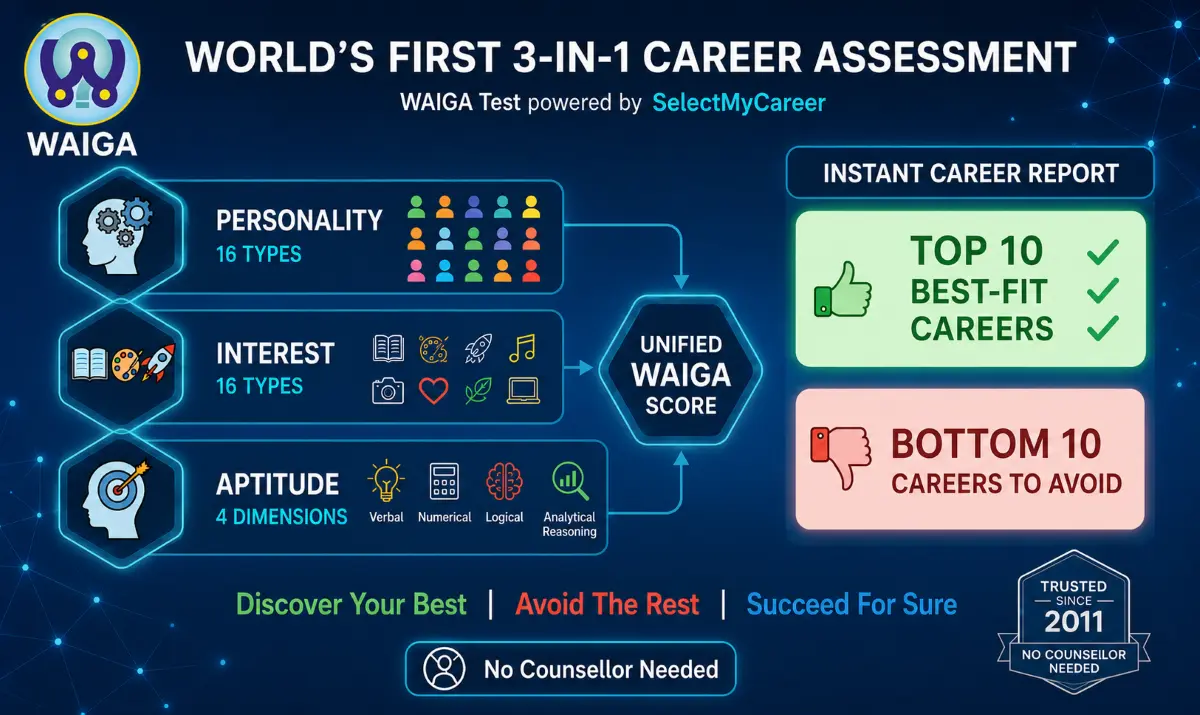
The WAIGA Career Assessment is designed to help you answer those questions with structured information rather than guesswork.
The most confident career decisions come from understanding what you enjoy, what you are naturally good at, how you prefer to work and which careers align with all of these dimensions.
That is the philosophy behind the WAIGA Career Decision Framework™.
WAIGA helps you understand your interests, personality and aptitude together, giving you structured information to consider as you explore your next career direction.
The WAIGA Career Assessment includes:
✔ 7 Interest Types
✔ 16 Personality Types
✔ 4 Aptitude Dimensions
✔ 1 WAIGA Score
✔ Instant Report
✔ No Counsellor Needed—Ever
Understand Yourself. Explore Your Options. Make Your Decision.
A career assessment can give you a starting point.
Your exploration gives you context.
Your priorities give you direction.
And the final decision is yours.
If you’re ready to start making career decisions based on a comprehensive understanding of yourself, explore the WAIGA Career Assessment and discover your unique career profile.
Your future deserves more than guesswork. It deserves clarity, confidence and informed decisions.
✓ One integrated assessment instead of multiple separate tests
✓ Instant personalised report
✓ No counsellor needed — ever
✔ Best on laptop or desktop | ✔ Takes 20-30 minutes | ✔ Instant report — 3 ways to access
✔ Registration takes 2 minutes |✔ Purchased test stays in dashboard — take it anytime
You can also begin with our Free Career Test if you’d like an introduction before taking the full assessment.
If you still have questions, feel free to contact us.
Frequently Asked Questions (FAQs)
Yes. Many degrees develop transferable skills that can be useful outside the subject area you studied. The key is to identify your capabilities and understand how they relate to the requirements of other careers.
Start by identifying the knowledge and skills your degree has given you, then research related occupations, industries and job descriptions. After creating a broad list, narrow it based on your interests, strengths, aptitude, personality, work environment and practical requirements.
No. Some degrees lead directly to particular professions, while others provide broader preparation that can be applied in many areas. Your degree can be a foundation for your career without permanently determining the direction you take.
Your degree may still be useful even if you don’t want the traditional career path associated with it. Look at the skills and experiences you gained and explore how they could transfer into other roles or industries.
Yes. Skills such as communication, analysis, research, organisation, teamwork, problem-solving and project management can be valuable across many occupations. Identifying your transferable skills can help you discover career options you might otherwise overlook.
A structured career assessment can provide additional information about your personality, interests and aptitude and help you explore careers that may align with your profile. It should be treated as one source of evidence alongside research, experience and personal decision-making.
Create a shortlist of three to five realistic options and compare them across factors such as interests, strengths, skills, work environment, lifestyle, training requirements and long-term goals. Then gather more evidence about the options that continue to look promising.
Written by the WAIGA Career Guidance Team