
Choosing a career can be difficult when you have no idea what you want to do. Apart from the question “How to Choose a Career When You Have Too Many Interests”, there is another kind of career confusion that can be just as challenging:
Table of Contents
You are interested in too many things.
Maybe you enjoy technology, psychology, business, writing, design and teaching. Perhaps you like science but also love music. You may be curious about medicine, entrepreneurship, engineering, marketing and working with people—all at the same time.
Instead of asking, “What am I interested in?”, you may find yourself asking:
“How do I choose a career when I am interested in everything?”
Having many interests is not necessarily a problem. In fact, it can be a strength. The challenge is learning how to turn a broad range of interests into a manageable set of career possibilities.
You do not need to eliminate every interest except one.
You need to understand which interests matter most, which ones can translate into meaningful work, and how they fit with your aptitude, personality, skills, values and real-world career opportunities.
This guide explains how to do that step by step.
Why Having Too Many Interests Can Make Career Choice Difficult
When you have several strong interests, the problem is often not a lack of options.
It is too many options.
Every possibility can create another question:
- Should I study science?
- Should I choose business?
- Should I become a designer?
- Could I work in technology?
- Would psychology suit me?
- Should I become a teacher?
- What about starting a business?
- Could I combine two of these interests?
- What if I choose one and regret giving up the others?
The more possibilities you see, the harder it can become to commit to one.
This can lead to what looks like indecision but is actually option overload.
You may keep researching careers without moving closer to a decision because every new option creates another possibility.
The goal, therefore, is not to discover one magical career that eliminates all other interests.
The goal is to narrow your options intelligently.
Being Interested in Many Things Is Not a Career Problem
Before trying to reduce your interests, it is important to understand something:
You do not have to turn every interest into a career.
People often assume that if they enjoy something, they should find a job based on it.
That is not necessarily true.
You can enjoy photography without becoming a photographer.
You can be fascinated by psychology without becoming a psychologist.
You can love technology without becoming a software developer.
You can enjoy economics without becoming an economist.
An interest can play different roles in your life.
It can become:
- a career,
- a specialization,
- a complementary skill,
- a side project,
- a hobby,
- a source of personal fulfilment,
- or simply something you enjoy learning about.
This distinction is important because otherwise you may feel pressure to turn every interest into a career decision.
You don’t have to.
The real question is:
Which of your interests deserve serious consideration as part of your career direction?
Start by Listing Your Interests—Without Judging Them
The first step is surprisingly simple.
Write down everything you are genuinely interested in.
Do not try to organise the list yet.
For example:
- Technology
- Psychology
- Business
- Writing
- Graphic design
- Biology
- Finance
- Teaching
- Public speaking
- Music
- Social media
- Entrepreneurship
- Research
- Travel
- Sports
Do not worry if the list looks unrealistic.
At this stage, you are not choosing a career.
You are collecting information about yourself.
The mistake many people make is immediately asking:
“Which one should I choose?”
Instead, begin with:
“What patterns can I see in what attracts me?”
Those patterns can be more useful than individual interests.
Look for Patterns Behind Your Interests
Your interests may appear unrelated on the surface but share a common underlying theme.
For example, someone might say:
- Psychology
- Teaching
- Public speaking
- Leadership
- Writing
At first, these look like five separate interests.
But there may be a common thread:
understanding people and communicating ideas.
Another person might list:
- Coding
- Mathematics
- Engineering
- Robotics
- Data analysis
The underlying pattern may be:
solving technical and analytical problems.
Someone else might enjoy:
- Graphic design
- Photography
- Fashion
- Advertising
- Social media
The common thread could be:
visual creativity and communication.
This is why simply counting your interests is not enough.
You should look for the themes underneath them.
Ask yourself:
- What do my interests have in common?
- What activities appear repeatedly?
- Do I enjoy creating, analysing, helping, organising, persuading, designing or discovering?
- Do I prefer working with people, information, technology, ideas or physical things?
- Am I attracted to solving problems or expressing ideas?
- Do I enjoy learning about a subject, or actually doing the work associated with it?
These questions can reveal a direction hidden inside a long list of interests.
Interest in a Subject Is Not the Same as Interest in the Work
This is one of the most important distinctions when choosing a career.
You may love a subject without loving the daily work associated with a career in that subject.
For example, you might enjoy psychology videos, books and conversations about human behaviour.
That does not automatically mean you would enjoy the everyday responsibilities of a psychologist.
You may love business stories but dislike sales.
You may love technology but dislike sitting at a computer for most of the day.
You may love medicine but dislike the long training pathway.
You may enjoy writing but dislike editing hundreds of pages.
You may love animals but not enjoy the scientific or operational work involved in veterinary medicine.
Therefore, ask two separate questions:
1. Do I enjoy learning about this?
And:
2. Would I enjoy doing the actual work?
The second question is much more important for career decisions.
Separate Curiosity From Sustained Interest
Another reason people feel interested in everything is that they confuse curiosity with sustained career interest.
Curiosity is valuable.
You may become fascinated by a new subject for several weeks or months.
But careers require sustained engagement.
A useful test is to ask:
Would I still want to explore this area after the initial excitement disappears?
For each interest, consider:
- How long have I been interested in it?
- Do I return to it repeatedly?
- Do I voluntarily learn more about it?
- Do I enjoy doing related activities?
- Would I still be interested if nobody praised me for it?
- Am I interested in the actual work or just the idea of the career?
An interest that survives time, effort and difficulty deserves more attention than a short-lived curiosity.
Distinguish “I Like It” From “I Want to Work in It”
This distinction can dramatically reduce career confusion.
There is a difference between:
“I like this.”
and
“I want to build my working life around this.”
For example:
You may like travel but not want a travel-related career.
You may enjoy watching sports but not want to become a professional athlete.
You may enjoy cooking but not want to work in a commercial kitchen.
You may like computers but not want a technical career.
You may enjoy helping people but prefer doing so through technology rather than direct interaction.
Instead of asking only:
“Do I like this?”
ask:
“Would I like the lifestyle, responsibilities, environment and daily activities that come with working in this field?”
That question creates much better career information.
Your Interests Are Only One Part of Career Fit
This is where career decisions often go wrong.
Someone discovers an interest and immediately assumes:
“This must be my career.”
But career fit is broader than interest.
A career can fit you—or fail to fit you—because of several interacting factors:
- Interests — what attracts and engages you
- Aptitude — areas in which you may have stronger natural ability or potential
- Personality — how you tend to think, communicate, decide and work
- Skills — what you can currently do
- Values — what matters to you
- Work preferences — the kind of environment and working style you prefer
- Lifestyle expectations — income, location, flexibility, working hours and other practical considerations
- Opportunities — what the real labour market and education pathways make possible
This is why choosing a career solely from an interest list can be misleading.
You need to look at the bigger picture.
Don’t Ignore Aptitude Just Because You Are Passionate About Something
Suppose you are extremely interested in a particular field.
That interest matters.
But it is worth asking whether the work also aligns with your current abilities or areas where you have potential to develop.
For example, someone may be fascinated by engineering but struggle significantly with the mathematical and technical requirements.
That does not automatically mean engineering is impossible.
It means the person should investigate:
- What abilities are required?
- How strong are those abilities currently?
- Can the relevant skills be developed?
- How much effort would development require?
- Would the learning process itself be satisfying?
Aptitude should not be treated as a rigid prediction of what you can or cannot become.
Instead, it provides useful evidence about the kinds of tasks and problem-solving demands that may suit you.
That evidence becomes particularly valuable when you have many interests competing for your attention.
Personality Can Help You Narrow Your Options
Imagine two people who are both interested in business.
One enjoys:
- competition,
- persuasion,
- networking,
- fast decisions,
- leadership,
- negotiation.
Another prefers:
- analysis,
- research,
- independent work,
- planning,
- detailed problem solving.
They may share the same broad interest in business.
But they could thrive in very different career environments.
This is why personality can add another layer of useful information.
Your personality does not determine your career.
But it can help you understand how you prefer to work.
Questions worth considering include:
- Do I prefer working independently or with others?
- Do I enjoy frequent interaction?
- Do I prefer predictable routines or changing situations?
- Do I like leading or supporting?
- Do I make decisions quickly or carefully?
- Do I enjoy competition?
- Do I prefer practical action or abstract ideas?
- Do I enjoy structure or flexibility?
Two careers may both match your interests but differ significantly in their working environments.
Personality can help you distinguish between them.
What If Your Interests Seem Completely Unrelated?
This is common.
You might simultaneously love:
- medicine,
- filmmaking,
- technology,
- psychology,
- business,
- music.
At first, it may seem impossible to find a career connecting these interests.
But you should not assume that unrelated interests mean you have no direction.
Sometimes they point toward interdisciplinary careers.
For example:
- Psychology + technology → user experience research, behavioural technology, human-computer interaction
- Biology + technology → biotechnology, health technology, bioinformatics
- Business + technology → product management, technology entrepreneurship
- Design + technology → UX/UI, digital product design
- Writing + technology → technical communication, content strategy
- Psychology + business → organisational psychology, consumer behaviour, human resources
- Science + communication → science communication, technical writing, education
You do not always have to choose between two interests.
Sometimes the better question is:
“Where do these interests overlap?”
Look for the Intersection Between Your Strongest Interests
Once you have identified your major interests, try creating combinations.
For example:
| Interest 1 | Interest 2 | Possible Career Areas |
|---|---|---|
| Technology | Business | Product management, entrepreneurship |
| Psychology | Technology | UX research, behavioural technology |
| Writing | Business | Marketing, content strategy |
| Biology | Technology | Biotechnology, health technology |
| Design | Technology | UX/UI, product design |
| Education | Technology | EdTech, instructional design |
| Finance | Technology | FinTech, financial analytics |
This does not mean every combination automatically produces a suitable career.
It simply expands the way you think about career possibilities.
Instead of asking:
“Which interest do I have to give up?”
you can ask:
“Are there career paths where two or more of my interests can work together?”
But Don’t Force a Combination Just Because It Sounds Interesting
There is a potential trap here.
Once you discover interdisciplinary careers, you may start combining everything.
That is not necessarily helpful.
Not every combination represents a realistic career.
You still need to investigate:
- What does the job actually involve?
- What qualifications are required?
- What skills are important?
- What does the work environment look like?
- What are the employment opportunities?
- What does a typical working day look like?
- Would you actually enjoy the work?
The goal is not to invent the most interesting combination.
The goal is to identify realistic career directions worth exploring further.
Create a Career Shortlist Instead of Choosing Immediately
If you have ten or fifteen interests, do not force yourself to select one immediately.
Create a shortlist.
A useful process is to reduce:
15 interests → 8 themes → 5 career areas → 3 serious options → 1–2 directions to test
The exact numbers do not matter.
The principle does.
Your first decision is not:
“What career will I do for the rest of my life?”
It is:
“Which options deserve deeper investigation?”
That is a much easier decision.
Use a Career Shortlisting Scorecard
Once you have several potential career directions, compare them systematically.
For each career, rate:
| Factor | Question |
|---|---|
| Interest | Do I genuinely want to explore this work? |
| Aptitude | Does the work use abilities that suit me? |
| Personality | Does the working style fit me? |
| Skills | Do I have relevant strengths or a realistic path to develop them? |
| Values | Does the work align with what matters to me? |
| Lifestyle | Does the career support the life I want? |
| Opportunity | Are there realistic education and employment pathways? |
| Reality | Have I investigated what the work is actually like? |
You can score each factor from 1 to 5.
The purpose is not to produce a mathematically perfect answer.
The purpose is to stop one attractive feature—such as salary or interest—from dominating the entire decision.
Don’t Let Salary Decide Between All Your Interests
Salary is a legitimate career consideration.
But it should not be the only one.
Suppose you have three possible careers:
- Career A pays very well but does not interest you.
- Career B strongly interests you but has a difficult training pathway.
- Career C fits your interests, abilities and lifestyle reasonably well and offers acceptable financial prospects.
The decision should not automatically go to Career A.
Likewise, Career B should not automatically win simply because you are passionate about it.
A stronger decision considers the whole picture.
Think about:
- income,
- stability,
- growth,
- work-life balance,
- location,
- education requirements,
- career progression,
- interest,
- aptitude,
- personality,
- values.
Career choice is a multi-factor decision.
Don’t Choose a Career Just Because You Are Good at It
This is the opposite mistake.
Sometimes people have a particular ability and assume:
“I’m good at this, so I should make it my career.”
But being good at something does not necessarily mean you want to spend years doing it.
You may be excellent at mathematics but dislike mathematics-related work.
You may communicate extremely well but dislike sales.
You may be technically capable but prefer working with people.
Your strengths matter.
But ability without interest can eventually become disengagement.
This is why aptitude and interest are better considered together.
Don’t Choose a Career Just Because You Love It Either
The reverse problem is equally important.
You may love a subject but discover that:
- the actual work is very different from what you imagined,
- the training requirements are not suitable,
- the working environment does not fit you,
- the required skills are not aligned with your strengths,
- or the lifestyle conflicts with your priorities.
Interest is a starting point.
It is not a complete career decision.
A better approach is:
Interest → investigate → assess fit → test → decide.
Use Career Assessments to Understand the Bigger Picture
When you have many interests, a structured career assessment can be particularly useful.
Why?
Because it can help you move beyond the question:
“What am I interested in?”
and examine several dimensions of career fit together.
A useful assessment may consider:
- personality,
- interests,
- aptitude,
- and other relevant dimensions of career fit.
The advantage is not that an assessment magically chooses your career.
The advantage is that it gives you structured evidence about yourself.
That evidence can help you identify patterns you may not have noticed.
For example, you might discover that although you have six strong interests, several of them repeatedly connect to:
- analytical work,
- creative problem solving,
- working with people,
- technology,
- or independent research.
That pattern can help narrow your search.
Why WAIGA Can Be Useful When You Have Many Interests
The WAIGA approach is particularly relevant to this problem because it does not look at career interests in isolation.
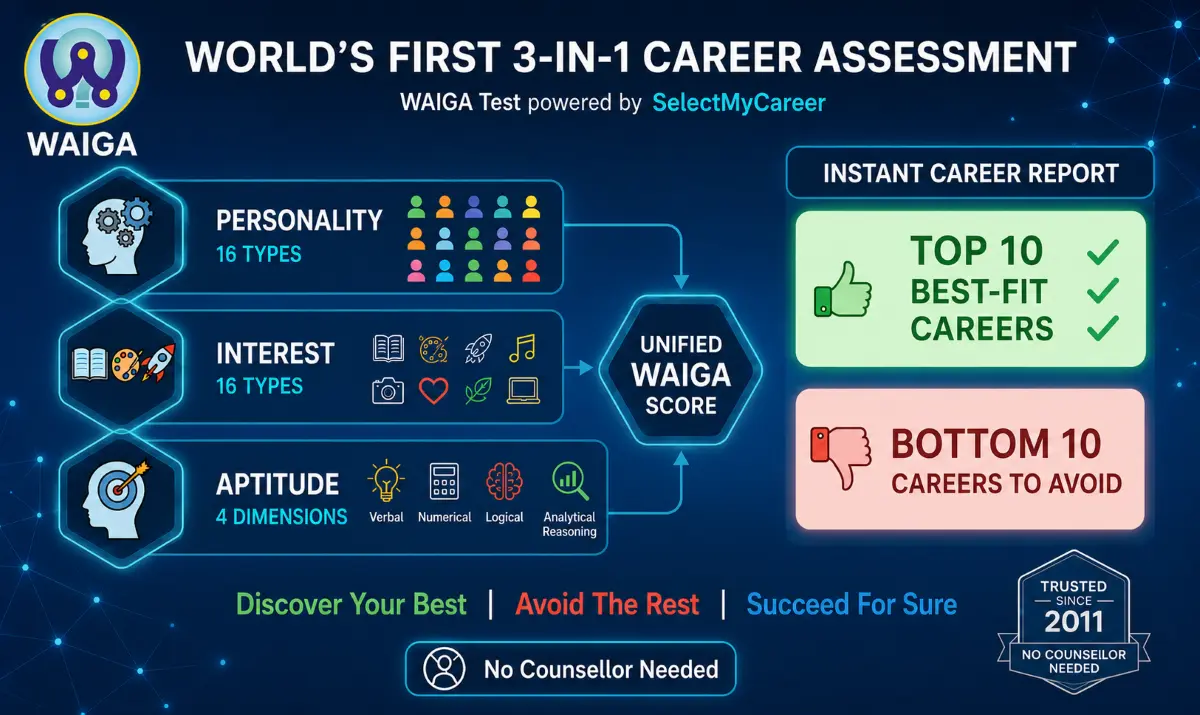
WAIGA brings together:
- Personality
- Interests
- Aptitude
into one broader career profile.
That matters because a long list of interests does not automatically tell you which directions are likely to be a good fit.
Your interests tell you what attracts you.
Your personality gives insight into how you tend to work.
Your aptitude provides evidence about areas of ability and problem solving.
Looking at these dimensions together can help you move from:
“I am interested in everything.”
to:
“These are the career directions that appear most worth exploring.”
And that is a much more useful starting point.
A Career Assessment Should Give You Evidence, Not Take Away Your Decision
It is important not to expect a career assessment to make the final decision for you.
No assessment can fully know:
- your family circumstances,
- financial situation,
- changing goals,
- personal responsibilities,
- actual experiences,
- local opportunities,
- or how your interests may develop over time.
A good assessment should therefore be treated as one source of evidence.
Use your results to generate better questions.
Then research the careers.
Talk to people working in those fields if possible.
Explore the qualifications.
Look at the work environment.
Try relevant projects or experiences.
Then decide.
The assessment supports the decision.
You make the decision.
You Don’t Need a Counsellor to Understand Your Career Assessment
Career assessments are sometimes presented as something that must be interpreted by a counsellor.
That is not always necessary.
A well-designed assessment can provide a clear, self-readable report that explains the results in a way an individual can understand.
This is an important part of the WAIGA philosophy.
No counselor ever required.
That does not mean professional counselling has no value.
It means you do not have to assume that paying someone to interpret your career assessment is the first or only step toward career clarity.
You can begin by understanding yourself, reviewing your results, researching your options and making your own informed decisions.
Professional guidance may still be useful in complex personal circumstances.
But simply having multiple career interests does not mean you need a counsellor.
What to Do After Taking a Career Assessment
Your assessment should not be the end of the process.
It should be the beginning of a better exploration process.
Step 1: Review your profile
Look for patterns across:
- personality,
- interests,
- aptitude,
- strengths,
- and areas of potential fit.
Step 2: Identify recurring themes
Ask:
What kinds of work repeatedly appear to suit me?
Step 3: Create a career shortlist
Choose several realistic career directions for further investigation.
Step 4: Research the actual careers
Look beyond attractive job titles.
Investigate:
- daily responsibilities,
- qualifications,
- skills,
- work environments,
- career progression,
- employment prospects,
- and lifestyle.
Step 5: Test your assumptions
Try:
- projects,
- internships,
- volunteering,
- courses,
- job shadowing,
- conversations with professionals,
- or small practical experiments.
Step 6: Narrow your options
Use what you learn to eliminate careers that no longer appear suitable.
Step 7: Make a decision
You do not need absolute certainty.
You need enough evidence to choose a direction and move forward.
What If You Still Have Too Many Career Options?
That can happen even after assessment.
If your shortlist is still too large, use another filter.
Ask:
Which career would I choose if all options paid approximately the same?
This removes salary from the immediate decision.
Then ask:
Which work would I still want to learn about after the initial excitement disappeared?
This tests sustained interest.
Then:
Which career best matches how I naturally work?
This brings personality into the decision.
Then:
Which option fits my abilities and offers a realistic path to development?
This considers aptitude and skills.
Then:
Which career fits the kind of life I want to build?
This considers lifestyle and values.
Finally:
Which option have I actually researched in the real world?
This separates imagined careers from real ones.
After answering these questions, your list will usually become much smaller.
What If You Are Afraid of Choosing the Wrong Career?
This is one of the biggest reasons people with many interests struggle to decide.
They are not necessarily confused about their options.
They are afraid that choosing one means permanently losing the others.
But a career decision does not always close every other door.
People change:
- industries,
- roles,
- specialisations,
- employers,
- skills,
- and careers.
Your first career direction does not have to determine your entire working life.
You can develop transferable skills.
You can learn new subjects.
You can pursue side projects.
You can change direction later.
The goal is not to predict your entire future perfectly.
The goal is to make the best informed decision you can with the information available today.
Your Career Does Not Have to Contain Every Interest
This is worth repeating.
You do not need a career that combines everything you enjoy.
Sometimes one or two interests become your career while others remain part of your life outside work.
For example:
- You might work in technology and keep music as a serious hobby.
- You might work in finance and continue writing.
- You might work in healthcare and pursue photography.
- You might work in education and explore entrepreneurship.
- You might work in design and maintain an interest in psychology.
A career does not have to satisfy every part of your personality.
It needs to be good enough across the factors that matter most to you.
A Simple Framework for Choosing When You Have Too Many Interests

If you want a practical process, use this seven-step framework.
1. List
Write down everything you are genuinely interested in.
2. Group
Combine related interests into broader themes.
3. Investigate
Find out what real careers exist within those themes.
4. Assess
Consider your personality, interests and aptitude alongside your skills and values.
5. Shortlist
Reduce your options to a manageable number.
6. Test
Get practical exposure to the strongest options wherever possible.
7. Decide
Choose the direction that offers the strongest overall fit—not simply the most exciting idea.
This process turns career choice from an emotional guessing game into a structured decision.
What If Your Interests Keep Changing?
Changing interests are not necessarily a sign that something is wrong.
You may naturally be someone who enjoys learning new things.
That can become a strength.
The challenge is learning how to distinguish between:
exploration and constant avoidance of commitment.
Exploration sounds like:
“I’m learning about several possibilities before deciding.”
Avoidance sounds like:
“I keep finding new options so I never have to choose.”
If you recognise the second pattern, give yourself a deadline.
For example:
- Spend two weeks researching.
- Choose your top five.
- Spend another two weeks comparing them.
- Select your top two or three.
- Test them.
- Make a decision about your next step.
You can always revise the decision later.
The Goal Is Not to Find One Perfect Career
There may not be one perfect career waiting to be discovered.
There may be several careers that could fit you reasonably well.
Your job is not to identify a mythical perfect answer.
Your job is to identify good options and make a thoughtful choice among them.
This is an important mindset shift.
Instead of asking:
“Which career is the one?”
ask:
“Which career directions fit me well enough to explore seriously?”
That question is more realistic—and much easier to answer.
Final Takeaway: You Don’t Have to Choose Between Everything You Love
Having too many interests can make career choice feel harder—but it can also give you more possibilities.
The solution is not to force yourself to stop being interested in things.
Instead:
Understand your interests.
Look for patterns.
Separate curiosity from sustained interest.
Investigate the actual work behind each career.
Consider your aptitude and personality.
Think about your skills, values and lifestyle.
Research realistic opportunities.
Create a shortlist.
Test the strongest options.
Then make a decision.
A career does not have to contain every interest you have.
And you do not have to know your entire future before choosing your next direction.
What matters is having enough understanding of yourself and the available options to make a decision based on evidence rather than fear, pressure or guesswork.
Ready to Understand Which Career Directions Fit You?
IIf you have many interests and are struggling to decide which ones could translate into a career, start by understanding yourself more clearly.
The WAIGA Career Assessment brings personality, interests and aptitude together to give you a broader picture of your career profile.
A structured career assessment can give you another perspective by bringing important parts of your career profile together.
Look at the bigger picture: your strengths, interests, aptitude, personality, values, skills and preferred way of working.
A structured assessment can help you bring those pieces together and give you a clearer starting point for your career decision.
Choosing a career does not begin with finding the perfect answer.
It begins with understanding yourself.
What are your natural strengths?
What kinds of work genuinely interest you?
How do you naturally prefer to work?
What possibilities might fit the person you are—and the life you want to build?
The WAIGA Career Assessment is designed to help you answer those questions with structured information rather than guesswork.
The most confident career decisions come from understanding what you enjoy, what you are naturally good at, how you prefer to work and which careers align with all of these dimensions.
That is the philosophy behind the WAIGA Career Decision Framework™.
WAIGA helps you understand your interests, personality and aptitude together, giving you structured information to consider as you explore your next career direction.
The WAIGA Career Assessment includes:
✔ 7 Interest Types
✔ 16 Personality Types
✔ 4 Aptitude Dimensions
✔ 1 WAIGA Score
✔ Instant Report
✔ No Counsellor Needed—Ever
Understand Yourself. Explore Your Options. Make Your Decision.
A career assessment can give you a starting point.
Your exploration gives you context.
Your priorities give you direction.
And the final decision is yours.
If you’re ready to start making career decisions based on a comprehensive understanding of yourself, explore the WAIGA Career Assessment and discover your unique career profile.
Your future deserves more than guesswork. It deserves clarity, confidence and informed decisions.
✓ One integrated assessment instead of multiple separate tests
✓ Instant personalised report
✓ No counsellor needed — ever
✔ Best on laptop or desktop | ✔ Takes 20-30 minutes | ✔ Instant report — 3 ways to access
✔ Registration takes 2 minutes |✔ Purchased test stays in dashboard — take it anytime
You can also begin with our Free Career Test if you’d like an introduction before taking the full assessment.
If you still have questions, feel free to contact us.
Frequently Asked Questions (FAQs)
Start by listing your interests, grouping them into themes and identifying the types of activities behind those interests. Then compare potential careers using factors such as aptitude, personality, skills, values, lifestyle and real-world opportunities. You do not need to eliminate every interest; you need to narrow your options to the careers worth exploring further.
No. Having many interests can be a strength because it can make you curious, adaptable and open to different opportunities. The challenge is avoiding option overload. A structured process can help you turn many interests into a manageable career shortlist.
Interests are an important starting point, but they should not be the only factor. A stronger career decision considers interests alongside aptitude, personality, skills, values, lifestyle preferences and the actual requirements of the career.
Look for underlying patterns or intersections. Apparently unrelated interests may share common themes such as creativity, problem solving, technology, communication, research or working with people. Interdisciplinary careers may also allow multiple interests to overlap.
Yes. A structured career assessment can help you understand patterns across areas such as personality, interests and aptitude. This can make it easier to identify career directions worth investigating. However, assessment results should be treated as evidence rather than as a final instruction about what you must do.
Not necessarily. You can begin with structured self-assessment, career research, practical exploration and comparison of your options. A self-readable career assessment can provide useful information without requiring a counsellor to interpret it. Professional counselling may still be useful in complex personal circumstances, but having multiple interests alone does not mean you need one.
A career decision does not have to determine your entire future. People can develop new skills, change roles, move between industries and change careers. The best approach is to make an informed decision based on the evidence available to you and remain open to learning from real-world experience.
There is no fixed number, but keeping your serious shortlist to roughly three to five options can make comparison easier. The goal is to have enough alternatives to explore without creating another situation where too many options prevent you from deciding.
Written by the WAIGA Career Guidance Team