

What career is best for me?
It is a simple question, but finding a satisfying answer can be surprisingly difficult.
You might be a student trying to decide what to study, a graduate wondering which jobs to apply for, or a working professional questioning whether your current career is right for you. Perhaps you have several interests but cannot decide which one to pursue. Or maybe you know what you enjoy but are unsure whether it can lead to a realistic career.
Table of Contents
You may have already taken online quizzes, asked friends for advice, searched for the highest-paying jobs, or compared careers recommended by people around you. Yet you still find yourself wondering whether you are making the right choice.
The difficulty is that the best career for you is not necessarily the most popular, highest-paying, or most prestigious option. It is a career worth considering because it fits your abilities, interests, personality, priorities, and practical circumstances.
Finding that career requires more than choosing a job title from a list. It requires understanding yourself, exploring the work available, evaluating your options, and gathering enough evidence to make an informed decision.
This guide will help you do exactly that.
You will learn how to identify careers that may suit you, understand the difference between interests and abilities, compare realistic opportunities, avoid common career-selection mistakes, and develop a practical plan for deciding what to pursue next.
You do not need to discover one perfect career that guarantees lifelong happiness. You need to identify promising options that fit you reasonably well and investigate them carefully.
Let’s begin.
1. What Career Is Best for Me? Start With a Better Question
When people ask, “What career is best for me?”, they often expect a specific job title in response.
They may want someone to tell them to become an engineer, doctor, designer, teacher, programmer, business professional, or something else.
But without understanding the person asking the question, recommending a particular occupation is little more than guessing.
Two people can have similar academic qualifications yet prefer entirely different kinds of work. One may enjoy analysing information, while another prefers communicating with people. One may value predictable routines, while another thrives on changing challenges.
Even people with similar personalities and interests can make different career choices because their financial circumstances, qualifications, responsibilities, and priorities differ.
Instead of asking only which career is best, consider these questions:
- What kinds of activities do I enjoy?
- Which abilities do I demonstrate, and which would I like to develop?
- What working environments suit my preferences?
- What matters most to me in a career?
- Which occupations use these characteristics?
- What qualifications and practical requirements do those occupations involve?
- Which opportunities are realistically available to me?
These questions turn an abstract concern into a process you can work through.
For example, suppose you enjoy solving problems, understanding systems, and working with information. Those preferences could make several careers worth investigating, including business analysis, data analysis, financial analysis, research, and certain technical roles.
They do not automatically determine which occupation is best for you. Each career involves different responsibilities, skills, working conditions, and entry requirements.
Your task is to discover which options deserve closer consideration.
The right starting point is not choosing a career title. It is understanding the characteristics that could make a career suitable for you.
2. Understand What Makes a Career a Good Fit
A career can look attractive from the outside but feel very different once you experience the actual work.
A prestigious profession may involve responsibilities you dislike. A creative occupation may offer satisfying work but less financial predictability than you need. A well-paid job may demand working hours or travel that conflict with your priorities.
This is why career fit matters.
Career fit describes how well a career aligns with your abilities, interests, personality, values, preferences, and practical circumstances.
A useful way to evaluate career fit is to consider six dimensions.
Your strengths and abilities
What can you do well? Which tasks do you learn relatively quickly? What abilities could you develop further with practice and training?
A career that uses your strengths can provide a useful starting point, although you do not need to possess every required skill before entering a field.
Your interests
Which subjects, activities, and problems attract your attention?
Interests can help you identify work you may enjoy exploring, but the actual responsibilities of a job matter more than the general appeal of its subject.
Your personality and working preferences
Do you prefer independent work, collaboration, practical activities, abstract problem-solving, structured responsibilities, or changing challenges?
Different roles place different demands on people. Understanding your preferences can help you investigate suitable working environments.
Your values
What do you want your working life to provide?
Your priorities might include financial security, meaningful contribution, flexibility, professional development, independence, recognition, or stability.
Understanding these priorities helps you compare careers that offer different benefits and trade-offs.
Your practical circumstances
Consider your current qualifications, financial responsibilities, location, available time, and willingness to undertake additional training.
A career may be attractive but require a longer or more expensive preparation period than you can manage immediately. That does not necessarily mean you should abandon it, but you need a realistic plan.
Opportunities and working conditions
What does the occupation involve? What are the entry requirements? Are there employment opportunities in your preferred location? What are the typical working conditions and possible progression routes?
A career decision should account for the reality of the occupation, not just the image it presents.
These six dimensions do not produce one universally correct answer. They help you compare possibilities in a more organised way.
For a deeper explanation, read our guide on how to know if a career is right for you.
3. Discover Your Strengths Before Choosing a Career
One of the most useful questions you can ask yourself is, “What am I good at?”
Your strengths can provide clues about the types of work in which you may perform effectively or develop useful skills.
However, identifying strengths is not always straightforward.
You might underestimate your abilities because certain tasks feel easy to you. You may compare yourself with people who have more experience. Or you may assume that good academic performance automatically identifies the career you should choose.
A more useful approach is to examine evidence.
Look at your achievements
Think about school assignments, college projects, workplace responsibilities, hobbies, competitions, and personal activities.
Which experiences went particularly well? What helped you succeed?
Perhaps you organised a group project, explained a difficult concept, identified an error, solved a practical problem, or learned a new tool quickly.
The achievement itself is only part of the evidence. Try to identify the ability that contributed to the result.
Notice what people rely on you for
Do friends ask you to explain complicated topics? Do classmates ask you to help organise projects? Do colleagues trust you with detailed work or problem-solving?
Repeated feedback can reveal abilities that you may overlook.
Of course, other people’s opinions are not definitive. Look for patterns across different situations rather than relying on a single compliment.
Identify tasks you learn quickly
Consider activities in which you seem to make progress relatively quickly.
You might recognise patterns, communicate ideas, understand numerical relationships, organise information, or learn practical procedures.
These are clues worth investigating, not proof that you must enter a particular profession.
Distinguish strengths from developed skills
A strength is not necessarily a fully developed professional skill.
You may have a relative aptitude for numerical reasoning without knowing how to use professional analytical software. You may communicate clearly but still need training in technical writing or public speaking.
This distinction matters because many career paths involve learning new skills.
Do not rule out an occupation simply because you have not yet developed the necessary expertise. Instead, examine what you already bring and what you would need to learn.
If you want a more detailed method, read How to Identify Your Strengths and Choose a Career That Fits.
4. Identify Your Interests and the Work You Actually Enjoy
Interests can help you narrow your career options, but they need to be understood carefully.
For example, enjoying technology does not automatically mean that software development is the right career for you. You might prefer product management, technical support, user experience research, cybersecurity, data analysis, or another area.
Similarly, enjoying biology does not mean you must become a doctor. Depending on your preferences and qualifications, you might investigate laboratory work, biotechnology, research, environmental science, healthcare administration, or science communication.
The key is to look beyond the subject and identify the activities that interest you.
Ask yourself:
- Do I enjoy investigating questions and finding explanations?
- Do I prefer creating something new?
- Am I interested in helping people solve problems?
- Do I enjoy working with numbers and information?
- Do I like organising activities and coordinating people?
- Do I prefer practical, hands-on work?
- Do I enjoy explaining ideas or persuading others?
- Do I like improving systems and processes?
Your answers may reveal patterns across several different fields.
For example, someone interested in science and writing may enjoy communicating complex scientific ideas. Someone interested in business and technology may want to investigate how organisations use digital tools to solve problems.
You do not have to choose one interest and abandon everything else. Sometimes, the most promising career options combine several interests.
However, be realistic about the difference between enjoying a subject and enjoying its professional application.
Watching videos about architecture is different from working with design constraints, technical requirements, revisions, budgets, and clients. Enjoying fitness is different from managing the responsibilities of a professional fitness career.
Research the everyday activities associated with each occupation before deciding whether your interest is likely to translate into satisfying work.
A career interest test can also help you examine patterns in the activities and subjects that attract you.
5. Consider Your Aptitude and Potential to Learn
Another important question is whether your abilities and learning potential align with the demands of a career.
Aptitude refers broadly to your relative readiness or potential to learn and perform particular types of tasks. It is not the same as existing knowledge, professional experience, or guaranteed future success.
For example, a person may demonstrate strengths in numerical reasoning but still need education and practice before becoming an effective financial analyst.
Someone else may demonstrate strong verbal reasoning but need to develop subject knowledge, writing skills, and practical experience before entering a communication-intensive profession.
When evaluating an occupation, consider three things.
First, identify the abilities the work requires.
Research the skills and capabilities commonly needed to perform the role.
Second, examine your current starting point.
Which relevant abilities do you already demonstrate? Which need further development?
Third, consider your willingness to learn.
Are you interested in developing the required skills? Can you commit the necessary time and effort? Are there realistic training routes available to you?
This approach avoids two common mistakes.
The first is rejecting a career because you are not already skilled enough to enter it. People often develop professional abilities through education, practice, and experience.
The second is assuming that enthusiasm alone will overcome every requirement. Some occupations require specific qualifications, licensing, technical knowledge, or extensive training.
A realistic career plan recognises both your existing abilities and the preparation required.
A career aptitude test may provide additional information about selected abilities, helping you identify strengths and areas to investigate.
6. Understand How Your Personality Relates to Career Choice
Personality can influence the kinds of activities, environments, and responsibilities you find comfortable or engaging.
It can therefore provide another useful perspective when comparing careers.
For example, consider whether you tend to prefer:
- Working independently or collaborating frequently.
- Following established procedures or exploring new approaches.
- Analysing details or focusing on broader patterns.
- Practical activities or abstract ideas.
- Predictable routines or varied challenges.
- Frequent interaction or extended periods of concentration.
These are preferences to investigate, not rigid categories.
A person who prefers independent work can still succeed in a collaborative profession. Someone who enjoys social interaction may also value quiet time for focused tasks.
Likewise, people can adapt their working styles as they develop experience and skills.
The goal is not to find a job that perfectly matches every aspect of your personality. It is to understand the environments and responsibilities in which you are more likely to feel comfortable and perform effectively.
Consider two hypothetical graduates who enjoy technology.
The first prefers structured problem-solving, detailed analysis, and extended periods of concentration. The second enjoys communicating with people, understanding user needs, and coordinating activities.
Both might explore careers in technology, but they may prefer different roles within the field.
The first might investigate certain analytical or technical positions. The second might explore user research, technical consulting, product coordination, or customer-facing technology roles.
These are possibilities to investigate, not conclusions that can be drawn from personality alone.
A career personality test can help you reflect on your preferences and consider how they relate to different kinds of work.
7. Decide What You Want Your Career to Provide
A career is not just a collection of tasks. It is also part of your broader life.
The working life you want may be influenced by your financial needs, family responsibilities, personal interests, location, health, and long-term goals.
This is why career values deserve serious consideration.
Some people prioritise financial security and predictable income. Others value independence, creativity, learning, meaningful contribution, or opportunities for advancement.
Many people want several of these things at once.
The difficulty is that different careers offer different combinations of benefits and disadvantages.
A role with strong advancement opportunities might involve long hours. A highly independent role may provide flexibility but less daily interaction. A career with a relatively predictable routine may offer stability but less variety.
There is no universally correct set of priorities.
Complete a career-values exercise
Write down the following priorities and select the five that matter most to you:
- Financial security.
- Income growth.
- Job stability.
- Flexibility.
- Independence.
- Creativity.
- Learning and development.
- Meaningful contribution.
- Recognition.
- Leadership opportunities.
- Work-life balance.
- Social interaction.
Now rank your five choices.
For each one, ask what it means in practical terms.
For example, if you value financial security, what minimum income would you need? If you value flexibility, how much control over your schedule matters? If you value meaningful contribution, what kinds of problems or communities would you like your work to benefit?
Specific answers make it easier to compare careers.
You may discover that your priorities differ from those of your friends or family. That is not necessarily a problem. Your career should be evaluated against your circumstances rather than someone else’s definition of success.
8. Explore Career Options Beyond Familiar Job Titles
Many people limit their career exploration to a handful of occupations they already know.
Students may focus on professions commonly discussed at school or at home. Graduates may search for jobs directly related to their degree. Working professionals may assume that their existing experience leaves them with only a few alternatives.
This can unnecessarily restrict your options.
A better approach is to explore careers by activity, skill, subject, and work environment—not just by title.
For example, someone interested in solving organisational problems might investigate:
- Business analysis.
- Operations.
- Process improvement.
- Project coordination.
- Management consulting.
- Supply-chain analysis.
Someone interested in communicating information might explore:
- Technical writing.
- Training and development.
- Science communication.
- Content strategy.
- Instructional design.
- Corporate communication.
Someone interested in working with people might investigate:
- Human resources.
- Customer success.
- Teaching and training.
- Community engagement.
- Recruitment.
- Certain healthcare or support roles, subject to their qualifications and requirements.
These examples illustrate how one underlying interest can connect to several occupations.
They are not recommendations for every person with the same preference. Each role has its own demands, entry requirements, and working conditions.
Look for transferable skills
You may also find that abilities developed in one setting are useful elsewhere.
Communication, organisation, analytical thinking, research, project coordination, and problem-solving can be relevant across multiple fields.
However, transferable skills do not eliminate the need for role-specific knowledge. You may still need additional training, qualifications, or experience to enter a new occupation.
The objective is to expand your awareness of possible career paths while remaining realistic about what each one requires.
9. Research the Reality Behind Each Career
Once you have identified some promising options, investigate what working in those occupations actually involves.
Do not rely solely on promotional descriptions, social media videos, salary rankings, or the experiences of a single person.
A career that looks attractive from the outside may involve responsibilities you have not considered.
For each occupation, investigate the following areas.
Daily responsibilities
What does a typical working day involve? Which tasks take up most of the person’s time?
Entry requirements
What qualifications, training, certifications, or experience are needed?
Skills and learning
Which technical and interpersonal skills are important? How much continued learning does the occupation involve?
Working conditions
What are the typical hours, environment, travel requirements, physical demands, and levels of responsibility?
Income and opportunities
What are realistic entry-level earnings and longer-term opportunities in the locations where you might work?
Career progression
How do people typically enter the field and progress? Are there alternative routes into the occupation?
Use several sources wherever possible.
Official occupational resources, employer job descriptions, professional associations, training providers, and conversations with experienced workers can provide complementary perspectives.
For example, the U.S. Bureau of Labor Statistics’ Occupational Outlook Handbook provides information about occupational duties, education, pay, and employment outlook in the United States.
If you intend to work in India or another country, investigate local qualifications, licensing requirements, salary information, and recruitment practices rather than assuming that information from another market applies directly.
Research is especially important when a career requires significant investment in education or training.
You want to understand the opportunity before committing substantial time and money to pursuing it.
10. Compare Your Career Options Systematically
After researching several occupations, you may still have two or three options that appear promising.
This is where a structured comparison can help.
Instead of asking which career sounds most attractive, evaluate each one against the same criteria.
Consider the following example.
| Factor | Career A | Career B | Career C |
|---|---|---|---|
| Uses my strengths | Strong | Moderate | Strong |
| Matches my interests | Strong | Strong | Moderate |
| Fits my preferred work style | Moderate | Strong | Strong |
| Aligns with my values | Strong | Moderate | Strong |
| Entry requirements are manageable | Strong | Moderate | Moderate |
| Opportunities look realistic | Needs research | Strong | Needs research |
These ratings are illustrative. You should fill in your own observations based on evidence.
Create your own career-fit scorecard
For each career you are considering, rate the following dimensions from 1 to 5:
- Strengths and abilities.
- Interests.
- Personality and working preferences.
- Values and priorities.
- Practical requirements.
- Opportunities and working conditions.
Use a score of 1 for a poor apparent fit and 5 for a strong apparent fit.
If you do not have enough information to evaluate a dimension, mark it as unknown instead of guessing.
After scoring the options, review the differences.
One career may align well with your interests but require training you cannot currently afford. Another may offer better stability but involve daily tasks you find less engaging.
These trade-offs deserve attention.
Do not treat the final total as a scientific prediction of future success or happiness. The scorecard is a decision aid, not a validated predictive model.
Its purpose is to help you organise information, identify unanswered questions, and understand why you prefer one option over another.
For more detailed guidance, see our career fit guide.
11. Use a Structured Career Assessment to Discover Patterns
Self-reflection and career research are important, but they have limitations.
You may overlook strengths that feel ordinary to you. You may misunderstand your interests or be unsure how your personality relates to different kinds of work.
You may also receive conflicting advice from friends, family members, teachers, or colleagues, each of whom sees only part of the picture.
A structured career assessment can help you organise information about yourself and identify possibilities worth investigating.
Different assessment tools measure different dimensions.
Interest assessments explore the subjects and activities that attract you.
Aptitude assessments examine selected abilities associated with learning or problem-solving.
Personality assessments describe patterns in preferences and behaviour.
Each can provide useful information, but a result based on one dimension does not establish whether a particular career is right for you.
For example, a career may match your interests but require skills you have not yet developed. Another may align with your aptitude but involve daily responsibilities you would not enjoy.
A more integrated understanding can help you examine these relationships.
How the WAIGA framework can help
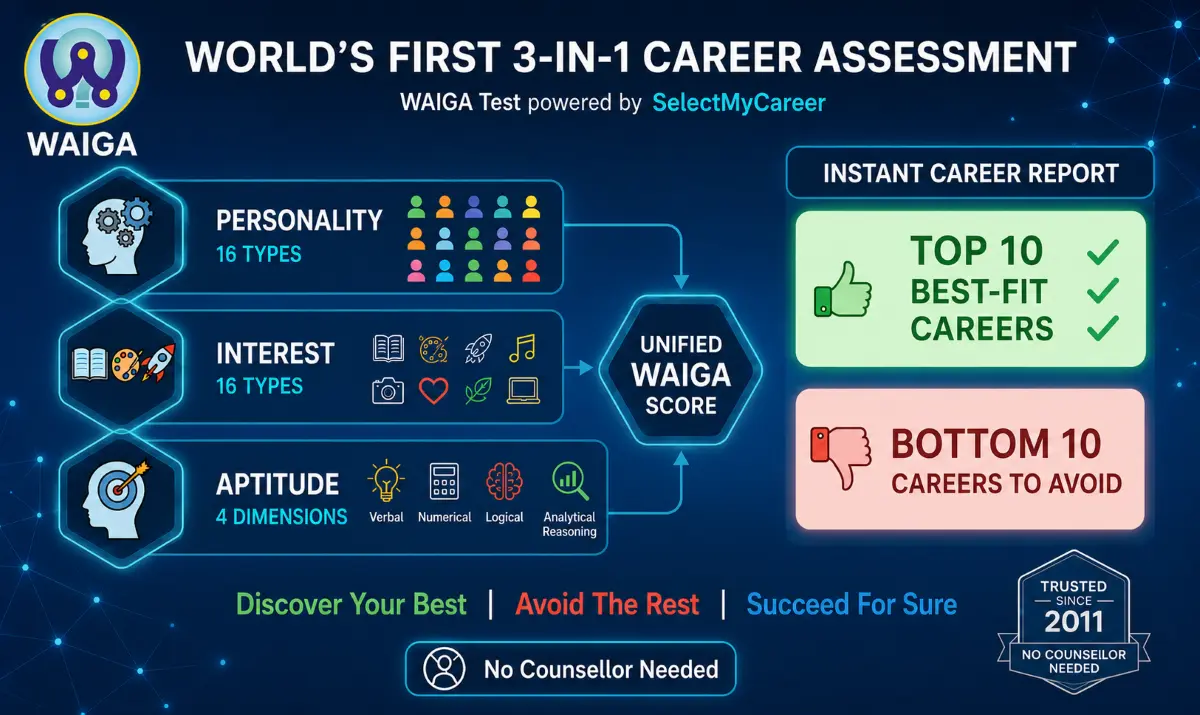
The WAIGA framework brings together three important dimensions of career exploration:
- Personality: Understanding patterns in your preferences and working style.
- Interests: Exploring the activities and subjects that attract you.
- Aptitude: Examining selected abilities relevant to different kinds of work.
WAIGA is designed to help you consider these dimensions together rather than relying on a single aspect of your profile.
Its report provides career-related suggestions, including best-fit career options, that you can investigate further.
This can be particularly useful if you have several interests, are unsure which abilities to prioritise, or want a more structured starting point for exploring careers.
However, an assessment should not replace your judgement.
Your results do not automatically account for every qualification requirement, employment opportunity, financial constraint, or personal responsibility. Those factors still need to be investigated.
Use the assessment to generate possibilities, recognise patterns, and ask better questions about your future.
No counselor ever required. WAIGA is designed with a self-readable report that allows you to review your results independently. You do not need a career counsellor simply to understand your report.
You remain responsible for evaluating the suggestions against real-world information and deciding which options deserve further exploration.
To learn more, visit the WAIGA Framework or explore the WAIGA test.
12. Test Your Leading Career Options Before Committing
Research and assessment can help you identify promising options, but practical experience adds another layer of evidence.
You may discover that a career’s daily activities are different from what you imagined. You may also find that you enjoy work you had previously overlooked.
Whenever possible, test your leading options through small experiments.
Complete a practical project
If you are considering data analysis, try analysing a dataset and explaining what you discover.
If you are interested in writing, produce a sample article, report, or technical explanation.
If you are exploring design, create a small project and seek constructive feedback.
If you are interested in business, investigate a real problem and propose a solution.
Choose an activity that resembles some aspect of the actual work rather than relying entirely on general information about the profession.
Take an introductory course
A short course can help you discover whether you enjoy learning the subject and are willing to develop the required skills.
Look for practical exercises and realistic examples rather than choosing solely on the basis of promotional claims.
Speak with people in the field
Ask people about their daily responsibilities, the challenges they face, the skills they use, and how they entered the occupation.
Useful questions include:
- What does a typical week look like?
- Which tasks occupy most of your time?
- What is most challenging about the work?
- What skills are important for beginners?
- What do you wish you had known before entering the field?
One person’s experience cannot represent every employer or role, but several perspectives can reveal useful patterns.
Reflect on what you learn
After each experiment, ask yourself:
- Did I enjoy the actual activity?
- Which parts interested me most?
- Which parts did I find difficult or frustrating?
- Would I be willing to improve at those difficult tasks?
- Did the experience change my opinion of the career?
- What do I still need to investigate?
You do not need to enjoy every aspect of a job. Every occupation includes routine tasks, frustrations, and responsibilities that are less appealing.
Look for a reasonable overall fit and a willingness to develop.
13. What If Several Careers Seem Equally Suitable?
You may discover that several occupations match your strengths, interests, and priorities reasonably well.
That is not a problem.
It means you have more than one promising possibility to investigate.
Instead of forcing yourself to choose immediately, compare the differences between the options.
Ask which career offers the most suitable combination of:
- Daily activities you find engaging.
- Opportunities to use or develop your strengths.
- Working conditions that fit your preferences.
- Practical entry routes.
- Financial prospects that meet your needs.
- Opportunities to learn and progress.
Then identify the biggest unanswered question for each option.
For example, you may be interested in both data analysis and business analysis. Rather than debating which sounds better, try a small data project and investigate the daily responsibilities of a business analyst.
Practical evidence may reveal that you prefer one type of work.
If both remain attractive, compare the training requirements and employment opportunities. You might also discover that the careers overlap more than you initially realised.
Remember that your first choice does not have to determine every future move.
Skills developed in one role may help you transition into another, although additional preparation may still be necessary.
You can make a decision about what to pursue next without claiming that you have identified your only possible career.
14. Common Mistakes to Avoid When Choosing a Career
Career decisions can become unnecessarily complicated when you rely on assumptions rather than evidence.
Here are some mistakes worth avoiding.
Choosing only for salary
Income is important, especially when you have financial responsibilities. However, choosing exclusively on the basis of earning potential may cause you to overlook the work involved, the qualifications required, or the working conditions.
Consider financial prospects alongside your abilities, interests, priorities, and practical circumstances.
Choosing only for passion
Interests matter, but enjoying a subject does not automatically mean you will enjoy its professional application.
Investigate the actual responsibilities and determine whether the career offers a realistic route towards the working life you want.
Following someone else’s career
A profession that suits a parent, friend, or role model may not suit you.
Learn from other people’s experiences, but evaluate their advice against your own characteristics and circumstances.
Assuming your degree determines your entire future
Your degree may provide a useful foundation for several occupations. Your options depend on your subject, transferable skills, additional training, and the requirements of your target roles.
Investigate related and adjacent careers rather than assuming you must pursue only one occupation.
Taking too many online quizzes
Repeatedly taking short quizzes may produce numerous labels and recommendations without helping you make a decision.
Choose assessment tools with a clear purpose, understand what they measure, and combine their results with research and practical experience.
Waiting for perfect certainty
No career decision can remove every uncertainty about the future.
You can reduce uncertainty by gathering evidence, comparing options, and testing your assumptions. Eventually, you will need to decide which option is promising enough to pursue.
Treating an assessment as a final verdict
A career assessment can help you understand yourself and identify possibilities, but it cannot determine your future with certainty.
Use results as a starting point for investigation, not as a reason to rule yourself out of every career that does not match a particular profile.
15. A Practical Seven-Day Exercise to Identify Your Career Options
If you are still unsure where to begin, use the following seven-day exercise.
You do not need to spend hours on it every day. The purpose is to move from vague uncertainty towards a manageable shortlist.
Day 1: List your strengths
Write down five abilities you believe you demonstrate.
For each ability, identify one example that supports it.
If you are unsure, include tasks you learn quickly, problems you enjoy solving, or responsibilities people regularly trust you with.
Day 2: Identify your interests
List subjects, activities, and problems that attract your attention.
Then identify the specific activities behind those interests.
For example, an interest in business might reflect an enjoyment of analysis, negotiation, organising projects, understanding customers, or developing new ideas.
Day 3: Examine your working preferences
Consider whether you prefer independent work, collaboration, structured responsibilities, practical tasks, analytical challenges, or changing situations.
Describe the environments in which you tend to work most comfortably.
Treat these preferences as clues rather than fixed limits.
Day 4: Rank your career values
Choose your five most important career priorities.
Rank them and write down what each one means in practical terms.
This will help you compare opportunities more realistically.
Day 5: Research five career options
Use your observations to identify five occupations worth investigating.
For each occupation, research its responsibilities, entry requirements, skills, working conditions, and opportunities.
Record what attracts you and what concerns you.
Day 6: Narrow your shortlist
Compare the options against your strengths, interests, working preferences, values, and practical circumstances.
Choose two or three options for further exploration.
Identify the most important unanswered question for each one.
Day 7: Choose your next action
Select one practical activity that will help you learn more.
You might begin a small project, research a training route, complete an introductory lesson, or arrange a conversation with someone in the field.
Write down what you intend to do and when you will do it.
At the end of seven days, you may not have a final career decision. You should have a clearer understanding of yourself, a more manageable list of possibilities, and a concrete plan for gathering further evidence.
That is meaningful progress.
16. What Career Is Best for Me at Different Stages of Life?
The process of choosing a career is similar at different stages of life, but the questions you need to answer may change.
If you are a school student
You may be deciding which subjects to study, which stream to choose, or which qualifications to pursue.
At this stage, investigate your interests, abilities, and possible career pathways before making choices that affect your educational options.
Avoid assuming that one subject automatically leads to only one profession.
Where possible, research qualification requirements and discuss practical educational choices with the relevant school or institution. You can use structured assessments and independent research to understand your options more clearly.
If you are a college student
You may already have chosen a degree but be unsure what to do with it.
Explore occupations related to your subject, as well as roles that use your transferable skills.
Internships, practical projects, relevant coursework, and conversations with professionals can help you discover which types of work suit you.
You do not need to wait until graduation to begin exploring possible career directions.
If you are a recent graduate
Your immediate questions may involve entry-level opportunities, employable skills, and the qualifications or experience employers expect.
Research job descriptions in your target field. Identify common requirements and compare them with your current skills.
Then create a plan to address important gaps through practical projects, training, or relevant experience.
Your first role can provide valuable experience and help you understand what you want from your longer-term career.
If you are already working
You may be evaluating whether your current role still suits you or whether another direction would provide better opportunities.
Start by identifying what you want to change.
Is the problem your responsibilities, employer, manager, working environment, income, or the profession itself?
The answer matters because changing your role within the same field may be more appropriate than changing careers entirely.
If you are considering a broader transition, investigate transferable skills, training requirements, financial implications, and realistic entry routes before making a major commitment.
If you want to change careers later in life
You may have responsibilities that make a career change more complicated, including family commitments, financial obligations, or limited time for training.
That does not automatically make a change impossible, but it makes planning especially important.
Consider whether you can move gradually, develop skills alongside your current work, or transition into a related occupation that uses your existing experience.
Evaluate the costs, risks, and practical requirements before committing to a new path.
At every stage, the objective remains the same: understand yourself, investigate realistic options, and make an informed decision based on your circumstances.
17. How to Turn Your Career Choice Into an Action Plan
Once you have identified a promising career direction, your next task is to turn the decision into practical steps.
A career choice is more useful when it leads to a plan for developing the necessary skills and gaining relevant experience.
Start by writing down your current position.
What qualifications do you have? Which relevant skills do you already demonstrate? What experience have you gained? What requirements remain unmet?
Next, identify the most important gaps.
For example, you might need to learn a particular software tool, develop a portfolio, complete a qualification, or gain experience through a practical project.
Do not try to improve everything simultaneously. Prioritise the requirements that are most important for entering your target role.
Then establish a realistic timeline.
Your plan might include:
- Researching relevant qualifications and training routes.
- Completing an introductory course.
- Developing one or two practical projects.
- Building a portfolio or documenting relevant experience.
- Identifying entry-level opportunities.
- Reviewing job descriptions regularly.
- Seeking feedback on your work.
- Reassessing your direction as you gain experience.
Set measurable milestones so you can see whether you are making progress.
For example, instead of writing “learn data analysis”, set a goal to complete a specific introductory project and explain your findings.
Instead of writing “explore design”, create a small portfolio piece that allows you to evaluate your interest and receive feedback.
Your plan should be ambitious enough to move you forward but realistic enough to fit your available time and resources.
Review it periodically. New experience may confirm your choice or reveal that another direction deserves consideration.
The purpose of planning is not to eliminate every possibility of change. It is to help you move from exploration towards informed action.
Final Takeaway: The Best Career for You Is One Worth Exploring Carefully
If you have been asking, “What career is best for me?”, remember that you do not need to find one perfect job title before you can begin making progress.
Start by understanding your strengths, interests, aptitude, personality, and values. Use those insights to identify possible career paths.
Research the actual work involved. Investigate qualifications, opportunities, and working conditions. Compare your options against your priorities, and test your assumptions through practical experience.
A structured career assessment can help you recognise patterns and identify possibilities you may not have considered. However, your decision should also reflect real-world evidence and your personal circumstances.
You may discover that one career is a particularly promising fit. You may find that several options deserve further exploration. Either outcome gives you something useful to work with.
Career decisions are important, but they do not have to be made through guesswork or pressure.
The best career for you is not simply the one that looks impressive to other people. It is one that offers a realistic and worthwhile combination of work you can develop competence in, activities you find engaging, conditions that fit your priorities, and opportunities that make sense for your life.
You do not need to know everything today. You need to understand yourself better, investigate your options, and take the next informed step.
Ready to Understand Your Career Fit?
If you are still unsure which career options deserve your attention, start by developing a clearer picture of yourself.
Choosing a career does not begin with finding the perfect answer.
It begins with understanding yourself.
What are your natural strengths?
What kinds of work genuinely interest you?
How do you naturally prefer to work?
What possibilities might fit the person you are—and the life you want to build?
The WAIGA Career Assessment is designed to help you answer those questions with structured information rather than guesswork.
The most confident career decisions come from understanding what you enjoy, what you are naturally good at, how you prefer to work and which careers align with all of these dimensions.
The WAIGA framework brings together personality, interests, and aptitude to help you understand your career profile and explore potential best-fit careers.
That is the philosophy behind the WAIGA Career Decision Framework™.
The WAIGA Career Assessment includes:
✔ 7 Interest Types
✔ 16 Personality Types
✔ 4 Aptitude Dimensions
✔ 1 WAIGA Score
✔ Instant Report
✔ No Counsellor Needed—Ever
If you’re ready to move beyond simply following your interests and start making career decisions based on a comprehensive understanding of yourself, explore the WAIGA Career Assessment and discover your unique career profile.
Your future deserves more than guesswork. It deserves clarity, confidence and informed decisions.
✓ One integrated assessment instead of multiple separate tests
✓ Instant personalised report
✓ No counsellor needed — ever
✔ Best on laptop or desktop | ✔ Takes 20-30 minutes | ✔ Instant report — 3 ways to access
✔ Registration takes 2 minutes |✔ Purchased test stays in dashboard — take it anytime
You can also begin with our Free Career Test if you’d like an introduction before taking the full assessment.
If you still have questions, feel free to contact us.
Frequently Asked Questions (FAQs)
Begin by identifying your strengths, interests, aptitude, personality preferences, and career values. Research occupations that align with these characteristics, then investigate their daily responsibilities, qualifications, working conditions, and opportunities. Compare your options systematically and use practical experience to test your assumptions before making a decision.
Look for common patterns across your interests. Identify the activities that attract you most, such as analysing information, creating things, solving problems, or helping people. Then explore careers that involve those activities. You do not necessarily need to choose one interest and abandon the rest, but you should narrow your options enough to investigate them properly.
A career test can provide information about selected aspects of your profile and suggest occupations worth exploring. However, no assessment should be treated as a guarantee that a particular career will suit you. Consider the results alongside your qualifications, values, practical circumstances, career research, and experience.
Both matter, but neither should determine the decision on its own. Interests can help you identify activities you may enjoy, while aptitude provides information about selected abilities and learning potential. Also consider personality, values, practical requirements, and opportunities. A structured assessment that examines multiple dimensions can help you develop a broader understanding of career fit.
Being good at an activity does not automatically mean you want to make it your career. Consider whether you enjoy the task itself, whether it aligns with your values, and whether you would want to perform similar work regularly. You may find that the ability is useful in a different occupation or that it is better kept as a personal strength rather than the centre of your working life.
Your degree can influence the occupations available to you, particularly when a profession requires specific qualifications. However, many degrees can support several career paths. Investigate roles related to your subject, transferable skills, and additional training options. Evaluate each possibility against your strengths, interests, priorities, and the requirements of the work.
There is no universal number, but starting with three to five options can make exploration manageable. Research those options, compare their requirements, and test the most promising ones through practical activities or conversations with professionals. If several options remain attractive, identify the biggest unanswered questions and investigate those before deciding what to pursue next.
Salary can be very important, particularly when you have financial responsibilities. However, it should be considered alongside working conditions, interests, abilities, stability, development opportunities, and personal priorities. A realistic career decision evaluates financial prospects without assuming that the highest-paying option will automatically provide the best overall fit.
Not necessarily. You can begin with structured self-reflection, career research, practical exploration, and suitable assessment tools. WAIGA is designed to provide a self-readable report that you can review independently—no counselor ever required. You can use the results to investigate possible career paths and make your own decisions.
Write down your strengths, interests, preferred working conditions, and most important career priorities. Use these observations to identify a small number of career options. Research the actual work and requirements of each one, then choose one practical activity that will help you learn more. Taking a manageable next step is often more productive than waiting for complete certainty.
Written by the WAIGA Career Guidance Team
Explore our latest articles:
- What Career Is Best for Me? How to Find Your Ideal Career
- How to Find Your Career Path When You Feel Lost: A Practical Guide
- How to Identify Your Strengths and Choose a Career That Fits
- How to Choose a Career When You Have Too Many Interests
- Do You Need Career Counselling? A Better Way to Find Career Direction