

Feeling lost about your career can be frustrating. You may be studying a subject without knowing what to do with it, working in a job that no longer feels right, or exploring so many possibilities that making a decision seems impossible.
You might find yourself asking:
- What career should I choose?
- How do I know what I am actually good at?
- What if I choose the wrong career?
- What if I have interests but no clear direction?
- How can I make a career decision when I do not know what I want?
If any of these questions sound familiar, you are not alone. Career uncertainty can affect students, graduates, early-career professionals and people who have worked for years.
The good news is that you do not need to know your entire future before you can take the next step. You need a better understanding of yourself, a realistic view of your options and a process for deciding what to explore next.
Table of Contents
This guide explains how to find your career path when you feel lost. You will learn how to understand the source of your confusion, identify your strengths and interests, evaluate career possibilities, use structured assessments and turn uncertainty into a practical plan.
The goal is not to discover one perfect career overnight. It is to build enough clarity to make your next career decision with greater confidence.
1. Understand Why You Feel Lost About Your Career
Before searching for career options, take a moment to understand why you feel uncertain.
Not all career confusion has the same cause. Someone who has too many interests needs a different approach from someone who has no idea what they enjoy. Likewise, a person who dislikes their current job may not need an entirely new career.
Identifying the source of your uncertainty helps you avoid solving the wrong problem.
You have too many career options
You may be interested in technology, business, design, healthcare, teaching or several other fields. Each option seems attractive for a different reason, but comparing them feels overwhelming.
When every possibility has advantages, it becomes difficult to choose one direction.
What can help: Narrow your options by comparing the nature of the work, your abilities, your interests, required qualifications, work environment and long-term opportunities.
You do not have to explore every possible career. Start with a manageable shortlist.
You do not know what you are good at
Perhaps you have never seriously examined your strengths. You may perform reasonably well in several subjects or tasks without knowing which abilities could translate into a satisfying career.
You might also underestimate your strengths because activities that come naturally to you do not feel particularly special.
What can help: Look for patterns in your achievements, the activities you learn quickly, the problems you enjoy solving and the tasks other people regularly trust you to handle.
You chose a path because other people expected it
Family expectations, social pressure, academic performance and the desire for financial security can strongly influence career decisions.
You may have selected a subject or profession because it seemed respectable, stable or familiar. Later, you may begin questioning whether it actually suits you.
What can help: Separate the reasons you originally chose your path from the reasons you might want to continue. Consider your own strengths, preferences, circumstances and goals alongside the expectations of others.
You are afraid of making the wrong decision
Sometimes the problem is not a lack of options but the fear of choosing one.
You may keep researching, comparing and asking for opinions because you want certainty before committing. Unfortunately, no amount of research can remove every uncertainty about a future career.
What can help: Treat career decisions as informed choices that can be tested and refined. Choose a promising direction to investigate rather than expecting to predict your entire working life.
Your current career no longer fits
You may have changed as a person, discovered new interests or realised that the realities of your current role do not match your expectations.
This does not automatically mean you must change professions. The problem could be your employer, responsibilities, manager, working hours or work environment.
What can help: Identify exactly what is not working before deciding whether you need a different role, a different workplace or a broader career change.
Understanding the source of your uncertainty gives you a starting point. Instead of asking a vague question such as “What should I do with my life?”, you can begin asking more useful questions about the problem you need to solve.
2. Stop Looking for One Perfect Career
One reason people remain stuck is the belief that there must be one ideal career they are destined to discover.
This expectation creates unnecessary pressure. Every option begins to look risky because choosing one means leaving other possibilities unexplored.
Real career decisions are more complex.
Several careers may suit your strengths and interests. Different options may offer different combinations of income, stability, creativity, flexibility, responsibility and personal satisfaction.
A career that fits you well also depends on practical circumstances, including qualifications, available opportunities, location and financial responsibilities.
Rather than searching for the one perfect career, look for a group of realistic options that align with your abilities, preferences and goals.
For example, someone who enjoys analysing information, solving problems and understanding systems might investigate data analysis, financial analysis, business analysis or certain technical roles.
These careers are not identical, but they may share characteristics that appeal to the same person.
This changes the question from:
“What is the one career I am meant to pursue?”
to:
“What types of work are compatible with how I think, what I enjoy and what I can develop?”
That is a more useful starting point because it allows you to explore several promising directions without treating the decision as irreversible.
3. Begin With What You Already Know About Yourself
When you feel lost, it is tempting to search the internet for career lists, personality descriptions and advice from people who seem to have everything figured out.
External information can help, but it is more useful when you have first considered what you know about yourself.
You do not need perfect self-awareness. Start with observations.
Ask yourself the following questions:
- Which subjects or activities have interested me over time?
- What kinds of problems do I enjoy solving?
- Which tasks do I learn relatively quickly?
- What do people commonly ask me to help them with?
- Do I prefer working with people, information, ideas, systems or practical objects?
- Do I enjoy organising work, investigating questions, creating something or helping others?
- What aspects of school, college, work or everyday life have felt satisfying?
- Which tasks leave me frustrated or drained, even when I can perform them?
Write down your answers without immediately trying to turn them into job titles.
For example, “I enjoy explaining difficult ideas” is more informative than immediately deciding that you must become a teacher.
The same strength could be relevant to training, consulting, communication, customer education, technical writing or other careers.
Similarly, enjoying puzzles and logical problems does not automatically mean that you should become a programmer. It gives you a characteristic to investigate across multiple occupations.
The objective is to recognise patterns in your preferences and abilities before narrowing your career options.
4. Identify Your Strengths, Not Just Your Qualifications
Qualifications can determine which opportunities are immediately available to you, but they do not tell the whole story of your potential career fit.
Two people with the same degree may have very different strengths, interests and preferred working styles.
One graduate might enjoy analysing data, while another might prefer coordinating projects or communicating with clients. Their qualifications overlap, but their most suitable roles may differ.
To identify your strengths, look at evidence from your experience.
Review your achievements
Think about projects, assignments, activities or responsibilities that went well.
Ask yourself what contributed to the result. Was it your ability to organise information, solve a difficult problem, communicate clearly, understand people, work accurately or learn a new skill?
Look beyond the achievement itself to the ability that helped you succeed.
Notice what comes naturally
Some activities require less effort for you than they appear to require for other people.
You might quickly understand patterns, notice errors, explain concepts, coordinate a group or find practical solutions.
These observations are clues, not final conclusions. A natural strength still needs to be developed and applied in the right context.
Separate strengths from interests
Being good at something does not necessarily mean you want to do it every day.
You might be excellent at resolving other people’s problems but prefer work that gives you more time for independent analysis. Alternatively, you may enjoy a subject even though you need further practice to develop the relevant skills.
A suitable career often involves a workable relationship between what you can do, what you want to do and what you are willing to learn.
For a more detailed process, read our guide on how to identify your strengths and choose a career that fits.
5. Explore Your Interests Without Expecting Them to Decide Everything
Interests help you understand which activities, subjects and problems naturally attract your attention.
They can provide valuable clues about the kinds of work you may enjoy exploring. However, an interest alone does not establish whether a particular occupation will suit you.
For example, enjoying science documentaries is not the same as enjoying laboratory research. Being interested in psychology does not automatically mean that you will enjoy every role involving human behaviour.
The daily work of a profession can be very different from the public image of that profession.
Instead of asking only which subjects you like, consider the activities behind those interests.
If you enjoy business, what appeals to you most?
- Understanding how organisations operate?
- Analysing financial information?
- Persuading people and negotiating?
- Developing new products?
- Managing projects and teams?
- Solving operational problems?
Each preference points towards different work activities.
The same approach applies to technology, healthcare, engineering, the arts, education and other fields.
Translate your interests into activities you would like to perform, then investigate careers that involve those activities.
You may also discover that several of your interests share a common theme. For example, you might enjoy both science and writing because you like explaining complex information. That shared pattern could open up possibilities you had not previously considered.
If you have many interests and struggle to choose between them, our guide on how to choose a career when you have too many interests can help you narrow your options.
6. Understand Your Aptitude and Readiness to Develop Skills
Career decisions should consider not only what interests you but also your current abilities and your capacity to develop the skills required for different kinds of work.
Aptitude refers broadly to your potential or relative readiness to learn and perform particular types of tasks. It is not the same as a qualification, an existing skill or a guarantee of future success.
For example, someone may have a relative strength in numerical reasoning but still need training to work as a financial analyst. Another person may have strong verbal reasoning but need to develop subject knowledge before entering a communication-intensive profession.
When exploring a career, ask:
- What abilities does this work require?
- Which of those abilities do I already demonstrate?
- Which skills would I need to develop?
- Am I willing to invest the necessary time and effort?
- What qualifications, experience or practical training are required?
These questions help you distinguish a career that is currently accessible from one that could become realistic with preparation.
Do not rule yourself out simply because you lack experience. Most people develop professional competence through education, practice and feedback.
At the same time, do not ignore important requirements or assume that enthusiasm alone will overcome every practical barrier.
A realistic career plan acknowledges both your existing capabilities and the work required to reach your goals.
Our guide to career aptitude tests explains how structured aptitude assessment can contribute to this process.
7. Consider Personality and Your Preferred Working Style
A career may look attractive because of its subject matter or status but feel uncomfortable in practice because its everyday working conditions do not suit you.
Personality can help you understand some of these preferences.
For example, consider whether you tend to prefer:
- Independent work or frequent collaboration.
- Predictable routines or changing challenges.
- Practical tasks or abstract problem-solving.
- Detailed analysis or broad strategic thinking.
- Structured responsibilities or considerable freedom.
- Frequent interaction with people or longer periods of focused work.
These are not rigid categories. Most people can work in different ways depending on the situation, experience and responsibilities.
The point is not to label yourself as someone who can only perform a particular type of work. It is to recognise the environments in which you are more likely to work comfortably and effectively.
Someone who enjoys independent concentration might prefer certain research, analytical or technical roles. Someone who enjoys frequent interaction may explore customer-facing, collaborative or people-oriented work.
However, these are starting hypotheses, not rules. Many occupations combine both independent work and collaboration.
Also consider the practical environment: working hours, travel, location, physical demands, team culture and the level of uncertainty involved.
A useful career decision considers the experience of doing the work, not merely the title attached to it.
You can learn more in our guide to career personality tests.
8. Identify What Matters Most to You in a Career
Even when a career matches your strengths and interests, it may not fit your priorities.
Career values are the qualities you consider important in your working life. They influence how you evaluate opportunities and trade-offs.
Common priorities include:
- Financial security.
- Income growth.
- Meaningful contribution.
- Independence and autonomy.
- Creativity.
- Learning and professional development.
- Stability and predictable hours.
- Flexibility and work-life balance.
- Recognition and advancement.
- Social interaction and teamwork.
You may care about several of these, but they will not always carry equal weight.
For example, a role with excellent advancement opportunities may involve longer hours. A stable position may offer less variety. A creative career may provide autonomy but involve uncertain income, especially at the beginning.
There is no universally correct set of career values. The important thing is to understand your own priorities and assess what different careers can realistically provide.
A simple values exercise
Choose your five most important career priorities. Then rank them from most important to least important.
Next, identify which priorities are essential and which are preferences.
For example:
| Priority | What to consider |
|---|---|
| Financial security | What minimum income do you need? |
| Flexibility | How much control over your schedule matters? |
| Learning | Do you want frequent opportunities to develop? |
| Meaning | What kinds of contribution feel worthwhile? |
| Stability | How much uncertainty can you realistically manage? |
Use your answers when comparing careers. They will help you see why an option that looks impressive on paper may not be the best fit for your circumstances.
9. Turn Your Self-Knowledge Into a Shortlist of Career Options
By this stage, you should have some observations about your strengths, interests, aptitude, working preferences and priorities.
Now use those observations to generate possible career paths.
Do not try to identify every occupation that could theoretically suit you. Start with three to five options worth investigating.
For each option, write down why it might fit.
For example:
| Career option | Why it may be worth exploring | What to investigate |
|---|---|---|
| Business analyst | Interest in systems, data and problem-solving | Analytical tasks, tools and entry requirements |
| Technical writer | Interest in explaining complex information | Writing samples, subject knowledge and portfolio |
| Project coordinator | Strength in organisation and communication | Coordination demands, deadlines and team responsibilities |
| Data analyst | Interest in patterns and numerical reasoning | Statistics, software skills and practical projects |
These are illustrative examples, not recommendations for any particular individual.
Your own shortlist should reflect your evidence and circumstances.
Look for common patterns
If two or three career options appeal to you, examine what they have in common.
Perhaps they involve investigating problems, improving systems, explaining information or helping people make decisions.
The shared activity may reveal more about your preferences than the job titles themselves.
This also helps you keep an open mind. You may discover an occupation you had never considered because you were focused on a narrow list of familiar professions.
At this stage, your shortlist is a set of hypotheses. You are not committing to all of these careers, and you do not need to decide immediately which one is best.
Your next task is to investigate them.
10. Research What Careers Are Really Like
Career titles can be misleading. Two jobs with similar names may involve very different responsibilities, while two occupations with different titles may require many of the same skills.
To understand a career, investigate the work itself.
For each option, find answers to these questions:
- What does a typical working day involve?
- Which tasks take up most of the person’s time?
- What qualifications or training are required?
- Which skills are important for entry-level roles?
- What does the work environment look like?
- What are the common challenges?
- How do people enter and progress in the field?
- What are the employment opportunities in the locations where I might work?
Use several sources where possible, including official occupational information, job descriptions, professional associations, course requirements and conversations with people working in the field.
For a broad overview of occupations in the United States, the U.S. Bureau of Labor Statistics’ Occupational Outlook Handbook provides information about job duties, education, pay and employment outlook.
If you plan to work in India or another country, prioritise relevant local information about qualifications, licensing, recruitment practices, salaries and employment conditions.
Read job descriptions carefully
Look beyond the job title and examine the responsibilities and requirements.
If several employers repeatedly request particular skills, that is useful information about what you may need to learn.
Also notice the tasks that appear frequently. If you are interested in a profession but dislike many of its core responsibilities, investigate whether another role in the same field would suit you better.
Research does not need to answer every question. Its purpose is to replace assumptions with a more realistic understanding of your options.
11. Test Your Options Before Making a Major Commitment
Reading about careers is helpful, but direct experience can reveal things that research cannot.
You may enjoy learning about a subject without enjoying the work associated with it. Conversely, a profession you had never seriously considered may become appealing after you try a relevant activity.
Where practical, use small experiments to test your assumptions.
Try a short project
If you are considering data analysis, work with a publicly available dataset and attempt to answer a meaningful question.
If you are exploring design, create a small design project and ask for feedback.
If you are interested in writing, produce a short article, technical explanation or portfolio sample.
If you are considering business, investigate a real business problem and develop a simple proposal.
The purpose is not to become an expert immediately. It is to experience some of the activities that the career involves.
Take a relevant course
A short introductory course can help you discover whether you enjoy the subject and whether you are willing to develop the necessary skills.
Choose a course that includes practical exercises rather than relying entirely on promotional descriptions of the profession.
Speak to people doing the work
Ask about their actual responsibilities, common frustrations, required skills and routes into the profession.
Instead of asking only whether they recommend their career, ask what an ordinary week looks like and what surprised them after entering the field.
One person’s experience will not represent an entire occupation, but several informed perspectives can reveal useful patterns.
Observe your response
After each experiment, ask yourself:
- Did I enjoy the actual activity or only the idea of the career?
- Which parts felt engaging?
- Which parts were frustrating?
- Did I want to learn more?
- Would I be willing to improve at the difficult parts?
- What would I need to investigate next?
You do not need to love every task. Every occupation includes less enjoyable responsibilities.
Look for a reasonable overall fit between the work, your abilities, your interests and your willingness to develop.
12. Use a Structured Career Assessment to See the Bigger Picture
Self-reflection, research and practical experiments are valuable, but they can leave gaps.
You may understand some of your strengths while overlooking others. Your interests may point towards several different fields. You may know your personality preferences but not understand how they relate to the abilities different occupations require.
A structured career assessment can help organise these pieces of information.
Different assessments measure different things:
- Interest assessments explore the activities and subjects that attract you.
- Aptitude assessments examine selected abilities relevant to learning or problem-solving.
- Personality assessments help describe patterns in preferences and behaviour.
- Skills assessments examine what you can currently do, often in a particular subject or task.
A single assessment that examines only one dimension may provide useful information without giving you the full picture of career fit.
For example, an interest assessment may identify work that attracts you but cannot, by itself, establish whether you possess the required skills, will enjoy the actual working environment or can meet the occupation’s entry requirements.
Similarly, an aptitude result does not determine what you should do with your life.
Why consider personality, interests and aptitude together?
The WAIGA framework brings together personality, interests and aptitude to help users develop a more integrated understanding of their career profile.
Rather than examining only one dimension, WAIGA is designed to help you consider how these factors work together when exploring possible career paths.
Its report provides career-related information, including best-fit career suggestions, that you can use as a starting point for further research.
The value is not in treating an assessment as an authority that makes your decision. It is in using structured information to identify possibilities, understand yourself more clearly and ask better questions.
If you want to explore the framework, visit the WAIGA Framework page or learn more about the WAIGA test.
No counselor ever required: WAIGA is designed with a self-readable report so you can review your results and use them independently. You do not need a career counsellor simply to interpret the report.
You remain responsible for evaluating the suggestions against your interests, circumstances, qualifications, research and real-world experience.
13. Evaluate Career Fit Instead of Chasing the Most Popular Option
Once you have a shortlist, compare the options systematically.
A career may be popular, prestigious or financially attractive but still be a poor match for your preferences and circumstances. Another option may be less familiar but offer a more suitable combination of work, development opportunities and lifestyle.
Consider six dimensions of career fit.
Strengths and abilities
Does the work use abilities you already demonstrate, or abilities you are realistically willing to develop?
Interests
Do the core activities appeal to you enough to sustain your attention and curiosity?
Personality and working style
Does the role’s typical environment suit your preferences reasonably well?
Values and priorities
Does the career offer the things that matter most to you, within realistic limits?
Practical requirements
Can you meet the entry requirements, and are the necessary training, time and costs manageable?
Opportunities and conditions
Are there realistic openings in your preferred location or market? What are the working conditions, compensation and likely routes for progression?
You can use a simple scorecard to compare options.
Give each career a score from 1 to 5 for each dimension, where 1 means a poor apparent fit and 5 means a strong apparent fit. Mark unknown information separately rather than guessing.
| Dimension | Career A | Career B | Career C |
|---|---|---|---|
| Strengths and abilities | |||
| Interests | |||
| Personality and working style | |||
| Values and priorities | |||
| Practical requirements | |||
| Opportunities and conditions |
Do not treat the total as a scientifically precise prediction. Use the scorecard to make differences visible and identify where you need more information.
For instance, a career may score well on interests but poorly on practical requirements. That does not necessarily mean you should reject it. It may mean you need to investigate training routes, costs or alternative entry paths.
Likewise, two careers may appear equally promising but differ in work environment or income stability. Your priorities will help you evaluate that trade-off.
The objective is a more informed decision, not a mathematically perfect answer.
14. What If You Still Do Not Know What You Want?
Sometimes, even after reflecting on your strengths and interests, you may still struggle to identify a direction.
This does not mean you have failed at self-discovery. It may mean you need more experience, better information or a simpler way to begin.
If you feel completely unsure, try these approaches.
Start with what you do not want
It can be easier to identify unsuitable conditions than to define an ideal career.
Perhaps you know that you do not want frequent travel, highly unpredictable hours, constant public speaking or a role with very little opportunity to learn.
These preferences will not determine your career, but they can help you remove options that conflict with important needs.
Be careful not to eliminate an entire profession based on one assumption. Different employers and roles can offer very different conditions.
Choose a broad area to investigate
You do not have to select a final job title immediately.
You could begin with a broad field such as technology, healthcare, business, education, engineering, finance or creative work.
Then investigate the different roles within that area.
A broad direction gives you somewhere to start without requiring you to make a permanent commitment.
Explore an activity rather than an occupation
If no career title appeals to you, begin with the work you would like to try.
You might enjoy investigating questions, building things, organising information, creating visual material, explaining concepts or solving practical problems.
Try small projects involving these activities. Your response can help you identify fields worth exploring.
Give yourself permission to be a beginner
You may not have enough experience to know whether you will enjoy a particular type of work.
That is normal. Career exploration is partly a process of learning through experience.
You do not need to know what you are naturally suited for before you begin developing new abilities. You need a reasonable hypothesis and a willingness to test it.
15. Avoid These Common Career-Decision Mistakes
When you feel lost, it is easy to fall into habits that increase confusion rather than reduce it.
Comparing yourself with other people
Friends may appear to have clear plans, impressive qualifications or successful careers.
Their progress does not mean you are behind in a universal race. People make career decisions under different circumstances and discover their preferences at different times.
Use other people’s experiences to learn about possibilities, not to decide whether your own timeline is acceptable.
Choosing only for salary or status
Income and professional recognition can be important. However, focusing exclusively on them may cause you to overlook the daily responsibilities, working conditions and skills involved.
Consider financial realities alongside the other factors that influence career fit.
Choosing only for passion
Interests matter, but a sustainable career also involves skills, opportunities, qualifications, practical needs and a willingness to perform the actual work.
You do not need a lifelong passion for every task. You need a workable combination of fit, opportunity and personal priorities.
Taking every test you can find
Repeatedly taking short online quizzes may produce many labels and recommendations without helping you decide what to do next.
Instead, choose assessment tools with a clear purpose. Understand what each one measures, then combine the results with research and experience.
Waiting for complete certainty
You may never reach a point where every risk disappears.
A more useful goal is to gather enough evidence to choose a reasonable next step, while remaining willing to adjust when new information becomes available.
Treating a career assessment as a final verdict
Assessment results can guide exploration, but they cannot capture every aspect of your life, future development or working environment.
Use them to generate questions and investigate options. Do not let a single score or label determine your identity or limit your future unnecessarily.
16. Build a 30-Day Plan to Find Your Career Direction
Career clarity often improves when you turn reflection into a series of manageable actions.
The following 30-day plan gives you a starting structure. Adjust the pace to your schedule and circumstances.
Week 1: Understand yourself
Goal: Identify the patterns that may help you choose a direction.
During the first week:
- Write down your main strengths and supporting evidence.
- List subjects, activities and problems that interest you.
- Identify tasks you learn quickly and tasks you find draining.
- Rank your five most important career values.
- Describe the working conditions you would prefer.
- Note your practical constraints, such as qualifications, location, time and budget.
At the end of the week, summarise your observations in a short profile.
For example:
“I enjoy investigating problems, organising information and explaining ideas. I prefer a mixture of independent work and collaboration. I value learning and reasonable stability. I am willing to develop technical skills but need to understand the training requirements before committing.”
Your summary does not need to be perfect. It needs to be useful enough to guide your next steps.
Week 2: Explore three to five career options
Goal: Turn self-knowledge into realistic possibilities.
Choose three to five occupations or career paths worth investigating.
For each one:
- Read several job descriptions.
- Identify common responsibilities.
- Research entry requirements.
- Investigate the skills you would need.
- Review realistic opportunities in your preferred market.
- Note what attracts you and what concerns you.
If helpful, use a structured career assessment to identify additional options or examine patterns you may have missed.
At the end of the week, narrow your list to two or three promising options.
Week 3: Test your leading options
Goal: Gather evidence beyond reading and reflection.
Choose small, practical experiments related to your leading options.
You might complete a beginner project, take a short introductory lesson, produce a sample of relevant work or speak to people with experience in the field.
Record what you learn.
Ask yourself whether the actual tasks match your expectations, which abilities you need to develop and whether the work still interests you after you experience some of its less glamorous aspects.
You may discover that one option is more attractive than you expected or that another is less suitable than it appeared.
Both outcomes are useful.
Week 4: Choose your next step
Goal: Turn your findings into a practical plan.
Compare your leading options using the career-fit scorecard.
Identify the most promising direction based on your current evidence. You do not need to declare it your permanent career.
Then define a concrete next step.
Examples include:
- Enrolling in a relevant introductory course.
- Building a small portfolio project.
- Researching a qualification or training route.
- Applying for suitable entry-level positions.
- Arranging an informational conversation.
- Exploring an internship or work-shadowing opportunity.
- Identifying a transferable skill to develop in your current role.
Write down what you will do, when you will do it and what you hope to learn.
At the end of 30 days, you may not have every answer. You should, however, have a clearer understanding of yourself, a more realistic shortlist and evidence that can guide your next decision.
17. How to Know You Are Moving in the Right Direction
Career clarity does not always arrive as a sudden moment of certainty.
More often, it develops gradually as you gather evidence and make better-informed choices.
You may be making progress when:
- You can explain why certain careers interest you.
- You understand which abilities you want to use or develop.
- You have identified conditions that matter to you.
- You can distinguish a job’s public image from its actual responsibilities.
- You have reduced a long list of possibilities to a manageable shortlist.
- You know what additional information you need.
- You are testing your assumptions through practical activities.
- You can identify a specific next step instead of feeling that you must solve everything at once.
You may still feel nervous. That is not necessarily a sign that you are choosing incorrectly.
Important decisions often involve uncertainty. What matters is whether you are learning, checking your assumptions and making choices that reflect your best understanding of the situation.
Also remember that a career path is not always linear. Your interests, responsibilities and priorities can change. Skills developed in one role may become valuable in another.
Finding a direction is not about predicting every future change. It is about making a thoughtful decision with the information currently available.
18. What If Your First Career Choice Does Not Work Out?
One concern that keeps people stuck is the fear that choosing a career means being committed to it forever.
In practice, careers can evolve.
You may discover that a role is not what you expected. You may enjoy your field but dislike your current workplace. You may develop new interests or find opportunities that were not available when you first made your decision.
The important thing is to understand what you learn from the experience.
If a role does not suit you, ask whether the issue is:
- The profession itself.
- The specific responsibilities.
- The employer or team.
- The working environment.
- The level of responsibility.
- A lack of training or support.
- A mismatch between your expectations and the reality of the work.
This distinction matters because the solution may be a change of role rather than a complete career change.
You may also discover that your existing skills are transferable to another field. Communication, organisation, analysis, project coordination and problem-solving can be useful across many occupations, although each new role may still require specific knowledge or training.
A career decision can be valuable even when it leads you to revise your direction. The experience provides information that helps you make better choices in the future.
19. Your Career Path Starts With the Next Useful Step
When you feel lost about your career, it is easy to believe that you must first discover your ultimate purpose, identify your perfect profession and become completely confident before taking action.
That expectation can keep you stuck.
A more practical approach is to understand yourself, identify plausible options, investigate the work, test your assumptions and make the next informed decision.
You can begin with simple observations about your strengths and interests. You can examine your preferred working style and values. You can research occupations, learn new skills and use structured assessments to organise what you discover.
Each step can reduce uncertainty.
You do not have to choose a career because it is popular, because someone else expects it or because an online quiz assigned you a label. Nor do you need to wait until you feel completely certain.
You need a decision-making process that helps you understand your options and evaluate them against your own circumstances.
You do not need your whole career mapped out today. You need a clearer next step—and a practical way to take it.
Ready to Find Your Career Path?
If you are struggling to choose a direction, begin by understanding the factors that influence career fit.
Choosing a career does not begin with finding the perfect answer.
It begins with understanding yourself.
What are your natural strengths?
What kinds of work genuinely interest you?
How do you naturally prefer to work?
What possibilities might fit the person you are—and the life you want to build?
The WAIGA Career Assessment is designed to help you answer those questions with structured information rather than guesswork.
The most confident career decisions come from understanding what you enjoy, what you are naturally good at, how you prefer to work and which careers align with all of these dimensions.
WAIGA helps you understand your interests, personality and aptitude together, giving you structured information to consider as you explore your next career direction.
That is the philosophy behind the WAIGA Career Decision Framework™.
The WAIGA Career Assessment includes:
✔ 7 Interest Types
✔ 16 Personality Types
✔ 4 Aptitude Dimensions
✔ 1 WAIGA Score
✔ Instant Report
✔ No Counsellor Needed—Ever
If you’re ready to move beyond simply following your interests and start making career decisions based on a comprehensive understanding of yourself, explore the WAIGA Career Assessment and discover your unique career profile.
Your future deserves more than guesswork. It deserves clarity, confidence and informed decisions.
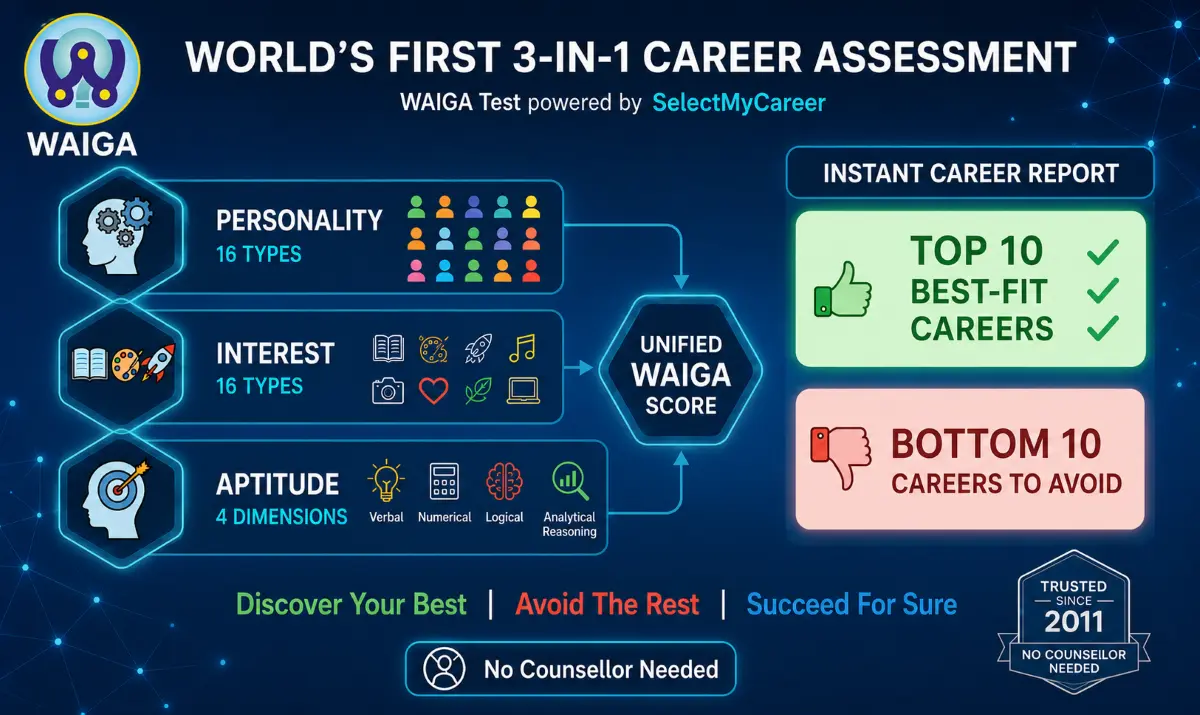
✓ One integrated assessment instead of multiple separate tests
✓ Instant personalised report
✓ No counsellor needed — ever
✔ Best on laptop or desktop | ✔ Takes 20-30 minutes | ✔ Instant report — 3 ways to access
✔ Registration takes 2 minutes |✔ Purchased test stays in dashboard — take it anytime
You can also begin with our Free Career Test if you’d like an introduction before taking the full assessment.
If you still have questions, feel free to contact us.
Frequently Asked Questions (FAQs)
Start by identifying the source of your uncertainty. Reflect on your strengths, interests, working preferences and values, then research a small number of realistic career options. Test your leading options through practical projects, courses or conversations with people in the field. Focus on finding your next useful step rather than deciding your entire future immediately.
Look for evidence in everyday life. Review activities you learn quickly, problems you enjoy solving, achievements you are proud of and tasks other people trust you to handle. Ask for specific feedback from people who know your work. You can also use structured aptitude or career assessments to explore abilities and patterns you may not have recognised.
A career assessment can help organise information about your interests, abilities or personality and suggest possibilities worth exploring. Its usefulness depends on what it measures and how you apply the results. A structured approach that considers multiple dimensions can provide a broader starting point, but you should still research careers, examine practical requirements and test your assumptions.
None of these factors should be considered in isolation. Interests help you understand what attracts you, aptitude provides information about selected abilities and learning potential, and personality can help you understand your preferences and working style. Career decisions should also account for values, qualifications, opportunities and practical circumstances. The aim is to find a workable combination rather than rely on a single factor.
There is no universal number, but beginning with three to five options can make exploration more manageable. Research them, compare their requirements and test the most promising possibilities. If your shortlist remains too broad, look for common patterns among the activities and skills involved. Narrowing your options through evidence is usually more useful than continually adding new possibilities.
Not necessarily. The practical challenges of changing careers vary according to your age, financial responsibilities, qualifications, health, location and target occupation. Begin by identifying transferable skills, researching entry requirements and assessing the time and cost of making a transition. You may be able to change responsibilities or industries gradually rather than starting completely from scratch.
Try to understand the concerns behind the disagreement, which may involve financial security, stability, social expectations or uncertainty about unfamiliar professions. Research your options carefully and prepare a realistic plan covering training, costs, employment opportunities and alternative routes. Listening to your family’s concerns can be useful, but your decision should also reflect your abilities, priorities and circumstances.
Not necessarily. You can begin with structured self-reflection, career research, practical exploration and a suitable assessment. WAIGA is designed to provide a self-readable report that you can review independently—no counselor ever required. In more complex situations, an appropriately qualified professional may offer additional support, but you do not need a counsellor simply to understand your WAIGA report or begin exploring career options.
There is no fixed timeline. Some people develop a shortlist quickly, while others need more time to gain experience, complete training or investigate opportunities. A structured 30-day exploration plan can help you make progress, but it is a starting framework rather than a guarantee of a final answer. Focus on steadily improving your understanding and making evidence-informed decisions.
Set aside some uninterrupted time and write down three things: what you know about your strengths, which activities or subjects interest you, and what matters most in your working life. Then choose one career question you can investigate this week. A small, specific action is a better starting point than trying to solve every uncertainty at once.
Written by the WAIGA Career Guidance Team
Explore our latest articles:
- How to Find Your Career Path When You Feel Lost: A Practical Guide
- How to Identify Your Strengths and Choose a Career That Fits
- How to Choose a Career When You Have Too Many Interests
- Do You Need Career Counselling? A Better Way to Find Career Direction
- What Should I Do With My Life? A Practical Guide to Finding the Right Career